Kirjojen hintavertailu. Mukana 12 407 858 kirjaa ja 12 kauppaa.

Kirjahaku

Etsi kirjoja tekijän nimen, kirjan nimen tai ISBN:n perusteella.

1000 tulosta hakusanalla Theodore W. Engstrom

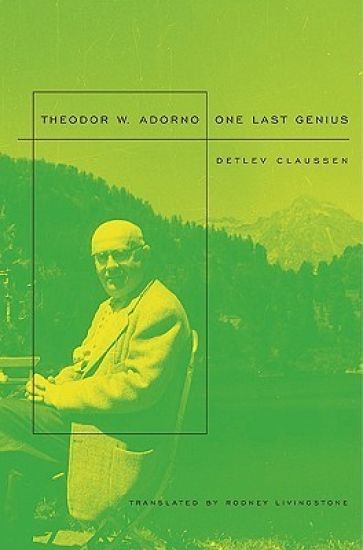
Theodor W. Adorno

Theodor W. Adorno

Detlev Claussen

The Belknap Press
2010
nidottu
He was famously hostile to biography as a literary form. And yet this life of Adorno by one of his last students is far more than literary in its accomplishments, giving us our first clear look at how the man and his moment met to create “critical theory.” An intimate picture of the quintessential twentieth-century transatlantic intellectual, the book is also a window on the cultural ferment of Adorno’s day—and its ongoing importance in our own.The biography begins at the shining moment of the German bourgeoisie, in a world dominated by liberals willing to extend citizenship to refugees fleeing pogroms in Eastern Europe. Detlev Claussen follows Theodor Wiesengrund Adorno (1903–1969) from his privileged life as a beloved prodigy to his intellectual coming of age in Weimar Germany and Vienna; from his exile during the Nazi years, first to England, then to the United States, to his emergence as the Adorno we know now in the perhaps not-so-unlikely setting of Los Angeles. There in 1943 with his collaborator Max Horkheimer, Adorno developed critical theory, whose key insight—that to be entertained is to give one’s consent—helped define the intellectual landscape of the twentieth century.In capturing the man in his complex relationships with some of the century’s finest minds—including, among others, Arnold Schoenberg, Walter Benjamin, Thomas Mann, Siegfried Kracauer, Georg Lukács, Hannah Arendt, and Bertolt Brecht—Claussen reveals how much we have yet to learn from Theodor Adorno, and how much his life can tell us about ourselves and our time.

Theodor W. Adorno

Theodor W. Adorno

Gerhard Schweppenhäuser

Duke University Press
2009
sidottu
Theodor W. Adorno (1903–1969) was one of the twentieth century’s most important thinkers. In light of two pivotal developments-the rise of fascism, which culminated in the Holocaust, and the standardization of popular culture as a commodity indispensable to contemporary capitalism-Adorno sought to evaluate and synthesize the essential insights of Western philosophy by revisiting the ethical and sociological arguments of his predecessors: Kant, Nietzsche, Hegel, and Marx. This book, first published in Germany in 1996, provides a succinct introduction to Adorno’s challenging and far-reaching thought. Gerhard SchweppenhÄuser, a leading authority on the Frankfurt School of critical theory, explains Adorno’s epistemology, social and political philosophy, aesthetics, and theory of culture.After providing a brief overview of Adorno’s life, SchweppenhÄuser turns to the theorist’s core philosophical concepts, including post-Kantian critique, determinate negation, and the primacy of the object, as well as his view of the Enlightenment as a code for world domination, his diagnosis of modern mass culture as a program of social control, and his understanding of modernist aesthetics as a challenge to conceive an alternative politics. Along the way, SchweppenhÄuser illuminates the works widely considered Adorno’s most important achievements: Minima Moralia, Dialectic of Enlightenment (co-authored with Horkheimer), and Negative Dialectics. Adorno wrote much of the first two of these during his years in California (1938–49), where he lived near Arnold Schoenberg and Thomas Mann, whom he assisted with the musical aesthetics at the center of Mann’s novel Doctor Faustus.
Theodor W. Adorno

Theodor W. Adorno

Gerhard Schweppenhäuser

Duke University Press
2009
pokkari
Theodor W. Adorno (1903–1969) was one of the twentieth century’s most important thinkers. In light of two pivotal developments-the rise of fascism, which culminated in the Holocaust, and the standardization of popular culture as a commodity indispensable to contemporary capitalism-Adorno sought to evaluate and synthesize the essential insights of Western philosophy by revisiting the ethical and sociological arguments of his predecessors: Kant, Nietzsche, Hegel, and Marx. This book, first published in Germany in 1996, provides a succinct introduction to Adorno’s challenging and far-reaching thought. Gerhard SchweppenhÄuser, a leading authority on the Frankfurt School of critical theory, explains Adorno’s epistemology, social and political philosophy, aesthetics, and theory of culture.After providing a brief overview of Adorno’s life, SchweppenhÄuser turns to the theorist’s core philosophical concepts, including post-Kantian critique, determinate negation, and the primacy of the object, as well as his view of the Enlightenment as a code for world domination, his diagnosis of modern mass culture as a program of social control, and his understanding of modernist aesthetics as a challenge to conceive an alternative politics. Along the way, SchweppenhÄuser illuminates the works widely considered Adorno’s most important achievements: Minima Moralia, Dialectic of Enlightenment (co-authored with Horkheimer), and Negative Dialectics. Adorno wrote much of the first two of these during his years in California (1938–49), where he lived near Arnold Schoenberg and Thomas Mann, whom he assisted with the musical aesthetics at the center of Mann’s novel Doctor Faustus.
Theodor W, Adorno II
A new title in Routledge’s Critical Assessments of Leading Philosophers series, this is a two-volume collection of the very best recent scholarship on Theodor W. Adorno (1903–69). It is an essential successor to an earlier four-volume collection, Theodor Adorno (Critical Evaluations in Cultural Theory) (978-0-415-30464-1), edited by Simon Jarvis and published by Routledge in 2006.Recent decades have seen a remarkable growth of scholarly studies devoted to Theodor W. Adorno’s philosophy and social theory. Every year, conferences and publications all over the world testify to a lively interest. Indeed, since his death in 1969, Adorno has been read and discussed not only by philosophers but by researchers in all areas of the theoretical humanities, and his impact has been considerable both inside and outside the academy. This new Routledge collection brings together the very best of recent research on Adorno. The editor has particularly focused on works that take account of contemporary developments in philosophy and social theory, demonstrating how Adorno’s view may engage with contemporary theoretical concerns.With a full index, together with a comprehensive introduction, newly written by the editor, which places the collected material in its historical and intellectual context, Theodor W. Adorno II is an indispensable work of reference. It is destined to be valued by scholars, students, and researchers as a vital research resource.
Theodor W. Adorno's Philosophy, Society, and Aesthetics

Theodor W. Adorno's Philosophy, Society, and Aesthetics

Stefano Petrucciani

Palgrave MacMillan
2021
sidottu
This book is a complete presentation of the most important themes of Theodor W. Adorno’s critical theory, and of its relevance for the understanding of the modern society. After an Introduction, which traces Adorno’s biographical and intellectual profile, the book is structured in three parts. The first is devoted to theoretical philosophy, and in particular to the concepts of philosophy, negative dialectics and metaphysics, and his aim is to clarify the Adornian understanding of such difficult concepts. The second is devoted to the main themes of Adorno’s social theory: the concept of domination, the relationship with Marxism, the theory of the decay of the individual, the critique of mass manipulation. The third part is devoted to aesthetics and culture criticism, and entails a conclusion in which the author outlines a confrontation between the Adornian and the Habermasian critique of modernity.
Theodor W. Adorno's Philosophy, Society, and Aesthetics

Theodor W. Adorno's Philosophy, Society, and Aesthetics

Stefano Petrucciani

Springer Nature Switzerland AG
2022
nidottu
This book is a complete presentation of the most important themes of Theodor W. Adorno’s critical theory, and of its relevance for the understanding of the modern society. After an Introduction, which traces Adorno’s biographical and intellectual profile, the book is structured in three parts. The first is devoted to theoretical philosophy, and in particular to the concepts of philosophy, negative dialectics and metaphysics, and his aim is to clarify the Adornian understanding of such difficult concepts. The second is devoted to the main themes of Adorno’s social theory: the concept of domination, the relationship with Marxism, the theory of the decay of the individual, the critique of mass manipulation. The third part is devoted to aesthetics and culture criticism, and entails a conclusion in which the author outlines a confrontation between the Adornian and the Habermasian critique of modernity.
Theodor W. Adorno: Negative Dialektik
In einem Brief nennt Adorno die Negative Dialektik kurz nach ihrem Erscheinen unter seinen Schriften das philosophische Hauptwerk, wenn ich so sagen darf". Dieser herausgehobenen Bedeutung, die das Werk f r Adorno hatte, entspricht nicht nur die lange Zeit, die er mit der Abfassung des Buchs besch ftigt war, sondern auch die lange Geschichte, die ihre zentralen Motive in seinem Denken haben. Philosophische Begriffskl rung, die Arbeit an Begriff und Kategorien" einer negativen Dialektik, versteht Adorno dabei als dialektischen bergang in inhaltliches Denken - und so betreibt er sie auch hier. Das hat Konsequenzen f r die Form des kooperativen Kommentars, der in diesem Band versucht wird. Adornos Negative Dialektik zu kommentieren, kann nur in dem Bewu tsein der un berbr ckbaren Kluft gelingen, die den Kommentar von diesem Text trennt.
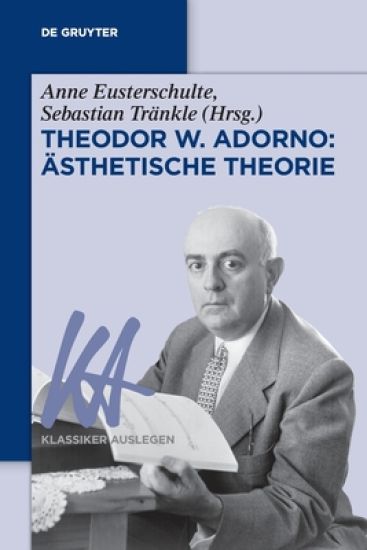
Theodor W. Adorno: Ästhetische Theorie
Theodor W. Adornos posthum veröffentlichte Ästhetische Theorie exponiert die Krise der Kunst im Zeitalter ihrer gesellschaftlichen Integration. Gesättigt mit der Erfahrung konkreter Kunstwerke, hinterfragt sie das tradierte Kategoriensystem philosophischer Ästhetik. Der vorliegende Band unternimmt erstmals eine kommentierende Auslegung, um den dichten Text aufzuschließen und ein Weiterdenken von Adornos kritischer Ästhetik anzuregen.
Theodor W. Adorno und die Wiener Moderne

Theodor W. Adorno und die Wiener Moderne

Johann Dvorák

Peter Lang AG
2005
nidottu
Der Kampf um die Moderne war im Wien der vergangenen Jahrhundertwende ein Feld der politischen Auseinandersetzung in der Sphare der Kultur. Die enge Verbundenheit von Kunst, asthetischer Theorie und Politik (bei gleichzeitiger Betonung des Unpolitischen) fand in Wien ihren besonderen Ausdruck; die Analyse des Scheinhaften, die Entdeckung des hinter dem schoenen Schein Verborgenen gehoerte (und gehoert) in Wien durchaus zu einer geradezu alltaglichen Notwendigkeit. An der Wiener Moderne und den in ihr abgelagerten gesellschaftlichen Auseinandersetzungen konnte Theodor W. Adorno in hervorragender Weise eine AEsthetik der Moderne in Verbindung mit der Entfaltung von Gesellschaftstheorien (in Form von Fragmenten) erarbeiten. Dabei zeigt sich auch, dass die Beziehungen zur Wiener Moderne (und deren soziale Rahmenbedingungen) massgebend fur Adornos theoretische Entwicklung bis zum Lebensende waren. In dem Buch werden die Entstehungsbedingungen der fruhen Theorien Adornos dargestellt, konzentriert auf den Zeitraum 1925 bis 1937, das heisstaufdie Zeit von Adornos Studium bei Alban Berg und Eduard Steuermann in Wien, seiner Redaktionstatigkeit bei der Zeitschrift Anbruch und seiner Versuche in der Emigration, in Wien Fuss zu fassen. Es werden die Ansatze zu einem Projekt der systematischen Entwicklung materialistischer Theorie (zusammen mit Walter Benjamin und Alfred Sohn-Rethel) gezeigt und abschliessend die Beziehung Adornos zu Wien (und vor allem zu Graz) nach 1945 skizziert.
Theodor W. Adorno

Theodor W. Adorno

David Bies

Grin Publishing
2009
nidottu
Studienarbeit aus dem Jahr 2002 im Fachbereich Germanistik - Sonstiges, Note: 1,3, Freie Universit t Berlin, Veranstaltung: Einf hrung in die Literaturtheorie, 4 Quellen im Literaturverzeichnis, Sprache: Deutsch, Abstract: Im Rahmen des Seminars "Einf hrung in die Literaturtheorie" setzt sich diese Hausarbeit mit der Literaturtheorie Adornos auseinander, die auf den Zusammenhang von Literatur und gesellschaftlicher Wirklichkeit fokussiert ist.
Theodor W. Adorno

Theodor W. Adorno

Marta Cornelia Broll

Grin Publishing
2009
pokkari
Der Verdacht, da die Realit t, die man serviert, nicht die sei, f r die sie sich ausgibt, wird wachsen.Theodor W. Adorno: Prolog zum Fernsehen (1953)Adorno stand zeit seines Lebens kritisch, wenn nicht schon eher pessimistisch in derBeurteilung und Bewertung neuer Medien gegen ber. Er bezweifelte die M glichkeit einer nachauratischen neuen Kunst und sprach Rundfunk, Film und Fernsehen absolut jedenErkenntniswert ab und das nicht nur im Vergleich zur alten b rgerlichen autonomen Kunst.F r Adorno bedeutete technische Reproduktion immer einen Verlust, 1959 formulierte er diesf r den Rundfunk folgenderma en: So hat in Amerika Edward Suchman in einer ingeni sen Studie dargetan, da von zwei Vergleichgruppen, diesogenannte ernste Musik h rten und von denen die eine diese Musik durch lebendige Auff hrungen, die anderenur vom Radio her kannte, die Radiogruppe flacher und verst ndnisloser reagierte als die erste."F r ihn liegt dies nicht ausschlie lich an einem m glichen sozialen und/oderbildungsrelevanten Gef lle zwischen den beiden Untersuchungsgruppen, und ebenso wenigan der Verwendung des neuen Mediums Rundfunk, sondern an den Eigenarten dertechnischen Reproduktion selbst. Das Verfahren der technischen Reproduktion ist untrennbarmit den Standards der Kulturindustrie, der Verflachung, der Wiederholung und Verdoppelungetc. verkn pft. Der Inhalt der Ideologien trete stets in seiner Bedeutung hinter deren Formzur ck und so ndert sich mit der Technik der Verbreitung zugleich das Verbreitete."F r Adorno bedinge die Form der technischen Reproduktion automatisch auch den Verlust anM glichkeiten zur objektiven Einsicht des reflektierenden Individuums.Beispielsweise bezweifelte er u. a. auch, ob eine Rundfunk -Symphonie berhaupt nocheine Symphonie genannt werden d rfe. So bewirken beide Prozesse, d.h. also dieVer nderung in der Produktion wie die der technischen Reproduktion und Distribution eineVervollkommnung der Reproduktionsleistungen, so dass die
Theodor W. Adornos Begriff der "Kulturindustrie" - Analyse und zeitkritische Anwendung auf die Gegenwart
Studienarbeit aus dem Jahr 2011 im Fachbereich Philosophie - Philosophie des 20. Jahrhunderts / Gegenwart, Note: 1,0, Universit t Regensburg (Institut f r Philosophie), Veranstaltung: Philosophie als Zeitkritik: Heidegger - Adorno - Habermas, Sprache: Deutsch, Abstract: Adornos Kulturkritik, die er in der "Dialektik der Aufkl rung" im Kapitel "Kulturindustrie. Aufkl rung als Massenbetrug" niederlegt, gilt als besonders einflussreich nicht nur in der Philosophie, sondern auch in benachbarten wissenschaftlichen Disziplinen wie etwa der Medientheorie. Gnadenlos und zynisch scheint Adorno die kulturelle Welt und ihren "autorit re n] Charakter gerade im demokratischsten Land" zu entlarven, wenn er etwa von der perfekt kalkulierten Massenunterhaltung aus Hollywood oder dem immergleichen harmonischen Aufbau eines Songs in der Popularmusik spricht, den "fertige n] Clich s, beliebig hier und dort zu verwenden, und allemal v llig definiert durch den Zweck" ihrer Verkaufstauglichkeit. Aus heutiger Sicht scheint die Frage interessant, inwiefern Adornos Kulturkritik des Sp tkapitalismus sich auf das 21. Jahrhundert anwenden l sst. In vielen Bereichen gerade der Unterhaltungsbranche scheinen f r die damalige Zeit v llig undenkbare neue Superlative erreicht und s mtliche Tabus gebrochen worden zu sein. Philosophie als Zeitkritik - inwiefern kann sie prophetische Z ge tragen und nicht nur erkl ren, wie die Welt beschaffen ist, sondern auch prognostizieren, wie sie beschaffen sein wird?