Kirjojen hintavertailu. Mukana 11 622 611 kirjaa ja 12 kauppaa.

Kirjahaku

Etsi kirjoja tekijän nimen, kirjan nimen tai ISBN:n perusteella.

1000 tulosta hakusanalla William D. Howells

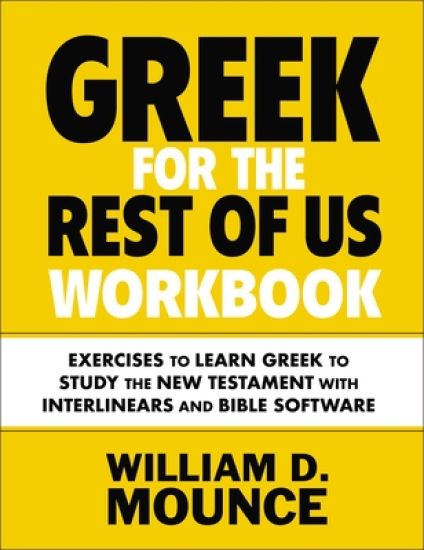
Greek for the Rest of Us Workbook

Greek for the Rest of Us Workbook

William D. Mounce

ZONDERVAN
2023
nidottu
A WORKBOOK to Help You Learn the Essentials of Biblical Greek So You Can Study the New Testament More DeeplyThe Greek for the Rest of Us Workbook is a companion to Greek for the Rest of Us, Third Edition (sold separately) by William D. Mounce. This workbook provides exercises to help readers practice and review, so they learn the essentials of biblical Greek more effectively and can study the New Testament more deeply.Greek for the Rest of Us, Third Edition is crash-course on "Greek for the rest of us" that acquaints the reader with the essentials of the language so they can study the New Testament more deeply. Readers will gain a sound knowledge of the fundamentals of Greek and learn how to use tools that will add muscle to their Bible studies.Readers using the Greek for the Rest of Us Workbook in conjunction with Greek for the Rest of Us, Third Edition will learn to:Read and pronounce Greek wordsLearn the fundamentals of the Greek noun and verb systemConduct effective Greek word studiesLearn the basics of Greek exegesis for biblical interpretationUnderstand why translations are different Read better commentariesBe comfortable using reverse and traditional interlinearsUnderstand the information displayed by biblical softwareThe Greek for the Rest Us Workbook will enhance your learning experience with exercises to help you practice and reinforce the concepts you are learning in Greek for the Rest of Us, Third Edition.
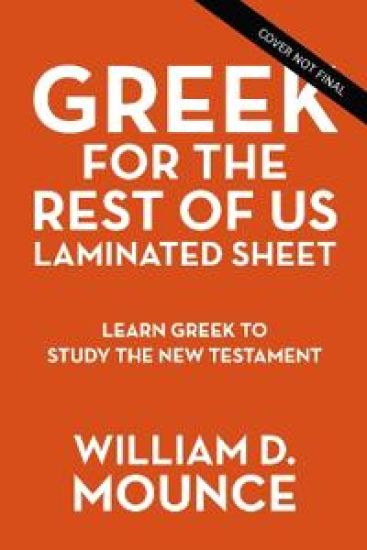
Greek for the Rest of Us Laminated Sheet
The Greek for the Rest of Us Laminated Sheet is a handy, at-a-glance study aid, ideal for last minute review, a quick overview of grammar, or as an aid in Bible study. The laminated sheet is a companion resource for Greek for the Rest of Us, Third Edition (sold separately) by William Mounce and is a critical part of acquainting readers with the essentials of the language and deepening their understanding of God's Word.When used in conjunction with Greek for the Rest of Us, Third Edition this laminated study sheet will help readers:Read and pronounce Greek wordsLearn the fundamentals of the Greek noun and verb systemConduct effective Greek word studiesLearn the basics of Greek exegesis for biblical interpretationUnderstand why translations are differentRead better commentariesBe comfortable using reverse and traditional interlinearsUnderstand the information displayed by biblical software
A Graded Reader of Biblical Greek

A Graded Reader of Biblical Greek

William D. Mounce

Zondervan
1996
nidottu
Making the leap from the basics of biblical Greek to its real-life application can be a frustrating challenge for students of intermediate Greek. A Graded Reader of Biblical Greek was developed to make the transition easier.It takes beginning exegetes from simple to progressively more difficult biblical texts. Students can now learn New Testament Greek the way they would any other language: through a graded program. A Graded Reader of Biblical Greek applies an inductive method to learning intermediate Greek grammar. It provides a workable introduction to exegesis, word studies, and developing a large vocabulary; and it assists the student in preparing for class, allowing classroom time to be put to its most effective use.Twenty Greek passages are presented in graded order.Difficult and unfamiliar grammatical constructions are explained.All words that occur fewer than 20 times in the New Testament are defined.An "Exegetical Discussion" section helps the exegete gain a deeper understanding of the language. A Graded Reader of Biblical Greek is the result of ten years of use and refinement by the author in an actual classroom setting.
The Morphology of Biblical Greek

The Morphology of Biblical Greek

William D. Mounce

Zondervan
1994
nidottu
The Morphology of Biblical Greek explains, in a way second-year Greek students can understand, how Greek words are formed. It shows that Greek word formation follows a limited set of rules. Once these rules are understood, it becomes clear that forms which once seemed to be irregular or an exception actually follow these morphological rules. The Morphology of Biblical Greek has five parts: 1.The rules that determine how Greek words change. 2. The rules of verb formation, from augment to personal ending. 3. Paradigms for every type of noun and adjective form, with all the words that belong in each category and any peculiarities of a given word. 4. All the verbs and principal parts, with verbs that follow the same rules grouped together. 5. An index of all words in the New Testament with their morphological category. The Morphology of Biblical Greek contains the most complete set of paradigms for nouns, verbs, adjectives, and pronouns available for New Testament Greek.
Mounce's Complete Expository Dictionary of Old and New Testament Words
For years, Vine’s Expository Dictionary has been the standard word study tool for pastors and laypeople, selling millions of copies. But sixty-plus years of scholarship have shed extensive new light on the use of biblical Greek and Hebrew, creating the need for a new, more accurate, more thorough dictionary of Bible words. William Mounce, whose Greek grammar has been used by more than 100,000 college and seminary students, is the editor of this new dictionary, which will become the layperson’s gold standard for biblical word studies. Mounce’s is ideal for the reader with limited or no knowledge of Greek or Hebrew who wants greater insight into the meanings of biblical words to enhance Bible study. It is also the perfect reference for busy pastors needing to quickly get at the heart of a word’s meaning without wading through more technical studies.What makes Mounce’s superior to Vine’s?The most accurate, in-depth definitions based on the best of modern evangelical scholarshipBoth Greek and Hebrew words are found under each English entry (Vine’s separates them)Employs both Strong’s and G/K numbering systems (Vine’s only uses Strong’s)Mounce’s accuracy is endorsed by leading scholars
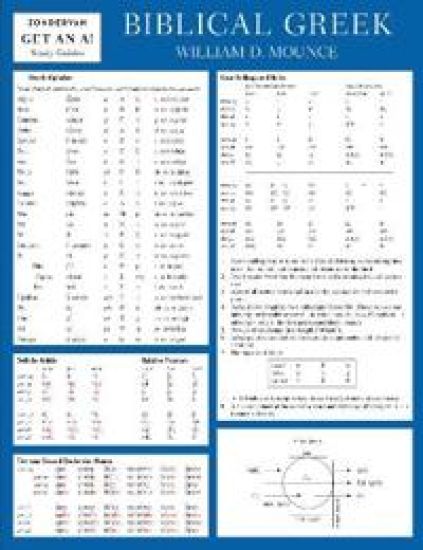
Biblical Greek Laminated Sheet

Biblical Greek Laminated Sheet

William D. Mounce

Zondervan
2005
muu
Students of biblical Greek and Hebrew may not know everything they need to know, but they do know there’s a lot they need to know! Whether studying for exams or translating passages of Scripture, students need critical information at their fingertips. Instead, it’s usually scattered throughout textbooks, self-made crib sheets, and sticky-notes on their computer monitor. Now there’s a better way! The Zondervan Get an A! Study Guides to Biblical Greek and Biblical Hebrew are handy, at-a-glance study aids ideal for last minute review, a quick overview of grammar, or as an aid in translation or sermon preparation. Each set contains four information-packed sheets that are laminated and three-hole-punched, making them both durable and portable. The study guides are tied to Zondervan’s Basics of Biblical Greek and Basics of Biblical Hebrew.
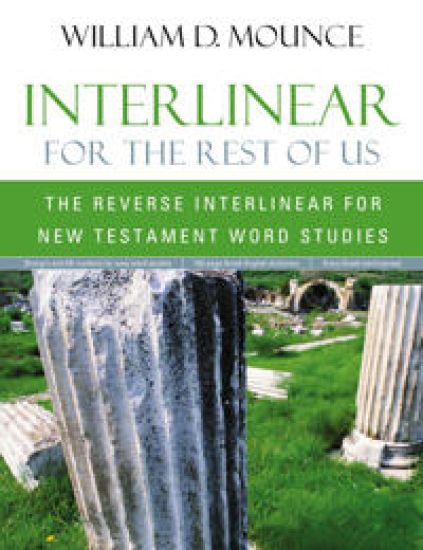
Interlinear for the Rest of Us

Interlinear for the Rest of Us

William D. Mounce

Zondervan
2013
nidottu
Most interlinear Bibles are superb resources for Greek students. But what about the rest of us who don’t know Greek? Here is the answer. While other interlinear Bibles assume that you know Greek. Interlinear for the Rest of Us assumes that you don’t, or that you’ve forgotten much of what you once knew. Designed for busy pastors, Sunday school teachers, and anyone who wants a practical tool for studying the Scriptures, this interlinear makes reading easy by flip-flopping the usual order of appearance. It uses the English text as the main text rather than the Greek, so there is absolutely no confusion about the meaning of what you’re reading. Discover the Greek words behind the English translation. Conduct your own word studies using Greek word study books—without knowing Greek. Interlinear for the Rest of Us offers these features: Interlinear passages appear in a “staff” with four interrelated lines (see excerpt). From top to bottom, the lines are: English text in New International Version Corresponding Greek words Parsing information Goodrick-Kohlenberger numbers Greek text in normal Greek order at the bottom of the page, underneath the interlinear section Mounce’s Greek-English Dictionary at the back of this volume, keyed to both Goodrick-Kohlenberger and Strong’s numbering systems Ideal for use with Greek for the Rest of Us and other Greek study tools
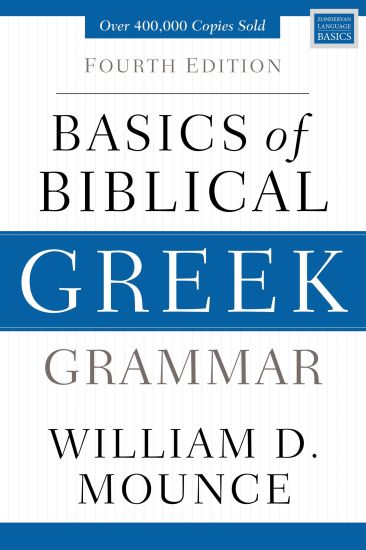
Basics of Biblical Greek Grammar

Basics of Biblical Greek Grammar

William D. Mounce

Zondervan
2019
sidottu
Clear. Understandable. Carefully organized. Basics of Biblical Greek Grammar by William D. Mounce is the standard textbook for colleges and seminaries. Since its initial publication in 1993 its integrated approach has helped more than 250,000 students learn New Testament Greek.The fourth edition of Basics of Biblical Greek Grammar has been updated throughout based on continuing feedback from professors, students, self-learners, and homeschoolers, making it even more effective for today's students. Other improvements have been made based on recent developments in scholarship.The key to the effectiveness of Basics of Biblical Greek Grammar in helping students learn is in how it introduces them to the language. Students learn about the features of the Greek language in a logical order, with each lesson building upon the one before it. Unnecessary obstacles that discourage students and hinder progress are removed, such as rote memorization of endless verbal paradigms. Instead, students receive encouragement along the way to assure them they are making the necessary progress. Detailed discussions are also included at key junctures to help students grasp important concepts.By the time students have worked their way through Basics of Biblical Greek Grammar they will have learned:The Greek AlphabetVocabulary for words occurring 50 times or more in the Greek New TestamentThe Greek noun systemThe Greek verbal system, including indicative and nonindicative verbs, and participlesA robust suite of learning aids is available for purchase to be used alongside the textbook to help students excel in their studies. These include a workbook, video lectures for each chapter featuring the author, flashcards keyed to vocabulary in each chapter, a laminated quick study sheet with key concepts, and audio of the vocabulary for each chapter to aid in acquisition.
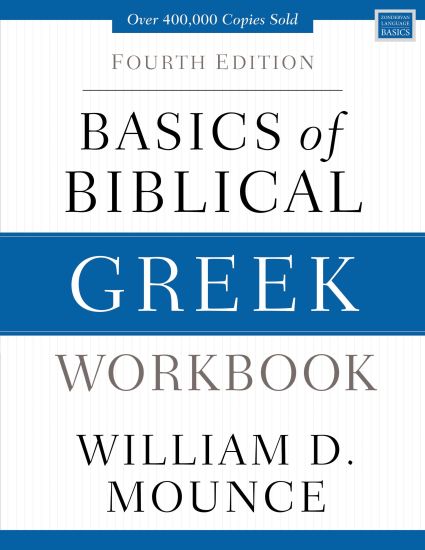
Basics of Biblical Greek Workbook

Basics of Biblical Greek Workbook

William D. Mounce

Zondervan
2019
nidottu
This expanded and updated workbook is designed with the student in mind and intended for use with the standard-setting Basics of Biblical Greek Grammar textbook, now in its fourth edition.Two optional chapters have been added to the Basics of Biblical Greek Workbook, allowing students to read large chunks of the biblical text and enjoy the fruits of their labor faster than ever before. Each chapter is divided into six sections and includes extensive exercises and significant biblical passages for translation.One of the most helpful and unique features of the workbook remains. You can go through the workbook on one of two tracks: Track One follows the workbook (and textbook) in its regular order, while Track Two is organized so you can learn verbs earlier in the course.
The Analytical Lexicon to the Greek New Testament
The Analytical Lexicon to the Greek New Testament was created to aid in the study of the Greek New Testament, using sophisticated computer resources to ensure an accurate, helpful, and in-depth analysis of the word forms that make up the New Testament. Its combination of features sets it apart from all previously published analytical lexicons: · Based on the UBS 3d edition (revised). · Includes both accepted and variant readings · Consistent with today’s standard Greek lexicons · Gives the frequency of each inflected form, verse references for forms that occur only once · Includes Goodrick-Kohlenberger numbers for all words · Includes principal parts for all verbs · Contains a grammatical section with a discussion of paradigms and explanations as to why paradigms are formed as they are Most significantly, The Analytical Lexicon to the Greek New Testament is keyed to the author’s Morphology of Biblical Greek, which explains in detail why some Greek words follow certain patterns and other Greek words follow seemingly very different patterns. The Analytical Lexicon to the Greek New Testament is more than a tool for quick reference—it provides the Greek student or scholar with an index to another body of literature.
Basics of Biblical Greek Vocabulary Cards
Basics of Biblical Greek Vocabulary Cards by William D. Mounce is intended to accompany the fourth edition of Basics of Biblical Greek Grammar. The vocabulary cards provide beginning students essential help in vocabulary acquisition of the Greek New Testament. Cards are numbered according to word frequency. Features include:The number of times the word occurs in the New TestamentVerbal rootsKeyed to Basics of Biblical Greek
Biblical Greek: A Compact Guide

Biblical Greek: A Compact Guide

William D. Mounce

Zondervan
2019
nidottu
Biblical Greek: A Compact Guide, Second Edition by William D. Mounce is a handy, at-a-glance reference for students, pastors, and teachers. It follows the organization and format of the fourth edition of Basics of Biblical Greek Grammar, but it's also usable by students who learned with a different grammar. By limiting its discussion to the "nuts and bolts," Greek language students working on translation and exegesis will more quickly and easily find the relevant grammatical refreshers. Students can, for example, check on the range of meaning for a particular word or make sure they remember how aorist participles function in a sentence.The paradigms, word lists, and basic discussions in Biblical Greek: A Compact Guide, Second Edition points students in the right direction and allow them to focus on more advanced Greek study.
The Rules of Influence: Winning When You're in the Minority
"Look out, Goliath--David has a training manual . . . One of the best books on social psychology ever written."---Daniel Gilbert, New York Times bestselling author of Stumbling on Happiness No one doubts the power of the majority. It makes the rules and enforces them, and most of us are willing to go along with it, most of the time. But what happens when you're not? What about when the issue is so important to you that you're willing to take on the naysayers? It doesn't matter if you're trying to sell a new product or service, persuade colleagues to try out a new business plan, start a revolution, or simply convince your family where to go for dinner. In all of these cases you're going up against the majority, and more often than not your efforts are going to come up short. Or at least that was the case before Dr. William Crano--an expert in the field of influence--applied the science of persuasion to those moments when you find yourself outnumbered and overmatched. By doing so, he has discovered proven strategies, such as working from the inside and changing the game from subjective preferences to objective decisions, and distilled these strategies and more into an extraordinary collection of rules that radically affect the likelihood of success. The Rules of Influence--the most powerful guide to being persuasive even under the most inhospitable conditions--gives you the tools to overcome overwhelming odds and take back control in every situation.
Why the Vietcong Fought

Why the Vietcong Fought

William D. Henderson

Praeger Publishers Inc
1980
sidottu
Henderson examines the sophisticated motivation and control systems utilized by the North Vietnamese command. The book is based on communist documents and recorded interviews with captured Viet Cong.
American Journalism History

American Journalism History

William D. Sloan

Greenwood Press
1989
sidottu
Sloan has undertaken to fill a long-standing gap in the study of journalism history. He has compiled a comprehensive annotated bibliography of works pertaining to United States journalism history from colonial to contemporary times. Some 2,600 separate entries provide information on dissertations, articles, monographs, books and reference materials published between 1810 and 1988. . . . Overall this is a useful, stimulating volume that pulls together a diverse collection of materials. It should enrich the teaching and writing of journalism history. American JournalismThe history of the American news media has been a popular subject with journalists, popular writers, and historians since the early years of the Republic, and it continues to attract widespread interest. Until now, however, no complete bibliography of these historical materials has been available. This comprehensive work provides access to the existing literature on all types of journalism from newspapers to television.In his introduction, Sloan reviews the different approaches to journalism history that have characterized writing in the field. The bibliography is divided by historical period and general theme into 16 sections. Carefully annotated, it presents concise summaries and bibliographic information for some 2,600 articles, books, research guides, and reference works published between 1810 and 1988. More than 100 journals are included. Cross-referencing and a detailed index will help the reader locate materials on specific topics as well as those with wider application. An invaluable tool for historians and other scholars engaged in research, this book will also serve as a useful reference for courses in mass communications and the history of journalism.
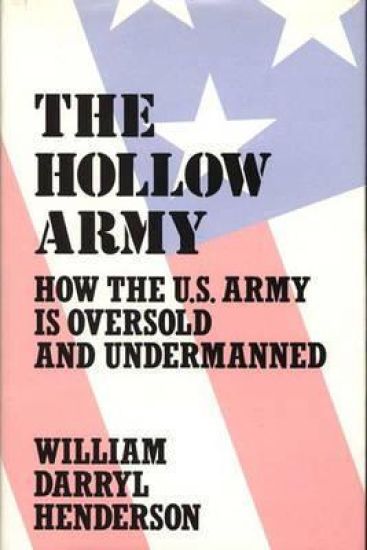
The Hollow Army

The Hollow Army

William D. Henderson

Praeger Publishers Inc
1990
sidottu
A blockbuster. . . sure to be controversial. A major work, not just in military sociology but among concerned citizens generally. The Hollow Army is one of a kind in that it completely runs against the conventional wisdom that today's American Army is an effective fighting force. Henderson's argument is brilliantly conceived, backed with data and penetrating insight. . . . The scholarship is extremely sound. . . and the use of data is peerless. Charles C. Moskos Chairman, Inter-University Seminar on Armed Forces and SocietyWilliam Darryl Henderson maintains that despite highly successful marketing efforts to sell the image of a new quality army to the American public, the Congress, and to the U.S. Army itself, the Army has, in fact, not risen above mediocre performance levels. Henderson dispels the myth of today's quality army, and explores the long buried and avoided MPT (manpower, personnel, and training) issues that are expanded on in succeeding chapters.The 24 charts, 13 tables, and 9 chapters of this compelling and timely investigation factually demonstrate the real army story. Henderson insists, in an introductory chapter, that everything, even the bad news must be told. Chapter 2 suggests that the nature and significance of the army's mission are changing and gaining in importance and the exploration of the actual number of combat troops in Chapter 3 concludes that the most important principle of war can no longer be effectively employed by the U.S. Army. The vital areas of training, personnel, and the small combat unit are addressed in the next four chapters. Chapter 8 details the unfocused character of the Non-Commissioned Officer (NCO) Corps. The final chapter suggests that if the army is to perform its stated function and achieve maximum value for the manpower and funds allocated, a rigorous structural-functional systems analysis and a searching review of underlying assumptions must be undertaken. This ambitious and eye-opening examination should be required reading not only for students and scholars of defense and military studies but for Congressional members, government officials, army personnel, and U.S. taxpayers as well.
The Early American Press, 1690-1783

The Early American Press, 1690-1783

William D. Sloan

Praeger Publishers Inc
1994
sidottu
The first book in a six-volume series on the history of American journalism, this volume provides a survey of the earliest printing in the American colonies, up through the Revolutionary War. The work focuses on the nature of journalism during the years covered, considers noteworthy figures, examines the relationship of journalism to society, and provides explanations for the main directions that journalism was taking. Early American printing was animated by remarkable vitality and sophistication, with the life of each newspaper and printer being marked by individual ideas and individual struggles. Early Americans also had quite sophisticated ideas about the role and operation of the press. In this survey, the authors try to suggest the complexities of the early American press. They address such issues as why newspapers first appeared, the purpose that newspaper operators saw for themselves, the role of the practice of journalism in the colonial press, and the role of the press in influencing public opinion. Their primary focus, however, is on the essential nature of the early American press and the factors that accounted for that character.
The Adventure of the Detected Detective

The Adventure of the Detected Detective

William D. Jenkins

Praeger Publishers Inc
1998
sidottu
What better introduction could there be to Finnegans Wake, perhaps the most difficult literary work ever written, than the Sherlock Holmes stories, perhaps the most readable and popular stories ever written? James Joyce made extensive use of Sherlockian material in his work; indeed, Jenkins argues, this use goes to the core of the meaning and structure of Finnegans Wake. In this exhaustive and entertaining analysis, Jenkins provides the specific references to Holmes' adventures in the Wake and examines the context in which they occur and how they relate to the larger Wake themes. Readers of world literature, especially Joyce and Doyle scholars and students, will find this a fascinating and useful volume.
The Politics of Food

The Politics of Food

William D. Schanbacher

Praeger Publishers Inc
2010
sidottu
A description of the current global food system, this book challenges our ethical responsibility to the global poor and implicates us all for failing to curb global hunger and malnutrition. The Politics of Food: The Global Conflict between Food Security and Food Sovereignty argues that our current global food system constitutes a massive violation of human rights. In this impassioned, well-researched book, William Schanbacher makes the case that the food security model for combating global hunger—driven by the United Nations, the World Bank, the International Monetary Fund, and other organizations—is a failure, too dependent on trade and too reliant on international agribusiness. Instead, the emerging model of food sovereignty—helping local farmers and businesses produce better quality food—is the more effective and responsible approach. Through numerous case studies, the book examines critical issues of global trade and corporate monopolization of the food industry, while examining the emerging social justice movements that seek to make food sovereignty the model for battling hunger.