Kirjojen hintavertailu. Mukana 12 363 183 kirjaa ja 12 kauppaa.

Kirjahaku

Etsi kirjoja tekijän nimen, kirjan nimen tai ISBN:n perusteella.

1000 tulosta hakusanalla Alfredo Rodriguez

Brazil

Brazil

Alfredo Saad-Filho; Lecio Morais

Pluto Press
2017
sidottu
Brazil is the world's sixth largest economy, has played a key role as one of the 'pink wave' administrations in Latin America, and was also responsible for wrecking the US-sponsored proposal for a Free Trade Area of the Americas. It is also one of the few large countries where social spending has risen and the distribution of income has improved in the last thirty years. However, as protests during the World Cup in 2014 have shown, the country remains highly unequal, unmet social needs are vast and its infrastructure is precarious. Alfredo Saad-Filho and Lecio Morais review the paradox that is modern-day Brazil. Focusing on the period from 1980 onwards, they analyse the tensions between the two systemic transitions to have dominated the country: the political transition from military rule to democracy, and to neoliberalism. The authors show how these transitions had contradictory logics and dynamics, yet ultimately became mutually supportive as they unfolded and intertwined.
Inquisition

Inquisition

Alfredo Colitto

Sphere
2011
pokkari
A Templar in disguise. A dangerous scientist. And a killer who turns hearts to iron . . .In 14th-century Italy, Mondino is a university anatomist - a man of science in a land governed by the brutal Inquisition. But the corpse brought to Mondino's laboratory one stormy night defies natural law: The victim is a Templar knight, and his heart has been transformed into a block of iron.Is it alchemy? Or the diabolical work of an ingenious killer? Aided by his headstrong student Gerardo - a young man concealing a deadly secret identity - Mondino must outwit both ruthless Inquisitors and vengeful Templars if he's to stop a murderer who threatens to shake the very foundations of Christendom.
Culture and Management in the Americas

Culture and Management in the Americas

Alfredo Behrens

Stanford University Press
2009
sidottu
Latin Americans are culturally different from North Americans in ways that so far have been inaccurately portrayed in the management literature. In Culture and Management in the Americas, Alfredo Behrens argues that these differences merit a substantial overhaul of management theory and practice to make the best of the significantly untapped Latin American potential for creativity, innovation, and teamwork. This applies in organizations with North American ownership and management, whether they are based in the U.S. or Latin America. Behrens, a management consultant and academic who has studied, taught, and practiced in South and North America and Europe, explains why the use of traditional North American research methods to capture cultural traits in the multi-cultural workforce is inappropriate. This practice produces a false picture of the cultural attributes and capabilities of Latin American managers and key staff. And this, in turn, leads to serious shortcomings in the development of appropriate motivation and leadership strategies and of appraisal and control instruments. Rather than relying on standardized surveys for measuring cultural attributes to underpin and develop such strategies and tools, the author suggests that managers look to the arts—particularly literature and cinema—for a richer and more useful alternative. He illustrates his points by reference to literary icons such as Argentina's Martin Fierro, Brazil's Macunaima, and America's Captain Ahab. He uses a variety of case studies to demonstrate what we can learn from these iconographic characters and what we can expect of each other when we apply these lessons—whether we are leading, following, or working in self-directed teams. This readable and enjoyable book will be an invaluable, engaging, and practical tool for anyone charged with managing at any level in workforce that combines both North American and Latin American cultures.
Mexico's Indigenous Past

Mexico's Indigenous Past

Alfredo Lopez Austin; Leonardo Lopez Lujan

University of Oklahoma Press
2005
nidottu
This handsomely illustrated book offers a panoramic view of ancient Mexico, beginning more than thirty thousand years ago and ending with European occupation in the sixteenth century. Drawing on archaeological and ethnohistorical sources, the book is one of the first to offer a unified vision of Mexico's precolonial past.Typical histories of Mexico focus on the prosperity and accomplishments of Mesoamerica, located in the southern half of Mexico, due to the wealth of records about the glorious past of this region. Mesoamerica was only one of three cultural superareas of ancient Mexico, however, all interlinked by complex economic and social relationships.Tracing the large social transformations that took place from the earliest hunter-gatherer times to the Postclassic states, the authors describe the ties between the three superareas of ancient Mexico, which stretched from present-day Costa Rica to what is now the southwestern United States. According to the authors, these superareas-Mesoamerica, Aridamerica, and Oasisamerica-cannot be viewed as independent entities. Instead, they must be considered as a whole to understand the complex reality of Mexico's past and possible visions of Mexico's future.
The Mexican Flyboy

The Mexican Flyboy

Alfredo Véa

University of Oklahoma Press
2016
nidottu
What if we could travel back in time to save our heroes from painful deaths? What if we could rewrite history to protect and reward the innocent victims of injustice? In Alfredo Véa's daring new novel, one man does just that, taking readers on a series of remarkable journeys. Abandoned as a child, brooding and haunted as an adult, Simon Vegas, ""the Mexican Flyboy,"" toils for years to repair a time machine that fell into his hands in Vietnam. With the help of his friend, eccentric Hephaestus Segundo, Simon uses the device to fly through time. Wherever acts of human cruelty take place, in the past or in the present, the machine lets him lift the suffering away and deliver them to a utopian afterlife. Blending magical realism, science fiction, history, and comic-book fantasy, The Mexican Flyboy swoops readers from the jungles of Southeast Asia to the vineyards of Northern California, from Ethel Rosenberg's execution to Joan of Arc's pyre, in a tale of justice, trauma, regret, and redemption. The dead pass through the narrative in a parade at once heartbreaking and hopeful, among them Vincent van Gogh and Malcolm X, Ernest Hemingway and Amadou Diallo. But the living - Simon's pregnant wife, Elena, his old friend Ezekiel Stein, prisoner Lenny Hudson - all throw doubt onto Simon's story. Is Simon truly a ""magus,"" transporting martyrs to a shared community in paradise? Or is he just a man broken by loss, guilt, and the trauma of war, hopelessly lost in an illusion of his own making? Crossing genres and blending comedy with tragedy, Alfredo Véa imagines a world where we can rewrite our pasts and heal the wounds inflicted by history. Inviting comparisons to the work of James Joyce and Jorge Luis Borges, Junot Díaz and Michael Chabon, this powerful book is like nothing else you have ever read.
Thinking and the I

Thinking and the I

Alfredo Ferrarin

Northwestern University Press
2019
nidottu
What is the relation between thinking and the I that thinks? And what is the relation between thought and reality? The ordinary view shared by modern philosophers from Descartes to Kant, as well as by common sense, is that there is only thought when someone thinks something, and thoughts and concepts are mental acts that refer to objects outside us.In Thinking and the I: Hegel and the Critique of Kant, Alfredo Ferrarin shows that Hegel's philosophy entails a radical criticism of this ordinary conception of thinking. Breaking with the habitual presuppositions of both modern philosophy and common sense, Ferrarin explains that thought, negation, truth, reflection, and dialectic for Hegel are not properties of an I and cannot be reduced to the subjective activity of a self-conscious subject. Rather, he elucidates, thought is objective for Hegel in different senses. Reality as a whole is animated by a movement of thought and an unconscious logic as a spontaneity that reifies itself in determinate forms. Ferrarin concludes the book with a comprehensive comparison of Hegel's and Kant's concepts of reason. While it mainly focuses on Hegel's Phenomenology, Science of Logic, and Encyclopaedia, this ambitious book covers all aspects of Hegel's philosophy. Its originality and strength lie in its recovery of the original core of Hegel's dialectic over and above its currently predominant transcendental, neopragmatist, or realist appropriations. It will be essential reading for all students of Hegel, Kant, and German idealism in general for years to come.
Thinking and the I

Thinking and the I

Alfredo Ferrarin

Northwestern University Press
2019
sidottu
What is the relation between thinking and the I that thinks? And what is the relation between thought and reality? The ordinary view shared by modern philosophers from Descartes to Kant, as well as by common sense, is that there is only thought when someone thinks something, and thoughts and concepts are mental acts that refer to objects outside us. In Thinking and the I: Hegel and the Critique of Kant, Alfredo Ferrarin shows that Hegel's philosophy entails a radical criticism of this ordinary conception of thinking. Breaking with the habitual presuppositions of both modern philosophy and common sense, Ferrarin explains that thought, negation, truth, reflection, and dialectic for Hegel are not properties of an I and cannot be reduced to the subjective activity of a self-conscious subject. Rather, he elucidates, thought is objective for Hegel in different senses. Reality as a whole is animated by a movement of thought and an unconscious logic as a spontaneity that reifies itself in determinate forms. Ferrarin concludes the book with a comprehensive comparison of Hegel's and Kant's concepts of reason. While it mainly focuses on Hegel's Phenomenology, Science of Logic, and Encyclopaedia, this ambitious book covers all aspects of Hegel's philosophy. Its originality and strength lie in its recovery of the original core of Hegel's dialectic over and above its currently predominant transcendental, neopragmatist, or realist appropriations. It will be essential reading for all students of Hegel, Kant, and German idealism in general for years to come.
Hombres Y Machos

Hombres Y Machos

Alfredo Mirande

Westview Press Inc
1997
nidottu
Although patriarchy, machismo, and excessive masculine displays are assumed to be prevalent among Latinos in general and Mexicans in particular, little is known about Latino men or macho masculinity. Hombres y Machos: Masculinity and Latino Culture fills an important void by providing an integrated view of Latino men, masculinity, and fatherhood?in the process refuting many common myths and misconceptions.Examining how Latino men view themselves, Alfredo Mirand rgues that prevailing conceptions of men, masculinity, and gender are inadequate because they are based not on universal norms but on limited and culturally specific conceptions. Findings are presented from in-depth personal interviews with Latino men (specifically, fathers with at least one child between the ages of four and eighteen living at home) from four geographical regions and from a broad cross-section of the Latino population: working and middle class, foreign-born and native-born. Topics range from views on machos and machismo to beliefs regarding masculinity and fatherhood. In addition to reporting research findings and placing them within a historical context, Mirand raws important insights from his own life.Hombres y Machos calls for the development of Chicano/Latino men's studies and will be a significant and provocative addition to the growing literature on gender, masculinity, and race. It will appeal to the general reader and is bound to be an important supplementary text for courses in ethnic studies, women's studies, men's studies, family studies, sociology, psychology, social work, and law.
Rascuache Lawyer

Rascuache Lawyer

Alfredo Mirandé

University of Arizona Press
2011
nidottu
Alfredo Mirandé, a sociology professor, Stanford Law graduate, and part-time pro bono attorney, represents clients who are rascuache—a Spanish word for “poor” or even “wretched”—and on the margins of society. For Mirandé, however, rascuache means to be “down but not out,” an underdog who is still holding its ground. Rascuache Lawyer offers a unique perspective on providing legal services to poor, usually minority, folks who are often just one short step from jail. Not only a passionate argument for rascuache lawyering, it is also a thoughtful, practical attempt to apply and test critical race theory—particularly Latino critical race theory—in day-to-day legal practice. Every chapter presents an actual case from Mirandé’s experience (only the names and places have been changed). His clients have been charged with everything from carrying a concealed weapon, indecent exposure, and trespassing to attempted murder, domestic violence, and child abuse. Among them are recent Mexican immigrants, drug addicts, gang members, and the homeless. All of them are destitute, and many are victims of racial profiling. Some “pay” Mirandé with bartered services such as painting, home repairs, or mechanical work on his car. And Mirandé doesn’t always win their cases. But, as he recounts, he certainly works tirelessly to pursue all legal remedies. Each case is presented as a letter to a fascinating (fictional) “Super Chicana” named Fermina Gabriel, who we are told is an accomplished lawyer, author, and singer. This narrative device allows the author to present his cases as if he were recounting them to a friend, drawing in the reader as a friend as well. Bookending the individual cases, Mirandé’s introductions and conclusions offer a compelling vision of progressive legal practice grounded in rascuache lawyering.
Behind the Mask

Behind the Mask

Alfredo Mirandé

University of Arizona Press
2017
sidottu
The image of biologically male people dancing while dressed in traditional, colorful female Zapotec, Juchiteca attire stands in sharp contrast to the prevailing view of Mexico as the land of charros, machismo, and unbridled ranchero masculinity. These indigenous people are called Los Muxes, and they are neither man nor woman, but rather a hybrid third gender.After seeing a video of a Muxe Vela, or festival, sociologist Alfredo Mirande was intrigued by the contradiction between Mexico's patriarchal reputation and its warm acceptance of Los Muxes. Seeking to get past traditional Mexican masculinity, he presents us with Behind the Mask, which combines historical analysis, ethnographic field research, and interviews conducted with Los Muxes of Juchitan over a period of seven years. Mirande observed community events, attended Muxe velas, and interviewed both Muxes and other Juchitan residents. Prefaced by an overview of the study methods and sample, the book challenges the ideology of a male-dominated Mexican society driven by the cult of machismo, featuring photos alongside four appendixes.Delving into many aspects of their lives and culture, the author discusses how the Muxes are perceived by others, how the Muxes perceive themselves, and the acceptance of a third gender status among various North American indigenous groups. Mirande compares traditional Mexicano/Latino conceptions of gender and sexuality to modern or Western object choice configurations. He concludes by proposing a new hybrid model for rethinking these seemingly contradictory and conflicting gender systems.
Behind the Mask

Behind the Mask

Alfredo Mirandé

University of Arizona Press
2019
nidottu
The image of biologically male people dancing while dressed in the traditional, colorful attire of Zapotec, Juchiteca, females stands in sharp contrast to the prevailing view of Mexico as the land of charros, machismo, and unbridled ranchero masculinity. These indigenous people are called los muxes, and they are neither man nor woman, but rather a hybrid third gender.After seeing a video of a muxe vela, or festival, sociologist Alfredo Mirandé was intrigued by the contradiction between Mexico's patriarchal reputation and its warm acceptance of los muxes. Seeking to get past traditional Mexican masculinity, he presents us with Behind the Mask, which combines historical analysis, ethnographic field research, and interviews conducted with los muxes of Juchitán over a period of seven years. Mirandé observed community events, attended muxe velas, and interviewed both muxes and other Juchitán residents. Prefaced by an overview of the study methods and sample, the book challenges the ideology of a male-dominated Mexican society driven by the cult of machismo, featuring photos alongside four appendixes.Delving into many aspects of their lives and culture, the author discusses how the muxes are perceived by others, how the muxes perceive themselves, and the acceptance of a third gender status among various North American indigenous groups. Mirandé compares traditional Mexicano/Latino conceptions of gender and sexuality to modern or Western object choice configurations. He concludes by proposing a new hybrid model for rethinking these seemingly contradictory and conflicting gender systems.
Ordinary Injustice

Ordinary Injustice

Alfredo Mirandé

University of Arizona Press
2023
nidottu
Ordinary Injustice is the unique and riveting story of a young Latino student, Juan Rulfo, with no previous criminal record involved in a domestic violence dispute that quickly morphs into a complex case with ten felonies, multiple enhancements, a “No Bail” order, and a potential life sentence without the possibility of parole. Building from author Alfredo MirandÉ’s earlier work Rascuache Lawyer, the account is told by “The Professor,” who led a pro bono rascuache legal defense team comprising the professor, a retired prosecutor, and student interns, working without a budget, office, paralegals, investigators, or support staff. The book is a must-read for anyone interested in race, gender, and criminal injustice and will appeal not only to law scholars and social scientists but to lay readers interested in ethnographic field research, Latinx communities, and racial disparities in the legal system. The case is presented as a series of letters to the author’s fictional alter-ego, Fermina Gabriel, an accomplished lawyer and singer. This narrative device allows the author to present the case as it happens, relaying the challenges and complexities as they occur and drawing the reader in. While Ordinary Injustice deals with important, complicated legal issues and questions that arise in criminal defense work and looks at the case from the time of Juan’s arrest to the preliminary hearing, indictment, pretrial motions, and attempts to obtain a negotiated plea, it is written in nontechnical and engaging language that makes law accessible to the lay reader.
Ordinary Injustice

Ordinary Injustice

Alfredo Mirandé

University of Arizona Press
2023
sidottu
Ordinary Injustice is the unique and riveting story of a young Latino student, Juan Rulfo, with no previous criminal record involved in a domestic violence dispute that quickly morphs into a complex case with ten felonies, multiple enhancements, a “No Bail” order, and a potential life sentence without the possibility of parole. Building from author Alfredo MirandÉ’s earlier work Rascuache Lawyer, the account is told by “The Professor,” who led a pro bono rascuache legal defense team comprising the professor, a retired prosecutor, and student interns, working without a budget, office, paralegals, investigators, or support staff. The book is a must-read for anyone interested in race, gender, and criminal injustice and will appeal not only to law scholars and social scientists but to lay readers interested in ethnographic field research, Latinx communities, and racial disparities in the legal system. The case is presented as a series of letters to the author’s fictional alter-ego, Fermina Gabriel, an accomplished lawyer and singer. This narrative device allows the author to present the case as it happens, relaying the challenges and complexities as they occur and drawing the reader in. While Ordinary Injustice deals with important, complicated legal issues and questions that arise in criminal defense work and looks at the case from the time of Juan’s arrest to the preliminary hearing, indictment, pretrial motions, and attempts to obtain a negotiated plea, it is written in nontechnical and engaging language that makes law accessible to the lay reader.
Isaac Abravanel on Miracles, Creation, Prophecy, and Evil

Isaac Abravanel on Miracles, Creation, Prophecy, and Evil

Alfredo Fabio Borodowski

Peter Lang Publishing Inc
2003
sidottu
How do philosophical theories influence the reading of the Bible? How did the transition from the Middle Ages to the Renaissance alter the views of God, miracles, prophecy, creation, and evil? This book explores these questions in detail through the work of Isaac Abravanel (1437-1508), a great Jewish statesman, philosopher, and biblical interpreter who embodied the fundamental paradigm shift from the Middle Ages to the Renaissance. This book also serves as an invaluable reference guide to such medieval Jewish philosophers as Saadia, Maimonides, and Gersonides, as well as some of their Muslim counterparts such as Averroes, Avicenna, and al-Ghazali, in most of the fundamental issues of philosophy and biblical interpretation.
Myths of the Opossum

Myths of the Opossum

Alfredo Lopez Austin

University of New Mexico Press
2011
nidottu
Using the myth cycle of the opossum and the theft of fire from the gods as a touchstone, Lopez Austin constructs a definition of myth that pertains to all of Mesoamerican culture, challenging the notion that to be relevant such studies must occur within a specific culture.
The Jews in the Roman Empire

The Jews in the Roman Empire

Alfredo Mordechai Rabello

Ashgate Publishing Limited
2000
sidottu
The focus of this book is on the legal status of the Jews within the Roman Empire and the changes that it underwent when the empire became Christian. Conflicts between Roman and Jewish jurisdiction form an important theme, while particular studies deal with questions of conversion, the observance of the Sabbath and Festivals, Hadrian's decree prohibiting circumcision, and with the treatment given to the Samaritans. In the field of family law, Professor Rabello deals with the issues of the patria potestas, family courts, marriage and divorce, and it is in these areas, he holds, that a basic understanding can be found of how the early Catholic Church treated Jews and Judaism.
Investigating Human Cancer with Computational Intelligence Techniques

Investigating Human Cancer with Computational Intelligence Techniques

Alfredo Vellido; Paulo Lisboa

Future Technology Press
2010
pokkari
Human cancer is at an important frontier of medical research, and one where Computational Intelligence methods have made substantial inroads in recent years. Computational Intelligence research in cancer now reaches all biological scales from human population down to the phenotype and genotype. It is also fair to say that it reaches the complete range of cancer pathologies. This book does not aim to achieve such completeness of coverage. Instead, the studies included in it should provide readers with a broad palette and a hopefully useful taster of what Computational Intelligence methods can achieve in the field. This volume contains an overview of the field and a collection of eight leading-edge studies from research teams composed of experts in the field on various aspects of the subject.
Ancient Footprints of the Colorado River

Ancient Footprints of the Colorado River

Alfredo Acosta Figueroa

Alfredo A.Figueroa
2015
nidottu
This book is the result of more than fifty-three years of research in the Lower Colorado River Basin Valleys and in Mexico. Most of the work is based on the sacred images that are in the surrounding mountains which provide a majestic view seen from our home located in the ancient Barrio de Acacitli. The Xicano Movement has motivated the foundation of this book. This in-depth research brings forth the truth of the Aztec/Mexica place of origin of Aztl n, and Moctezuma and Cuauht moc. Time is measured and time is based on the rising of the Pleiades to its zenith. This Seven Sisters constellation rises to its zenith every fifty-two years, and the last time this event occurred was on November 14, 2003. This cosmic mathematical event is recorded on the Azteca Sun Stone Calendar and is referred to as the Binding of the Years. One of the main objectives in the teachings of the history of the Xicanos/Mexica has been to identify the true location of Aztl n somewhere in the southwest area of the United States. Our research was conducted within the lower Colorado River basin valleys and is based on the sacred mountain images, sacred ancient trails, landmarks, pictographs, petroglyphs, intaglios/geoglyphs, solstices and equinoxes. These overwhelmingly geographical and cosmological connections cannot be denied. Our research is also based on the native oral language, traditional songs, and history of the lower Colorado River basin Valleys. The map of the Treaty of Guadalupe Hidalgo is one of the official United States documents that substantiate our compelling evidence of the location of Aztl n. The Azcatitlan Codex shows La Cuna de Aztl n portrayed by a child in a cradle. The child that is shown in a cradle represents the birth of humanity. Below the cradle is a "petate" (mat), which represents earth, and to the right of the cradle there is a woman, who represents Malinalxochitl/Chimalma which is the child's mother. The cradle is well manifested in the Big Maria Mountains, thus the origin of La Cuna De Aztlan. The abundance of geographical and cosmological evidence found in the Lower Colorado River Basin Valleys serves as a guide for further in-depth studies. Our quest for knowledge is now coming to light. The dual prophecy of the last Mexica Tlatoani Cuauht moc will be fulfilled: "Our Sun will shine again and the greatness of Mexico/Tenochtitlan will never perish." The birth of the Escuela de la Raza Unida and the Xicano Alternative School Movement served as the catalyst that opened the door to a new horizon, escalating our quest and persistence in the revelation of the truth of Aztl n and of our indigenous origins on the Colorado River. Finally, this study and investigation by Colorado River natives has resulted in the ethnology, the true meaning, of the word Mexico/Aztl n and the location of the mystical ancient Aztl n. Again, we emphasize that history will be rewritten by descendents of the Mexica. We are learning how to interpret the codices and correlate them with our natural geographical surroundings as they pertain to the lower Colorado River Basin Valleys. This is the first step in challenging the deliberate lies that we find in the text books that our younger generations are being subjected to in the public schools. The evidence brought forth to you in this book provides intense thought provoking concepts that will leave you with a new found perception of who we are as a people here on earth and of our relationship with the cosmos. The wisdom of our ancestors goes back thousands of years on this earth and their "footprints" here on the Colorado River tell us their story of origin; our story of origin which has been obscured from the world for hundreds of years by the lies written by historians whose fictitious accounts served only to defend the European conquest.
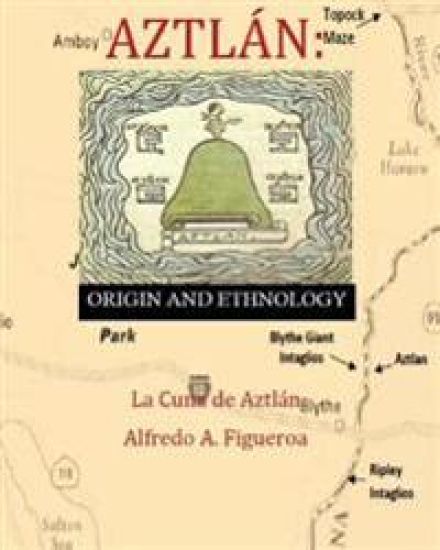
Aztlan Origin and Ethnology

Aztlan Origin and Ethnology

Alfredo a. Figueroa

Alfredo A. Figueroa
2017
nidottu
Aztl n, the mystical place of origin for Mexican people has been a geographic, historical and spiritual home to millions of indigenous people of North America (Cemanahuac). According to Mexica codices and ancient oral history, this place of origin was located somewhere in Northwest Mexico or Southwest United States. Since the Spanish overthrow of the Mexica people in Mexico, Tenochtitlan on August 13, 1521 the Spaniards led by Hernan Cortes were intrigued with the rumors that they heard regarding a place called Aztl n, a land of many riches. Since that time, very little evidence has been found but in the hearts of the Chicano/Mexica indigenous, the existence of this earthly paradise is not a fantasy, myth, nor theory, but a geographic reality. This landmark work of a native of the Palo Verde Valley has revealed the location of Aztl n, the origin of the Mexica creation story. He has uncovered the blatant lies that have been passed on for centuries, first by the Spanish invaders, then by the Mexican historians and researchers. This book is a must for anyone that wants to know the truth of why humans are here on earth. The author, Alfredo Acosta Figueroa is a historian, Chemehuevi sacred sites Tribal monitor, former organizer of the UFW and staunch environmentalist. He has made it his life's work to uncover the secrets that are revealed in his book Aztlan Origins and Ethnology.