Kirjojen hintavertailu. Mukana 11 717 486 kirjaa ja 12 kauppaa.

Kirjahaku

Etsi kirjoja tekijän nimen, kirjan nimen tai ISBN:n perusteella.

1000 tulosta hakusanalla David J. Fitzpatrick

Asylum Seekers and Refugees in the Contemporary World
Examining a number of case studies, including Palestinian, Afghan and Iraqi refugees, David J. Whittaker’s book provides a balanced introduction to this very controversial subject.Fuelled by extensive coverage in the media, the issue of asylum seekers and refugees is one of the most talked about subjects in contemporary politics. Whittaker cuts through the emotive language to give an objective introduction to the subject. Asylum Seekers and Refugees in the Contemporary World discusses the international as well as national implications of the issue, and the book looks in detail at the issue as it has affected Britain and Europe in particular, as well as including material on the UN and its response to the refugee ‘problem’.Including a final statement on the British government’s 2005 proposals for dealing with refugees, this volume is essential reading for all students of the history of the modern world and is ideal for newcomers to the subject.

The Organization for Security and Co-operation in Europe (OSCE)
During the Cold War, the two global superpowers were able to come together to resolve many issues of transparency and common challenges, leading to a change in European and global security. The OSCE covered the area formerly occupied by NATO and the Warsaw Pact, championing the Helsinki Final Act, which became a key international instrument to encourage peace and security. Following the end of the Cold War, the OSCE became a key institution positioned between the European Union and NATO, focusing on furthering democracy, protecting human and minority rights, and encouraging military reform in a drastically dynamic region. David J. Galbreath sheds light on an institution that changed the face of global security during the Cold War and championed the rise of democratization in Central and Eastern Europe as well as the former Soviet republics following the collapse of the Soviet Union.
The Organization for Security and Co-operation in Europe (OSCE)
During the Cold War, the two global superpowers were able to come together to resolve many issues of transparency and common challenges, leading to a change in European and global security. The OSCE covered the area formerly occupied by NATO and the Warsaw Pact, championing the Helsinki Final Act, which became a key international instrument to encourage peace and security. Following the end of the Cold War, the OSCE became a key institution positioned between the European Union and NATO, focusing on furthering democracy, protecting human and minority rights, and encouraging military reform in a drastically dynamic region. David J. Galbreath sheds light on an institution that changed the face of global security during the Cold War and championed the rise of democratization in Central and Eastern Europe as well as the former Soviet republics following the collapse of the Soviet Union.
The Political Economy of European Social Democracy
This book takes an in-depth look into recent developments in European social democracy. It begins by highlighting the somewhat paradoxical turn by a number of social democratic parties towards enhanced support for European integration, a move that has occurred despite the apparently ‘neoliberal’ direction of much of EU policy-output. A critical realist method is adopted, informed by both Marxist and anarchist critiques of social democratic parties, to argue that we can view this paradoxical development as resulting from the inherently unstable representation of constituents’ demands for decommodification, a process central to traditional social democratic parties. In making this argument, the book traces the transformation from ‘traditional’ to ‘new’ (or ‘third way’) social democratic parties in the UK, Sweden, France, Italy and Spain. It also outlines some of the most important developments in social democratic policy-making at the European level. The book therefore provides an in-depth, theoretically-original, analytical narrative of the key empirical developments to affect contemporary social democratic parties in recent years. In highlighting some of the contradictions inherent to both ‘traditional’ and ‘new’ social democratic parties, the book does much to suggest some of the reasons for their continued decline over the past three decades.David Bailey completed his PhD at the London School of Economics, and currently teaches at the University of Birmingham. His research focuses on social democratic parties and European integration. He has published articles in the Journal of Common Market Studies, and Comparative European Politics.
Cyberspace and the State

Cyberspace and the State

David J. Betz; Tim Stevens

Routledge
2011
nidottu
The major aim of Cyberspace and the State is to provide conceptual orientation on the new strategic environment of the Information Age. It seeks to restore the equilibrium of policy-makers which has been disturbed by recent cyber scares, as well as to bring clarity to academic debate on the subject particularly in the fields of politics and international relations, war and strategic studies. Its main chapters explore the impact of cyberspace upon the most central aspects of statehood and the state system—power, sovereignty, war, and dominion. It is concerned equally with practice as with theory and may be read in that sense as having two halves.
Alexander the Great: Lessons in Strategy

Alexander the Great: Lessons in Strategy

David J. Lonsdale

Routledge
2009
nidottu
This book offers a strategic analysis of one of the most outstanding military careers in history, identifying the most pertinent strategic lessons from the campaigns of Alexander the Great. David Lonsdale argues that since the core principles of strategy are eternal, the study and analysis of historical examples have value to the modern theorist and practitioner. Furthermore, as strategy is so complex and challenging, the remarkable career of Alexander provides the ideal opportunity to understand best practice in strategy, as he achieved outstanding and continuous success across the spectrum of warfare, in a variety of circumstances and environments. This book presents the thirteen most pertinent lessons that can be learned from his campaigns, dividing them into three categories: grand strategy, military operations, and use of force. Each of these categories provides lessons pertinent to the modern strategic environment. Ultimately, however, the book argues that the dominant factor in his success was Alexander himself, and that it was his own characteristics as a strategist that allowed him to overcome the complexities of strategy and achieve his expansive goals.
The Political Economy of European Social Democracy
This book takes an in-depth look into recent developments in European social democracy. It begins by highlighting the somewhat paradoxical turn by a number of social democratic parties towards enhanced support for European integration, a move that has occurred despite the apparently ‘neoliberal’ direction of much of EU policy-output. A critical realist method is adopted, informed by both Marxist and anarchist critiques of social democratic parties, to argue that we can view this paradoxical development as resulting from the inherently unstable representation of constituents’ demands for decommodification, a process central to traditional social democratic parties. In making this argument, the book traces the transformation from ‘traditional’ to ‘new’ (or ‘third way’) social democratic parties in the UK, Sweden, France, Italy and Spain. It also outlines some of the most important developments in social democratic policy-making at the European level. The book therefore provides an in-depth, theoretically-original, analytical narrative of the key empirical developments to affect contemporary social democratic parties in recent years. In highlighting some of the contradictions inherent to both ‘traditional’ and ‘new’ social democratic parties, the book does much to suggest some of the reasons for their continued decline over the past three decades.David Bailey completed his PhD at the London School of Economics, and currently teaches at the University of Birmingham. His research focuses on social democratic parties and European integration. He has published articles in the Journal of Common Market Studies, and Comparative European Politics.
A Certain Share of Low Cunning

A Certain Share of Low Cunning

David J. Cox

Routledge
2012
nidottu
This book provides an account and analysis of the history of the Bow Street Runners, precursors of today's police force. Through a detailed analysis of a wide range of both qualitative and quantitative research data, this book provides a fresh insight into their history, arguing that the use of Bow Street personnel in provincially instigated cases was much more common than has been assumed by many historians. It also demonstrates that the range of activities carried out by Bow Street personnel whilst employed on such cases was far more complex than can be gleaned from the majority of books and articles concerning early nineteenth-century provincial policing, which often do little more than touch on the role of Bow Street. By describing the various roles and activities of the Bow Street Principal Officers with specific regard to cases originating in the provinces it also places them firmly within the wider contexts of provincial law-enforcement and policing history. The book investigates the types of case in which the 'Runners' were involved, who employed them and why, how they operated, including their interaction with local law-enforcement bodies, and how they were perceived by those who utilized their services. It also discusses the legacy of the Principal Officers with regard to subsequent developments within policing. Bow Street Police Office and its personnel have long been regarded by many historians as little more than a discrete and often inconsequential footnote to the history of policing, leading to a partial and incomplete understanding of their work. This viewpoint is challenged in this book, which argues that in several ways the utilization of Principal Officers in provincially instigated cases paved the way for important subsequent developments in policing, especially with regard to detective practices. It is also the first work to provide a clear distinction between the Principal Officers and their less senior colleagues.
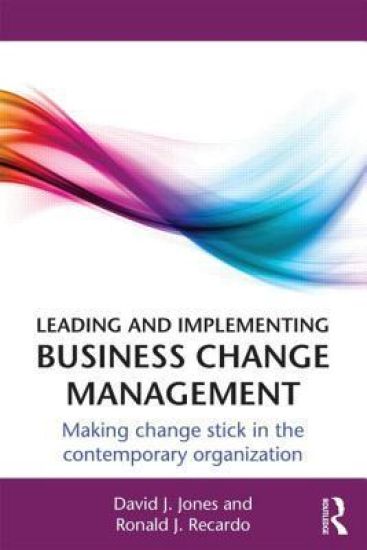
Leading and Implementing Business Change Management

Leading and Implementing Business Change Management

David J. Jones; Ronald J. Recardo

Routledge
2013
sidottu
Being change capable is the "new normal" for today’s growth-minded organizations. The "do more with less" strategies of the past are no longer effective in preparing organizations to meet the increasing challenges for growth, competitiveness and innovation required of them in this new era. Business change challenges including customer and market shifts, legal and regulatory requirements, strategic redirection, acquisitions, strategic partnerships, and cultural transformation are demanding that organizations effectively and efficiently manage change across multiple dimensions. To reach this level of change capability, organizations must adopt an integrated, balanced and customized approach to change management.Change management is addressed from the unique perspective of both its foundational concepts as well as practical application. Using an integrated, scalable and flexible framework, this book provides tools which can be readily customized and applied to initiatives across or within stages of the business change management lifecycle, from assessing the need for change, through planning the change initiative, designing a balanced change solution which integrates the people, process, and project management elements, through deploying and institutionalizing the change. Common risks associated with failed or stalled change initiatives are presented with best practices and key topics associated with change management are explored and illustrated through real-life case studies. Aimed at both the professionals within organizations and post graduate students and researchers within business strategy, organizational behaviour and change management disciplines, this book will provide a conceptual understanding of change management and a roadmap with a supporting toolbox for leading and implementing change that sticks.
Leading and Implementing Business Change Management

Leading and Implementing Business Change Management

David J. Jones; Ronald J. Recardo

Routledge
2013
nidottu
Being change capable is the "new normal" for today’s growth-minded organizations. The "do more with less" strategies of the past are no longer effective in preparing organizations to meet the increasing challenges for growth, competitiveness and innovation required of them in this new era. Business change challenges including customer and market shifts, legal and regulatory requirements, strategic redirection, acquisitions, strategic partnerships, and cultural transformation are demanding that organizations effectively and efficiently manage change across multiple dimensions. To reach this level of change capability, organizations must adopt an integrated, balanced and customized approach to change management.Change management is addressed from the unique perspective of both its foundational concepts as well as practical application. Using an integrated, scalable and flexible framework, this book provides tools which can be readily customized and applied to initiatives across or within stages of the business change management lifecycle, from assessing the need for change, through planning the change initiative, designing a balanced change solution which integrates the people, process, and project management elements, through deploying and institutionalizing the change. Common risks associated with failed or stalled change initiatives are presented with best practices and key topics associated with change management are explored and illustrated through real-life case studies. Aimed at both the professionals within organizations and post graduate students and researchers within business strategy, organizational behaviour and change management disciplines, this book will provide a conceptual understanding of change management and a roadmap with a supporting toolbox for leading and implementing change that sticks.
The Impact and Legacy of Educational Sloyd
Originating in Finland in eighteen-sixty-five, Educational Sloyd used handicrafts practised in schools to promote educational completeness through the interdependence of the mind and body. These radical ideas spread throughout Europe and America and had a significant impact on the early development of manual training, manual arts, industrial education and technical education. Today it is generally acknowledged that Educational Sloyd laid the foundations of modern technological education.This book traces the development of Sloyd from its conception by Uno Cygnaeus and the first Sloyd school founded by Otto Salomon, to its enthusiastic take up in Scandinavia and beyond. It examines the debates and controversy which surround the Sloyd system, and considers the transition from ‘hands-on’ craft work to concepts of technology education. Finally, the investigation reveals the lasting legacy of the ideas and practice of Sloyd education, and how it continues to influence technological education.Included in the book:- the foundations of Educational Sloyd- debates, controversy and rival factions- key case studies in Finland and Iceland- the lasting legacy of Sloyd education.This fascinating and comprehensive historical exploration will be of interest to scholars and researchers in the areas of technology education, comparative education and the history of education.
Learning to Read the Numbers

Learning to Read the Numbers

David J. Whitin; Phyllis E. Whitin

Routledge
2010
sidottu
Being a critical reader of numerical information is an integral part of being literate in today’s data-drenched world. Uniquely addressing both mathematics and language issues, this text shows how critical readers dig beneath the surface of data to better evaluate their usefulness and to understand how numbers are constructed by authors to portray a certain version of reality. Engaging, concise, and rich with examples and clear connections to classroom practice, it provides a framework of critical questions that children and teachers can pose to crack open authors’ intentions, expose their decisions, and make clear who are the winners and losers – questions that are essential for building democratic classrooms.Explaining and illustrating how K-8 teachers can engage students in developing the ability to be both critical composers and critical readers of texts, Learning to Read the Numbers is designed for teacher education courses across the areas of language arts, mathematics, and curriculum studies, and for elementary teachers, administrators, and literacy and mathematics coaches. Learning to Read the Numbers is a co-publication of The National Council of Teachers of English (www.ncte.org) and Routledge.
Learning to Read the Numbers

Learning to Read the Numbers

David J. Whitin; Phyllis E. Whitin

Routledge
2010
nidottu
Being a critical reader of numerical information is an integral part of being literate in today’s data-drenched world. Uniquely addressing both mathematics and language issues, this text shows how critical readers dig beneath the surface of data to better evaluate their usefulness and to understand how numbers are constructed by authors to portray a certain version of reality. Engaging, concise, and rich with examples and clear connections to classroom practice, it provides a framework of critical questions that children and teachers can pose to crack open authors’ intentions, expose their decisions, and make clear who are the winners and losers – questions that are essential for building democratic classrooms.Explaining and illustrating how K-8 teachers can engage students in developing the ability to be both critical composers and critical readers of texts, Learning to Read the Numbers is designed for teacher education courses across the areas of language arts, mathematics, and curriculum studies, and for elementary teachers, administrators, and literacy and mathematics coaches. Learning to Read the Numbers is a co-publication of The National Council of Teachers of English (www.ncte.org) and Routledge.
Beyond the Campus

Beyond the Campus

David J. Maurrasse

Routledge
2001
nidottu
The role of the university and its relationship to the community has long been a highly debated topic among educators, administrators, and local business leaders. David J. Maurrasse offers a passionate appeal for community partnerships. Going further than a simple explanation of the problems at hand, Beyond the Campus offers a road map for both universities and local institutions to work together for the good of their communities.
The Call for Diversity

The Call for Diversity

David J. Siegel

Routledge
2003
sidottu
This book explores the organizational responses of professional schools and colleges to pressures, demands, requirements, expectations, and incentives related to diversity. The macro-organizational perspective supplies much-needed balance and complexity to traditional depictions of post-secondary institutions as largely self-motivated in their diversity efforts.
Organizing for Social Partnership

Organizing for Social Partnership

David J. Siegel

Routledge
2010
sidottu
The most complex social challenges – such as post-secondary access and success for under-represented students, diversification of the workforce, poverty, environmental degradation, and global health – exceed the problem-solving capacity of single organizations or societal sectors. Organizing for Social Partnership provides colleges and universities, corporations, government agencies, nonprofits, and other organizations with a model for how to effectively address these and other pressing social issues through strong, effective collaboration. This valuable book is relevant for graduate students enrolled in courses on postsecondary organization and governance, equity and diversity, access, administration, and contemporary issues. Organizing for Social Partnership will also spark dialogue among higher education leaders and their counterparts in business, government, and the social sector.
Organizing for Social Partnership

Organizing for Social Partnership

David J. Siegel

Routledge
2010
nidottu
The most complex social challenges – such as post-secondary access and success for under-represented students, diversification of the workforce, poverty, environmental degradation, and global health – exceed the problem-solving capacity of single organizations or societal sectors. Organizing for Social Partnership provides colleges and universities, corporations, government agencies, nonprofits, and other organizations with a model for how to effectively address these and other pressing social issues through strong, effective collaboration. This valuable book is relevant for graduate students enrolled in courses on postsecondary organization and governance, equity and diversity, access, administration, and contemporary issues. Organizing for Social Partnership will also spark dialogue among higher education leaders and their counterparts in business, government, and the social sector.
At&t Reliability Manual

At&t Reliability Manual

David J. Klinger; Yoshinao Nakada; Maria A. Menendez

Van Nostrand Reinhold Inc.,U.S.
1999
sidottu
Partial Contents: Reliability Concepts; Device Reliability; Hazard Rates; Monitoring Reliability; Specific Device Information, and more. Appendixes. 60 illustrations.
Optical Imaging and Spectroscopy

Optical Imaging and Spectroscopy

David J. Brady

John Wiley Sons Inc
2009
sidottu
An essential reference for optical sensor system design This is the first text to present an integrated view of the optical and mathematical analysis tools necessary to understand computational optical system design. It presents the foundations of computational optical sensor design with a focus entirely on digital imaging and spectroscopy. It systematically covers: Coded aperture and tomographic imaging Sampling and transformations in optical systems, including wavelets and generalized sampling techniques essential to digital system analysis Geometric, wave, and statistical models of optical fields The basic function of modern optical detectors and focal plane arrays Practical strategies for coherence measurement in imaging system design The sampling theory of digital imaging and spectroscopy for both conventional and emerging compressive and generalized measurement strategies Measurement code design Linear and nonlinear signal estimation The book concludes with a review of numerous design strategies in spectroscopy and imaging and clearly outlines the benefits and limits of each approach, including coded aperture and imaging spectroscopy, resonant and filter-based systems, and integrated design strategies to improve image resolution, depth of field, and field of view. Optical Imaging and Spectroscopy is an indispensable textbook for advanced undergraduate and graduate courses in optical sensor design. In addition to its direct applicability to optical system design, unique perspectives on computational sensor design presented in the text will be of interest for sensor designers in radio and millimeter wave, X-ray, and acoustic systems.
EM Detection of Concealed Targets

EM Detection of Concealed Targets

David J. Daniels

John Wiley Sons Inc
2010
sidottu
THE LATEST EM TECHNIQUES FOR DETECTING CONCEALED TARGETS, WHETHER EXPLOSIVES, WEAPONS, OR PEOPLE Extensively illustrated from basic principles to system design, the fundamental concepts of RF, microwave, millimeter wave, and terahertz detection systems and techniques to find concealed targets are explained in this publication. These concealed targets may be explosive devices or weapons, which can be buried in the ground, concealed in building structures, hidden under clothing, or inside luggage. Concealed targets may also be people who are stowaways or victims of an avalanche or earthquake. Although much information is available in conference proceedings and professional society publications, this book brings all the relevant information in a single, expertly written and organized volume. Readers gain an understanding of the physics underlying electromagnetic (EM) detection methods, as well as the factors that affect the performance of EM detection equipment, helping them choose the right type of equipment and techniques to meet the demands of particular tasks. Among the topics covered are: Ultra-wideband radar and ground-penetrating radarMillimeter, sub-millimeter, and terahertz systemsRadar systems including Doppler, harmonic, impulse, FMCW, and holographicRadiometric systemsNuclear quadrupole resonance systems Author David Daniels has many years of experience designing and deploying EM systems to detect concealed targets. As a result, this publication is essential for scientists and engineers who are developing or using EM equipment and techniques for a diverse range of purposes, including homeland security, crime prevention, or the detection of persons.