Kirjojen hintavertailu. Mukana 11 518 949 kirjaa ja 12 kauppaa.

Kirjahaku

Etsi kirjoja tekijän nimen, kirjan nimen tai ISBN:n perusteella.

868 tulosta hakusanalla Emerich Sumser

Vilsen i Europa

Vilsen i Europa

Emeric Carlsson

Visto Förlag
2022
nidottu
"Du skrämmer mig inte längre", sade jag och tyckte själv att jag lät övertygande. "Du kommer inte åt mig."Jag lämnade plattformen och likt förra gången trodde jag att skepnaden skulle försvinna. Men den var fortfarande kvar. Iakttagande. Väntade på att jag skulle ta ett snedsteg. Jag mår bra, tänkte jag. Män kan inte må dåligt. Jag mår bra.Andreas har aldrig gjort något bara för sig själv. Alltid har han något eller någon som kommer före: jobbet, kompisen, ångesten. Slutligen har han nått en punkt i livet med en molande känsla av tomhet i själen. En sommar bestämmer han sig därför för att tågluffa ensam i Europa och, hur säreget det än låter, hitta sig själv. Kanske kan han glömma det mörka som har varit om han bara lämnar allt och drar. Andreas tar sig från plats till plats. Han går tills han är trasig. Skorna får hål, nacken blir stel, väskan sliten. Planen är att gå tills han är lagad, tills psyket är helt igen. Det ser så lätt ut när andra vilsna individer beger sig ut på äventyr, men hur hittar man egentligen sig själv när man inte vet var man ska börja leta?
Short Stories in Japanese

Short Stories in Japanese

Michael Emmerich

Penguin Books Ltd
2011
nidottu
Here is the perfect introduction to contemporary Japanese fiction. Featuring many stories appearing in English for the first time, this collection, with parallel translations, offers students at all levels the opportunity to enjoy a wide range of contemporary literature without having to constantly consult a dictionary. Richly diverse in themes and styles, the stories are by well-known writers-like Haruki Murakami and Banana Yoshimoto-as well as by emerging voices. Complete with notes, these selections make excellent reading in either language.
The Tale of Genji

The Tale of Genji

Michael Emmerich

Columbia University Press
2013
sidottu
Michael Emmerich thoroughly revises the conventional narrative of the early modern and modern history of The Tale of Genji. Exploring iterations of the work from the 1830s to the 1950s, he demonstrates how translations and the global circulation of discourse they inspired turned The Tale of Genji into a widely read classic, reframing our understanding of its significance and influence and of the processes that have canonized the text. Emmerich begins with an analysis of the lavishly produced best seller Nise Murasaki inaka Genji (A Fraudulent Murasaki's Bumpkin Genji, 1829-1842), an adaptation of Genji written and designed by Ryutei Tanehiko, with pictures by the great print artist Utagawa Kunisada. He argues that this work introduced Genji to a popular Japanese audience and created a new mode of reading. He then considers movable-type editions of Inaka Genji from 1888 to 1928, connecting trends in print technology and publishing to larger developments in national literature and showing how the one-time best seller became obsolete. The study subsequently traces Genji's reemergence as a classic on a global scale, following its acceptance into the canon of world literature before the text gained popularity in Japan. It concludes with Genji's becoming a "national classic" during World War II and reviews an important postwar challenge to reading the work after it attained this status. Through his sustained critique, Emmerich upends scholarship on Japan's preeminent classic while remaking theories of world literature, continuity, and community.
The Tale of Genji

The Tale of Genji

Michael Emmerich

Columbia University Press
2015
pokkari
Michael Emmerich thoroughly revises the conventional narrative of the early modern and modern history of The Tale of Genji. Exploring iterations of the work from the 1830s to the 1950s, he demonstrates how translations and the global circulation of discourse they inspired turned The Tale of Genji into a widely read classic, reframing our understanding of its significance and influence and of the processes that have canonized the text. Emmerich begins with an analysis of the lavishly produced best seller Nise Murasaki inaka Genji (A Fraudulent Murasaki's Bumpkin Genji, 1829-1842), an adaptation of Genji written and designed by Ryutei Tanehiko, with pictures by the great print artist Utagawa Kunisada. He argues that this work introduced Genji to a popular Japanese audience and created a new mode of reading. He then considers movable-type editions of Inaka Genji from 1888 to 1928, connecting trends in print technology and publishing to larger developments in national literature and showing how the one-time best seller became obsolete. The study subsequently traces Genji's reemergence as a classic on a global scale, following its acceptance into the canon of world literature before the text gained popularity in Japan. It concludes with Genji's becoming a "national classic" during World War II and reviews an important postwar challenge to reading the work after it attained this status. Through his sustained critique, Emmerich upends scholarship on Japan's preeminent classic while remaking theories of world literature, continuity, and community.
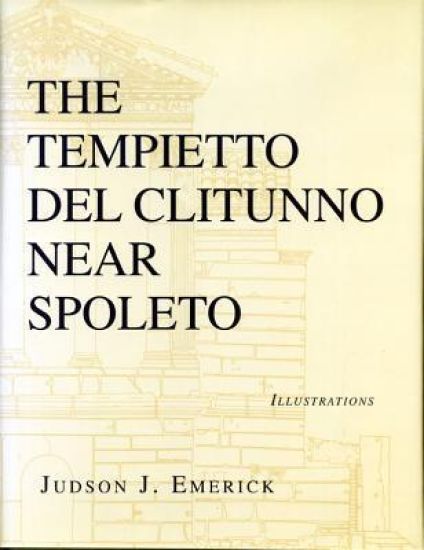
The Tempietto del Clitunno near Spoleto

The Tempietto del Clitunno near Spoleto

Judson Emerick

Pennsylvania State University Press
1998
sidottu
This is the first full-length study of the enigmatic Early Medieval chapel near the river Clitunno in central Umbria. Judson Emerick makes the Tempietto del Clitunno, a celebrated art-historical test case, the focus of a study that penetrates to the deep structure of the discipline.For centuries scholars have puzzled over the chapel's lavish Corinthian column screens, the crosses surrounded by Neo-Attic vine scrolls in its pedimental reliefs, and the Christian Latin inscriptions in huge Neo-Augustan block capitals from its friezes. The sixteenth-century humanists who named the building the "Tempietto del Clitunno" treated it as an ancient Roman temple that the Christians later converted. But modern art historians, learning that the Tempietto had been built from the ground up as a chapel, declared it an anomaly, the product of a most startling and unexpected Early Christian and medieval classical revival.Emerick intervenes by critiquing the notion of classical revival in medieval architecture. Impatient with the old Enlightenment historical plot that makes the Tempietto into a dark-age prodigy, Emerick boldly redescribes the architectural record to take away the Tempietto's strangeness. He shows conclusively that the chapel's orders, pedimental reliefs, and inscriptions conform to ancient Roman Imperial Corinthian standards, but then goes on to show that just this Corinthian decorative system was frequent, even normal in festive, public, Christian cult rooms from Constantine's day down through the twelfth century.History of style as an end in itself yields here to style treated as political phenomenon. Emerick turns to the frescoes on the Tempietto's rear apse wall for clues to the builders' political goals. He explains how grandees from the medieval Lombardo-Frankish Duchy of Spoleto, full participants in a Christian theocratic state, set up an array of Mediterranean icons inside the Tempietto to enhance their social and political control. The chapel's Corinthian decorative system, he concludes, must be integral to this political program.
Translation and the Making of Originals
In this ground-breaking work, Karen Emmerich challenges the assumption that original or source texts have a fixed identity. The textual makeup of a 'source text' is no more stable than its meaning. Originals are not given but made and translation is a process by which foreign works of literature are transformed into 'originals' through the creation of the supposedly derivative works we call translations. Karen Emmerich establishes this argument by bringing recent works in the field of textual scholarship to bear on discussions of translation. She explores multiple forms of textual instability and the translation strategies that have and can be employed in dealing with them. The scope of the discussion is broad covering ancient works, oral works, unfinished or fragmentary works, multilingual works, and works that straddle the divide between translation and 'original' creation, drawn from a range of languages, periods, genres, and literary traditions. This timely book also engages such issues as the politics and ethics of translation, how aesthetic categories and market forces contribute to the establishment and promotion of particular 'originals,' and the role translation plays in the formation, re-formation, and deformation of national and international literary canons. This is essential reading for students and scholars working in the areas of literary translation studies, comparative literature and world literature.
Engineering Distributed Objects

Engineering Distributed Objects

Wolfgang Emmerich

John Wiley Sons Inc
2000
sidottu
The pay-offs for creating distributed applications are in achieving portability, scalability and fault-tolerance. In order to simplify building software that performs robustly regardless of platform or network infrastructure, a new strata of 'middleware' has been created. This book provides a conceptual framework within which to describe object-oriented middleware for the integration of distributed objects. UML is used to explain distributed systems concepts. Presenting both an extended case study and smaller illustrative examples, there are plenty of coded examples in Java, C++, CORBA IDL and Microsoft IDL, which reflect the reality of today's multi-language heterogeneous systems. This is a book for developers who are new to programming in distributed environments. It also supports a variety of courses where the central theme is object-oriented development with middleware technologies. The book shows the middleware concepts and principles using examples taken from: * OMG/CORBA * Microsoft COM * Java/RMI On the accompanying website (http://www.distributed-objects.com) are exercises, sample solutions and working code for the examples. This site is also designed for instructors to assist them with course development and delivery.
Divorcing with Dignity

Divorcing with Dignity

Tim Emerick-Cayton

Westminster/John Knox Press,U.S.
1993
nidottu
This practical guide provides an alternative to the standard methods of arbitration and litigation used by divorcing couples--and shows how mediation can be utilized instead. Based on the author's professional experience in law and as a minister who has mediated for more than five hundred couples, Tim Emerick-Cayton provides illustrations on how to survive the pain and anguish of divorcing while maintaining personal integrity and faith. With case examples of those who have experienced successful mediation, Emerick-Cayton shows how mediation reduces cost, hostility, and confusion. Emerick-Cayton says mediated agreements are complied with almost twice as often as court-rendered judgments.
Pneumatological Concepts in the Epistle to the Hebrews

Pneumatological Concepts in the Epistle to the Hebrews

Martin Emmrich

University Press of America
2004
nidottu
This book is the first treatise exclusively devoted to developing the epistle's teaching about the Spirit. Presently, scholarship has focused most of its attention on the epistle's eschatology and Christology, with pneumatology usually being relegated to a few passing remarks. The book argues that the latter notion has been unduly neglected. This book is the first treatise exclusively devoted to developing the epistle's teaching about the Spirit. Presently, scholarship has focused most of its attention on the epistle's eschatology and Christology, with pneumatology usually being relegated to a few passing remarks. The book argues that the latter notion has been unduly neglected.
NerdCrush

NerdCrush

Alisha Emrich

Running Press,U.S.
2023
sidottu
Happily Ever Afters meets You've Got Mail in this geeky, Black Girl Magic filled debut romance about cosplay and finding the courage to be yourself. Ramona Lambert is a typical shy, artistic sixteen-year-old. She has a best friend whom she’s known since they were in diapers; parents who love her; a love for cosplay; and a crush on the cute boy in her class. The only problem? Her best friend moved away; her parents don't quite understand her love of cosplay; and she is pretty sure her crush has no idea she exists. To escape her troubles, Ramona turns to cosplay and her original character, Rel, who gives her the confidence and freedom that she lacks in real life. Embracing this confidence, she decides to strike up an email conversation with her crush, Caleb Wolfe, from her cosplay account in the hopes getting to know him . . . and maybe win his heart. Then as Caleb and Ramona are swept up in their emails back and forth to each other, and Ramona falls even harder as he opens up about his hopes, insecurities, and his own geeky loves. However, as Caleb starts to grow closer and closer to Rel, he also strikes up a friendship with Ramona, who knows she can't keep the truth about Rel from Caleb but isn't sure she is ready to risk losing him. With an important cosplay convention coming up and the anxiety of her double-life weighing on her, Ramona has to decide if she’ll hide behind her cosplay character forever or take the chance and let Caleb see the real her--because he might actually like her for who she is.
John Jacob Astor and the First Great American Fortune
This biography analyzes Astor's rise from poor German immigrant in 1784 to the first modern millionaire--he was one before the term "millionaire" entered the English language. Many consider him to be the fourth wealthiest American of all times. After his death in 1848, the public began to discuss the "responsibility" of a millionaire. Some argued that he must have been greedy and cold. Some voices demanded that he should have given all his money back to the United States. More liberal thinkers praised him for his genius and vision. This biography presents a balanced picture. Astor was the founder of the first American settlement on the Pacific (Astoria, Oregon) and of New York's fine hotels the Astor House and the Waldorf-Astoria, as well as a developer of the American West and a fur trader. Many American cities and sites are named after him. He donated the Astor Library to the city of New York (it became the first public library of the city), now part of the New York Public Library.
The Last Layer of the Ocean

The Last Layer of the Ocean

Mary Emerick

Oregon State University
2021
nidottu
There are five layers of the ocean, though most of us alive will only ever see one. The deepest layer of the ocean is called by some the midnight zone. The only light comes from bioluminescence, created by animals themselves. In order to see, the creatures there must create their own light. They must move like solitary suns, encased in their own bubbles of freezing water. This layer is the most completely unexplored zone on the planet. Though it is hostile to humans, it also is fascinating beyond belief. If you had a chance to see it, wouldn't you want to go there?The year Mary is 38, the suicide of a stranger in a nearby reservoir compels her to make a change. She decides to strike out for Alaska and take a chance on love and home. She begins to learn how to travel in a small yellow kayak along the coast, contending with gales, high seas, and bears. She explores the different meanings of home: the perspectives of people who were born in this place and others who chose it, the first peoples who have been here for generations, and the ones who eventually leave.When she marries a man from another island, she is convinced that this time love will stick. She soon learns that navigating marriage is just as difficult as learning the ocean. Divided into sections detailing the main kayaking strokes, this memoir shows how each can be a metaphor for the lives we all pass through and the tools we need to stay afloat.