

Kirjahaku
Etsi kirjoja tekijän nimen, kirjan nimen tai ISBN:n perusteella.
1000 tulosta hakusanalla J C Everlyn

The Welsh Pulpit of To-Day, Sermons, Ed. by J.C. Jones
Hutson Street Press
2025
sidottu

The Welsh Pulpit of To-Day, Sermons, Ed. by J.C. Jones
Hutson Street Press
2025
pokkari
![The Death of Christ Was a Propitiatory Sacrifice and a Vicarious Atonement for the Sins of Mankind, Atheological Essay [By J.C. Cowley]](/covers/9781024137699.jpg)
The Death of Christ Was a Propitiatory Sacrifice and a Vicarious Atonement for the Sins of Mankind, Atheological Essay [By J.C. Cowley]
John Cowley Fisher
Hutson Street Press
2025
pokkari
The System of Shorthand, Practiced by Mr. Thomas Lloyd, in Taking Down the Debates of Congress; And Now (with His Permission) Published for General Use, by J.C.
John Carey
Gale Ecco, Print Editions
2010
pokkari
The System of Shorthand, Practiced by Mr. Thomas Lloyd, in Taking Down the Debates of Congress; and now (with his Permission) Published for General use, by J.C
John Carey
Gale Ecco, Print Editions
2018
sidottu
The 18th century was a wealth of knowledge, exploration and rapidly growing technology and expanding record-keeping made possible by advances in the printing press. In its determination to preserve the century of revolution, Gale initiated a revolution of its own: digitization of epic proportions to preserve these invaluable works in the largest archive of its kind. Now for the first time these high-quality digital copies of original 18th century manuscripts are available in print, making them highly accessible to libraries, undergraduate students, and independent scholars.Delve into what it was like to live during the eighteenth century by reading the first-hand accounts of everyday people, including city dwellers and farmers, businessmen and bankers, artisans and merchants, artists and their patrons, politicians and their constituents. Original texts make the American, French, and Industrial revolutions vividly contemporary.++++The below data was compiled from various identification fields in the bibliographic record of this title. This data is provided as an additional tool in helping to insure edition identification: ++++British LibraryW007576Attributed to John Carey by Evans, who notes that the copyright was issued to him. List of subscribers' names, p. 1-2], 2nd count. Philadelphia]: Entered according to act of Congress, and sold by H. and P. Rice, no. 50. Market-Street, Philadelphia, 1793. 2],16p., 2leaves of plates (1folded): ill.; 12
Des morts sans tombe Le cas des ossements humains en contexte non sépulcral en Europe tempérée entre les 6e et 3e millénaires av. J.-C.
Jean-Gabriel Pariat
BAR Publishing
2007
nidottu
L'eau dans les espaces et les pratiques funéraires d'Alexandrie aux époques grecque et romaine (IVe siècle av. J.-C. - IIIe siècle ap. J.-C.)
Agnès Tricoche
BAR Publishing
2009
nidottu
In the cemeteries of Graeco-Roman Alexandria in Egypt, archaeological investigations initiated more than a century ago discovered various water systems adapted for specific funerary purposes. From the foundation of the city in 332 B.C. to the third century A.C., over fifty hydraulic installations have been noted within the records of Alexandria itself and its vicinity. From a corpus that inventories the hydraulic structures identified to this day in the archaeological literature, the different water management systems are described and reasons put forward to explain the presence of these devices (wells, cisterns, basins, etc.). The results show that the cemeteries should not just be considered as a cities for the dead but also as places of rebirth and life. Some of the devices discovered within the funerary context have echoes in the libation systems already known in the Mediterranean and lead towards an evaluation, from textual and iconographical documents, of the role of water in the offerings to the Alexandrian dead. French text.
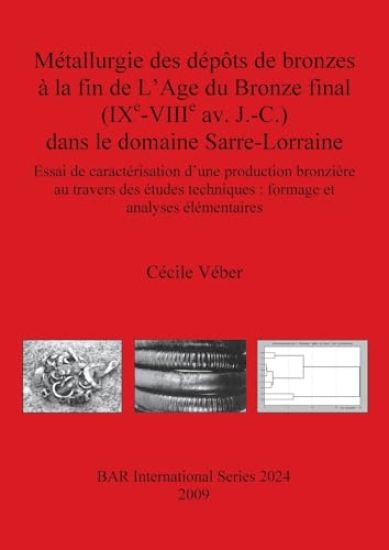
Métallurgie des dépôts de bronzes à la fin de L'Age du Bronze final (IXe-VIIIe av. J.-C.) dans le domaine Sarre-Lorraine
Cécile Véber
BAR Publishing
2009
nidottu
THis study re-evaluates discoveries of deposits of bronze artefacts in the Lorraine, the Saar and Luxemburg during the late Bronze Age. It studies the objects typologically and in terms of their manufacture, combining this with statistical analysis of hoard composition, and the condition of the objects when deposited. There is also metallurgical analysis of the artefacts. French text.

Frayer la route d'un monde inversé. Sacrifice et offrandes animales dans la culture Mochica (100-800 apr. J.-C.) côte nord du Pérou
Nicolas Goepfert
BAR Publishing
2011
muu
The Moche culture (100-800 A.D.) developed on the northern Peruvian coast in an area spread over the Piura and Nepe a valleys. The zooarchaeological study of the faunal remains discovered in graves at four main ceremonial sites (Sip n, San Jos de Moro, El Brujo and Moche) has provided evidence of twelve sacrificed animal species: domestic taxa such as llamas, dogs and guinea pigs, and also wild species such as bats. A comparison of the zooarchaeological data with the iconographical corpus showed that animals served different ritual purposes, such as mortuary food and as guides for the deceased's soul into the afterlife; they were also symbolically considered as mediators between the world of the living and the dead. The study also comparesarchaeological data with other sources, such as ethnohistorical texts and ethnographical testimonies leading to a better understanding of the symbolical dimension represented by Andean animals.
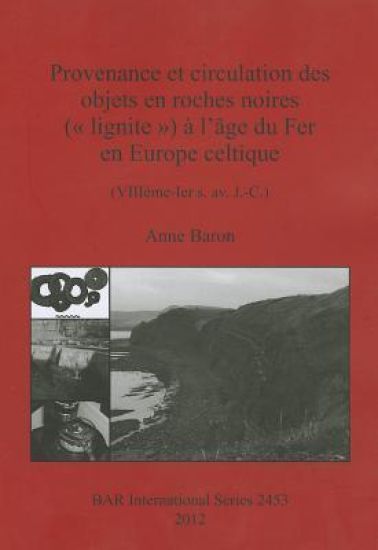
Provenance et circulation des objets en roches noires (« lignite ») à l'âge du Fer en Europe celtique (VIIIème-Ier s. av. J.-C.)
Anne Baron
BAR Publishing
2012
nidottu
The numerous discoveries of black stone artefacts in Europe open new fields of research of great interest as regards the understanding of raw material acquisition and manufacturing and also the reconstruction of ancient exchange networks. Two main research axes were explored for this multidisciplinary research: the material was studied using archaeological, geological and analytical approaches. A new analytical protocol using LA-ICP-MS was tested and gives promising results and opens future developments. The aim of this study was to reconstruct the relationships between artefacts and sources during the Iron Age in Celtic Europe, and also to understand the distribution of the raw material and production systems of these black stone artefacts. Some changes between the Iron Age periods necessitated the examination of the circulation and diffusion of black stone objects across Europe, and also the long-distance trade of materials. These results constitute the most comprehensive archaeological, geological, and analytical referential database for European black stone material available to date.

Maria Stuart. A Tragedy by Fr. V. Schiller. With Explanatory Notes by J.C. Oehlschlaeger ...
Friedrich Schiller
University of Michigan Library
2006
pokkari
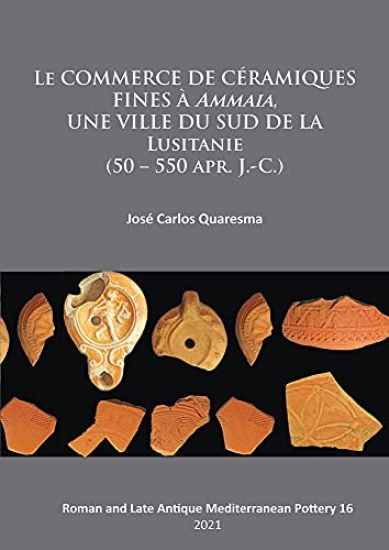
Le commerce de céramiques fines à ammaia, une ville du sud de la Lusitanie (50 – 550 apr. J.-c.)
José Carlos Quaresma
Archaeopress
2021
nidottu
This volume presents the entire assemblage of fine wares (terra sigillata, lamps and thin-walled wares) from Ammaia, a Roman and Late Antique town located in the hinterland of southern Lusitania (presently in Portuguese territory). Despite its distance from the Atlantic coast, Ammaia took advantage of its proximity to Augusta Emerita, the capital of Lusitania. This aspect is particularly strong between c. AD 50 and c. AD 150, when the local market imported large quantities of fine wares from the capital. The Late Antique phase reveals a balanced capacity of importation at Ammaia, whose fine wares, essentially related to terra sigillata, were provided by wares from northern Hispania (Douro and Ebro valleys) and North Africa (Tunisia). Moreover, recent research at Ammaia has provided excellent stratigraphic contexts dated to between c. AD 50 and c. AD 150, crucial for the understanding of the chronological evolution of Italian, South-Gaulish and Hispanic terra sigillata. In the final chapter, the author undertakes a wide-ranging analysis of southern Lusitania with regard to the consumption of fine wares and amphorae. Several chronological phases have been established, based on stratigraphic and typological evidence, for the period between c. AD 50 and c. AD 550: that is the Early Empire (from the Claudio-Neronian period onwards) and its transition into the Late Roman period and the post-Roman phase. In the final sub-chapters, this analysis focuses on the problematic 5th century and up to the latest Lusitanian stratigraphic evidence of around the middle of the 6th century AD.
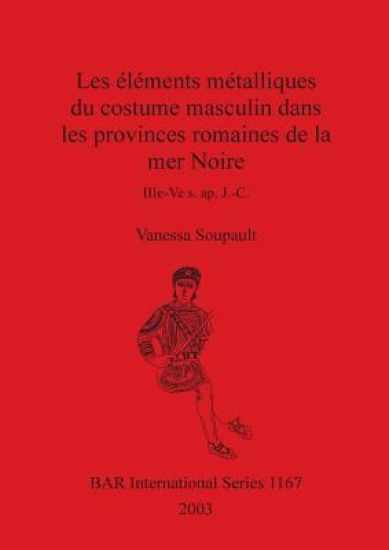
Les éléments métalliques du costume masculin dans les provinces romaines de la mer Noire IIIe-Ve s. ap. J.-C.
Soupault Vanessa
BAR Publishing
2003
nidottu
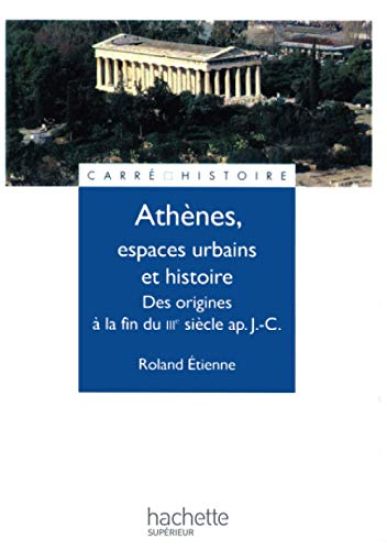
Athènes, espaces urbains et histoire - Des origines à la fin du IIIe siècle ap. J.-C.
Etienne-R
Hesuppedago
2022
nidottu

Illustration Du Vertueux Alfred-Le-Grand, Roi d'Angleterre, Poème, Par J.-C. Defosse
Jean-Charles Defosse
Hachette Livre - BNF
2017
pokkari
Histoire Universelle. Les Asiatiques. Assyriens, Hébreux, Phéniciens de 4000 À 559 Av. J.-C.
Marius Fontane
Hachette Livre - BNF
2016
pokkari
Histoire Universelle. La Papauté, Charlemagne de 632 À 877 Ap. J.-C.
Marius Fontane
Hachette Livre - BNF
2016
pokkari
Histoire Universelle. Les Iraniens, Zoroastre de 2500 À 800 Av. J.-C.
Marius Fontane
Hachette Livre - BNF
2016
pokkari
La Stèle de Mésa, Roi de Moab, 896 Av. J.-C. Lettre À M. Le Cte de Vogué
Charles Clermont-Ganneau
Hachette Livre - BNF
2018
pokkari