Kirjojen hintavertailu. Mukana 12 427 878 kirjaa ja 12 kauppaa.

Kirjahaku

Etsi kirjoja tekijän nimen, kirjan nimen tai ISBN:n perusteella.

1000 tulosta hakusanalla J C Rodrigues

Histoire Du Royaume de Ts'in, 777-207 Av. J.-C

Histoire Du Royaume de Ts'in, 777-207 Av. J.-C

Albert Tschepe

Hachette Livre - BNF
2016
pokkari
Histoire du royaume de Han: 423-225. Numero 30 / par le P. Albert Tschepe, ...Date de l'edition originale: 1910"Collection: Varietes sinologiques; 31"Ce livre est la reproduction fidele d'une oeuvre publiee avant 1920 et fait partie d'une collection de livres reimprimes a la demande editee par Hachette Livre, dans le cadre d'un partenariat avec la Bibliotheque nationale de France, offrant l'opportunite d'acceder a des ouvrages anciens et souvent rares issus des fonds patrimoniaux de la BnF.Les oeuvres faisant partie de cette collection ont ete numerisees par la BnF et sont presentes sur Gallica, sa bibliotheque numerique.En entreprenant de redonner vie a ces ouvrages au travers d'une collection de livres reimprimes a la demande, nous leur donnons la possibilite de rencontrer un public elargi et participons a la transmission de connaissances et de savoirs parfois difficilement accessibles.Nous avons cherche a concilier la reproduction fidele d'un livre ancien a partir de sa version numerisee avec le souci d'un confort de lecture optimal. Nous esperons que les ouvrages de cette nouvelle collection vous apporteront entiere satisfaction.Pour plus d'informations, rendez-vous sur www.hachettebnf.frhttp: //gallica.bnf.fr/ark: /12148/bpt6k5439897n
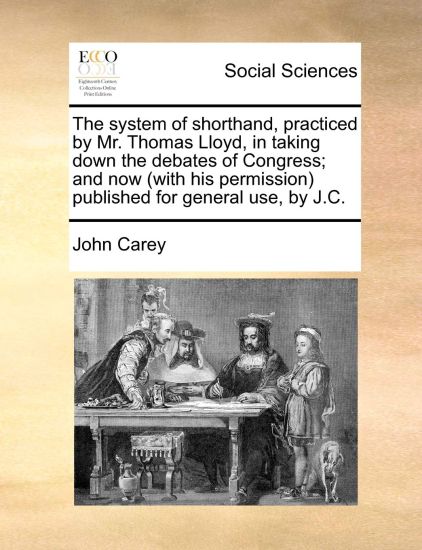
The System of Shorthand, Practiced by Mr. Thomas Lloyd, in Taking Down the Debates of Congress; and now (with his Permission) Published for General use, by J.C
The 18th century was a wealth of knowledge, exploration and rapidly growing technology and expanding record-keeping made possible by advances in the printing press. In its determination to preserve the century of revolution, Gale initiated a revolution of its own: digitization of epic proportions to preserve these invaluable works in the largest archive of its kind. Now for the first time these high-quality digital copies of original 18th century manuscripts are available in print, making them highly accessible to libraries, undergraduate students, and independent scholars.Delve into what it was like to live during the eighteenth century by reading the first-hand accounts of everyday people, including city dwellers and farmers, businessmen and bankers, artisans and merchants, artists and their patrons, politicians and their constituents. Original texts make the American, French, and Industrial revolutions vividly contemporary.++++The below data was compiled from various identification fields in the bibliographic record of this title. This data is provided as an additional tool in helping to insure edition identification: ++++British LibraryW007576Attributed to John Carey by Evans, who notes that the copyright was issued to him. List of subscribers' names, p. 1-2], 2nd count. Philadelphia]: Entered according to act of Congress, and sold by H. and P. Rice, no. 50. Market-Street, Philadelphia, 1793. 2],16p., 2leaves of plates (1folded): ill.; 12
L'eau dans les espaces et les pratiques funéraires d'Alexandrie aux époques grecque et romaine (IVe siècle av. J.-C. - IIIe siècle ap. J.-C.)
In the cemeteries of Graeco-Roman Alexandria in Egypt, archaeological investigations initiated more than a century ago discovered various water systems adapted for specific funerary purposes. From the foundation of the city in 332 B.C. to the third century A.C., over fifty hydraulic installations have been noted within the records of Alexandria itself and its vicinity. From a corpus that inventories the hydraulic structures identified to this day in the archaeological literature, the different water management systems are described and reasons put forward to explain the presence of these devices (wells, cisterns, basins, etc.). The results show that the cemeteries should not just be considered as a cities for the dead but also as places of rebirth and life. Some of the devices discovered within the funerary context have echoes in the libation systems already known in the Mediterranean and lead towards an evaluation, from textual and iconographical documents, of the role of water in the offerings to the Alexandrian dead. French text.
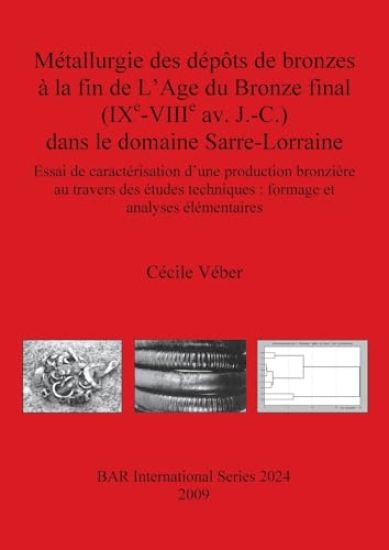
Métallurgie des dépôts de bronzes à la fin de L'Age du Bronze final (IXe-VIIIe av. J.-C.) dans le domaine Sarre-Lorraine
THis study re-evaluates discoveries of deposits of bronze artefacts in the Lorraine, the Saar and Luxemburg during the late Bronze Age. It studies the objects typologically and in terms of their manufacture, combining this with statistical analysis of hoard composition, and the condition of the objects when deposited. There is also metallurgical analysis of the artefacts. French text.
Frayer la route d'un monde inversé. Sacrifice et offrandes animales dans la culture Mochica (100-800 apr. J.-C.) côte nord du Pérou
The Moche culture (100-800 A.D.) developed on the northern Peruvian coast in an area spread over the Piura and Nepe a valleys. The zooarchaeological study of the faunal remains discovered in graves at four main ceremonial sites (Sip n, San Jos de Moro, El Brujo and Moche) has provided evidence of twelve sacrificed animal species: domestic taxa such as llamas, dogs and guinea pigs, and also wild species such as bats. A comparison of the zooarchaeological data with the iconographical corpus showed that animals served different ritual purposes, such as mortuary food and as guides for the deceased's soul into the afterlife; they were also symbolically considered as mediators between the world of the living and the dead. The study also comparesarchaeological data with other sources, such as ethnohistorical texts and ethnographical testimonies leading to a better understanding of the symbolical dimension represented by Andean animals.
Provenance et circulation des objets en roches noires (« lignite ») à l'âge du Fer en Europe celtique (VIIIème-Ier s. av. J.-C.)
The numerous discoveries of black stone artefacts in Europe open new fields of research of great interest as regards the understanding of raw material acquisition and manufacturing and also the reconstruction of ancient exchange networks. Two main research axes were explored for this multidisciplinary research: the material was studied using archaeological, geological and analytical approaches. A new analytical protocol using LA-ICP-MS was tested and gives promising results and opens future developments. The aim of this study was to reconstruct the relationships between artefacts and sources during the Iron Age in Celtic Europe, and also to understand the distribution of the raw material and production systems of these black stone artefacts. Some changes between the Iron Age periods necessitated the examination of the circulation and diffusion of black stone objects across Europe, and also the long-distance trade of materials. These results constitute the most comprehensive archaeological, geological, and analytical referential database for European black stone material available to date.