Kirjojen hintavertailu. Mukana 11 244 527 kirjaa ja 12 kauppaa.

Kirjahaku

Etsi kirjoja tekijän nimen, kirjan nimen tai ISBN:n perusteella.

1000 tulosta hakusanalla John Hardingham

John Locke: The Reasonableness of Christianity
In 1695 John Locke published The Reasonableness of Christianity, an enquiry into the foundations of Christian belief. He did so anonymously, to avoid public involvement in the fiercely partisan religious controversies of the day. In the Reasonableness Locke considered what it was to which all Christians must assent in faith; he argued that the answer could be found by anyone for themselves in the divine revelation of Scripture alone. He maintained that the requirements of Scripture were few and simple, and therefore offered a basis for tolerant agreement among all Christians, and the promise of peace, stability, and security through toleration. This is the first critical edition of the Reasonableness: for the first time an authoritative annotated text is presented, with full information about sources, variants, amendments, and the publishing history of the work. Also provided in the editorial notes are cross-references, references to other works by Locke, definitions of terms, and other information conducive to an understanding of the text. Though modern interest has focused particularly on Locke's philosophy and political theory, increasing attention is being paid to his religious thought. These different strands cannot be understood properly in isolation from each other: so the broader aim of this edition is to help towards an improved understanding of his religious thought in the context of his work as a philosopher, political theorist, and exponent of religious toleration. In his editorial introduction John Higgins-Biddle investigates how Locke's ideas developed, and offers a critical assessment of the three main contemporary and subsequent interpretations of Locke's religious thought, all of which are shown to be unsatisfactory.
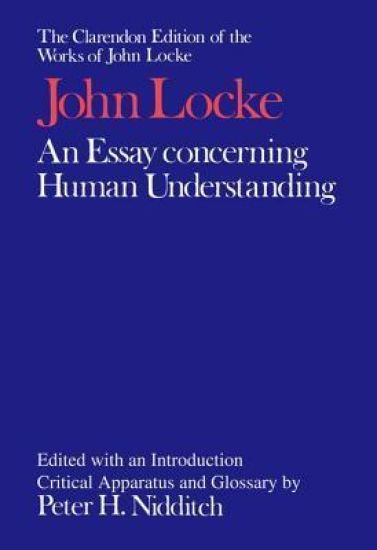
John Locke: Drafts for the Essay Concerning Human Understanding and Other Philosophical Writings
This is the first of three volumes which will contain all of Locke's extant philosophical writings relating to An Essay Concerning Human Understanding, not included in other Clarendon editions like the Correspondence. It contains the earliest known drafts of the Essay, Drafts A and B, both written in 1671, and provides for the first time an accurate version of Locke's text. Virtually all his changes are recorded in footnotes on each page. Peter Nidditch, whose highly acclaimed edition of An Essay Concerning Human Understanding was published in this series in 1975, used pioneering editorial techniques in his compilation of Volume 1. Most of the work was completed before his tragically early death in 1983. Volumes 2 and 3, almost wholly the work of G. A. J. Rogers will contain the third extant draft of the Essay (Draft C), the Epitome and the Conduct of the Understanding. They will also include a History of the Writing of the Essay, together with other shorter writings by Locke.
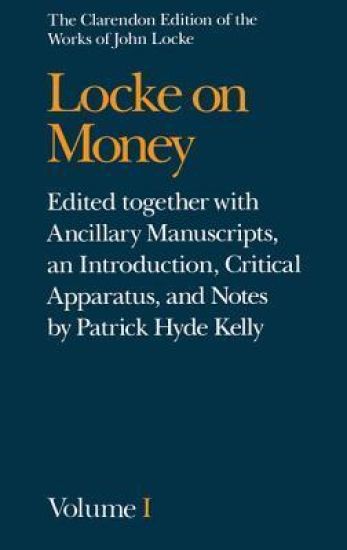
John Locke: Locke on Money

John Locke: Locke on Money

John Locke

Clarendon Press
1991
sidottu
Locke on Money presents for the first time the entire body of the philosopher's writings on this important subject (other than Two Treatises of Government). Accurate texts, together with an apparatus listing variant readings and significant manuscript changes, record the evolution of Locke's ideas from the original 1668-74 paper on interest to the three pamphlets on interest and coinage published in the 1690s. The introduction by Patrick Hyde Kelly establishes the wider context of Locke's writings in terms of contemporary debates on these subjects, the economic conditions of the time, and the circumstances of writing and publication. It shows, notably, that Locke's supposed responsibility for the 1696 recoinage is a myth. The account of what Locke derived from Mercantilist writings and of how he reformulated these in accordance with his philosophy illuminates his contribution to the evolution of economics, and will aid reappraisal of Two Treatises. The picture that emerges confirms Locke's status as major economic thinker, contrary to the prevalent view of recent decades. There are two volumes in the present edition. The first contains the introductory matter, and the texts of the Early Writings on Interest, 1688-74, and Some Considerations. The second comprises Short Observations, Further Considerations, and the Appendices, Bibliography, and Index.
John Locke: Correspondence

John Locke: Correspondence

John Locke

Clarendon Press
1978
sidottu
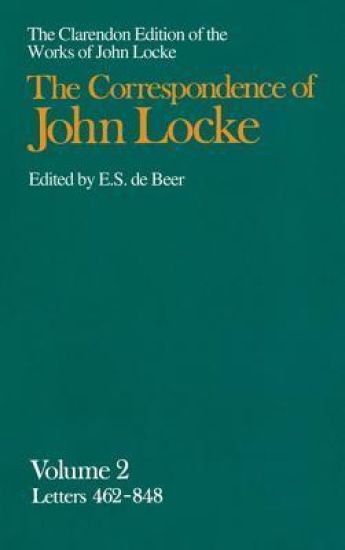
A scholarly edition of The Clarendon Edition of the Works of John Locke: Correspondence: Letters 849-1241 by E. S. de Beer. The edition presents an authoritative text, together with an introduction, commentary notes, and scholarly apparatus.
John Locke: Correspondence

John Locke: Correspondence

John Locke

Clarendon Press
1979
sidottu
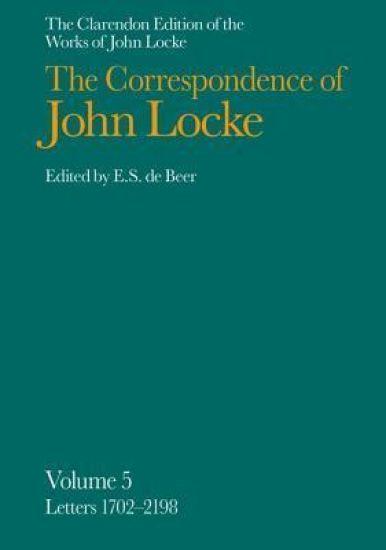
A scholarly edition of The Clarendon Edition of the Works of John Locke: Correspondence: Letters 1702-2198 by E. S. de Beer. The edition presents an authoritative text, together with an introduction, commentary notes, and scholarly apparatus.
John Locke: Correspondence

John Locke: Correspondence

John Locke

Clarendon Press
1980
sidottu
A scholarly edition of The Clarendon Edition of the Works of John Locke: Correspondence: Letters 2199-2664 by E. S. de Beer. The edition presents an authoritative text, together with an introduction, commentary notes, and scholarly apparatus.
John Locke: Correspondence

John Locke: Correspondence

John Locke

Clarendon Press
1981
sidottu
A scholarly edition of The Clarendon Edition of the Works of John Locke: Correspondence: Letters 2665-3286 by E. S. de Beer. The edition presents an authoritative text, together with an introduction, commentary notes, and scholarly apparatus.
The Clarendon Edition of the Works of John Locke: Some Thoughts Concerning Education
One of the major works of John Locke (1632-1704), this detailed and comprehensive guide is mainly concerned with moral education. While concentrating on its role in creating a responsible adult and on the importance of virtue as a transmitter of culture, it also ranges over such practical topics as the effectiveness of physical punishment, how best to teach foreign languages, table manners, and varieties of crying. This critical edition is based on the third (1695) edition, and includes variants from the first five editions, from the Harvard University Library and the British Library drafts, and from Locke's correspondence to Edward Clarke and his wife.
John Locke: A Paraphrase and Notes on the Epistles of St. Paul
Locke's posthumously published work on Galatians, 1 and 2 Corinthians, Romans, and Ephesians provides important evidence of his thought during the final years of his life, and gives insights into his theology which are not available in his other writings. This critical edition of the work is based as far as possible on Locke's manuscript, and includes an editorial introduction, and textual, manuscript, and explanatory notes, as well as transcriptions of hitherto unpublished papers by Locke.
John Locke: A Paraphrase and Notes on the Epistles of St. Paul
Locke's posthumously published work on Galatians, 1 and 2 Corinthians, Romans and Ephesians, provides important evidence of his thought during the final years of his life, ad gives insights into his theology which are not available in his other writings. This critical edition of the work is based as far as possible on Locke's manuscript, and includes an editorial introduction, textual, manuscript, and explanatory notes, as well as transcriptions of hitherto unpublished papers by Locke.
John Locke: Locke on Money

John Locke: Locke on Money

John Locke

Clarendon Press
1991
sidottu
Locke on Money presents for the first time the entire body of the philosopher's writings on this important subject (other than `Two Treatises of Government'). Accurate texts, together with an apparatus listing variant readings and significant manuscript changes, record the evolution of Locke's ideas from his original 1668-74 paper on interest to the three pamphlets on interest and coinage published in the 1960s. The introduction Patrick Hyde Kelly establishes the wider context of Locke's writings in terms of contemporary debates on these subjects, the economic conditions of the time, and the circumstances of writing and publication. It shows, notably, that Locke's supposed responsibility for the 1696 is a myth. The account of what Locke derived from Mercantilist writings and of how he reformulated these in accordance with his philosophy illuminates his contribution to the evolution of economics, and will aid reappraisal of `Two Treaties'. The picture that emerges confirms Locke's status as a major economic thinker, contrary to the prevalent view of recent decades. There are two volumes in the present edition. The first contains the introductory matter, and the texts of `The Early Writings on Interest, 1688-74' and `Some Considerations'. The second comprises `Short Observations', `Further Considerations', and the Appendices, Bibliography, and Index.
John Locke and the Problem of Depravity

John Locke and the Problem of Depravity

W. M. Spellman

Clarendon Press
1988
sidottu
The religious thought of the philosopher John Locke (1632-1704) is examined in this book, which focuses in particular on his view of original sin and its consequences for education in the early Enlightenment. The author argues that Locke has been wrongly accused of denying original sin, ignoring the atonement, and preaching moralism, and that in fact he was much closer to traditional Protestant teaching on human sinfulness than is generally recognized. While education might serve as an effective counterweight to man's innate propensity to overturn God's laws, he recognised that it could never reduce the importance of the central drama: Christ's work of salvation.
John Locke: Some Thoughts Concerning Education
Some Thoughts concerning Education, originally published in 1693, is one of John Locke's major works, the culmination of a decade's writings on the subject. It mainly concerns moral education and its role in creating a responsible adult, and the importance of virtue as a transmitter of culture. But Locke ranges also over such practical topics as the effectiveness of physical punishment, table manners, eating habits, varieties of crying, treatment of servants, and cruelty to animals. He discusses subject-learning, the teaching of foreign languages, and the order of studying different disciplines. Published when Locke was already famous for his doctrines about knowledge, the person, and civil society, this was the most comprehensive and detailed work of its time on education.
Studying John

Studying John

John Ashton

Clarendon Press
1994
sidottu
Is historical criticism of the New Testament dead? In this telling collection of eight new studies on John's Gospel, John Ashton argues that this is very far from the case. Challenging the assumptions of methodologies which ignore the historical context in which the Gospel was composed, the author offers a spirited defence of historical criticism and provides practical demonstration of the many new insights which it has still to yield. The first two chapters treat in greater depth two key themes (the Prologue of John and the Jews) which appeared in the author's Understanding the Fourth Gospel (Clarendon Paperbacks, 1993). A third chapter is intended to supplement and correct this larger work. The rest of the book explores further facets of the Gospel, and at the same time exposes some of the serious theoretical weaknesses in much recent writing on the Gospel.
John Henry Newman: Fifteen Sermons Preached Before the University of Oxford
Newman himself called the Oxford University Sermons, first published in 1843, `the best, not the most perfect, book I have done'. He added, `I mean there is more to develop in it'. Indeed, the book is a precursor of all his major later works, including especially the Essay on the Development of Christian Doctrine and the Grammar of Assent. Dealing with the relationship of faith and reason, the fifteen sermons represent Newman's resolution of the conflict between heart and head that so troubled believers, non-believers, and agnostics of the nineteenth century, Their controversial nature also makes them one of the primary documents of the Oxford Movement. This new edition provides an introduction to the sermons, a definitive text with textual variants, extensive annotation, and appendices containing previously unpublished material.
John of Scythopolis and the Dionysian Corpus

John of Scythopolis and the Dionysian Corpus

Paul Rorem; John C. Lamoreaux

Clarendon Press
1998
sidottu
John, the sixth-century orthodox bishop of Scythopolis in Palestine, was the first of many authors to comment upon the highly influentional Pseudo-Dionysian writings (such as The Mystical Theology). Here translated and interpreted, John's Prologue and Scholia (marginalia) have only recently been separable from later comments. They present his complex theological and philosophical observations on the Dionysian texts. The book begins with the general outlines of the appearance and reception of the Dionysian corpus in the sixth century, followed by an overview of the career and works of John of Scythopolis. Written around AD 540, John's own comments in the Prologue provide the outline for introducing the concerns dominating his Scholia: biblical, classical, and patristic sources; liturgical terminology and context; orthodox and heretical doctrines of the Trinity, Christology, creation, and eschatology; Dionysian authenticity; Neoplatonism and John's unacknowledged quotations from Plotinus. Most of the Scholia and all of the Prologue are translated and annotated in order to present the first of many layers of Dionysian interpretation.