Kirjojen hintavertailu. Mukana 12 431 443 kirjaa ja 12 kauppaa.

Kirjahaku

Etsi kirjoja tekijän nimen, kirjan nimen tai ISBN:n perusteella.

1000 tulosta hakusanalla Ludwig Duncker

Ludwig Börne

Ludwig Börne

Heinrich Heine

Createspace Independent Publishing Platform
2016
nidottu
Ludwig B rne by Heinrich Heine. This book is a reproduction of the original book published in 1862 and may have some imperfections such as marks or hand-written notes.
Ludwig Wittgensein

Ludwig Wittgensein

Kt Fann

Partridge Publishing Singapore
2020
pokkari
I put together this anthology in 1967 while I was writing my doctoral dissertation "Wittgenstein's Conception of Philosophy". It was first published by Dell Publishing Co. in 1969.. It contains all the important memoirs, reminiscences and comments by people who knew him, including his friends and students such as Bertrand Russel, G. E. Moore, John Wisdom, Rudolf Carnap, George H. Von Wright, Rush Rhee, Norman Malcolm, M. O'c. Drury, Gilbert Ryle, O. K. Bouwsma, Alice Ambrose, Paul Feyerabend, Morris Lazerowitz, etc. it also contains his contemporaries' reactions to his philosophy. It's a useful resource book even today. Since it has long been out of print, we are making it electronically available here.
Ludwig Thoma: Rascal Stories: Bilingual German-English Translator Edition

Ludwig Thoma: Rascal Stories: Bilingual German-English Translator Edition

Philipp Strazny

Createspace Independent Publishing Platform
2017
nidottu
In the Rascal Stories, Ludwig Thoma recounts his school time and his numerous run-ins with authority figures. Many German children and adults alike have enjoyed the unflattering descriptions of rich and important neighbors, arrogant teachers, self-righteous clerics, and annoying relatives. The situational comedy will have you chuckle and some off-hand remarks will leave it up to you to imagine outrageous scenes. You can read this book to catch a glimpse of 1900 Bavarian society, or to simply enjoy the ride.In this translator's edition, the original German is presented side by side with the English translation. Students of German will find it a useful tool for language learning and students of German literature and society will find explanations to text passages that otherwise might remain relatively inaccessible.
Ludwig Börne

Ludwig Börne

Heinrich Heine

Camden House Inc
2006
sidottu
First English translation of Heine's controversial though masterful polemic, with introduction and commentary. In 1840, Heinrich Heine, the major German poet of Jewish origin of the age, published a book on Ludwig Börne, the major German political writer of Jewish origin of the period, who had died three years before. Regarded by Heine andothers as his best-written book, it was also his most disastrously conceived. Intended to recover the high ground of revolutionary principle and philosophy against the attacks mounted on him by Börne and his supporters, the bookwas instead met by a storm of outrage from which it seemed Heine's reputation might never recover. In the course of time, the evaluation was reversed; Heine was increasingly celebrated as a true herald of revolution. His vocabulary of Hellenism and Nazarenism, employed for the first time in Börne, was transmitted into English usage by Matthew Arnold. But Börne itself is Heine's only major work that has never been fully translated into English. The commentary to the edition clarifies the conflict between the two most prominent German-Jewish public intellectuals of their time, corrects the misapprehensions constantly in circulation about their relationship and the book,and reveals the many peculiarities of the text. Jeffrey L. Sammons is Leavenworth Professor of German Emeritus at Yale University and the author of four books on Heine.
Ludwig Van Beethoven - Symphonies Nos. 1 to 9 in Full Score

Ludwig Van Beethoven - Symphonies Nos. 1 to 9 in Full Score

Ludwig Van Beethoven

WWW.Bnpublishing.com
2009
sidottu
Ludwig Van Beethoven - Symphonies Nos. 1 to 9 in Full ScoreCompleted in 1824, three years before the composer's death, Beethoven's Ninth Symphony occupies a special place at the summit of Classical literature - the peak of Beethoven's orchestral output and, for generations of composers, the supreme model of extended symphonic form. The finale is in itself unique in the orchestral repertory of its time, bringing the power of poetry and song to the symphonic fabric: Beethoven's dramatic choral setting of Schiller's Ode and die Freude - his "Ode to Joy."The work is reproduced here from the authoritative Litolff edition and appears in full score with bar-numbered movements for easy reference. Ideal for study in the classroom, at home, or in the concert hall, this affordable, high-quality, conveniently sized volume will be the edition of choice for music students and music lovers alike.
Ludwig Leichhardt's Ghosts

Ludwig Leichhardt's Ghosts

Andrew Wright Hurley

Camden House Inc
2018
sidottu
A fascinating cultural studies account of the "afterlife" of Leichhardt, revealing both German entanglement in British colonialism in Australia, and in a broader sense, what happens when we maintain an open stance to the ghosts ofthe past. After the renowned Prussian scientist and explorer Ludwig Leichhardt left the Australian frontier in 1848 on an expedition to cross the continent, he disappeared without a trace. Andrew Hurley's book complicates that view by undertaking an afterlife biography of "the Humboldt of Australia." Although Leichhardt's remains were never located, he has been sought and textually "found" many times over, particularly in Australia and Germany. He remains a significant presence, a highly productive ghost who continues to "haunt" culture. Leichhardt has been employed for all sorts of political purposes. In imperial Germany, he was a symbol of pure science, but also a bolster for colonialism. In the 20th century, he became a Nazi icon, a proto-socialist, the model for the protagonist of Nobel laureate Patrick White's famous novel Voss, as well as a harbinger of multiculturalism. He has also been put to useby Australian Indigenous cultures. Engaging Leichhardt's ghosts and those who have sought him yields a fascinating case study of German entanglement in British colonialism in Australia. It also shows how figures from the colonialpast feature in German and Australian social memory and serve present-day purposes. In an abstract sense, this book uses Leichhardt to explore what happens when we maintain an open stance to the ghosts of the past. Andrew Wright Hurley is Associate Professor in German Studies at the University of Technology Sydney. His book Into the Groove: Popular Music and Contemporary German Fiction was published by Camden House in 2015.
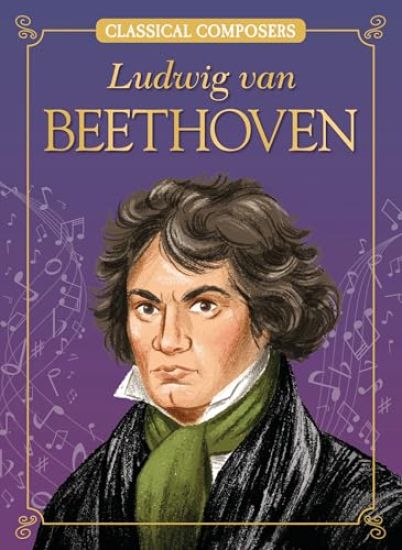
Ludwig Van Beethoven

Ludwig Van Beethoven

Joanne Mattern

Red Chair Press Books for Young Readers
2025
nidottu
Ludwig van Beethoven (1770-1827), a German composer and pianist, bridged the Classical and Romantic eras. Known for his emotionally charged and groundbreaking compositions, including the Ninth Symphony and "Moonlight Sonata," Beethoven overcame deafness to create some of the most influential and best-loved works in the history of Western classical music. Colorful illustrations plus photographs of meaningful sites and settings connect readers to important points in Beethoven's history. A timeline and B Sharp sidebars add details to the composer's life story.
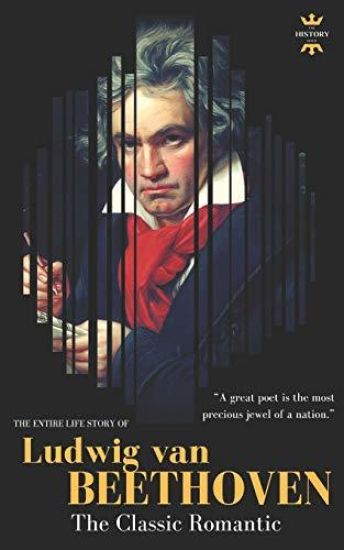
Ludwig Van Beethoven: The Entire Life Story of A Genius Composer
Ludwig van Beethoven is a crucial figure in the transition between the Classical and Romantic eras in Classical music. Beethoven displayed his musical talents at an early age and was taught by his father Johann van Beethoven and by composer and conductor Christian Gottlob Neefe.Inside you'll read aboutBackground and early lifeEstablishing his career in ViennaMusical maturityLoss of hearingPatronageMiddle periodPersonal and family difficultiesLate worksIllness and deathAnd much more At the age of 21 he moved to Vienna, where he began studying composition with Joseph Haydn and gained a reputation as a virtuoso pianist. He lived in Vienna until his death. By his late 20s his hearing began to deteriorate, and by the last decade of his life he was almost completely deaf. In 1811 he gave up conducting and performing in public but continued to compose; many of his most admired works come from these last 15 years of his life.
Ludwig van Beethoven

Ludwig van Beethoven

Hourly History

Createspace Independent Publishing Platform
2018
pokkari
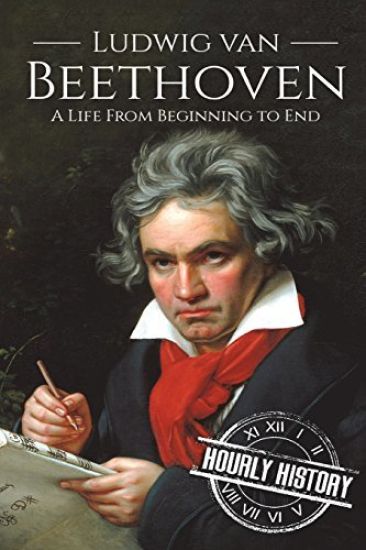
Ludwig van BeethovenWhat kind of a man could create the dreaming melodies of the Moonlight Sonata? Give birth to the dramatic voice of the Fifth Symphony? Compose the Ode to Joy? Meet Ludwig van Beethoven, the musical genius, the passionate artist, the incorrigible man, the composer from whose soul music breathed. Inside you will read about...✓ Groomed for Greatness✓ Beethoven's Deafness and Depression✓ F r Elise- Guardianship of His Nephew Karl✓ Karl's Suicide Attempt✓ Beethoven's Final NotesAnd much more This will not be an idealistic story of perfection. Just like his music, Beethoven's story will have its fearful lows and its exulting crescendos. It will have its repeated themes. It will have its sudden surprises. And it will speak to the heart.
Ludwig van Beethoven: ou le Petit Maître de chapelle

Ludwig van Beethoven: ou le Petit Maître de chapelle

Eugénie Foa

Createspace Independent Publishing Platform
2018
nidottu
- Mon Dieu que c'est d sagr able d' tre laid ... disait un petit gar on de cinq ans mont debout sur une chaise devant une chemin e, ce qui mettait son visage la hauteur de la glace du trumeau qui d corait cette chemin e; et, arm d'une brosse, et puisant dans un pot de pommade qu'il avait sa port e d' normes portions de son contenu qu'il posait sur ses cheveux noirs et cr pus, il essayait avec sa brosse de donner sa chevelure h riss e une position couch e. Mon Dieu que c'est d sagr able d' tre laid, surtout quand on est le fils a n de M. Beethoven, premier t nor de la chapelle lectorale de Cologne, qu'il me faudra un jour chanter dans la chapelle, et que j'entendrai toutes les femmes crier: Mon Dieu qu'il est laid... L ... j'ai beau mettre de la pommade, en mettre tant et plus... jamais ces cheveux ne seront lisses comme les cheveux de Charles ou de Jean... jamais Mon Dieu que mes fr res sont heureux d' tre blonds... et jolis... Maudite m che de cheveux cr pus... Voyez comme elle se rel ve... ent t e de m che, va ... Je suis en col re... oh que je suis en col re... comme la bonne quand la soupe se renverse... comme M. Stumer, mon ma tre d' criture... quand je ne peux pas faire ce qu'il veut... Et cette veste, comme elle me rend gros, bouffi... et mon pantalon, comme il est laid... et mes souliers ... que je suis mal chauss ... Et cette petite L onore, qui est si moqueuse ... aussit t qu'elle me verra... elle se moquera de moi... Voil le gros poupart... ou le vilain grognon... ou le petit ours mal l ch ...
Ludwig Van Beethoven - Sheet Music

Ludwig Van Beethoven - Sheet Music

Ludwig Van Beethoven

Master Music
2023
pokkari
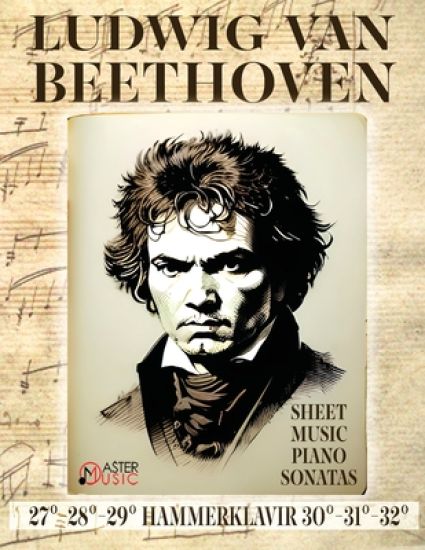
Sheet Music by Composer Ludwig Van Beethoven.Beethoven remains one of the most admired composers in the history of Western music; his works rank amongst the most performed of the classical music repertoire and span the transition from the Classical period to the Romantic era in classical music.Ludwig van Beethoven wrote 32 mature piano sonatas between 1795 and 1822. (He also wrote 3 juvenile sonatas at the age of 13 and one unfinished sonata, WoO. 51.)Although originally not intended to be a meaningful whole, as a set they comprise one of the most important collections of works in the history of music.Hans von B low called them "The New Testament" of piano literature (Johann Sebastian Bach's The Well-Tempered Clavier being "The Old Testament").Beethoven's piano sonatas came to be seen as the first cycle of major piano pieces suited to both private and public performance.They form "a bridge between the worlds of the salon and the concert hall".The first person to play them all in a single concert cycle was Hans von B low; the first complete recording is Artur Schnabel's for the label His Master's Voice.In this Volume: Piano Sonata No.27 in E minor, op.90Piano Sonata No.28 in A major, op.101Piano Sonata No.29 in B flat major, op.106 "Hammerklavier"Piano Sonata No.30 in E major, op.109Piano Sonata No.31 in A flat major, op.110Piano Sonata No.32 in C minor, op.111Size 8,5 x 11 inchPages 144Special Launch Price
Ludwig Van Beethoven - Sheet Music

Ludwig Van Beethoven - Sheet Music

Ludwig Van Beethoven

Master Music
2023
pokkari
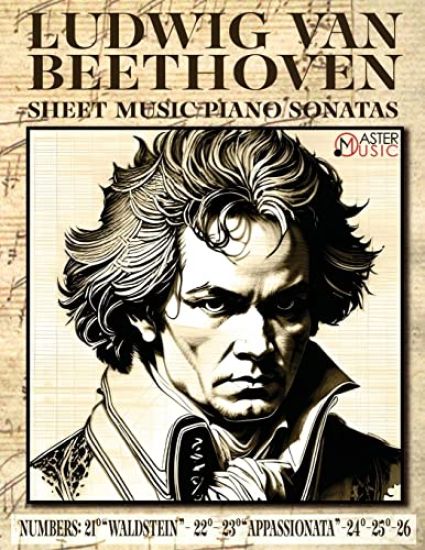
Sheet Music by Composer Ludwig Van Beethoven.Beethoven remains one of the most admired composers in the history of Western music; his works rank amongst the most performed of the classical music repertoire and span the transition from the Classical period to the Romantic era in classical music.Ludwig van Beethoven wrote 32 mature piano sonatas between 1795 and 1822. (He also wrote 3 juvenile sonatas at the age of 13 and one unfinished sonata, WoO. 51.)Although originally not intended to be a meaningful whole, as a set they comprise one of the most important collections of works in the history of music.Hans von B low called them "The New Testament" of piano literature (Johann Sebastian Bach's The Well-Tempered Clavier being "The Old Testament").Beethoven's piano sonatas came to be seen as the first cycle of major piano pieces suited to both private and public performance.They form "a bridge between the worlds of the salon and the concert hall".The first person to play them all in a single concert cycle was Hans von B low; the first complete recording is Artur Schnabel's for the label His Master's Voice.In this Volume: Piano Sonata No.21 in C major, op.53 "Waldstein" Piano Sonata No.22 in F major, op.54 Piano Sonata No.23 in F minor, op.57 "Appassionata"Piano Sonata No.24 in F# major, op.78 Piano Sonata No.25 in G major, op.79 Piano Sonata No.26 in E flat major, op.81 Size 8,5 x 11 inchPages 130
Ludwig Van Beethoven - Sheet Music

Ludwig Van Beethoven - Sheet Music

Ludwig Van Beethoven

Master Music
2023
pokkari
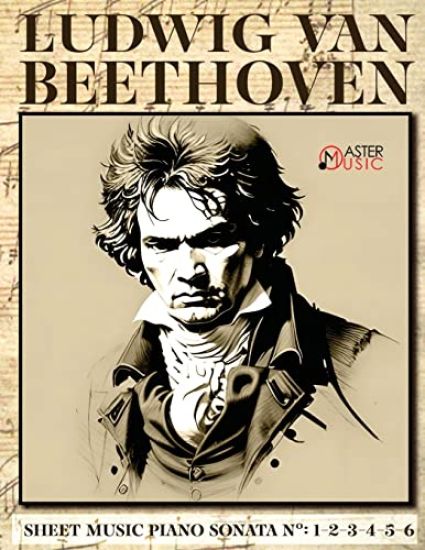
Sheet Music by Composer Ludwig Van Beethoven.Beethoven remains one of the most admired composers in the history of Western music; his works rank amongst the most performed of the classical music repertoire and span the transition from the Classical period to the Romantic era in classical music.Ludwig van Beethoven wrote 32 mature piano sonatas between 1795 and 1822. (He also wrote 3 juvenile sonatas at the age of 13 and one unfinished sonata, WoO. 51.)Although originally not intended to be a meaningful whole, as a set they comprise one of the most important collections of works in the history of music.Hans von B low called them "The New Testament" of piano literature (Johann Sebastian Bach's The Well-Tempered Clavier being "The Old Testament").Beethoven's piano sonatas came to be seen as the first cycle of major piano pieces suited to both private and public performance.They form "a bridge between the worlds of the salon and the concert hall".The first person to play them all in a single concert cycle was Hans von B low; the first complete recording is Artur Schnabel's for the label His Master's Voice.In this Volume: Piano Sonata No.1 in F minor, op.2, no.1Piano Sonata No.2 in A major, op.2, no.2 Piano Sonata No.3 in C major op.2, no.3 Piano Sonata No.4 in E flat major, op.7 Piano Sonata No.5 in C minor, op.10, no.1 Piano Sonata No.6 in A major, op.10, no.2 Size 8,5 x 11 inchPages 114
Ludwig Van Beethoven - Sheet Music

Ludwig Van Beethoven - Sheet Music

Ludwig Van Beethoven

Master Music
2023
pokkari
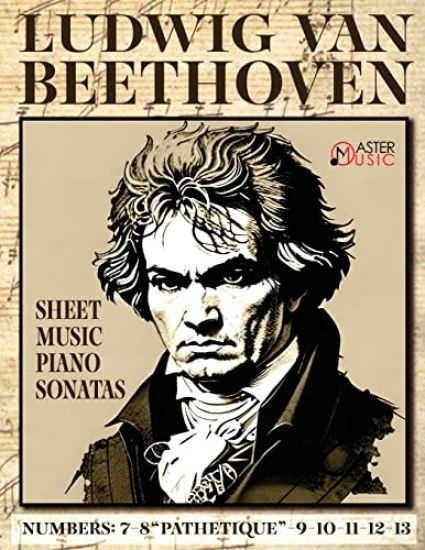
Sheet Music by Composer Ludwig Van Beethoven.Beethoven remains one of the most admired composers in the history of Western music; his works rank amongst the most performed of the classical music repertoire and span the transition from the Classical period to the Romantic era in classical music.Ludwig van Beethoven wrote 32 mature piano sonatas between 1795 and 1822. (He also wrote 3 juvenile sonatas at the age of 13 and one unfinished sonata, WoO. 51.)Although originally not intended to be a meaningful whole, as a set they comprise one of the most important collections of works in the history of music.Hans von B low called them "The New Testament" of piano literature (Johann Sebastian Bach's The Well-Tempered Clavier being "The Old Testament").Beethoven's piano sonatas came to be seen as the first cycle of major piano pieces suited to both private and public performance.They form "a bridge between the worlds of the salon and the concert hall".The first person to play them all in a single concert cycle was Hans von B low; the first complete recording is Artur Schnabel's for the label His Master's Voice.In this Volume: Piano Sonata No.14 in C# minor, op.27, nr.2 "Moonlight"Piano Sonata No.15 in D major, op.28 "Pastoral"Piano Sonata No.16 in G major, op.31, no.1Piano Sonata No.17 in D minor, op.31, no.2Piano Sonata No.18 in E flat major, op.31, no.3Piano Sonata No.19 in G minor, op.49, no.1Piano Sonata No.20 in G major, op.49, no.2 Size 8,5 x 11 inchPages 124Special Launch Price
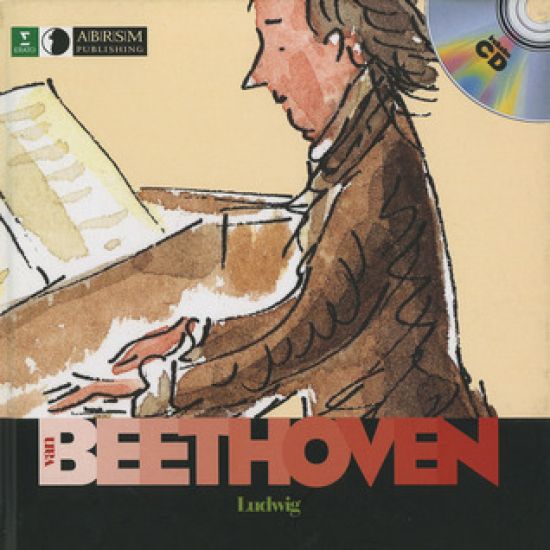
Ludwig van Beethoven

Ludwig van Beethoven

Yann Walcker

Moonlight Publishing Ltd
2001
muu
An illustrated biography about Beethoven’s childhood and how he came to become a great composer. The accompanying CD contains recordings of some of his most famous works as well as the narration of the story. Beethoven did badly at school because all he could think about was music, and Mozart was one of his early admirers. Children will learn that they can make up a tune to their favourite poem and sing it, and that with only seven notes they can play countless tunes.
Ludwig Wittgenstein

Ludwig Wittgenstein

Edward Kanterian

Reaktion Books
2007
nidottu
Ludwig Wittgenstein, writes noted scholar Edward Kanterian, was a ‘philosopher’s philosopher’. He was one of the founders of modern analytic philosophy and is regarded as the greatest philosophical genius since Immanuel Kant. In this book, Kanterian traces the complex relationship between the philosopher’s life, his work and his time. The author describes Wittgenstein’s eventful life, his numerous trips, and his friendships with some of the greatest thinkers of the twentieth century, including Bertrand Russell, John Maynard Keynes, George Edward Moore and Gilbert Royle. Kanterian also presents a careful account of Wittgenstein’s notoriously abstract philosophical works, from his early masterpiece Tractatus Logico-Philosophicus (1921) to the Philosophical Investigations, published posthumously in 1953.The author makes Wittgenstein’s work comprehensible to lay readers, as well as offering original interpretations that further illuminate the writings. Emerging from the highly sophisticated Viennese upper class at the turn of the last century, Wittgenstein had intellectual and artistic aspirations going far beyond theoretical philosophy. In particular he took great interest in art and music, and during his entire lifetime was deeply tormented by ethical and religious questions. There is something about Wittgenstein’s life and persona, the author believes, that captivates our collective imagination and seems to offer answers to the ethical problems of our own time. Kanterian sees Wittgenstein’s life as the focal point of important conflicts and tensions of an entire age.A readable, concise account that uses many telling quotations from the philosopher’s own writings, as well as numerous illustrations, this book will appeal to scholars and students of Wittgenstein, and the broad audience for introductions to philosophy.
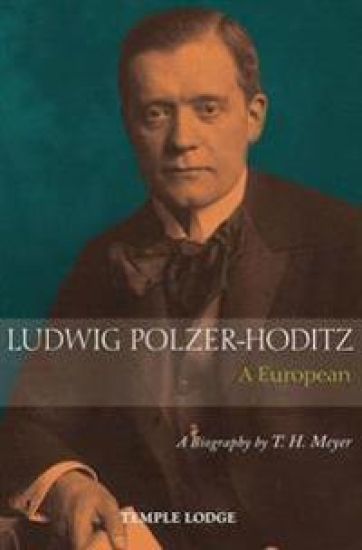
Ludwig Polzer-Hoditz, a European

Ludwig Polzer-Hoditz, a European

T. H. Meyer

Temple Lodge Publishing
2014
nidottu
Finally available in English, Thomas Meyer's major biography of Ludwig Polzer-Hoditz (1869-1945) offers a panoramic view of an exceptional life. One of Rudolf Steiner's most valued and independent-minded colleagues, Polzer-Hoditz was born in Prague - in the midst of the Austro-Hungarian Empire - to an aristocratic family with royal connections. Leaving behind the traditions of his background, he was to become a key actor in Steiner's regenerative 'threefold' social impulses, working tirelessly for a genuinely unified and free Europe. Polzer-Hoditz also fought to protect Rudolf Steiner's esoteric legacy and the integrity of the Anthroposophical Society that had been founded to further his work. Following Steiner's untimely death, Polzer-Hoditz fostered a broad range of friendships and alliances with key figures such as D.N. Dunlop, Walter Johannes Stein and Ita Wegman. In a bid to avoid further division and conflict, he made significant interventions to alter the tragic course of events that consumed the Anthroposophical Society, although he was unable to stop the major split within the membership that was to follow. In the final decade of his life he concentrated his energies on world issues, seeking to influence events in Europe in particular, lecturing widely and writing a number of books and memoranda. In contrast to the destructive 'special interests' of the national and religious groups that craved dominion and power, Polzer-Hoditz sought to build a true understanding between Central and Eastern Europe and to cultivate a spiritual connection with the West. Meyer's book is a pioneering work in biographical literature, structured in four main sections that reflect the stages of an individual's personal development. In the concluding section he studies world events up to the present day, practising a method referred to as a 'symptomatological observation of history', which Polzer-Hoditz himself sought to develop. Much more than a standard biography, Ludwig Polzer-Hoditz presents a vibrantly living picture of how a spiritual individuality can work in human culture and history - in past, present and future. This first English edition is based on the latest German version and features additional material.