Kirjojen hintavertailu. Mukana 12 390 323 kirjaa ja 12 kauppaa.

Kirjahaku

Etsi kirjoja tekijän nimen, kirjan nimen tai ISBN:n perusteella.

1000 tulosta hakusanalla Luke Shephard

Luke's Light: The Goddess-Queen in the Bible

Luke's Light: The Goddess-Queen in the Bible

Paula Gott

Booksurge Publishing
2007
nidottu
There are two words that are repeated over and over throughout Luke's Light: masculine and feminine. They are repeated because they kept showing up in Luke's two texts. I set out with just one goal: find and decipher the coded messages. But Luke put a lot of effort into revealing Jesus' message of gender equity. And even more surprising was finding the same message of gender balance in the Old Testament texts that Luke used to send his message to Theophilus. Luke's Light illuminates the darkest corners of the Church's darkest secret, closely held and fiercely protected for nearly two thousand years. Tens of millions of people who suspected or discovered the secret were labeled heretics, tortured into recanting, and then murdered. Only in the past two hundred years could this secret be revealed with any hope of physical survival, thanks to the edicts that came out of Rome centuries ago that were designed to protect and preserve the deception. This is a story of new discoveries about Jesus, his life, his work, and his family. The hidden stories confirm many ancient Christian traditions, while it dispels others. The big question is 'Why coded messages' Why wouldn't Luke just write openly and clearly so that anyone could read the information he wanted to impart? Perhaps that question is best answered by trying to put ourselves in Luke's place in the religious politics of his time. Consider what you might do if your church should be invaded by a larger and more powerful religion, a group that is destroying all evidence of your chosen religious doctrine. Consider what you might do to preserve the information about you, your family, and your religion. Assume that you are aware of other cultures from history that had experienced a similar fate. And assume that you believe that records of that culture would remain but records of your religion would all be destroyed. Assume that you are permitted to write about what is happening, but only if your story supports the new religion's version and doctrine. What might you do to tell the real story of what happened to you? I believe you might write a story that appears to support the invaders' story. But you might name people who lived in that 'other culture' whose records you thought would survive. You might tell similar stories, hoping that someone would recognize the similarities and understand that you could not write about what was really happening but had to refer to that other culture's history in order to preserve your own. Luke did exactly what any of us would do under similar circumstances. He found a way to leave a coded message that could be found at some future time as long as historians and religious leaders preserved the documents he used to relay the story. He had before him Paul's letters to the Churches; Mark's gospel; Q gospel; Matthew's gospel; the Greek Septuagint; Plutarch's Moralia and Parallel Lives; classics by Homer, Euripides, Aratus, Epimenides, and others. Perhaps the most important document on that table was Philo's guidelines for Allegory. Every chapter in Luke's Gospel contains Pythagorean Sacred Numbers. Why would Luke go to such lengths to leave Sacred Numbers in his gospel? The answer is quite simple: Regardless of the language spoken, everyone who reads his gospels has the same understanding of numbers and the various functions applied to numbers. Numbers are the One Universal Language. A Pythagorean Master Teacher inserted the numbers into Luke's Gospel to attract attention and to send a numeric message-using the One Universal Language-that there is a coded, written message. That's the real story. And that's where Philo's Rules for Allegory are needed. Perhaps the most important of Philo's guidelines is to watch for something unusual in the text. The first obviously 'unusual' occurrence in Luke's gospel is the appearance of the Angel, Gabriel: Luke 1:19: 'The angel replied, 'I am Gabriel. I stand in the presence of God, and I have been
Luke Carter And The Sword Of Kings: Return Of The Darkside

Luke Carter And The Sword Of Kings: Return Of The Darkside

Aj Ensor

Createspace Independent Publishing Platform
2009
nidottu
--- Amazing... "...Twelve-year-old Luke is a reluctant hero, an American-style Harry Potter with a "slacker" attitude and guts... " ...Jim Barns: Editor, Independent Publisher's Magazine --- The Magical World of Boys and Girls is Alive in America in this Epic Coming of Age Family Action Adventure. Twelve-year-old Luke is a reluctant hero who is forced to deal with circumstances beyond his control in a world he knows nothing about and in a place the modern world had long forgotten. Luke's family and friend's are threatened. Luke does not believe it because he has no interest in leaving his Florida home. Then one event in his own backyard changes his world forever. Join Writer A.J. Ensor on a world wind voyage as Luke Carter comes of age and learns that friends can come in many forms, a family is defined by love and while it might take a village to raise a boy sometimes our villages need strong if not uncommon leaders.
Letters From The Ocean Floor: A collection of the Christian poetry and writings of Luke Borgnis, 1998-2008
Letters From the Ocean Floor is a collection of the Christian poetry, letters and writings of Luke Borgnis spanning over the first decade of his formative years as a writer. The topics range from the sacred to the secular, the ideal to the vulgar. It is a journey of confession and grace, mirroring the lives of many Generation Xers as they struggle to find their faith in the postmodern landscape. Letters From the Ocean Floor takes mostly from the world of live poetry readings, but include other minor works of a theological or philosophical nature. Letters From the Ocean Floor is perfect for someone looking to jumpstart their creativity about their faith or to delve deeper into topics that are many times stymied in clich s.
Luke and Vergil

Luke and Vergil

Dennis R. MacDonald

Rowman Littlefield
2014
sidottu
These two volumes of The New Testament and Greek Literature are the magnum opus of biblical scholar Dennis R. MacDonald, outlining the profound connections between the New Testament and classical Greek poetry. MacDonald argues that the Gospel writers borrowed from established literary sources to create stories about Jesus that readers of the day would find convincing. In Luke and Vergil MacDonald proposes that the author of Luke-Acts followed Mark’s lead in imitating Homer’s Iliad and Odyssey, but greatly expanded his project, especially in the Acts, but adding imitations not only of the epics but also of Euripides’ Bacchae and Plato’s Socratic dialogues. The potential imitations include spectacular miracles, official resistance, epiphanies, prison breaks, and more. The book applies mimesis criticism and uses side-by-side comparisons to show how early Christian authors portrayed the origins of Christianity as more compelling than the Augustan Golden Age.
Luke Smith - (4338.209.3 - 4338.214.3)
Luke's saga as a Guardian intensifies, weaving a tapestry of loyalty, innovation, and peril. Tasked with safeguarding a battling community, his resolve is tested by a series of clandestine operations and daring escapes, pushing him to the limits of courage and ingenuity. As the boundaries between worlds blur, Luke's commitment draws him deeper into moral dilemmas, culminating in a confrontation that threatens to expose his efforts.
Luke Smith (4338.204.1 - 4338.209.2)
Luke Smith's world transforms with the discovery of a cryptic device, thrusting him into the guardianship of destiny itself. His charismatic charm and unpredictable decisions now carry weight beyond imagination, balancing on the razor's edge between salvation and destruction. Embracing his role as a Guardian, Luke faces the paradox of power: the very force that defends also threatens to annihilate. As shadows gather and the fabric of reality strains, Luke must navigate the consequences of his actions, unaware that a looming challenge will test the very core of his resolve.
Luke Learner Guide: Books of Faith

Luke Learner Guide: Books of Faith

David L. Tiede

Augsburg Fortress Publishing
2011
nidottu
The Gospel of Luke invites us to explore the story of Jesus and his mission as God's Chosen One (Messiah). From the joyous accounts of Jesus' birth in a manger in Bethlehem to the stark images of Golgotha to the eye-opening meal at Emmaus, we are invited into a remarkable story. This course invites participants into rich discovery as they explore key stories and events of this Gospel. This 8-session course explores selected passages from the Gospel of Luke. Why Was Jesus Born? (Luke 2:1-20) What Will Become of This Child? (Luke 2:21-40) Let God Be God (Luke 4:14-30) What Was Jesus Doing? (Luke 7:1-7) Why Must Jesus Die? (Luke 9:18-36) And Grace Will Lead Me Home (Luke 15:1-32) Ah, Holy Jesus, How Hast Thou Offended? (Luke 23:26-49) How Did Jesus' Resurrection Change the World? (Luke 24:13-35)
Luke Leader Guide: Books of Faith

Luke Leader Guide: Books of Faith

David L. Tiede

Augsburg Fortress Publishing
2011
nidottu
The Gospel of Luke invites us to explore the story of Jesus and his mission as God's Chosen One (Messiah). From the joyous accounts of Jesus' birth in a manger in Bethlehem to the stark images of Golgotha to the eye-opening meal at Emmaus, we are invited into a remarkable story. This course invites participants into rich discovery as they explore key stories and events of this Gospel. This 8-session course explores selected passages from the Gospel of Luke. Why Was Jesus Born? (Luke 2:1-20) What Will Become of This Child? (Luke 2:21-40) Let God Be God (Luke 4:14-30) What Was Jesus Doing? (Luke 7:1-7) Why Must Jesus Die? (Luke 9:18-36) And Grace Will Lead Me Home (Luke 15:1-32) Ah, Holy Jesus, How Hast Thou Offended? (Luke 23:26-49) How Did Jesus' Resurrection Change the World? (Luke 24:13-35)
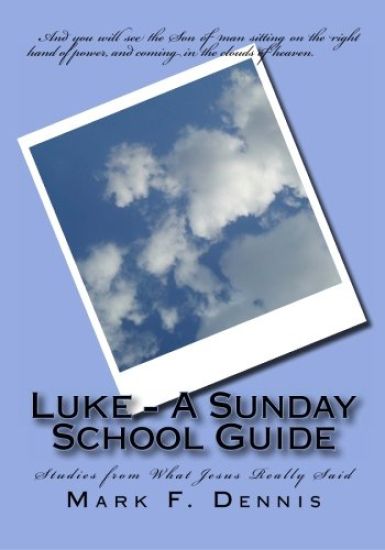
Luke - A Sunday School Guide: Studies from What Jesus Really Said

Luke - A Sunday School Guide: Studies from What Jesus Really Said

Mark F. Dennis

Createspace Independent Publishing Platform
2011
nidottu
Setting a goal to read and study the whole Bible, let alone the New Testament by its self, may seem daunting and an impossible challenge. Starting with the Gospels is one of the best ways to begin a study of the Bible and starting with the words of Jesus makes the challenge an even more exciting. After all, because of the fact that He is the Son of God, wouldn't studying his words, be the best way to start? For centuries, the Gospel of Jesus Christ has been preached throughout the world. His teachings have been taught in nearly every language, dialect and nation, astonishing the wise and humbling the proud. Christ's teachings focused on love: "Love one another as I have loved you" and "Do unto others as you would have them do to you". When Jesus was asked which of the Ten Commandments the greatest commandment is, He replies, "You will love the Lord your God with all your heart, and with all your soul, and with your entire mind; this is the first and great commandment. And the second is like it, you will love your neighbor as yourself. On these two commandments hang all the law and the prophets". While reading His words, let us focus on what He says. Do we truly live as He taught? Do we follow in His footsteps? The word "Christian" means "Follower of Christ". Let's learn what He taught us and then follow what He said. The world is watching us; it was once said by Mahatma Gandhi that if India would ever truly become a Christian nation, it would be because of the Christ of the Christians and not because of the Christians of the Christ. Christians today have not left the greatest impression on the world. Let's be true followers of Christ and live by His words. Only then will the world know what a Christian truly is. As the song says, "They will know we are Christians by our love." Read carefully His words and then study the context in which He was speaking. Review the questions carefully and answer them as honestly as you can. Enjoy your study of Christ's words.