

Kirjahaku
Etsi kirjoja tekijän nimen, kirjan nimen tai ISBN:n perusteella.
1000 tulosta hakusanalla Mathilde Estvan



My Inner GPS - A Road Map to Manifesting a Meaningful Life
Mathilde Benmoha Carro
Mathilde Benmoha Carro
2018
pokkari
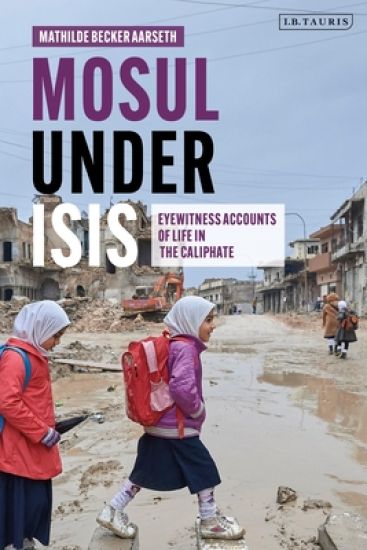
The Islamic State of Iraq and Syria (ISIS) ruled Mosul from 2014-2017 in accordance with its extremist interpretation of sharia. But beyond what is known about ISIS governance in the city from the group’s own materials, very little is understood about the reality of its rule, or reasons for its failure, from those who actually lived under it.This book reveals what was going on inside ISIS institutions based on accounts from the civilians themselves. Focusing on ISIS governance of education, healthcare and policing, the interviewees include: teachers who were forced to teach the group's new curriculum; professors who organized secret classes in private; doctors who took direct orders from ISIS leaders and worked in their headquarters; bureaucratic staff who worked for ISIS. These accounts provide unique insight into the lived realities in the controlled territories and reveal how the terrorist group balanced their commitment to Islamist ideology with the practical challenges of state building. Moving beyond the simplistic dichotomy of civilians as either passive victims or ISIS supporters, Mathilde Becker Aarseth highlights here those people who actively resisted or affected the way in which ISIS ruled. The book invites readers to understand civilians’ complex relationship to the extremist group in the context of fragmented state power and a city torn apart by the occupation.

The Islamic State of Iraq and Syria (ISIS) ruled Mosul from 2014-2017 in accordance with its extremist interpretation of sharia. But beyond what is known about ISIS governance in the city from the group’s own materials, very little is understood about the reality of its rule, or reasons for its failure, from those who actually lived under it.This book reveals what was going on inside ISIS institutions based on accounts from the civilians themselves. Focusing on ISIS governance of education, healthcare and policing, the interviewees include: teachers who were forced to teach the group's new curriculum; professors who organized secret classes in private; doctors who took direct orders from ISIS leaders and worked in their headquarters; bureaucratic staff who worked for ISIS. These accounts provide unique insight into the lived realities in the controlled territories and reveal how the terrorist group balanced their commitment to Islamist ideology with the practical challenges of state building. Moving beyond the simplistic dichotomy of civilians as either passive victims or ISIS supporters, Mathilde Becker Aarseth highlights here those people who actively resisted or affected the way in which ISIS ruled. The book invites readers to understand civilians’ complex relationship to the extremist group in the context of fragmented state power and a city torn apart by the occupation.

Caning techniques with polymer clay allow you to create your own intricately detailed, sophisticated and chic jewelry. This clear and concise guide, by professional jewelry designer Mathilde Brun, shows you step-by-step how to make clay "canes," layers of clay strategically pressed together, to adapt into multiple jewelry pieces. Polymer clay is ideal for DIY jewelry: flexible and pliable, it permanently hardens quickly under low heat without shrinking. By making "canes" of clay, delicate patterns, like lace, are made possible with uniform results, an unattainable feat with mere brush or pencil. With simple and easy to follow directions, learn how to turn your canes into necklaces, pendants, earrings, pins, rings, and brooches. Supported by over 400 step-by-step illustrations, material lists, and instructional guidance on the cane-making, conditioning, shaping, color mixing, pattern imprinting, curing, sanding, and buffing of polymer clay, this book provides everything you need to realize your own unique jewelry and design potential.

Rosa Luxemburg holds an enduring fascination as a radical socialist committed to democratic values, and a woman whose charismatic personality and impassioned speeches inspired her followers without resort to bureaucratic organization. Her assistant and friend, Mathilde Jacob, was Luxemburg's mainstay during her years of imprisonment in World War I. Jacob provided material and emotional support, organized Rosa Luxemburg's clandestine communication with the outside world, and herself played a key role in the illegal work of the Spartacus group. When revolution broke out in Germany in 1918, she sought unsuccessfully to pretect Rosa in the tragic events that led to her death. Mathilde Jacob's memoir, written as a testimony of "love for a person and for a cause", and sent abroad for safe-keeping when she fell victim to the Nazis, was unknown to Rosa Luxembourg's early biographers. It paints a vivd portrait of the subject, and of the group of friends that made up the Spartacus leadership - Karl Liebknecht, Leo Kpgiches, Clara Zetkin and Paul Levi.

Torkel Aschehoug and Norwegian Historical Economic Thought
Mathilde C. Fasting
Anthem Press
2013
sidottu
The historical schools of economics have been neglected within the arena of economic theory since the Second World War in favour of the now-dominant classical and neoclassical schools of economic thought. As alternative frameworks re-emerge, this book offers a revaluation of the legal theorist, economist and politician Torkel Aschehoug (1822–1909) and his historical-empirical approach to economics, a highly influential current in Norway during the last decades of the nineteenth century.


What does it mean to oppose or support an authoritarian regime from afar? During the years of Ben Ali's dictatorship in Tunisia between 1987 and 2011, diaspora activism played a key role in the developments of post-independence Tunisian politics. Centring this study on long-distance activism in France, where the majority of leftist and Islamist exile groups took refuge, Mathilde Zederman explores how this activism helps to shed new light on Tunisia's political history. Tunisian Politics in France closely explores the interactions and conflicts between different constellations of pro-regime and oppositional actors in France, examining the dynamics of what the author persuasively describes as a 'trans-state space of mobilisation'. In doing so, Zederman draws attention to the constraints and possibilities of long-distance activism. Utilising material gathered from extensive fieldwork in France and Tunisia, this study considers how the evolution of diaspora activism both challenges and reinforces the boundaries of Tunisian politics.

Around the World at Play, a Picture Book of a German Play Fair;
Mathilde Ritter
Hassell Street Press
2021
nidottu
This work has been selected by scholars as being culturally important and is part of the knowledge base of civilization as we know it.This work is in the public domain in the United States of America, and possibly other nations. Within the United States, you may freely copy and distribute this work, as no entity (individual or corporate) has a copyright on the body of the work.Scholars believe, and we concur, that this work is important enough to be preserved, reproduced, and made generally available to the public. To ensure a quality reading experience, this work has been proofread and republished using a format that seamlessly blends the original graphical elements with text in an easy-to-read typeface.We appreciate your support of the preservation process, and thank you for being an important part of keeping this knowledge alive and relevant.



![Exercises [sic] Ã?lÃ(c)mentaires Et GraduÃ(c)s Pour Le DÃ(c)veloppement De La Voix. Op. 1](/covers/9781024467871.jpg)
Exercises [sic] Ã?lÃ(c)mentaires Et GraduÃ(c)s Pour Le DÃ(c)veloppement De La Voix. Op. 1
Mathilde Marchesi
Hutson Street Press
2025
sidottu
![Exercises [sic] Ã?lÃ(c)mentaires Et GraduÃ(c)s Pour Le DÃ(c)veloppement De La Voix. Op. 1](/covers/9781024472202.jpg)
Exercises [sic] Ã?lÃ(c)mentaires Et GraduÃ(c)s Pour Le DÃ(c)veloppement De La Voix. Op. 1
Mathilde Marchesi
Hutson Street Press
2025
pokkari



This book is the first encompassing history of diasporas in Europe between 1500 and 1800. Huguenots, Sephardim, British Catholics, Mennonites, Moriscos, Moravian Brethren, Quakers, Ashkenazim… what do these populations who roamed Europe in the sixteenth to eighteenth centuries have in common? Despite an extensive historiography of diasporas, publications have tended to focus on the history of a single diaspora. Each of these groups was part of a community whose connections crossed political and cultural as well as religious borders. Each built dynamic networks through which information, people, and goods circulated. United by a memory of persecution, by an attachment to a homeland—be it real or dreamed—and by economic ties, those groups were nevertheless very diverse. As minorities, they maintained complex relationships with authorities, local inhabitants, and other diasporic populations. This book investigates the tensions they experienced. Between unity and heterogeneity, between mobility and locality, between marginalisation and assimilation, it attempts to reconcile global- and micro-historical approaches.The authors provide a comparative view as well as elaborate case studies for scholars, students, and the public who are interested in learning about how the social sciences and history contribute to our understanding of integration, migrations, and religious coexistence.