Kirjojen hintavertailu. Mukana 11 699 587 kirjaa ja 12 kauppaa.

Kirjahaku

Etsi kirjoja tekijän nimen, kirjan nimen tai ISBN:n perusteella.

1000 tulosta hakusanalla Norbert Groddeck

Mémoìres historiques, apologétiques, &c. Présentès en 1751. au Souverain Pontife Benoit XIV. Sur les missions de la Societé de Jésus aux Indes & à la Chine, ... Par le R.P. Norbert, ... Tome III.
The 18th century was a wealth of knowledge, exploration and rapidly growing technology and expanding record-keeping made possible by advances in the printing press. In its determination to preserve the century of revolution, Gale initiated a revolution of its own: digitization of epic proportions to preserve these invaluable works in the largest archive of its kind. Now for the first time these high-quality digital copies of original 18th century manuscripts are available in print, making them highly accessible to libraries, undergraduate students, and independent scholars.The Age of Enlightenment profoundly enriched religious and philosophical understanding and continues to influence present-day thinking. Works collected here include masterpieces by David Hume, Immanuel Kant, and Jean-Jacques Rousseau, as well as religious sermons and moral debates on the issues of the day, such as the slave trade. The Age of Reason saw conflict between Protestantism and Catholicism transformed into one between faith and logic -- a debate that continues in the twenty-first century.++++The below data was compiled from various identification fields in the bibliographic record of this title. This data is provided as an additional tool in helping to insure edition identification: ++++British LibraryT135376A continuation of the memoirs contained in the third edition published at Besan on in 1747. Booksellers' names from the 'projet de souscription'; the projected fourth volume was apparently never published.Londres: chez les libraires fran ois i.e. Paul Vaillant, Fran ois Changuion, and Guillaume Meyer], 1751. IV leaves, v-xxiv,687, 1]p.; 4
Dreams Come True: The True Story of a Dream, Two Lads and the Atlantic Ocean
Often I speak about how said it is, as the majority of people sorry themselves out of life and walk their paths of life tip-toeing all the way to their graves. Reading the story of this fantastic journey I could not help remembering the lines of Helen Keller, the writer, who lives a complete life while she is blind and deaf: "Life is either a great adventure or nothing."Norbert and Levente, by kayaking over the Atlantic Ocean, provide a living example to that, to which I congratulate coming from all my heart, as they struggled to conquer nature's forces and their own boundaries day after day. They are living proof that if someone devotes himself for real, the circumstances will abide. Naturally, at first this is no more than a grand thought, which is only made believable to us by experiencing it all in our own lives.Most never get to the point where this experience could take, where it could be proven to be true. To start on the path of reaching for our own dreams the best to do is to follow the adventures of other dreamers before us.Sitting next to Norbi to accompany him on an adventure of this magnificent scale is a sensational chance for all of us to take. I do encourage you my dear friend to imagine, and buckle your belt in this kayak and enjoy every last magical moment of this journey.With friendship, P
Ingenio

Ingenio

Norbert

Hachette Livre - BNF
2013
pokkari
Ingenio...Date de l'edition originale: 1865Ce livre est la reproduction fidele d'une oeuvre publiee avant 1920 et fait partie d'une collection de livres reimprimes a la demande editee par Hachette Livre, dans le cadre d'un partenariat avec la Bibliotheque nationale de France, offrant l'opportunite d'acceder a des ouvrages anciens et souvent rares issus des fonds patrimoniaux de la BnF.Les oeuvres faisant partie de cette collection ont ete numerisees par la BnF et sont presentes sur Gallica, sa bibliotheque numerique.En entreprenant de redonner vie a ces ouvrages au travers d'une collection de livres reimprimes a la demande, nous leur donnons la possibilite de rencontrer un public elargi et participons a la transmission de connaissances et de savoirs parfois difficilement accessibles.Nous avons cherche a concilier la reproduction fidele d'un livre ancien a partir de sa version numerisee avec le souci d'un confort de lecture optimal. Nous esperons que les ouvrages de cette nouvelle collection vous apporteront entiere satisfaction.Pour plus d'informations, rendez-vous sur www.hachettebnf.fr
Face to Face with Polar Bears

Face to Face with Polar Bears

Norbert Rosing; Elizabeth Carney

Collins
2019
nidottu
National Geographic Face to Face Readers is a high-interest series of books for confident, independent readers that have been adapted to a Key Stage 2 audience by education experts. The books pair magnificent National Geographic photographs with lively first-person text and fascinating facts about the natural world. Wrap up warm and travel to the wintery world of the Arctic with experienced nature photographers to learn all about the world’s biggest land-based carnivore, the polar bear. Written in an engaging and fun to read format, the captivating photos and fascinating facts are perfect for encouraging the future explorers and researchers of tomorrow! Level 5 readers are ideal for kids who are confident in reading independently and ready for the challenge of varied sentence lengths, some technical vocabulary and increasing inference.
The Human Use of Human Beings

The Human Use of Human Beings

Norbert Wiener

HARPERCOLLINS PUBLISHERS INC
2025
nidottu
For the 75th anniversary, a new edition of The Human Use of Human Beings—the landmark book that delves into the relationship between humans and computers, and presciently anticipates many contemporary dilemmas surrounding AI technology. With a new introduction by Brian Christian, author of the bestselling Algorithms to Live By and The Alignment Problem.In 1950, mathematician-philosopher Norbert Wiener ended this classic book on the place of machines in society with a warning: “We shall never receive the right answers to our questions unless we ask the right questions.... The hour is very late, and the choice of good and evil knocks at our door.”Wiener, the founder of the science of cybernetics—the study of the relationship between computers and the human nervous system—was widely mislabeled as an advocate for the automation of human life. As The Human Use for Human Beings reveals, his vision was much more complex and interesting, and is more relevant in today’s world of AI than anyone could have anticipated.In his new introduction, Brian Christian aptly calls Wiener the “progenitor of contemporary AI-safety discourse.” Wiener hoped that machines would release people from relentless and repetitive drudgery to achieve more creative pursuits, yet he anticipated the danger of dehumanizing and displacement. His pioneering views on the human-machine relationship as a “communicative process” are only more crucial now, as we carry in our pockets AI devices that we can literally speak to. His prescient warnings illuminate our contemporary relationships with language, art, and even social media.The Human Use of Human Beings examines the implications of cybernetics for education, law, language, science, technology, as Wiener anticipates the enormous impact—in effect, a third industrial revolution—that the computer has had on our lives.
Increasing Intelligence

Increasing Intelligence

Norbert Jaušovec; Anja Pahor

Academic Press Inc
2017
nidottu
The finding that working memory training can increase fluid intelligence triggered a great number of cognitive training studies, the results of which have been fiercely debated among experts. The finding also prompted a surge of commercial versions of these working memory training programs. Increasing Intelligence overviews contemporary approaches and techniques designed to increase general cognitive ability in healthy individuals. The book covers behavioral training and different electrical stimulation methods such as TMS, tDCS, tACS, and tRNS, along with alternative approaches ranging from neurofeedback to cognitive-enhancing drugs. It describes crucial brain features that underlie intelligent behavior and discusses theoretical and technical shortcomings of the reported studies, then goes on to suggest avenues for future research and inquiry.
Arithmetical Similarities

Arithmetical Similarities

Norbert Klingen

Clarendon Press
1998
sidottu
This book deals with the characterization of extensions of number fields in terms of the decomposition of prime ideals, and with the group-theoretic questions arising from this number-theoretic problem. One special aspect of this question is the equality of Dedekind zeta functions of different number fields. This is an established problem which was solved for abelian extensions by class field theory, but which was only studied in detail in its general form from around 1970. The basis for the new results was a fruitful exchange between number theory and group theory. Some of the outstanidng results are based on the complete classification of all finite simple groups. This book reports on the great progress achieved in this period. It allows access to the new developments in this part of algebraic number theory and contains a unique blend of number theory and group theory. The results appear for the first time in a monograph and they partially extend the published literature.
Numerical Methods and Scientific Computing

Numerical Methods and Scientific Computing

Norbert Köckler

Clarendon Press
1994
sidottu
The book covers the whole range of numerical mathematics from linear equations to ordinary differential equations with short sections on the calculus of errors and on partial differential equations. It attempts to give a unified approach of theory, algorithms, applications and use of software. Therefore it contains only a few proofs but many examples and applications. This book is appearing simultaneously with the problem-solving environment PAN. The PAN system contains an enlarged hypertext version of the text, together with all the programs described in the text, help systems, and utility tools. PAN is licensed public domain software. This parallel appearance of paper and electronic versions including additional useful software is unique. There are four appendices, which describe PAN, the programs written for PAN that are used in the text for examples and applications, and the NAG Fortran and NAG Graphics Libraries used by the programs.
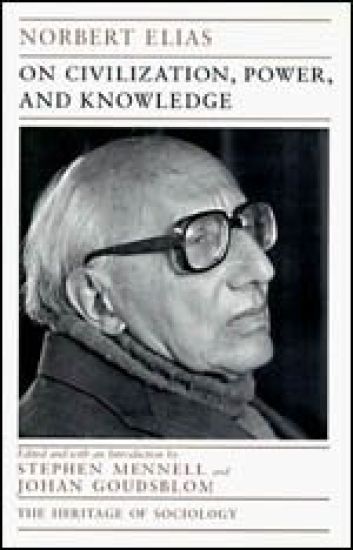
On Civilization, Power, and Knowledge

On Civilization, Power, and Knowledge

Norbert Elias

University of Chicago Press
1998
sidottu
Nobert Elias (1897-1990) is described as one of the great sociologists of the 20th century. Born in Germany, Elias earned a doctorate in philosophy and then turned to sociology, working with Max Weber's younger brother, Alfred Weber, and with Karl Mannheim. He later fled the Nazi regime in 1935 and spent most of his life in Britain. He is best known for his book, "The Civilizing Process," wherein he traces the subtle changes in manners among the European upper classes since the Middle Ages, and shows how those seemingly innocuous changes in etiquette reflected profound transformations of power relations in society. He later applied these insights to a wide range of subjects, from art and culture to the control of violence, the sociology of sports, the development of knowledge and the sciences, and the methodology of sociology. This volume is a collection of Elias's most important writings, and includes many of his ideas. The development of Elias's thinking during the course of his long career is traced, along with a discussion of how his work relates to other major sociologists and how the various selections are interconnected.
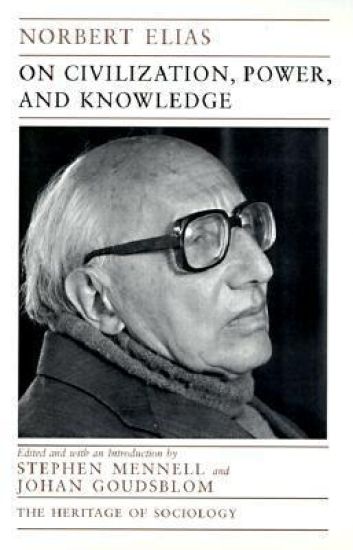
On Civilization, Power, and Knowledge

On Civilization, Power, and Knowledge

Norbert Elias

University of Chicago Press
1998
nidottu
Nobert Elias (1897-1990) is described as one of the great sociologists of the 20th century. Born in Germany, Elias earned a doctorate in philosophy and then turned to sociology, working with Max Weber's younger brother, Alfred Weber, and with Karl Mannheim. He later fled the Nazi regime in 1935 and spent most of his life in Britain. He is best known for his book, "The Civilizing Process," wherein he traces the subtle changes in manners among the European upper classes since the Middle Ages, and shows how those seemingly innocuous changes in etiquette reflected profound transformations of power relations in society. He later applied these insights to a wide range of subjects, from art and culture to the control of violence, the sociology of sports, the development of knowledge and the sciences, and the methodology of sociology. This volume is a collection of Elias's most important writings, and includes many of his ideas. The development of Elias's thinking during the course of his long career is traced, along with a discussion of how his work relates to other major sociologists and how the various selections are interconnected.
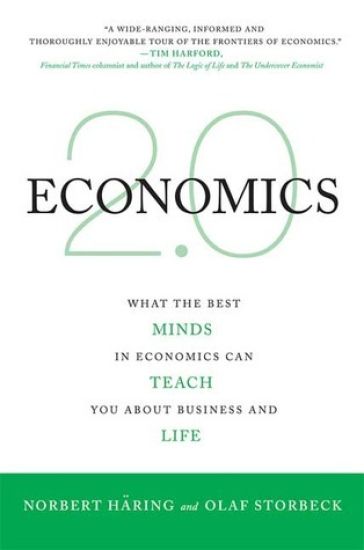
Economics 2.0

Economics 2.0

Norbert Haring; Olaf Storbeck

Palgrave Macmillan
2009
sidottu
Economics shapes our life, from global policy to how much you pay for a new pair of shoes from China to whether you will survive your bypass surgery. For example, did you know how fitness studios earn most of their money? - From the laziness and irrationality of their customers. Why are women more successful investors? - Because they are more humble and less interested in finance. Featuring recent work from top thinkers in the economic field from around the world, such as Philippe Aghion, Paul Krugman, George Akerlof, Gary Becker, and George Loewenstein, the book includes chapters on the rationality versus the irrationality of financial markets, the subprime crisis, globalization, and the methods marketers are using to sell us products we don't need. Economics 2.0 makes an impressive case for the argument that economics is not a dry science and that economic principles are constantly exerting their influence. Completely without formulas and theoretical ballast, Norbert Haring and Olaf Storbeck present the current findings of prominent economists, helping to expand both our knowledge and our appreciation of the economics that impact and shape our life.
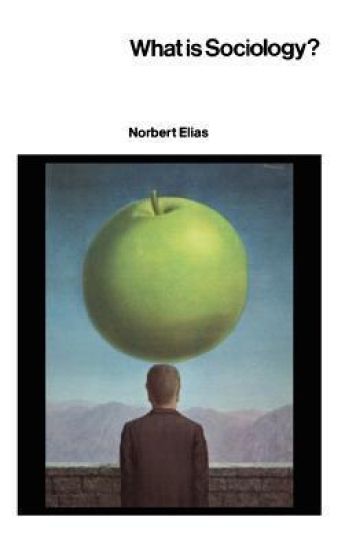
What Is Sociology?

What Is Sociology?

Norbert Elias

Columbia University Press
1984
pokkari
What is Sociology? presents in concise and provocative form the major ideas of a seminal thinker whose work-spanning more than four decades-is only now gaining the recognition here it has long had in Germany and France. Unlike other post-war sociologists, Norbert Elias has always held the concept of historical development among his central concerns; his dynamic theories of the evolution of modern man have remedied the historical and epistemological shortcomings of structualism and ethno-methodology. What is Sociology? refines the arguments that were first found in Elias' massive work on the civilizing process, in which he formulated his major assertions about the interdependence of the making of modern man and modern society. It is Elias' contention that changes in personality structure-embodied in phenomena ranging from table manners and hygiene habits to rites of punishment and courtly love-inevitably reflect and mould patterns of control generated by new political and social instututions. Elias' rejection of a dichotomy between individual and society, and his use of psychoanalysis, political theory, and social history, help restore a fullness of resource to sociology.
Adenauer's Germany and the Nazi Past

Adenauer's Germany and the Nazi Past

Norbert Frei; Fritz Stern

Columbia University Press
2002
sidottu
Of all the aspects of recovery in postwar Germany perhaps none was as critical or as complicated as the matter of dealing with Nazi criminals, and, more broadly, with the Nazi past. While on the international stage German officials spoke with contrition of their nation's burden of guilt, at home questions of responsibility and retribution were not so clear. In this masterful examination of Germany under Adenauer, Norbert Frei shows that, beginning in 1949, the West German government dramatically reversed the denazification policies of the immediate postwar period and initiated a new "Vergangenheitspolitik," or "policy for the past," which has had enormous consequences reaching into the present. Adenauer's Germany and the Nazi Past chronicles how amnesty laws for Nazi officials were passed unanimously and civil servants who had been dismissed in 1945 were reinstated liberally-and how a massive popular outcry led to the release of war criminals who had been condemned by the Allies. These measures and movements represented more than just the rehabilitation of particular individuals. Frei argues that the amnesty process delegitimized the previous political expurgation administered by the Allies and, on a deeper level, served to satisfy the collective psychic needs of a society longing for a clean break with the unparalleled political and moral catastrophe it had undergone in the 1940s. Thus the era of Adenauer devolved into a scandal-ridden period of reintegration at any cost. Frei's work brilliantly and chillingly explores how the collective will of the German people, expressed through mass allegiance to new consensus-oriented democratic parties, cast off responsibility for the horrors of the war and Holocaust, effectively silencing engagement with the enormities of the Nazi past.
Bloodroot

Bloodroot

Norbert Krapf

Indiana University Press
2008
pokkari
Bloodroot showcases poetry from the collected works of Jasper, Indiana, native Norbert Krapf. Spanning 35 years, these poems focus on Krapf's experiences living in southern Indiana and the intersection of his life with his German ancestry. Forty of the poems are published here for the first time. Photographs by David Pierini, inspired by Krapf's work with many taken in and around Dubois County, grace this evocative portrait of a poet and place.
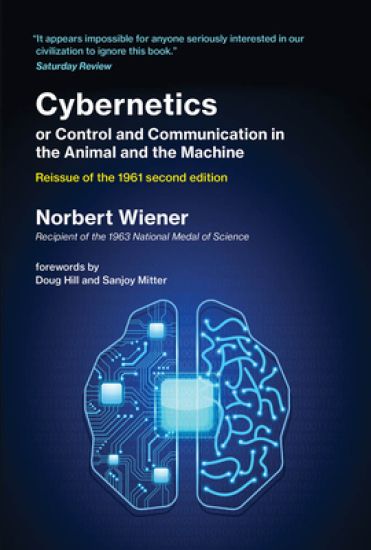
Cybernetics or Control and Communication in the Animal and the Machine

Cybernetics or Control and Communication in the Animal and the Machine

Norbert Wiener; Doug Hill; Sanjoy Mitter

MIT Press
2019
pokkari
A classic and influential work that laid the theoretical foundations for information theory and a timely text for contemporary informations theorists and practitioners.With the influential book Cybernetics, first published in 1948, Norbert Wiener laid the theoretical foundations for the multidisciplinary field of cybernetics, the study of controlling the flow of information in systems with feedback loops, be they biological, mechanical, cognitive, or social. At the core of Wiener's theory is the message (information), sent and responded to (feedback); the functionality of a machine, organism, or society depends on the quality of messages. Information corrupted by noise prevents homeostasis, or equilibrium. And yet Cybernetics is as philosophical as it is technical, with the first chapter devoted to Newtonian and Bergsonian time and the philosophical mixed with the technical throughout. This book brings the 1961 second edition back into print, with new forewords by Doug Hill and Sanjoy Mitter. Contemporary readers of Cybernetics will marvel at Wiener's prescience-his warnings against "noise," his disdain for "hucksters" and "gadget worshipers," and his view of the mass media as the single greatest anti-homeostatic force in society. This edition of Cybernetics gives a new generation access to a classic text.
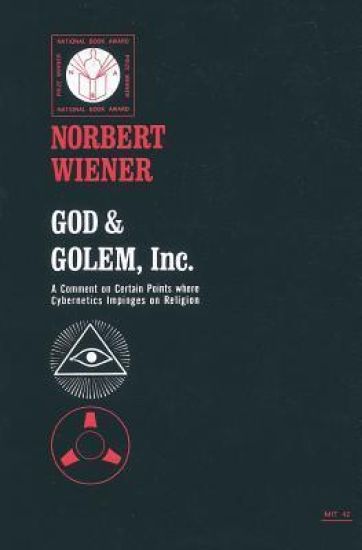
God & Golem, Inc.

God & Golem, Inc.

Norbert Wiener

MIT Press
1966
pokkari
The new and rapidly growing field of communication sciences owes as much to Norbert Wiener as to any one man. He coined the word for it-cybernetics. In God & Golem, Inc., the author concerned himself with major points in cybernetics which are relevant to religious issues.The first point he considers is that of the machine which learns. While learning is a property almost exclusively ascribed to the self-conscious living system, a computer now exists which not only can be programmed to play a game of checkers, but one which can "learn" from its past experience and improve on its own game. For a time, the machine was able to beat its inventor at checkers. "It did win," writes the author, "and it did learn to win; and the method of its learning was no different in principle from that of the human being who learns to play checkers.A second point concerns machines which have the capacity to reproduce themselves. It is our commonly held belief that God made man in his own image. The propagation of the race may also be interpreted as a function in which one living being makes another in its own image. But the author demonstrates that man has made machines which are "very well able to make other machines in their own image," and these machine images are not merely pictorial representations but operative images. Can we then say: God is to Golem as man is to Machines? in Jewish legend, golem is an embryo Adam, shapeless and not fully created, hence a monster, an automation.The third point considered is that of the relation between man and machine. The concern here is ethical. "render unto man the things which are man's and unto the computer the things which are the computer's," warns the author. In this section of the book, Dr. Wiener considers systems involving elements of man and machine. The book is written for the intellectually alert public and does not involve any highly technical knowledge. It is based on lectures given at Yale, at the Societe Philosophique de Royaumont, and elsewhere.
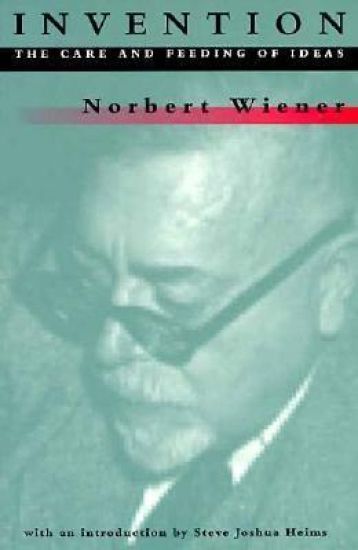
Invention

Invention

Norbert Wiener; Steve Joshua Heims

MIT Press
1994
pokkari
Internationally honored for brilliant achievements throughout his career, author of Cybernetics, ExProdigy, and the essay God and Golem, Inc., which won the National Book Award in 1964, Norbert Wiener was no ordinary mathematician. With the ability to understand how things worked or might work at a very deep level, he linked his own mathematics to engineering and provided basic ideas for the design of all sorts of inventions, from radar to communications networks to computers to artificial limbs. Wiener had an abiding concern about the ethics guiding applications of theories he and other scientists developed. Years after he died, the manuscript for this book was discovered among his papers. The world of science has changed greatly since Wiener's day, and much of the change has been in the direction he warned against. Now published for the first time, this book can be read as a salutary corrective from the past and a chance to rethink the components of an environment that encourages inventiveness.Wiener provides an engagingly written insider's understanding of the history of discovery and invention, emphasizing the historical circumstances that foster innovations and allow their application. His message is that truly original ideas cannot be produced on an assembly line, and that their consequences are often felt only at distant times and places. The intellectual and technological environment has to be right before the idea can blossom. The best course for society is to encourage the best minds to pursue the most interesting topics, and to reward them for the insights they produce. Wiener's comments on the problem of secrecy and the importance of the "free-lance" scientist are particularly pertinent today.Steve Heims provides a brief history of Wiener's literary output and reviews his contributions to the field of invention and discovery. In addition, Heims suggests significant ways in which Wiener's ideas still apply to dilemmas facing the scientific and engineering communities of the 1990s.