

Kirjahaku
Etsi kirjoja tekijän nimen, kirjan nimen tai ISBN:n perusteella.
1000 tulosta hakusanalla Paul Mathieu



This collection contains the complete poetic works of Paul Laurence Dunbar, who was among the first African Americans to gain wide renown for literature in the United States. A poet of unquestionable skill and ability, Paul Laurence Dunbar was the son of two former slaves. His father, who managed to escape slavery, was an early enlistee who fight for the Union army in the American Civil War - a fact which profoundly influenced his son's outlook upon the U.S. military and life as a citizen of the USA. The poetry of Dunbar shows his flair for observation and superb knack for smooth-flowing yet profound words. Noticing immediately how he could swiftly create and sell poems to popular magazines, the young Dunbar turned down offers for educational support and instead devoted his time and effort to writing. Uniquely, Dunbar would write poets in regional dialects, incorporating slang of both white and black Americans.
This collection contains the complete poetic works of Paul Laurence Dunbar, who was among the first African Americans to gain wide renown for literature in the United States. A poet of unquestionable skill and ability, Paul Laurence Dunbar was the son of two former slaves. His father, who managed to escape slavery, was an early enlistee who fight for the Union army in the American Civil War - a fact which profoundly influenced his son's outlook upon the U.S. military and life as a citizen of the USA. The poetry of Dunbar shows his flair for observation and superb knack for smooth-flowing yet profound words. Noticing immediately how he could swiftly create and sell poems to popular magazines, the young Dunbar turned down offers for educational support and instead devoted his time and effort to writing. Uniquely, Dunbar would write poets in regional dialects, incorporating slang of both white and black Americans.
German music critic and opera producer Paul Bekker (1882–1937) is a rare example of a critic granted the opportunity to turn his ideas into practice. In this first full-length study of Bekker in English, Nanette Nielsen investigates Bekker's theory and practice in light of ethics and aesthetics, in order to uncover the ways in which these intersect in his work and contributed to the cultural and political landscape of the Weimar Republic. By linking Beethoven's music to issues of freedom and individuality, as he argues for its potential to unify the masses, Bekker had already in 1911 begun to construct the ethical framework for his musical sociology and opera aesthetics. Nielsen discusses some of the complex (and conflicting) layers of modernism and conservatism in Bekker that would have a continued presence in his work and its reception throughout his career. Bekker's demands for a 'practical ethics' led to his criticisms of metaphysically grounded approaches to aesthetics, and his ethical views are put into further relief in a sketch of the development of his music phenomenology in the 1920s. Nielsen unravels the complex intersections between Bekker's ethics and his opera aesthetics in connection with his practice as an Intendant at the Wiesbaden State Theatre (1927–1932), offering a critical reading of an opera staged during his tenure: Hugo Herrmann’s Vasantasena (1930). Further works are considered in light of the theoretical framework underpinning the book, inspired by several intersections between ethics and aesthetics encountered in Bekker's work.

Using research, analysis and a range of historical sources, Paul Weller and Popular Music immerses the reader in the excitement of Paul Weller’s unique creative journey, covering topics such as the artist’s position within his field; his creative processes; the contexts in which the music was made; the artist as collaborator; signifiers that mark the trajectory of the music; and formative influences. Focusing on over 40 years of recorded work from ‘In the City’ to ‘Fat Pop (Volume One)’, this study explores why Paul Weller's music is widely considered both timeless and of its time, and with reference to a wide range of interviews, reviews and texts, it offers an in-depth critical analysis of Paul Weller’s music. It will be of particular interest to scholars and researchers of popular music, popular culture, performance studies and music production.
This book examines the gradual development of Paul Celan's reception of the surrealist texts, including presenting studies of the compositional processes of the translations and of his poetological writings. It provides a valuable insight into his firsthand experience of surrealism.
Paul Ricoeur’s Philosophical Anthropology as Hermeneutics of Liberation
Roger W.H. Savage
TAYLOR FRANCIS LTD
2022
nidottu
This book offers a unique account of the role imagination plays in advancing the course of freedom’s actualization. It draws on Paul Ricoeur’s philosophical anthropology of the capable human being as the staging ground for an extended inquiry into the challenges of making freedom a reality within the history of humankind. This book locates the abilities we exercise as capable human beings at the heart of a sustained analysis and reflection on the place of the idea of justice in a hermeneutics for which every expectation regarding rights, liberties, and opportunities must be a hope for humanity as a whole. The vision of a reconciled humanity that for Ricoeur figures in a philosophy of the will provides an initial touchstone for a hermeneutics of liberation rooted in a philosophical anthropology for which the pathétique of human misery is its non- or pre-philosophical source. By setting the idea of the humanity in each of us against the backdrop of the necessity of preserving the tension between the space of our experiences and the horizons of our expectations, the book identifies the ethical and political dimensions of the idea of justice’s federating force with the imperative of respect.Paul Ricoeur’s Philosophical Anthropology as Hermeneutics of Liberation will be of interest to scholars and advanced students working in hermeneutics, phenomenology, ethics, political theory, and aesthetics.
Paul Dukas: Legacies of a French Musician
Routledge
2020
nidottu
This book appraises the contribution of Paul Dukas (1865–1935) to a wide variety of French musical practices. As a composer, critic, artistic collaborator and teacher, Dukas was central to the fin de siècle and early twentieth-century Paris musical scene (and more broadly to the French scene). Significantly, his compositional style mediated tradition through the modern language of his present, while his critical writings pioneered a new mode of musical discourse in the French press. Of further interest are Dukas’s professional relationships with iconic figures such as Gabriel Fauré and Claude Debussy, and his role in fostering the next generation of French composers. In addition to mentoring famous names such as Olivier Messiaen and Tony Aubin, he staunchly supported his female students, notably Elsa Barraine, Claude Arrieu and Yvonne Desportes. This unique essay collection offers a panoramic perspective on a comparatively neglected French musician. Paul Dukas: Legacies of a French Musician traces two aspects of his work: Part I treats Dukas as a composer, thinker and artistic collaborator; Part II constructs his intellectual legacy as seen in his creative and pedagogic endeavours. This book is essential reading for anyone interested in fin de siècle and early twentieth-century French music, women in French music, music criticism and composition education in the Paris Conservatoire.
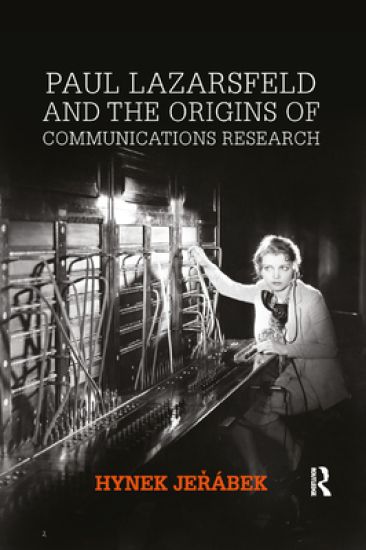
The manuscript discusses the early days of communication research, explicitly the first works of Paul Lazarsfeld’s radio and media research in Vienna, Newark, NJ, Princeton and New York during the years between the early 1930s, and the end of the 1940s. Lazarsfeld’s Viennese radio research, especially the world’s first extensive audience research – RAVAG study (1931) – is entirely new information for English speaking scholars. The book shows the details of Lazarsfeld’s methodological reasoning in his projects in the field of communication. The book also presents the research institutes that Lazarsfeld founded in Vienna in 1931, from Newark Center in New Jersey (1935) to Princeton Office of Radio Research in 1937, and up to the foundation of Lazarsfeld’s famous BASR at Columbia University in New York in the 1940s. The monograph shows how important Lazarsfeld’s first studies were for the future development of communication.
The concept of death, particularly violent death, is prevalent throughout the writings of Paul the Apostle. His letters in the New Testament address this topic from a variety of perspectives, some of which can appear to be almost contradictory. However, this need not be problematic. Paul and Death uses the method of psychological exegesis to show that the different attitudes toward death in Paul’s letters make for a much more coherent discourse if they are seen as an aid to individual and collective psychological coping.Taking the differences between each of Paul’s letters as its starting point, this study suggests that a variety of coping strategies in relation to death may be beneficial depending on the situation, the person, and the stage of the coping process. Drawing on psychologically-oriented hermeneutic theory, and theories about psychological coping in particular, the author argues that each case of psychological coping must be understood in its historical situation, and as strategies emanating from a specific person’s subjective appraisal.Combining theology and biblical studies with modern psychology, this book will be of particular interest to academics and students that are studying the relationship between Religion and notions of Death.
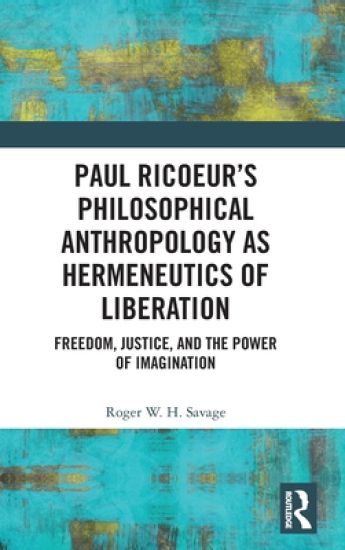
Paul Ricoeur’s Philosophical Anthropology as Hermeneutics of Liberation
Roger W.H. Savage
Routledge
2020
sidottu
This book offers a unique account of the role imagination plays in advancing the course of freedom’s actualization. It draws on Paul Ricoeur’s philosophical anthropology of the capable human being as the staging ground for an extended inquiry into the challenges of making freedom a reality within the history of humankind. This book locates the abilities we exercise as capable human beings at the heart of a sustained analysis and reflection on the place of the idea of justice in a hermeneutics for which every expectation regarding rights, liberties, and opportunities must be a hope for humanity as a whole. The vision of a reconciled humanity that for Ricoeur figures in a philosophy of the will provides an initial touchstone for a hermeneutics of liberation rooted in a philosophical anthropology for which the pathétique of human misery is its non- or pre-philosophical source. By setting the idea of the humanity in each of us against the backdrop of the necessity of preserving the tension between the space of our experiences and the horizons of our expectations, the book identifies the ethical and political dimensions of the idea of justice’s federating force with the imperative of respect.Paul Ricoeur’s Philosophical Anthropology as Hermeneutics of Liberation will be of interest to scholars and advanced students working in hermeneutics, phenomenology, ethics, political theory, and aesthetics.
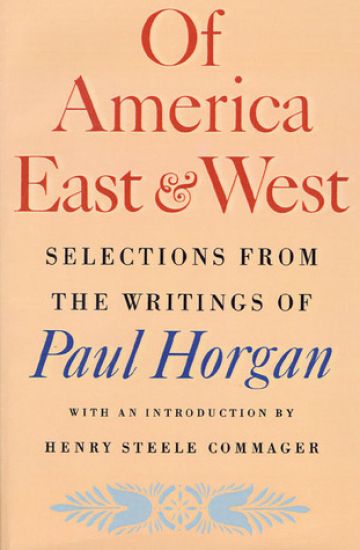
Of America East & West: Selections from the Writings of Paul Horgan
Paul Horgan
Farrar, Straus and Giroux
1985
nidottu
No historian writes with such command of language or feeling for human nature. The difference is his luminous imagination, as Henry Steele Commager observes in the introduction to the newest Horgan volume, Of America East & West, a sumptuous selection from fifteen of the earlier works, many of which have been long out of print. I began reading Paul Horgan more than twenty years ago and he has given me no end of pleasure ever since. Whether in fiction, history or biography, he is a writer of large vision and manysidedness. He can be serene, funny, elegant, earthy and lyrical. He can range across art, opera, politics, natural history, military history and intellectual history. Narrative energy suffuses everything he writes. But it is his gift of empathy that lifts his work to the level of art and gives the history he writes 'reality.'
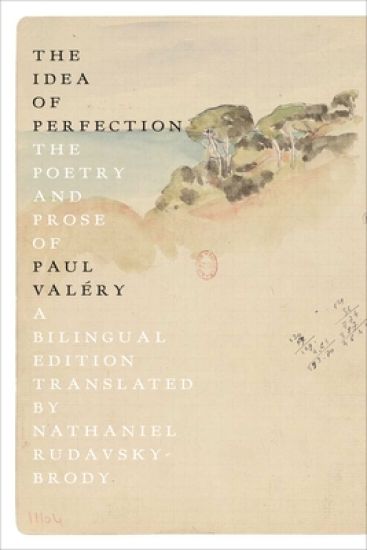
The Idea of Perfection: The Poetry and Prose of Paul Valéry; A Bilingual Edition
Paul Valéry
Farrar, Straus and Giroux
2021
nidottu
A fresh look into the monumental work of Paul Val ry, one of the major French literary figures of the twentieth century. Heir to Mallarm and the symbolists, godfather to the modernists, Paul Val ry was a poet with thousands of readers and few followers, great resonance and little echo. Along with Rilke and Eliot, he stands as a bridge between the tradition of the nineteenth century and the novelty of the twentieth. His reputation as a poet rests on three slim volumes published in a span of only ten years. Yet these poems, it turns out, are inseparable from another, much vaster intellectual and artistic enterprise: the Notebooks. Behind the published works, behind the uneventful life of the almost forgotten and then exceedingly famous poet, there hides another story, a private life of the mind, that has its record in 28,000 pages of notes revealed in their entirety only after his death. Their existence had been hinted at, evoked in rumors and literary asides; but once made public it took years for their significance to be fully appreciated. It turned out that the prose fragments published in Val ry's lifetime were not the after-the-fact musings of an accomplished poet, nor his occasional sketchbook, nor excerpts from his private journal. They were a disfigured glimpse of a vast and fragmentary "exercise of thought," a restless intellectual quest as unguided and yet as persistent, as rigorous, and as uncontainable as the sea that is so often their subject. The Idea of Perfection shows both sides of Val ry: the craftsman of sublimely refined verse, and the fervent investigator of the limits of human intellect and expression. It intersperses his three essential poetic works--Album of Early Verse, The Young Fate, and Charms--with incisive selections from the Notebooks and finishes with the prose poem "The Angel." Masterfully translated by Nathaniel Rudavsky-Brody, with careful attention to form and a natural yet metrical contemporary poetic voice, The Idea of Perfection breathes new life into poems that are among the most beautiful in the French language and the most influential of the twentieth century.
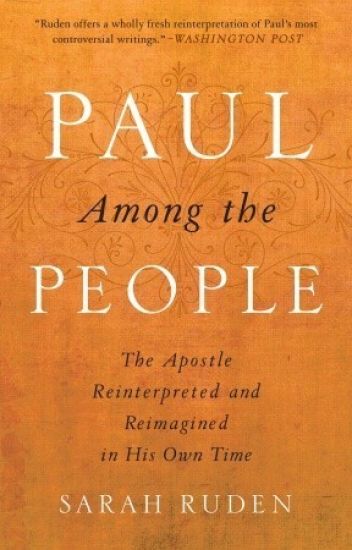
Paul Among the People: The Apostle Reinterpreted and Reimagined in His Own Time
Sarah Ruden
Image
2011
nidottu
In Paul Among the People, Sarah Ruden explores the writings of the evangelist Paul in the context of his time and culture, to recover his original message of freedom and love while overturning the common--and fundamental--misconception that Paul represented a puritanical, hysterically homophobic, misogynist, or reactionary vision. By setting famous and controversial words of Paul against ancient Greek and Roman literature, Ruden reveals a radical message of human freedom and dignity at the heart of Paul's preaching. Her training in the Classics allows her to capture the stark contrast between Paul's Christianity and the violence, exploitation, and dehumanization permeating the Roman Empire in his era. In contrast to later distortions, the vision of Christian life Ruden finds in Paul is centered on equality before God and the need for people to love one another. A remarkable work of scholarship, synthesis, and understanding, Paul Among the People recaptures the moral urgency and revolutionary spirit that made Christianity such a shock to the ancient world and laid the foundation of the culture in which we live today.
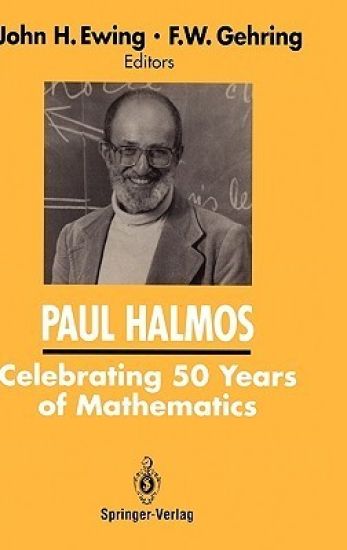
PAUL HALMOS Celebrating 50 Years of Mathematics
Springer-Verlag New York Inc.
1991
sidottu
Paul Halmos will celebrate his 75th birthday on the 3rd of March 1991. This volume, from colleagues, is an expression of affection for the man and respect for his contributions as scholar, writer, and teacher. It contains articles about Paul, about the times in which he worked and the places he has been, and about mathematics. Paul has furthered his profession in many ways and this collection reflects that diversity. Articles about Paul are not biographical, but rather tell about his ideas, his philosophy, and his style. Articles about the times and places in which Paul has worked describe people, events, and ways in which Paul has influenced students and colleagues over the past 50 years. Articles about mathematics are about all kinds of mathematics, including operator theory and Paul's research in the subject. This volume represents a slice of mathematical life and it shows how many parts of mathematics Paul has touched. It is fitting that this volume has been produced with the support and cooperation of Springer-Verlag. For over 35 years, Paul has contributed to mathematics publishing as founder and editor of many outstanding series.
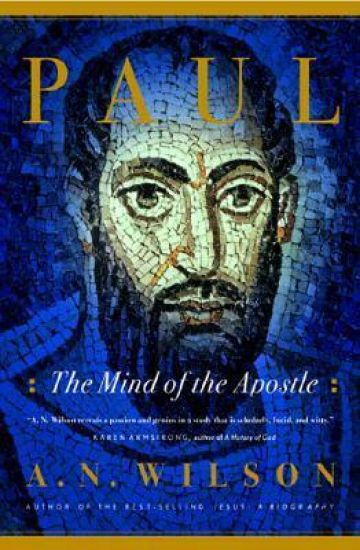
As A. N. Wilson, biographer of Tolstoy, C. S. Lewis, and Jesus, makes clear in this astonishing and gripping narrative, Christianity without Paul is quite literally nothing. Jesus, with the layers of exegesis, scholarship, and ceremony stripped away, is a Jew, a fastidious and fervent Jew, who would lead his followers into a stricter, purer observance of Judaism. It is Paul who will claim divinity for him, who will transform him into the Messiah, center of an entirely new religion. In Wilson's deft and psychologically astute narrative, we see Paul negotiating the dangerous political currents of the Roman Empire; traveling everywhere; making converts; writing the great epistles that define our understanding of Christ and the sublime paradoxes of his teaching; defusing the natural antagonism of the supreme temporal power to this dangerous spiritual force, Christianity, which would in time consume that empire from within. What drove Paul? What fueled this act of inspired creativity? What would he think of what his church has become? The answers lie in Wilson's extraordinary biography, which lays bare the psychological journey of Christianity's true inventor.
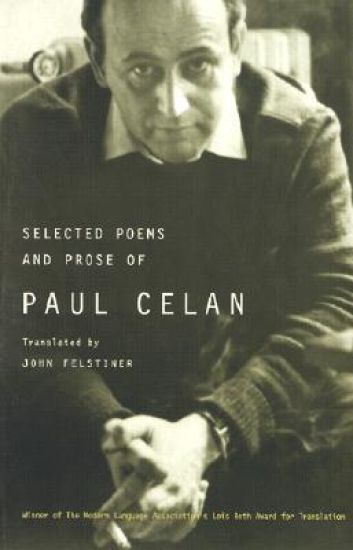
Paul Celan was born in 1920 in the East European province of Bukovina. Soon after his parents, German-speaking Jews, had perished at the hands of the Nazis, Celan wrote "Todesfuge" ("Deathfugue"), the most compelling poem to emerge from the Holocaust. Self-exiled in Paris, for twenty-five years Celan continued writing in his German mother tongue, although it had "passed through the thousand darknesses of deathbringing speech." His writing purges and remakes that language, often achieving a hope-struck radiance never before seen in modern poetry. But in 1970, his psychic wounds unhealed, Celan drowned himself in the Seine. This landmark volume includes youthful lyrics, unpublished poems, and prose. All poems appear in the original and in translation on facing pages. John Felstiner's translations stem from a twenty-year immersion in Celan's life and work. John Bayley wrote in the New York Review of Books, "Felstiner translates ... brilliantly."