Kirjojen hintavertailu. Mukana 11 342 296 kirjaa ja 12 kauppaa.

Kirjahaku

Etsi kirjoja tekijän nimen, kirjan nimen tai ISBN:n perusteella.

1000 tulosta hakusanalla Robert D. Lesslie

The Basketball Draft Fact Book

The Basketball Draft Fact Book

Robert D. Bradley

Scarecrow Press
2013
sidottu
On June 2nd, 1947, the Basketball Association of America (BAA) and the National Basketball League (NBL) held the first college basketball draft in the history of the sport. The two leagues selected a combined 100 college seniors, including future Hall of Famers Harry Gallatin, Andy Phillip, and Jim Pollard. Since then, over 9,000 draft choices have been made by the major professional basketball leagues. The Basketball Draft Fact Book is the first detailed and comprehensive listing of all professional basketball drafts in the history of the sport, from the first draft in 1947 to the present. In The Basketball Draft Fact Book, each season’s draft is summarized, noting significant events and circumstances pertinent to that year and providing insight into the unique conditions and notable players involved. Following the summary is a complete list of all players drafted that season. This book includes not only the NBA, but the American Basketball League, American Basketball Association, and the Women’s National Basketball Association, as well. Additional sections cover expansion and dispersal drafts, international players selected in the draft, the processes used to determine the order of the drafts, the impact of trades, and more. The Basketball Draft Fact Book provides an authoritative history of basketball drafts in the U.S., with more complete and accurate information than any other source. Containing corrections to hundreds of errors in the draft information currently available, this volume is a valuable resource for basketball fans, historians, writers, and researchers.

Dobson's "Encyclopaedia"

Dobson's "Encyclopaedia"

Robert D. Arner

University of Pennsylvania Press
1991
sidottu
This is the first study of the life and career of Thomas Dobson, arguably the most prominent American printer, publisher, and bookseller between the years 1785 and 1822, whose accomplishments included publication of the first American edition of the Hebrew Bible, and the first American edition of the Encyclopaedia Britannica.
Dare to Be Scared

Dare to Be Scared

Robert D. San Souci

Open Court Publishing Co ,U.S.
2003
sidottu
This story collection for middle readers offers thirteen diverse scary stories, including fantasy, science fiction, and ghost tales, from the author of Cinderella Skeleton and Witch Baby.
Double-Dare to Be Scared

Double-Dare to Be Scared

Robert D. San Souci

Cricket Books, a division of Carus Publishing Co
2004
sidottu
What’s creepier than being lost in the woods all alone? How about being lost in those woods, and sensing that you’re not alone?Robert D. San Souci, popular author of Dare to Be Scared, has spun another thirteen masterful tales to keep nightlights burning across the country. Fans of his first book will be thrilled to find not only the same spirit of scary fun, but even deeper, darker twists and surprises. Newcomers will discover something for every (daring) palate, with stories that range from campfire grabbers to unsettling chillers, and combine elements of folklore and pop culture.
Triple-Dare to Be Scared

Triple-Dare to Be Scared

Robert D. San Souci

Cricket Books, a division of Carus Publishing Co
2007
sidottu
A story collection for middle readers offers thirteen diverse scary stories, including fantasy, science fiction, and ghost tales, from the author of Cinderella Skeleton and Witch Baby.
Dare to Be Scared 4

Dare to Be Scared 4

Robert D. San Souci

Cricket Books, a division of Carus Publishing Co
2009
sidottu
In this new addition to the series, author Robert D. San Souci and illustrator David Ouimet join forces to present 13 deliciously frightening tales. Elements of urban legend and folklore are utilized to weave powerful and suspenseful (yet age-appropriate) stories that young readers are sure to revisit, finding new meaning -- and shivers -- with each reading. In Dare to Be Scared 4, the stories range from "Fairy Godmother" to "A Really Scary Story" that should bear a label warning: Books can be dangerous! In "Snow Day," Connor soon discovers that you can't make big magic without paying for it big time. It's best to have a flashlight for under-the-covers story-reading that reveals what's really behind the closed doors of the "Principal's Office," on the railroad tracks at dusk in "Heading Home," and the eerie fate of 13-year-old Peter in "Moonrise." David Ouimet's unique scratchboard illustrations and Robert San D. Souci's compelling prose make this a welcome jaunt through the world of ghosts and ghouls along with the children trying to escape their clutches!
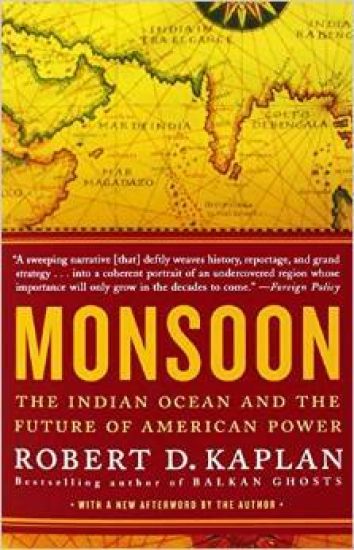
Monsoon

Monsoon

Robert D. Kaplan

Random House Inc
2011
pokkari
On the world maps common in America, the Western Hemisphere lies front and center, while the Indian Ocean region all but disappears. This convention reveals the geopolitical focus of the now-departed twentieth century, but in the twenty-first century that focus will fundamentally change. In this pivotal examination of the countries known as "Monsoon Asia"--which include India, Pakistan, China, Indonesia, Burma, Oman, Sri Lanka, Bangladesh, and Tanzania--bestselling author Robert D. Kaplan shows how crucial this dynamic area has become to American power. It is here that the fight for democracy, energy independence, and religious freedom will be lost or won, and it is here that American foreign policy must concentrate if the United States is to remain relevant in an ever-changing world. From the Horn of Africa to the Indonesian archipelago and beyond, Kaplan exposes the effects of population growth, climate change, and extremist politics on this unstable region, demonstrating why Americans can no longer afford to ignore this important area of the world.
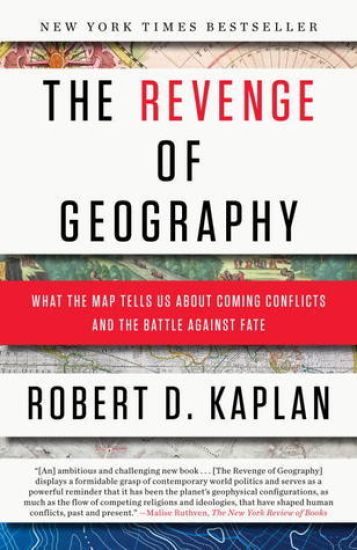
The Revenge of Geography

The Revenge of Geography

Robert D. Kaplan

Random House Inc
2013
pokkari
NEW YORK TIMES BESTSELLER - In this provocative, startling book, Robert D. Kaplan, the bestselling author of Monsoon and Balkan Ghosts, offers a revelatory new prism through which to view global upheavals and to understand what lies ahead for continents and countries around the world. Bestselling author Robert D. Kaplan builds on the insights, discoveries, and theories of great geographers and geopolitical thinkers of the recent and distant past to look back at critical pivots in history and then to look forward at the evolving global scene. Kaplan traces the history of the world's hot spots by examining their climates, topographies, and proximities to other embattled lands. He then applies the lessons learned to the present crises in Europe, Russia, China, the Indian Subcontinent, Turkey, Iran, and the Arab Middle East. The result is a holistic interpretation of the next cycle of conflict throughout Eurasia, a visionary glimpse into a future that can be understood only in the context of temperature, land allotment, and other physical certainties. A brilliant rebuttal to thinkers who suggest that globalism will trump geography, this indispensable work shows how timeless truths and natural facts can help prevent this century's looming cataclysms.Praise for The Revenge of Geography " An] ambitious and challenging new book . . . The Revenge of Geography] displays a formidable grasp of contemporary world politics and serves as a powerful reminder that it has been the planet's geophysical configurations, as much as the flow of competing religions and ideologies, that have shaped human conflicts, past and present."--Malise Ruthven, The New York Review of Books"Robert D. Kaplan, the world-traveling reporter and intellectual whose fourteen books constitute a bedrock of penetrating exposition and analysis on the post-Cold War world . . . strips away much of the cant that suffuses public discourse these days on global developments and gets to a fundamental reality: that geography remains today, as it has been throughout history, one of the most powerful drivers of world events."--The National Interest "Kaplan plunges into a planetary review that is often thrilling in its sheer scale . . . encyclopedic."--The New Yorker " The Revenge of Geography] serves the facts straight up. . . . Kaplan's realism and willingness to face hard facts make The Revenge of Geography a valuable antidote to the feel-good manifestoes that often masquerade as strategic thought."--The Daily Beast
Asia's Cauldron

Asia's Cauldron

Robert D. Kaplan

Random House Inc
2015
pokkari
NAMED ONE OF THE BEST BOOKS OF THE YEAR BY FINANCIAL TIMESFrom Robert D. Kaplan, named one of the world's Top 100 Global Thinkers by Foreign Policy magazine, comes a penetrating look at the volatile region that will dominate the future of geopolitical conflict. Over the last decade, the center of world power has been quietly shifting from Europe to Asia. With oil reserves of several billion barrels, an estimated nine hundred trillion cubic feet of natural gas, and several centuries' worth of competing territorial claims, the South China Sea in particular is a simmering pot of potential conflict. The underreported military buildup in the area where the Western Pacific meets the Indian Ocean means that it will likely be a hinge point for global war and peace for the foreseeable future. In Asia's Cauldron, Robert D. Kaplan offers up a vivid snapshot of the nations surrounding the South China Sea, the conflicts brewing in the region at the dawn of the twenty-first century, and their implications for global peace and stability. One of the world's most perceptive foreign policy experts, Kaplan interprets America's interests in Asia in the context of an increasingly assertive China. He explains how the region's unique geography fosters the growth of navies but also impedes aggression. And he draws a striking parallel between China's quest for hegemony in the South China Sea and the United States' imperial adventure in the Caribbean more than a century ago. To understand the future of conflict in East Asia, Kaplan argues, one must understand the goals and motivations of its leaders and its people. Part travelogue, part geopolitical primer, Asia's Cauldron takes us on a journey through the region's boom cities and ramshackle slums: from Vietnam, where the superfueled capitalism of the erstwhile colonial capital, Saigon, inspires the geostrategic pretensions of the official seat of government in Hanoi, to Malaysia, where a unique mix of authoritarian Islam and Western-style consumerism creates quite possibly the ultimate postmodern society; and from Singapore, whose "benevolent autocracy" helped foster an economic miracle, to the Philippines, where a different brand of authoritarianism under Ferdinand Marcos led not to economic growth but to decades of corruption and crime. At a time when every day's news seems to contain some new story--large or small--that directly relates to conflicts over the South China Sea, Asia's Cauldron is an indispensable guide to a corner of the globe that will affect all of our lives for years to come. Praise for Asia's Cauldron "Asia's Cauldron is a short book with a powerful thesis, and it stands out for its clarity and good sense. . . . If you are doing business in China, traveling in Southeast Asia or just obsessing about geopolitics, you will want to read it."--The New York Times Book Review "Kaplan has established himself as one of our most consequential geopolitical thinkers. . . . Asia's Cauldron] is part treatise on geopolitics, part travel narrative. Indeed, he writes in the tradition of the great travel writers."--The Weekly Standard "Kaplan's fascinating book is a welcome challenge to the pessimists who see only trouble in China's rise and the hawks who view it as malign."--The Economist "Muscular, deeply knowledgeable . . . Kaplan is an ultra-realist who] takes a non-moralistic stance on questions of power and diplomacy."--Financial Times
In Europe's Shadow

In Europe's Shadow

Robert D. Kaplan

Random House Inc
2016
pokkari
obert Kaplan first visited Romania in the 1970s, when he was a young journalist and the country was a bleak Communist backwater. It was one of the darkest corners of Europe, but few Westerners were paying attention. What ensued was a lifelong obsession with a critical, often overlooked country?a country that, today, is key to understanding the current threat that Russia poses to Europe.In Europe?s Shadow is a vivid blend of memoir, travelogue, journalism, and history, a masterly work thirty years in the making?the story of a journalist coming of age, and a country struggling to do the same. Through the lens of one country, Kaplan examines larger questions of geography, imperialism, the role of fate in international relations, the Cold War, the Holocaust, and more. Here Kaplan illuminates the fusion of the Latin West and the Greek East that created Romania, the country that gave rise to Ion Antonescu, Hitler?s chief foreign accomplice during World War II, and the country that was home to the most brutal strain of Communism under Nicolae Ceau?escu. Romania past and present are rendered in cinematic prose: the ashen faces of citizens waiting in bread lines in Cold War?era Bucharest; the Baragan Steppe, laid bare by centuries of foreign invasion; the grim labor camps of the Black Sea Canal; the majestic Gothic church spires of Transylvania and Maramures. Kaplan finds himself in dialogue with the great thinkers of the past, and with the Romanians of today, the philosophers, priests, and politicians?those who struggle to keep the flame of humanism alive in the era of a resurgent Russia. Upon his return to Romania in 2013 and 2014, Kaplan found the country transformed yet again?now a traveler?s destination shaped by Western tastes, yet still emerging from the long shadows of Hitler and Stalin.In Europe?s Shadow is the story of an ideological and geographic frontier?and the book you must read in order to truly understand the crisis with Russia, and within Europe itself.
Hitler's Soldiers in the Sunshine State

Hitler's Soldiers in the Sunshine State

Robert D. Billinger Jr.

University Press of Florida
2009
nidottu
"They were Uncle Sam's smiling workers and they looked like all-American boys. There were at least 10,000 of them, deployed in 25 Florida camps between 1942 and 1946. They were also members of the Wehrmacht, Hitler's armed forces."--Forum "Most Americans were unaware their government was housing Hitler's soldiers on its shores. . . . Billinger weaves interviews with former prisoners, American soldiers who worked in the camps, newspaper accounts, and government documents into a stunning historical narrative."--Kansas City Star "A tropical paradise that for some became a tropical hell."--Sarasota Herald-Tribune "First came crewmen of destroyed U-boats, then thousands of Afrika Korps veterans who swamped the system in 1943. Pro-Nazi, arrogant, and tough, they defied U.S. authorities, terrorized anti-Nazi inmates, and rioted."--Choice "Filled with colorful personal accounts, this historical book packs the punch of fiction."--St. Petersburg Times "Billinger's first-rate history of this little-known chapter in American history teaches us that, in spite of wartime propaganda, our enemies are human, too."--Atlantic City Press "Hard to put down."--Daytona Beach News-Journal In the first book-length treatment of the German prisoner of war experience in Florida during World War II, Robert D. Billinger, Jr., tells the story of the 10,000 men who were "guests" of Uncle Sam in a tropical paradise that for some became a tropical hell. Having been captured while serving on U-boats off the Carolinas, with the Afrika Korps in Tunisia, with the paratroops in Italy, or with labor battalions in France, the POWs were among the 378,000 Germans held as prisoners in 45 states. Except for the servicemen who guarded them, the civilian pulp-cutters, citrus growers, and sugarcane foremen who worked them, and the FBI and local police who tracked the escapees among them, most people were--and still are--unaware of the German POWs who inhabited the 27 camps that dotted the Sunshine State. Billinger describes the experiences of the Germans and their captors as both sides came to the realization that, while the Germans' worst enemies were often their own comrades-in-arms, wartime enemies might also become life-long friends. Concentrating especially on the story of Camp Blanding in North Florida, Billinger based his research on both American and German archives. His account mixes rare photos with interviews with former prisoners; reports by the International Red Cross, the YMCA, and the U.S. military; and local newspaper articles. This book will be of great value to scholars and historians, as well as all readers with an interest in World War II. Those with an interest in Florida history will also find much to admire in this engaging account of a barely known wartime episode.A volume in The Florida History and Culture Series, edited by Raymond Arsenault and Gary R. Mormino.
A Brief History of Northern Kentucky

A Brief History of Northern Kentucky

Robert D. Webster; Paul A. Tenkotte

The University Press of Kentucky
2019
sidottu
Thousands of years ago, the land that would become Northern Kentucky emerged above sea level when a large portion of the continental plate bulged upward. Today, the region rests on the crest of that uplift, known as the Cincinnati Arch. And just like the fascinating geology of this region, Northern Kentucky continues to grow and develop. From the arrival of the Native Americans, to the first European settlers in the late 1700s, to the building of Ark Encounter at Williamstown in 2016, Northern Kentucky's landscape and population have changed dramatically. This encompassing study delves into the region's unique past and considers its ever-evolving future.Provided is a wide-ranging overview of Northern Kentucky's rich history, including details about its early pioneers such as James Taylor Jr., Simon Kenton, and Daniel Boone, who knew the potential of the incredibly beautiful territory they had discovered at the mouth of the Licking River. The collection also chronicles significant historic moments, like the Battle of Blue Licks, the building of the Roebling Bridge, and tragedies such as the Ohio River Flood of 1937 and the Beverly Hills Supper Club fire of 1977. Famous Northern Kentuckians, such as singer and actress Rosemary Clooney, artist Frank Duveneck, and performer Kenny Price, are also featured. This well-rounded study also addresses the revitalization of the region -- including the recent multi-billion-dollar riverside developments in Covington, Newport, and Bellevue -- and how Northern Kentucky has evolved into one of the most desirable places in the country.
Overcoming Tradition And Modernity

Overcoming Tradition And Modernity

Robert D. Lee

Westview Press Inc
1997
nidottu
“Authenticity” has begun to rival “development” as a key to understanding the political aspirations of the Islamic world. Almost everywhere modernity has laid waste to tradition, those habits and practices deemed to be timeless and true. Imperialism carried European notions of progress into Muslim-dominated parts of the globe, and subsequently Muslims themselves espoused Western practices, techniques, and philosophies. Regimes calling themselves liberal, socialist, and Arab nationalist all embraced modernity as their principal objective. Most of these regimes failed to create the promised better lives their citizens desired. Moreover, ordinary Muslims felt despair as modernity ripped apart families, exposed youngsters to the materialism and hedonism of Western entertainments, heightened social expectations, and undermined religious belief. Even though tradition has proved itself incapable of staving off modernity, the promises and premises of modern development literature have been called into question. Where is the truth around which Muslims can rally? Does modernity require a rejection of tradition? Does the embrace of Islamic ideas necessitate turning away from modernity? Robert D. Lee explores these compelling questions by presenting four contemporary Muslim writers—Muhammad Iqbal, Sayyid Qutb, ‘Ali Shari’ati, and Mohammed Arkoun—all of whom have refused to bow to such a dichotomy of modernity and tradition. This study examines their efforts, deeply influenced by European thinking, to find a truth beyond tradition and modernity—an “authentic” understanding of Islam upon which Muslims can build a future. All four thinkers believe such an authentic understanding can serve as the foundation for a new politics. Lee argues, however, that each of these versions of authenticity suffers shortcomings and falters in its efforts to move from the particularity of culture onto a grander scale of political organization appropriate for the modern world.
Contemporary Continental Philosophy

Contemporary Continental Philosophy

Robert D'amico

Westview Press Inc
1999
pokkari
Contemporary Continental Philosophy steps back from current debates comparing Continental and analytic philosophy and carefully, yet critically outlines the tradition's main philosophical views on epistemology and ontology. Forgoing obscure paraphrases, D'Amico provides a detailed, clear account and assessment of the tradition from its founding by Husserl and Heidegger to its challenge by Derrida and Foucault. Though intended as a survey of this tradition throughout the twentieth century, this study's focus is on the philosophical problems which gave it birth and even now continue to shape it.The book reexamines Husserl as an early critic of epistemological naturalism whose grasp of the philosophical importance of the theory of meaning was largely ignored. Heidegger's contrasting effort to revive ontology is examined in terms of his distinction between ontic and ontological questions. In contrast with many earlier studies, the author outlines confusions engendered by the misappropriation of the distinct philosophical agendas of Husserl and Heidegger by such famous figures as Sartre and Merleau-Ponty. The book is also original in its emphasis on how social externalism in epistemology, inspired by Karl Mannheim, influenced this tradition's structuralist and Marxist phases. The philosophical defences of a theory of interpretation by Gadamer and Habermas are closely examined and assessed and the study concludes with a a probing yet balanced account of Foucault and Derrida as critics of philosophical autonomy. The book concludes by reassessing this century-long divide between the analytic and Continental traditions and its implication for the future of philosophy.
Race, Place, and Environmental Justice After Hurricane Katrina

Race, Place, and Environmental Justice After Hurricane Katrina

Robert D. Bullard; Beverly Wright

Westview Press Inc
2009
nidottu
On August 29, 2005, Hurricane Katrina made landfall near New Orleans leaving death and destruction across the Louisiana, Mississippi, and Alabama Gulf Coast counties. The lethargic and inept emergency response that followed exposed institutional flaws, poor planning, and false assumptions that are built into the emergency response and homeland security plans and programs. Questions linger: What went wrong? Can it happen again? Is our government equipped to plan for, mitigate, respond to, and recover from natural and manmade disasters? Can the public trust government response to be fair? Does race matter? Racial disparities exist in disaster response, cleanup, rebuilding, reconstruction, and recovery. Race plays out in natural disaster survivors' ability to rebuild, replace infrastructure, obtain loans, and locate temporary and permanent housing. Generally, low-income and people of color disaster victims spend more time in temporary housing, shelters, trailers, mobile homes, and hotels - and are more vulnerable to permanent displacement. Some 'temporary' homes have not proved to be that temporary. In exploring the geography of vulnerability, this book asks why some communities get left behind economically, spatially, and physically before and after disasters strike.
Christmas Trees for Pleasure and Profit

Christmas Trees for Pleasure and Profit

Robert D. Wray

Rutgers University Press
2008
nidottu
Christmas Trees for Pleasure and Profit is for anyone who enjoys being and working outdoors and is seeking a profitable hobby or small business venture. Robert Wray has updated this fourth edition to include the latest techniques and tools for harvesting trees, new methods of transport, the most recent data on herbicides, and advice on how to run a Christmas-tree business today.A perennial bestseller, this illustrated guide covers selecting land, choosing species, planting, harvesting, and managing a plantation. Wray provides guidance for choosing species suitable for the grower's situation, where and how to get planting stock, and how to care for it. The planting process is described in detail, including both hand and machine methods. The book presents useful techniques for protecting the growing trees from weeds, animals, fire, insects, and disease, and offers a full description of shearing or shaping trees to improve their form and densityùkeys to a successful crop.As the grower's job is not done until the trees are sold, issues of grading, harvesting, advertising, and marketing are examined. A chapter on finances deals with costs, profits, and taxes. From novice to experienced grower, there is something in this book for everyone.
Northrop Frye

Northrop Frye

Robert D. Denham

University of Virginia Press
2005
sidottu
Even the casual reader will notice a strong preoccupation with religion in the work of Northrop Frye. In his latest book, however, the esteemed Frye scholar Robert Denham shows that it played a far greater role than has been assumed - religion was in fact central to practically everything Frye wrote. Denham's focus shifts the emphasis from Anatomy of Criticism, Frye's most famous work, and places it on those works with which Frye began and ended his career - the early Fearful Symmetry and, fifty years later, his two studies of the Bible and The Double Vision. This reevaluation is based on a close examination of Frye's religiously charged language and aided by Denham's remarkable and unique access to Frye's notebooks. The notebooks' contents not only expand on ideas laid out in Frye's published works but also touch on subjects most readers would not associate with Frye, such as his wide reading in both Eastern religious texts and in esoteric traditions ranging from astrology to the Kabbalah. Denham does not attempt to distill a theology from Frye's work; rather, he seeks to trace the movement of Frye's thought, demonstrating the imaginative use to which he put his wide-ranging reading. The result is a pivotal work, redefining our understanding of one of the most important humanists of the twentieth century.
Mobility and Modernity

Mobility and Modernity

Robert D Aguirre

Ohio State University Press
2019
pokkari
Mobility and Modernity: Panama in the Nineteenth-Century Anglo-American Imagination rewrites the history of the Panama Canal, assessing for the first time the literary culture of the preceding decades. In this period, U.S. and British writers and visual artists developed sophisticated languages of mobility, time, and speed to cast the isthmus as an in-between place, a point of connection to more important destinations. These discourses served an important role in their own day and laid the imaginative ground for the canal to come. In this study, Robert D. Aguirre provides bold new interpretations of Anthony Trollope, John Lloyd Stephens, and Eadweard Muybridge and also recovers information about literary communities previously lost to history. Mobility and Modernity shows how Panama became defined as a site of incipient globalization and a crucial link of empire. Across this narrow strip of land people and things traveled, technology developed, and political forces erupted. The isthmus became a site of mobility that paradoxically produced varieties of immobility. Parting ways with histories that celebrate the canal as a mighty engineering feat, Mobility and Modernity reveals a more complex story of cultural conflict that began with the first gold rush news in the late 1840s and continued throughout the century.
Get a Job

Get a Job

Robert D. Crutchfield

New York University Press
2014
sidottu
Are the unemployed more likely to commit crimes? Does having a job make one less likely to commit a crime? Criminologists have found that individuals who are marginalized from the labor market are more likely to commit crimes, and communities with more members who are marginal to the labor market have higher rates of crime. Yet, as Robert Crutchfield explains, contrary to popular expectations, unemployment has been found to be an inconsistent predictor of either individual criminality or collective crime rates. In Get a Job, Crutchfield offers a carefully nuanced understanding of the links among work, unemployment, and crime. Crutchfield explains how people's positioning in the labor market affects their participation in all kinds of crimes, from violent acts to profit-motivated offenses such as theft and drug trafficking. Crutchfield also draws on his first-hand knowledge of growing up in a poor, black neighborhood in Pittsburgh and later working on the streets as a parole officer, enabling him to develop a more complete understanding of how work and crime are related and both contribute to, and are a result of, social inequalities and disadvantage. Well-researched and informative, Get a Job tells a powerful story of one of the most troubling side effects of economic disparities in America.