

Kirjahaku
Etsi kirjoja tekijän nimen, kirjan nimen tai ISBN:n perusteella.
1000 tulosta hakusanalla Robert Simpson

Robert Mills Architect of the Washington Monument 1781-1855
H. M. Pierce Gallagher
Columbia University Press
2022
sidottu

Robert Winston Science Squad Explains
Robert Winston; Steve Setford; Trent Kirkpatrick
DK Children
2020
sidottu
Have you ever wondered what makes electricity? Or what's inside an atom? Or how high the Moon really is? Or what light is made of and why you need it? The Science Squad provides all the answers in this colourful, fact-packed and informative book, explaining more than 100 key STEAM concepts in a clear way that will appeal to children aged five and above. This is the perfect visual introduction to the key concepts children need to know about all things STEAM. Each topic is explained using illustrated characters that represent science, technology, engineering, art, and maths. The second book in the Science Squad series, Science Squad Explains is an essential read for young STEAM fans.

Let Professor Robert Winston take you on a scientific journey through human history in this fact-packed science book.Delve into the stories of history's most influential scientific experiments, inventions and life-changing discoveries that have impacted our understanding and changed the world in this science book for kids aged 7-9.Robert Winston's Story of Science will teach children about the incredible world of science through fascinating facts, innovative inventions, and daring discoveries. Learn how random accidents have led to some of the greatest findings our world has ever seen, and how anybody who dares to dream can be successful.This fascinating science book for children offers:- Expertly written and accessible text by Robert Winston for children of the appropriate age to understand and enjoy even trickier concepts.- An exploration of each invention's past, present, and future development that is explored for a thorough and modern look at the role of science, technology and design in our everyday lives.- The answers to some of the most fascinating queries on the history of our world; piquing children's curiosities and sparking interest.From the creation of dynamite and the world's first printer, to magical medicine and the discovery of soap; science really is the pioneering study that has the power to change everything! This book of amazing scientific concepts and discoveries covers a wide range of topics to inspire the next generation of young minds.

The ultimate guide to De Niro's film career, a movie by movie guide with Q and As with collaborators.

Robert Johnson, Mythmaking, and Contemporary American Culture
Patricia R. Schroeder
University of Illinois Press
2004
sidottu
Mississippi bluesman Robert Johnson died young and left behind just twenty-nine recorded songs. But the legacy, legends, and lore surrounding him loom large in American music history. Merging literary analysis with cultural criticism and biographical study, Patricia R. Schroeder explores Johnson's ongoing role as a cultural icon. Schroeder's detailed analysis engages key images and myths about the blues musician (such as the Faustian crossroads exchange of his soul for guitar virtuosity). Navigating the many competing interpretations that swirl around him, Schroeder reveals the cultural purposes served by the stories and the storytellers. The result is a fascinating examination of the relationships among Johnson's life, its subsequent portrayals, and the forces that drove the representations.Offering penetrating insights into both Johnson and the society that perpetuates him, Robert Johnson, Mythmaking, and Contemporary American Culture is essential reading for blues fans and cultural critics interested in a foundational musical figure.

This book explores the life and works of the pioneering opera composer Robert Ashley, one of the leading American composers of the post-Cage generation. Ashley's innovations began in the 1960s when he, along with Alvin Lucier, Gordon Mumma, and David Behrman, formed the Sonic Arts Union, a group that turned conceptualism toward electronics. He was also instrumental in the influential ONCE Group, a theatrical ensemble that toured extensively in the 1960s.During his tenure as its director, the ONCE Festival in Ann Arbor presented most of the decade's pioneers of the performing arts. Particularly known for his development of television operas beginning with Perfect Lives, Ashley spun a long series of similar text/music works, sometimes termed "performance novels." These massive pieces have been compared with Wagner's Ring Cycle for the vastness of their vision, though the materials are completely different, often incorporating noise backgrounds, vernacular music, and highly structured, even serialized, musical structures. Drawing on extensive research into Ashley's early years in Ann Arbor and interviews with Ashley and his collaborators, Kyle Gann chronicles the life and work of this musical innovator and provides an overview of the avant-garde milieu of the 1960s and 1970s to which he was so central. Gann examines all nine of Ashley's major operas to date in detail, along with many minor works, revealing the fanatical structures that underlie Ashley's music as well as private references hidden in his opera librettos.
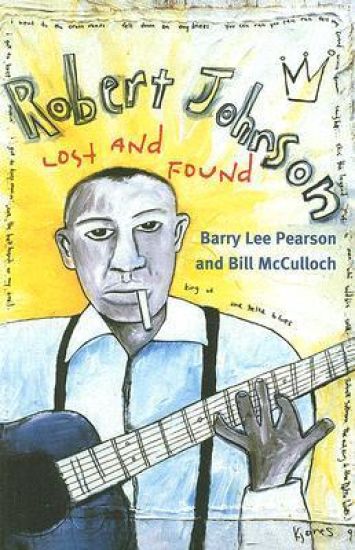
Even with just forty-one recordings to his credit, Robert Johnson (1911-38) is a towering figure in the history of the blues. His vast influence on twentieth-century American music, combined with his mysterious death at the age of twenty-seven, still encourage the speculation and myth that have long obscured the facts about his life. The most famous legend depicts a young Johnson meeting the Devil at a dusty Mississippi crossroads at midnight and selling his soul in exchange for prodigious guitar skills. Barry Lee Pearson and Bill McCulloch examine the full range of writings about Johnson and weigh the conflicting accounts of Johnson's life story against interviews with blues musicians and others who knew the man. Their extensive research uncovers a life every bit as compelling as the fabrications and exaggerations that have sprung up around it. In examining the bluesman's life and music, and the ways in which both have been reinvented and interpreted by other artists, critics, and fans, Robert Johnson: Lost and Found charts the cultural forces that have mediated the expression of African American artistic traditions.

This book explores the life and works of the pioneering opera composer Robert Ashley, one of the leading American composers of the post-Cage generation. Ashley's innovations began in the 1960s when he, along with Alvin Lucier, Gordon Mumma, and David Behrman, formed the Sonic Arts Union, a group that turned conceptualism toward electronics. He was also instrumental in the influential ONCE Group, a theatrical ensemble that toured extensively in the 1960s.During his tenure as its director, the ONCE Festival in Ann Arbor presented most of the decade's pioneers of the performing arts. Particularly known for his development of television operas beginning with Perfect Lives, Ashley spun a long series of similar text/music works, sometimes termed "performance novels." These massive pieces have been compared with Wagner's Ring Cycle for the vastness of their vision, though the materials are completely different, often incorporating noise backgrounds, vernacular music, and highly structured, even serialized, musical structures. Drawing on extensive research into Ashley's early years in Ann Arbor and interviews with Ashley and his collaborators, Kyle Gann chronicles the life and work of this musical innovator and provides an overview of the avant-garde milieu of the 1960s and 1970s to which he was so central. Gann examines all nine of Ashley's major operas to date in detail, along with many minor works, revealing the fanatical structures that underlie Ashley's music as well as private references hidden in his opera librettos.
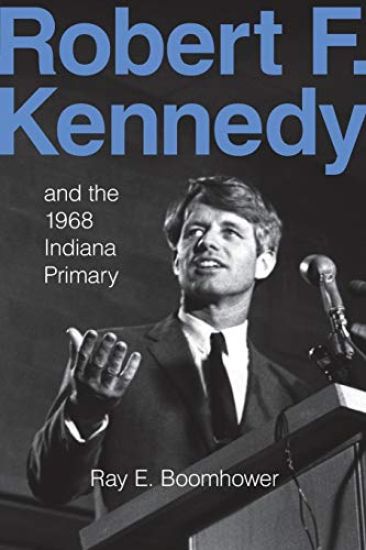
Robert F. Kennedy and the 1968 Indiana Primary
Ray E. Boomhower
Indiana University Press
2017
pokkari
On April 4, 1968, Senator Robert F. Kennedy, Jr., arrived in Indiana to campaign for the Indiana Democratic presidential primary. As Kennedy prepared to fly from an appearance in Muncie to Indianapolis, he learned that civil rights leader Dr. Martin Luther King, Jr., had been shot outside his hotel in Memphis, Tennessee. Before his plane landed in Indianapolis, Kennedy heard the news that King had died. Despite warnings from Indianapolis police that they could not guarantee his safety, and brushing off concerns from his own staff, Kennedy decided to proceed with plans to address an outdoor rally to be held in the heart of the city's African American community. On that cold and windy evening, Kennedy broke the news of King's death in an impassioned, extemporaneous speech on the need for compassion in the face of violence. It has proven to be one of the great speeches in American political history. Marking the 40th anniversary of Kennedy's Indianapolis speech, this book explains what brought the politician to Indiana that day, and explores the characters and events of the 1968 Indiana Democratic presidential primary in which Kennedy, who was an underdog, had a decisive victory.
Robert F. Kennedy and the 1968 Indiana Primary
Ray E. Boomhower
Indiana University Press
2008
sidottu
On April 4, 1968, Senator Robert F. Kennedy, Jr., arrived in Indiana to campaign for the Indiana Democratic presidential primary. As Kennedy prepared to fly from an appearance in Muncie to Indianapolis, he learned that civil rights leader Dr. Martin Luther King, Jr., had been shot outside his hotel in Memphis, Tennessee. Before his plane landed in Indianapolis, Kennedy heard the news that King had died. Despite warnings from Indianapolis police that they could not guarantee his safety, and brushing off concerns from his own staff, Kennedy decided to proceed with plans to address an outdoor rally to be held in the heart of the city's African American community. On that cold and windy evening, Kennedy broke the news of King's death in an impassioned, extemporaneous speech on the need for compassion in the face of violence. It has proven to be one of the great speeches in American political history. Marking the 40th anniversary of Kennedy's Indianapolis speech, this book explains what brought the politician to Indiana that day, and explores the characters and events of the 1968 Indiana Democratic presidential primary in which Kennedy, who was an underdog, had a decisive victory.


Robert the Devil
Pennsylvania State University Press
2018
pokkari
Samuel N. Rosenberg, one of the premier translators of Old French, presents in this volume the first modern English-language version of the thirteenth-century French romance Robert le Diable, a tale of supernatural birth and spiritual redemption.Robert is born after his mother, a childless noblewoman, secretly calls upon Satan to help her conceive. His wicked behavior as a boy and, later, as a destructive young man is so brutal that one day Robert prevails upon his mother to reveal the secret of his birth and thus the source of his wickedness. Upon learning the truth, he leaves his privileged home in Normandy to seek salvation. Robert’s lengthy penance—under the aegis of the Pope and a pious hermit—begins with his acting as a mute fool in the Roman Emperor’s court and ends with his sainthood. In between he plays the hero’s role in defeating the Turks in battle and turns down the hand of the Emperor’s daughter in marriage, choosing instead to return to the hermit’s abode.The legend of Robert le Diable was extraordinarily influential in the seven hundred years after its creation, generating new versions and adaptations in various languages, ranging from sixteenth-century English adaptations by Wynken de Worde and Thomas Lodge to Giacomo Meyerbeer’s esteemed 1831 opera. Framed by a thoughtful introduction and thorough bibliography, this accessible translation renders the original octosyllabic rhymed couplets of the metrical Old French romance in energetic free verse.
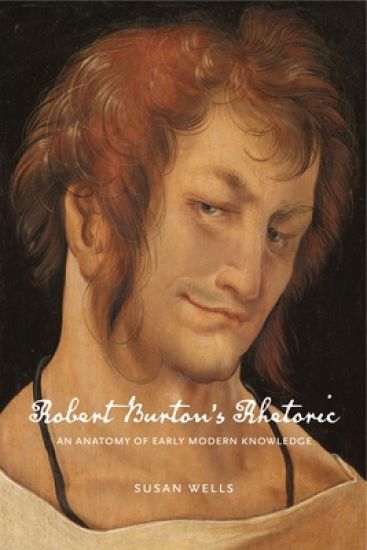
Published in five editions between 1621 and 1651, The Anatomy of Melancholy marks a unique moment in the development of disciplines, when fields of knowledge were distinct but not yet restrictive. In Robert Burton’s Rhetoric, Susan Wells analyzes the Anatomy, demonstrating how its early modern practices of knowledge and persuasion can offer a model for transdisciplinary scholarship today.In the first decades of the seventeenth century, Robert Burton attempted to gather all the existing knowledge about melancholy, drawing from professional discourses including theology, medicine, and philology as well as the emerging sciences. Examining this text through a rhetorical lens, Wells provides an account of these disciplinary exchanges in all their subtle variety and abundant wit, showing that questions of how knowledge is organized and how it is made persuasive are central to rhetorical theory. Ultimately, Wells argues that in addition to a book about melancholy, Burton’s Anatomy is a meditation on knowledge.A fresh interpretation of The Anatomy of Melancholy, this volume will be welcomed by scholars of early modern English and the rhetorics of health and medicine, as well as those interested in transdisciplinary work and rhetorical theory.
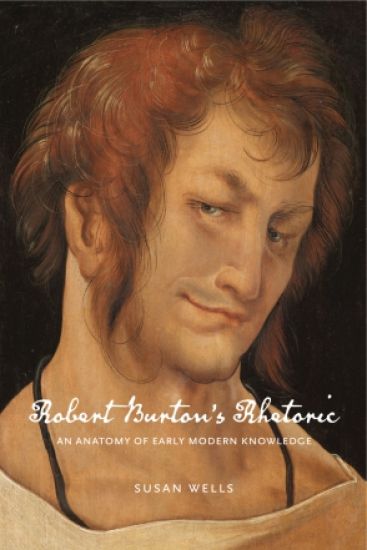
Published in five editions between 1621 and 1651, The Anatomy of Melancholy marks a unique moment in the development of disciplines, when fields of knowledge were distinct but not yet restrictive. In Robert Burton’s Rhetoric, Susan Wells analyzes the Anatomy, demonstrating how its early modern practices of knowledge and persuasion can offer a model for transdisciplinary scholarship today.In the first decades of the seventeenth century, Robert Burton attempted to gather all the existing knowledge about melancholy, drawing from professional discourses including theology, medicine, and philology as well as the emerging sciences. Examining this text through a rhetorical lens, Wells provides an account of these disciplinary exchanges in all their subtle variety and abundant wit, showing that questions of how knowledge is organized and how it is made persuasive are central to rhetorical theory. Ultimately, Wells argues that in addition to a book about melancholy, Burton’s Anatomy is a meditation on knowledge.A fresh interpretation of The Anatomy of Melancholy, this volume will be welcomed by scholars of early modern English and the rhetorics of health and medicine, as well as those interested in transdisciplinary work and rhetorical theory.

Robert de Reims, also known as “La Chievre de Rains,” was among the earliest trouvères—poet-composers who were contemporaries of the troubadours but who wrote in the dialects of northern France. This critical edition provides new translations into English and modern French of all the songs and motets ascribed to him, along with the original texts, the extant music, and a substantive introduction.Active sometime between 1190 and 1220, Robert was an influential figure in the literary circles of Arras. Thirteen compositions set to music are here attributed to him, including nine chansons and four polyphonic motets that were broadly disseminated in the thirteenth century and beyond. Robert’s work is exceptional on a number of fronts. He lavished particular care on the phonic harmony of his words. Acoustic luxuriance and expertise in rhyming, grounded in the play of echoes and variation (often extending into the music), constitute the hallmark of his poetry. Moreover, he is the earliest trouvère known to have composed a parodic sotte chanson contre Amours (silly song against Love).Located clearly at the nexus of monophonic song and polyphony, Robert’s corpus also poses the intriguing question of trouvère participation in the development of the polyphonic repertory. The case of Robert de Reims jostles and tempers the standard history of the chanson and motet.Accessible and instructive, this trilingual critical edition of his complete works makes the oeuvre of this innovative and consequential trouvère available in one volume for the first time.

Apologie de la vraie théologie Chrétienne; contenant l'explication et la défense des principes et de la doctrine de la société dite des Quakers. Ecrite en Latin et en Anglois par Robert Barclay. Et traduit ... en Francois, par E. P. Bridel, ...
Robert Barclay
Wentworth Press
2018
sidottu
Recherches sur les influences solaires et lunaires, pour prouver le magnétisme universel, &c. ... Par M. Robert de Lo-Looz, ... of 4; Volume 1
Robert De Lo-Looz
Wentworth Press
2018
sidottu

Robert Estienne's Influence on Lexicography
DeWitt T. Starnes
University of Texas Press
1963
nidottu
Towering above printers of his time and their successors for many years afterward was the figure of Robert Estienne, the great French lexicographer of the sixteenth century, whose contribution to knowledge and its dissemination is the subject of this authoritative book. The span of Robert Estienne's life (1503–1559) encompassed the historical epochs and events which shaped his career: the Renaissance, the Reformation, and the invention of printing by movable type. His keen interest in the revival of ancient literatures and languages and his training in the art of printing pointed the road he would travel, and the climate of opinion in the Reformation determined his destiny. Robert Estienne promoted classical learning by printing the works of good authors; to spread knowledge of ancient literature he compiled dictionaries and grammars which were adopted by most of the universities of Europe. His dictionary of proper names of Biblical and classical origin, the Dictionarium historicum ac poeticum, became one of the great source books for later compilers of dictionaries and for authors. His influence on English writers was pervasive. Ben Jonson showed familiarity with his texts; Spenser and Milton sometimes set trarislations of his phraseology directly into their poetry. Perpetuation of the few errors he made is one sure proof that his dictionaries were used and copied. An exemplar of learning in the classics and scripture, he searched in ancient manuscripts to avoid repeating the numerous errors that had crept into Bible translations over hundreds of years. For his efforts he was called a heretic by docteurs de theologie in the Sorbonne, but was protected by the royal favor of Francis I of France. Between attacks of theologians on the one side and the King's protection on the other, he became a "controversial" figure and after many years of calumny and persecution finally took refuge in Geneva. Estienne established a family tradition of printing correct and beautiful books, and the printing establishments which made the name of Estienne celebrated throughout the world continued for 162 years.
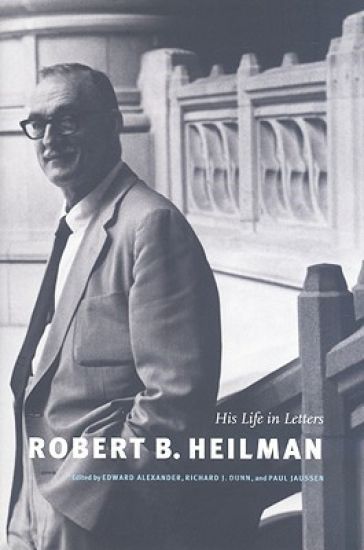
Robert B. Heilman
University of Washington Press
2009
sidottu
Robert Bechtold Heilman was a great literary figure of the twentieth century. This collection of his correspondence includes over 600 exchanges with more than 100 correspondents, among them Saul Bellow, Kenneth Burke, Malcolm Cowley, Richard Eberhart, Charles Johnson, Bernard Malamud, and William Carlos Williams. The letters follow Heilman's career from the time he was a thirty-six-year-old member of Louisiana State University's English Department, through his tenure at the University of Washington from 1948 to 1975, until a few years before his death in 2004. Two of his appointees who spent their entire careers at the University of Washington, Edward Alexander and Richard Dunn, have edited the letters with Paul Jaussen.The rich representation of letters to as well as from Heilman gives the reader access to decades-long conversations between him and Robert Penn Warren, Cleanth Brooks, Joseph Epstein, Theodore Roethke, and many others. They provide a sense of Heilman's character, personality, and achievements in the context of American letters. They also afford an inside history of the changes that took place over sixty years, for better and worse, in American universities, literary criticism, and the politics of literature.In the 1940s, Heilman not only defended the New Criticism against its many enemies, but in his own writing extended its imperial reach to the tragedies of Shakespeare. By the fifties, the focus of his letters shifted to the University of Washington's Department of English, and his flair for efficient, energetic, and imaginative administration resonates through them. The first time University of Washington President Raymond Allen read a letter by Heilman, he scribbled a note to his provost: "I like this man's philosophy very much . . . would he not make an excellent Dean of Arts and Sciences?" Heilman had been at the university less than four months.He soon transformed the department, making Washington a national center for poetry. He exhibited courage and ingenuity in defending academic freedom from yahooism and McCarthyism, nurtured and protected an ailing and unpredictable Roethke (a letter about Roethke is one of the wisest and most eloquent letters ever written by a university administrator), and struggled with demands for the appointment of black faculty as well as with the volatile campus politics of the sixties.Heilman's major correspondents - especially his Washington colleagues Solomon Katz and Andrew Hilen - were learned and articulate masters of the epistolary art. To read his letters and theirs is to understand that Samuel Johnson's famous observation "we shall receive no letters in the grave" was not a sigh of expected relief from nuisance and obligation but an anticipatory lament over the loss of a supreme pleasure.