Kirjojen hintavertailu. Mukana 11 244 527 kirjaa ja 12 kauppaa.

Kirjahaku

Etsi kirjoja tekijän nimen, kirjan nimen tai ISBN:n perusteella.

1000 tulosta hakusanalla Rodney Timms

From Athens to Gordion – The Papers of a Memorial Symposium for Rodney S. Young
The nine papers in this volume, presented by former colleagues and students of the late Rodney S. Young, are representative of Young's archaeological interests: Athens, where he received his archaeological training, and Gordion, where he achieved his greatest successes. This book will prove valuable to students and scholars interested in the interconnections between Greece and Anatolia from the Bronze Age through classical times.
Sgt. Rodney M. Davis

Sgt. Rodney M. Davis

John D Hollis

Hugo House Publishers
2018
pokkari
How Far Would You Go to Honor a Code? Honor. Courage. Commitment. These are the pillars of United States Marine Corps values. So why Sgt. Rodney M. Davis lunged atop that enemy grenade at the expense of his own life on Sept. 6, 1967 is the quintessential question that has haunted not only those who stood closest to him at that critical moment, but his own family and friends for over fifty years now. Why would a young African-American with a beautiful wife and two infant children eagerly awaiting his return home from Vietnam commit such a noble and courageous, yet sacrificial act? And for Marines he barely knew if at all? And for a country that often treated him like a second-class citizen at the time? was a brave man and a good Marine. My grandfather always told me that if Davis] had not jumped on that grenade, every Marine in that trench would have been seriously injured or killed. My grandfather believed that he would have died that day. My mother would have been an orphan at the age of one, and I would have never known my grandfather. In a time when the United States was ravaged by racial tension, I wonder what kind of bond men form while fighting a war, for him to have saved the lives of a bunch of white men - including a Texan officer - that he knew for a short period of time? Davis] was a modern-day hero, and the kind of Marine I strive to live up to." Steven Brackeen Turunc, the eldest grandson of Davis' late platoon commander, John Brackeen. Turunc graduated from Officer Candidates School in November 2014 and is currently serving on active duty in the U.S. Marine Corps. That Davis was posthumously awarded the Medal of Honor at the White House on March, 26, 1969 did little to assuage the heartbreak felt by his grieving family and the many friends he left behind. But looking after his own had always been Davis' calling. This is his story.
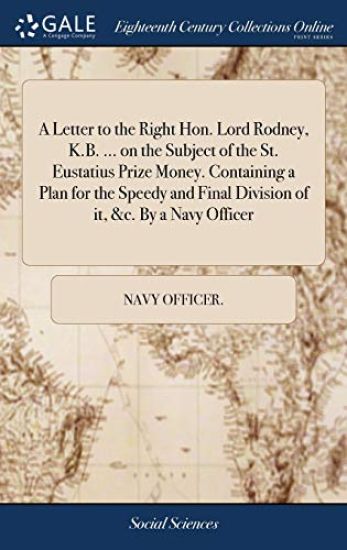
A Letter to the Right Hon. Lord Rodney, K.B. ... on the Subject of the St. Eustatius Prize Money. Containing a Plan for the Speedy and Final Division of it, &c. By a Navy Officer
The 18th century was a wealth of knowledge, exploration and rapidly growing technology and expanding record-keeping made possible by advances in the printing press. In its determination to preserve the century of revolution, Gale initiated a revolution of its own: digitization of epic proportions to preserve these invaluable works in the largest archive of its kind. Now for the first time these high-quality digital copies of original 18th century manuscripts are available in print, making them highly accessible to libraries, undergraduate students, and independent scholars.Delve into what it was like to live during the eighteenth century by reading the first-hand accounts of everyday people, including city dwellers and farmers, businessmen and bankers, artisans and merchants, artists and their patrons, politicians and their constituents. Original texts make the American, French, and Industrial revolutions vividly contemporary.++++The below data was compiled from various identification fields in the bibliographic record of this title. This data is provided as an additional tool in helping to insure edition identification: ++++John Rylands University Library of ManchesterT169929With a half-title.London: printed in the year, 1788. 53, 1]p.; 8
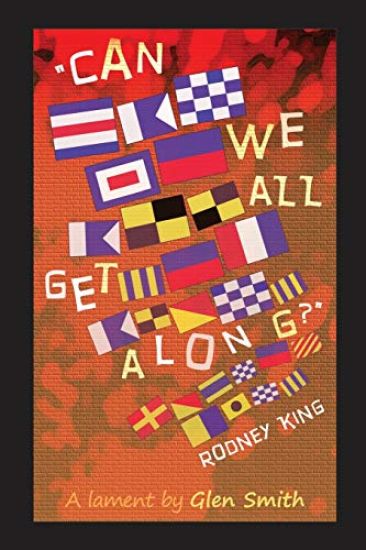
"Can We All Get Along?" Rodney King: A lament

"Can We All Get Along?" Rodney King: A lament

Glen Smith

Createspace Independent Publishing Platform
2016
nidottu
Both animals and man exhibit competition for sexual reproduction, power, and geographic space through flagging and parading. Support is attracted. Competitors are warned. Groups created by man to secure power create images, or flags, which represent them. "Can We All Get Along?" Rodney King is a visual essay that quilts flags into multiple combinations in order to lament the inability of the diverse tribes of humanity to live in peace.
The Runaway; Or, The Adventures of Rodney Roverton (Edition1)
Practical Farm Buildings: Plans and Suggestions, a classical book, has been considered important throughout the human history, and so that this work is never forgotten we at Alpha Editions have made efforts in its preservation by republishing this book in a modern format for present and future generations. This whole book has been reformatted, retyped and designed. These books are not made of scanned copies of their original work and hence the text is clear and readable.
Rising from the Ashes: Los Angeles, 1992. Edward Jae Song Lee, Latasha Harlins, Rodney King, and a City on Fire
In the spring of 1992, after a jury returned not guilty verdicts in the trial of four police officers charged in the brutal beating of a Black man, Rodney King, Los Angeles was torn apart. Thousands of fires were set, causing more than a billion dollars in damage. In neighborhoods abandoned by the police, protestors and storeowners exchanged gunfire. More than 12,000 people were arrested and 2,400 injured. Sixty-three died.In Rising from the Ashes, award-winning author Paula Yoo draws on the experience of the city's Korean American community to narrate and illuminate this uprising, from the racism that created economically disadvantaged neighborhoods torn by drugs and gang-related violence, to the tensions between the city's minority communities. At its heart are the stories of three lives and three families: those of Rodney King; of Latasha Harlins, a Black teenager shot and killed by a Korean American storeowner; and Edward Jae Song Lee, a Korean American man killed in the unrest. Woven throughout, and set against a minute-by-minute account of the uprising, are the voices of dozens others: police officers, firefighters, journalists, business owners, and activists whose recollections give texture and perspective to the events of those five days in 1992 and their impact over the years that followed.
The Case of Richard Downing Jennings, an English Subject, who Resided at Saint Eustatius, as a Merchant, When That Island was Captured by Lord Rodney and General Vaughan in the Year 1781
The 18th century was a wealth of knowledge, exploration and rapidly growing technology and expanding record-keeping made possible by advances in the printing press. In its determination to preserve the century of revolution, Gale initiated a revolution of its own: digitization of epic proportions to preserve these invaluable works in the largest archive of its kind. Now for the first time these high-quality digital copies of original 18th century manuscripts are available in print, making them highly accessible to libraries, undergraduate students, and independent scholars.Delve into what it was like to live during the eighteenth century by reading the first-hand accounts of everyday people, including city dwellers and farmers, businessmen and bankers, artisans and merchants, artists and their patrons, politicians and their constituents. Original texts make the American, French, and Industrial revolutions vividly contemporary.++++The below data was compiled from various identification fields in the bibliographic record of this title. This data is provided as an additional tool in helping to insure edition identification: ++++Harvard University Houghton LibraryN014653London: printed by J. W. Galabin, 1790. 62p.; 8
History Play

History Play

Rodney Bolt

HarperPerennial
2005
nidottu
What if Christopher Marlowe staged his own death, fled to the Continent and went on to write the works we now attribute to Shakespeare? 'About anyone so great as Shakespeare, it is probable that we can never be right; and if we can never be right, it is better that we should from time to time change our way of being wrong.' T. S. Eliot Mark Twain likened writing the biography of Shakespeare to reconstructing the skeleton of a brontosaurus – using 'nine bones and six hundred barrels of plaster of Paris'. We work with a handful of facts and a pile of conjecture. All biographies of Shakespeare, from the wayward to the academic, use the same few-score hard facts kneaded together with legend, then leavened by a dash of zeitgeist and a large dollop of author's imagination. Poems and plays are plundered for booty, even by those who profess scepticism as to the inferences that can be drawn about the life from the work. Like statistics, quotations can be turned to very different facts. This book is not, of course, an attempt to prove that Christopher Marlowe staged his own death, fled to the continent, and went on to write the work attributed to Shakespeare. It, however, playfully assumes that as its starting point, and swings the old bones around, viewing them from a different angle to build a different brontosaurus. It does so in a spirit of fun, and with the intention of a little saucy iconoclasm. Shakespeare's works are unassailable, and will survive any amount of subversion, but by playing with our commonplace history, Rodney Bolt argues that the quasi-religious idol the man has become is perhaps in need of the efforts of a wicked woodworm. Where other writers have looked at the evidence and deduced a story, Bolt has imagined a story, then supported it with the same sparse evidence. At this distance, the difference between deduction and speculation is paper thin. The point of the take is not only to question our view of history and the validity of biography, but to show how people travelled, how cultures crossed, and how art gets made.