Kirjojen hintavertailu. Mukana 11 342 296 kirjaa ja 12 kauppaa.

Kirjahaku

Etsi kirjoja tekijän nimen, kirjan nimen tai ISBN:n perusteella.

1000 tulosta hakusanalla Samuel Coleridge

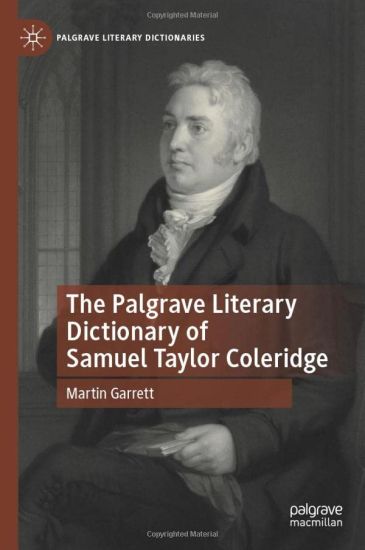
The Palgrave Literary Dictionary of Samuel Taylor Coleridge

The Palgrave Literary Dictionary of Samuel Taylor Coleridge

Martin Garrett

Springer International Publishing AG
2022
sidottu
This volume explores ‘the labyrinth of what we call Coleridge’ (Virginia Woolf): his poems and prose, their sources, interpretation and reception; his life, troubled marriage and fatherhood, conversation, changing intellectual contexts and legacy. Major entries cover such canonical works as The Rime of the Ancient Mariner, Christabel, ‘Kubla Khan’, the ‘conversation poems’ and Biographia Literaria. But a fuller understanding of Coleridge must embrace many lesser-known poems – lyrics, satire, comical squibs. The prose – critical, philosophical, political, religious – ranges from his early radical writings to the more conservative On the Constitution of the Church and State, his influential Shakespeare lectures, and the vast resource of the notebooks. Coleridge read widely throughout his life and engaged extensively with the work of, among many others, Milton, Fielding, Berkeley, Priestley, Kant, Schelling. One of his most important relationships was with William Wordsworth. Another was with Sara Hutchinson. Entries trace Coleridge’s changing reputation, from brilliant young activist to the ‘Sage of Highgate’ to the later apostle of the theories of the imagination and of Practical Criticism. Other topics covered include opium, plagiarism, the French Revolution, Pantisocracy, Unitarianism, and the Salutation and Cat tavern.
The Palgrave Literary Dictionary of Samuel Taylor Coleridge

The Palgrave Literary Dictionary of Samuel Taylor Coleridge

Martin Garrett

Springer International Publishing AG
2023
nidottu
This volume explores ‘the labyrinth of what we call Coleridge’ (Virginia Woolf): his poems and prose, their sources, interpretation and reception; his life, troubled marriage and fatherhood, conversation, changing intellectual contexts and legacy. Major entries cover such canonical works as The Rime of the Ancient Mariner, Christabel, ‘Kubla Khan’, the ‘conversation poems’ and Biographia Literaria. But a fuller understanding of Coleridge must embrace many lesser-known poems – lyrics, satire, comical squibs. The prose – critical, philosophical, political, religious – ranges from his early radical writings to the more conservative On the Constitution of the Church and State, his influential Shakespeare lectures, and the vast resource of the notebooks. Coleridge read widely throughout his life and engaged extensively with the work of, among many others, Milton, Fielding, Berkeley, Priestley, Kant, Schelling. One of his most important relationships was with William Wordsworth. Another was with Sara Hutchinson. Entries trace Coleridge’s changing reputation, from brilliant young activist to the ‘Sage of Highgate’ to the later apostle of the theories of the imagination and of Practical Criticism. Other topics covered include opium, plagiarism, the French Revolution, Pantisocracy, Unitarianism, and the Salutation and Cat tavern.

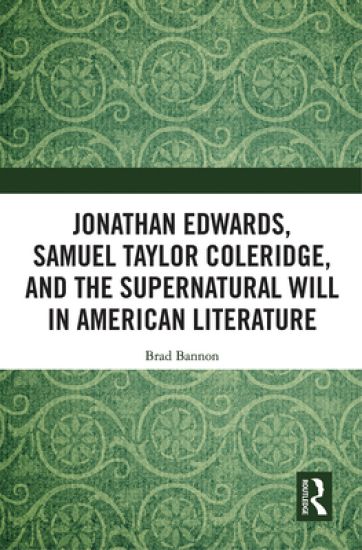
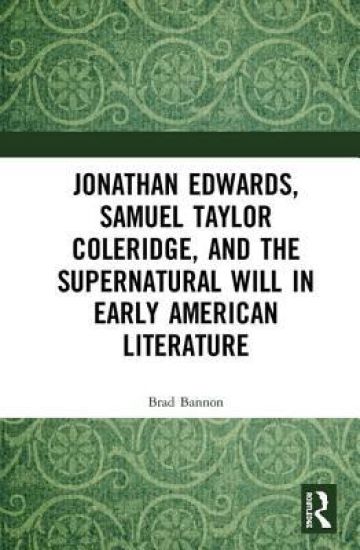
Jonathan Edwards, Samuel Taylor Coleridge, and the Supernatural Will in American Literature
In a work that will be of interest to students and scholars of American Literature, Romanticism, Transcendentalism, the History of Ideas,and Religious Studies, Brad Bannon examines Samuel Taylor Coleridge’s engagement with the philosophical theology of Jonathan Edwards. A closer look at Coleridge’s response to Edwards clarifies the important influence that both thinkers had on seminal works of the nineteenth century, ranging from the antebellum period to the aftermath of the American Civil War—from Poe’s fiction and Emerson’s essays to Melville’s Billy Budd and Crane’s The Red Badge of Courage. Similarly, Coleridge’s early espousal of an abolitionist theology that had evolved from Edwards and been shaped by John Woolman and Olaudah Equiano sheds light on the way that American Romantics later worked to affirm a philosophy of supernatural self-determination. Ultimately, what Coleridge offered the American Romantics was a supernatural modification of Edwards’ theological determinism, a compromise that provided Emerson and other nineteenth-century thinkers with an acceptable extension of an essentially Calvinist theology. Indeed, a thoroughgoing skepticism with respect to salvation, as well as a faith in the absolute inscrutability of Providence, led both the Transcendentalists and the Dark Romantics to speculate freely on the possibility of supernatural self-determination while doubting that anything other than God, or nature, could harness the power of causation.
Jonathan Edwards, Samuel Taylor Coleridge, and the Supernatural Will in American Literature
In a work that will be of interest to students and scholars of American Literature, Romanticism, Transcendentalism, the History of Ideas,and Religious Studies, Brad Bannon examines Samuel Taylor Coleridge’s engagement with the philosophical theology of Jonathan Edwards. A closer look at Coleridge’s response to Edwards clarifies the important influence that both thinkers had on seminal works of the nineteenth century, ranging from the antebellum period to the aftermath of the American Civil War—from Poe’s fiction and Emerson’s essays to Melville’s Billy Budd and Crane’s The Red Badge of Courage. Similarly, Coleridge’s early espousal of an abolitionist theology that had evolved from Edwards and been shaped by John Woolman and Olaudah Equiano sheds light on the way that American Romantics later worked to affirm a philosophy of supernatural self-determination. Ultimately, what Coleridge offered the American Romantics was a supernatural modification of Edwards’ theological determinism, a compromise that provided Emerson and other nineteenth-century thinkers with an acceptable extension of an essentially Calvinist theology. Indeed, a thoroughgoing skepticism with respect to salvation, as well as a faith in the absolute inscrutability of Providence, led both the Transcendentalists and the Dark Romantics to speculate freely on the possibility of supernatural self-determination while doubting that anything other than God, or nature, could harness the power of causation.
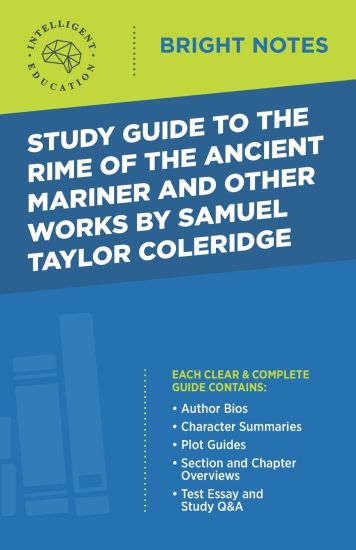
Study Guide to The Rime of the Ancient Mariner and Other Works by Samuel Taylor Coleridge
A comprehensive study guide offering in-depth explanation, essay, and test prep for selected works by Samuel Taylor Coleridge, whose work has influenced many poets of the time. Titles in this study guide include Dejection an Ode, Kubla Khan, Christabel, and The Rime of the Ancient Mariner. As a poet, critic, and philosopher of the early-nineteenth-century, he founded the Romantic Movement in England. Moreover, his poetry was characterized by imagination, passion, and the supernatural. This Bright Notes Study Guide explores the context and history of Samuel Taylor Coleridge's classic work, helping students to thoroughly explore the reasons they have stood the literary test of time. Each Bright Notes Study Guide contains: - Introductions to the Author and the Work - Character Summaries - Plot Guides - Section and Chapter Overviews - Test Essay and Study Q&As The Bright Notes Study Guide series offers an in-depth tour of more than 275 classic works of literature, exploring characters, critical commentary, historical background, plots, and themes. This set of study guides encourages readers to dig deeper in their understanding by including essay questions and answers as well as topics for further research.
Aesthetics, Poetics and Phenomenology in Samuel Taylor Coleridge

Aesthetics, Poetics and Phenomenology in Samuel Taylor Coleridge

Tom Marshall

Springer Nature Switzerland AG
2020
sidottu
This book re-evaluates the philosophical status of Samuel Taylor Coleridge by providing an extended comparison between his work and the phenomenological theory of Edmund Husserl. Examining Coleridge’s accounts of the imagination, perception, poetic creativity and literary criticism, it draws a systematic and coherent structure out of a range of Coleridge’s philosophical writing. In addition, it also applies the principles of Coleridge’s philosophy to an interpretation of his own poetic output.
Aesthetics, Poetics and Phenomenology in Samuel Taylor Coleridge

Aesthetics, Poetics and Phenomenology in Samuel Taylor Coleridge

Tom Marshall

Springer Nature Switzerland AG
2021
nidottu
This book re-evaluates the philosophical status of Samuel Taylor Coleridge by providing an extended comparison between his work and the phenomenological theory of Edmund Husserl. Examining Coleridge’s accounts of the imagination, perception, poetic creativity and literary criticism, it draws a systematic and coherent structure out of a range of Coleridge’s philosophical writing. In addition, it also applies the principles of Coleridge’s philosophy to an interpretation of his own poetic output.