Kirjojen hintavertailu. Mukana 12 595 353 kirjaa ja 12 kauppaa.

Kirjahaku

Etsi kirjoja tekijän nimen, kirjan nimen tai ISBN:n perusteella.

1000 tulosta hakusanalla Samuel Johnson

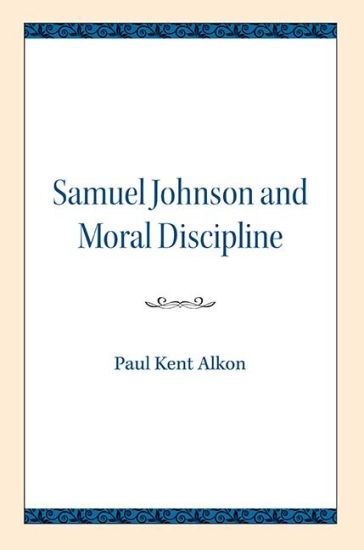
Samuel Johnson and Moral Discipline

Samuel Johnson and Moral Discipline

Paul Kent Alkon

Northwestern University Press
2018
nidottu
Paul Kent Alkon’s Samuel Johnson and Moral Discipline provides reading of Johnson that emphasizes his moral discourse. Shortly after its publication, Alkon’s book became first of all the standard reading of Johnson’s essays, contrasting them with the moral ideas Johnson discussed in his sermons, as moral writings, and second, as one of the first books on Johnson to explore the essayist’s focus on moral thinking as central to his writing.
Samuel Johnson and Three Infidels

Samuel Johnson and Three Infidels

Mark J. Temmer

University of Georgia Press
2009
pokkari
European literary history teems with prejudices. Nowhere perhaps is bias more evident than in the field of Anglo-French relations of the eighteenth century. In England looms the formidable figure of Samuel Johnson, while the French-speaking world is dominated by Rousseau, Voltaire, and Diderot. Samuel Johnson thought little of Voltaire and never mentioned Diderot. That he wanted to banish Rousseau to the American colonies is well known. All three men were, in Johnson's mind, infidels to the Christian order of society.In Samuel Johnson and Three Infidels, Mark Temmer reevaluates dogmatic views and critical commonplaces that have encrusted these relationships by comparing representative works of the three Continental authors to corresponding works and realities embodied and created by Samuel Johnson. After reviewing existing harmonies and dissonances between France and England, Temmer turns to the lives of Johnson and Rousseau, interpreting them as ontological masterpieces made visible mainly in Rousseau's Confessions and in biographies of Johnson by James Boswell and Hester Piozzi, both of whom insist on remarkable affinities between the two men. In the words of Mrs. Piozzi, they were "alike as sensations of frost and fire." Despite their opposing doctrines, Temmer reveals a pietism in Rousseau that often matches in intensity Johnson's otherworldly yearnings.Temmer moves from this comparison into a discussion of Candide and Rasselas, works published within months of each other in 1759. Integrating Voltaire's satire and Johnson's moral tale into the philosophical history of the age, Temmer goes on to uncover shared moments of laughter and music, ringing out against the gray background of a life in which, for both men, "much is to be endured and little to be enjoyed." Finally, exploring Johnson's Life of Richard Savage and Diderot's Le Neveu de Rameau, Temmer suggests the strong possibility that Diderot's masterpiece may have been influenced by Johnson's biography as well as by Savage's own An Author to be Lett.In this book, Temmer moves beyond the boundaries that have traditionally defined eighteenth-century scholarship on either shore of the English Channel. Creating a cross-cultural conversation bounded only by the lives and interests of his subjects, Temmer relates Johnson to Continental literature and defines his innovative role in a tradition that leads to Hegel, Dostoevsky, and Nietzsche.
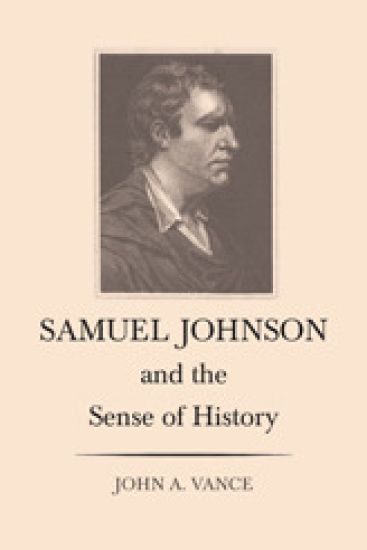
Samuel Johnson and the Sense of History

Samuel Johnson and the Sense of History

John A. Vance

University of Georgia Press
2009
pokkari
No area of Johnsonian studies has been less appreciated and more misunderstood than Johnson's response to history. Popular notions to the effect that he was insensitive to history have discouraged scholars and critics from discovering the role history played in his thinking. In this first book-length investigation of the subject, John A. Vance concludes that few misconceptions about Samuel Johnson have been so glaring as his supposed dislike of history.More specifically, in separate chapters Vance examines the development of Johnson's historical sense—from his readings, heritage, and travels to historical sites; Johnson's recall and use of historical figures and events, most notably the seventeenth-century attitude toward the most maligned member of the historical family, antiquarianism.The author also devotes two chapters to Johnson's historical writings—that is, those works in which he either incorporates history into his critical, biographical, and political discussions or those in which he clearly assumes the role of historian himself. Vance furthermore considers Johnson's views on historical facts, educative and moral history, the broadening scope of historical investigation, the nature of historical truth and skepticism, historical research, historical causation, and the historian's style.
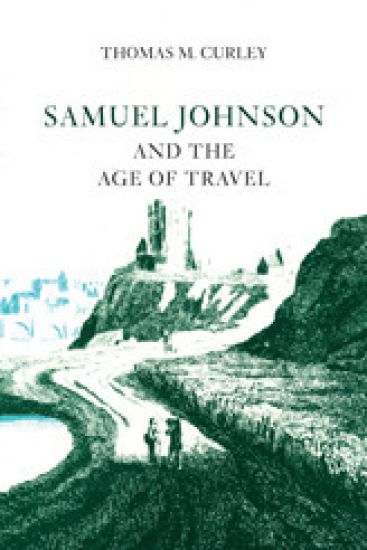
Samuel Johnson and the Age of Travel

Samuel Johnson and the Age of Travel

Thomas M. Curley

University of Georgia Press
2009
pokkari
Although Samuel Johnson's famed ramblings never took him more than five hundred miles from his London home, he was an indefatigable planner of distant voyages. Sharing with his fellow Englishmen that passion for investigating the unknown which had ushered in a momentous geographical revolution, Johnson became the original armchair traveler. His writings proclaim a boundless curiosity about the globe and demonstrate a pervasive preoccupation with travel in every conceivable form. Travel represented more for him than geographical movement; it was a symbol of intellectual growth in his life, his morality, and his society. While Johnson's biographers have all emphasized his fascination with exploration and discovery, no comprehensive study of his complex relationship to the epoch-making geographical advances of his century has heretofore appeared.Thomas Curley's Samuel Johnson and the Age of Travel offers new perspectives on this crucial and surprisingly little-known concern of the man and his age, when English literature brilliantly mirrored the widening frontiers of the British Empire. Drawing extensively on Johnson's entire canon, the works of his contemporaries, and a vast store of much neglected travel books, Curley places Johnson's love of travel and travel literature firmly in its literary and historical contexts.Johnson's career began with the translation of a travel book, yielded numerous articles and essays on the subject in his middle years, and culminated in the publication of his own splendid description of the Highlands in A Journey to the Western Islands of Scotland. Keenly interested in geography, Johnson studied well over two centuries of travel literature to validate his own philosophy of human nature and to promote improved literary standards in what was then the second most popular genre in England. His masterpiece, Rasselas, not only enshrined his recurring vision of man as perpetual explorer but also exemplified that fruitful interaction between travel books and belles-lettres so prevalent throughout Johnson's age.Samuel Johnson and the Age of Travel sheds new light on Johnson's career ambitions, his talents in moral observation and literary creation, and his inquisitive age. Johnson emerges in Curley's study as a truly representative writer completely captivated by the romance of Georgian travel and illustrative of the cultural impact of an expanding world picture upon the minds and letter of eighteenth-century Englishmen.
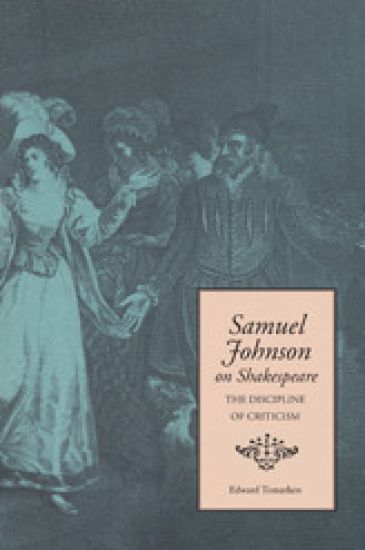
Samuel Johnson on Shakespeare

Samuel Johnson on Shakespeare

Edward Tomarken

University of Georgia Press
2009
pokkari
Since the first appearance of Samuel Johnson's edition of Shakespeare's drama in 1765, its Preface has often been published separately, while the Notes have been treated as miscellaneous and fragmentary. As a result, few modern readers realize that the Notes in fact contain coherent interpretations of most of the plays and that many portions of the Preface are generalizations related to those readings. Scholars who have examined the Notes carefully have almost always used them in studies of larger issues, such as Johnson's morality or rhetoric. In this book, Edward Tomarken provides the first full-length study of the Notes to Shakespeare, showing how they raise issues of direct concern to modern critics and theoreticians.While referring to Johnson's notes on all the Shakespearean dramas, Tomarken focuses on eight plays--Henry IV, Troilus and Cressida, Twelfth Night, The Taming of the Shrew, King Lear, The Tempest, Hamlet, and Macbeth--to demonstrate the range of Johnson's editorial and critical abilities. Each chapter, devoted to a single play, moves from the particular to the general-from specific remarks about the play in the Notes, to related theoretical statements in the Preface, and finally to an axiom of literary theory. Ranging from a formulation concerning ideology in criticism to a reconsideration of aesthetic empathy, these axioms are, Tomarken contends, essential to literary criticism as a discipline and manifest Johnson's relevance to moder
Samuel Johnson's Parliamentary Reporting: Debates in the Senate of Lilliput
This work has been selected by scholars as being culturally important and is part of the knowledge base of civilization as we know it.This work is in the public domain in the United States of America, and possibly other nations. Within the United States, you may freely copy and distribute this work, as no entity (individual or corporate) has a copyright on the body of the work.Scholars believe, and we concur, that this work is important enough to be preserved, reproduced, and made generally available to the public. To ensure a quality reading experience, this work has been proofread and republished using a format that seamlessly blends the original graphical elements with text in an easy-to-read typeface.We appreciate your support of the preservation process, and thank you for being an important part of keeping this knowledge alive and relevant.
Samuel Johnson in Grub Street

Samuel Johnson in Grub Street

Edward Alan 1914- Dn Bloom

Hassell Street Press
2021
sidottu
This work has been selected by scholars as being culturally important and is part of the knowledge base of civilization as we know it.This work is in the public domain in the United States of America, and possibly other nations. Within the United States, you may freely copy and distribute this work, as no entity (individual or corporate) has a copyright on the body of the work.Scholars believe, and we concur, that this work is important enough to be preserved, reproduced, and made generally available to the public. To ensure a quality reading experience, this work has been proofread and republished using a format that seamlessly blends the original graphical elements with text in an easy-to-read typeface.We appreciate your support of the preservation process, and thank you for being an important part of keeping this knowledge alive and relevant.
Samuel Johnson's Parliamentary Reporting: Debates in the Senate of Lilliput
This work has been selected by scholars as being culturally important and is part of the knowledge base of civilization as we know it.This work is in the public domain in the United States of America, and possibly other nations. Within the United States, you may freely copy and distribute this work, as no entity (individual or corporate) has a copyright on the body of the work.Scholars believe, and we concur, that this work is important enough to be preserved, reproduced, and made generally available to the public. To ensure a quality reading experience, this work has been proofread and republished using a format that seamlessly blends the original graphical elements with text in an easy-to-read typeface.We appreciate your support of the preservation process, and thank you for being an important part of keeping this knowledge alive and relevant.
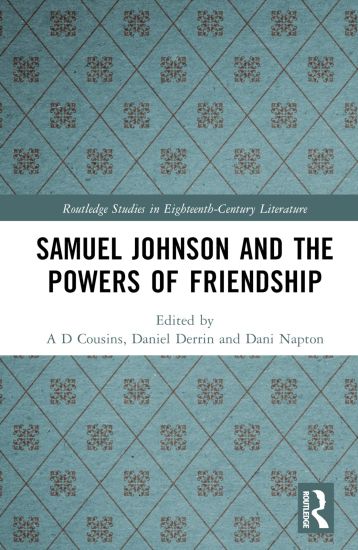
Samuel Johnson and the Powers of Friendship
This book is the first to assess Johnson’s diverse insights into friendship—that is to say, his profound as well as widely ranging appreciation of it—over the course of his long literary career. It examines his engagements with ancient philosophies of friendship and with subsequent reformulations of or departures from that diverse inheritance. The volume explores and illuminates Johnson’s understanding of friendship in the private and public spheres—in particular, friendship’s therapeutic amelioration of personal experience and transformative impact upon civil life. Doing so, it considers both his portrayals of interaction with his friends and his more overtly fictional representations of friendship across the many genres in which he wrote. It presents at once an original re-assessment of Johnson’s writings and new interpretations of friendship as an element of civility in mid-eighteenth-century British culture.
Samuel Johnson and the Powers of Friendship
This book is the first to assess Johnson’s diverse insights into friendship—that is to say, his profound as well as widely ranging appreciation of it—over the course of his long literary career. It examines his engagements with ancient philosophies of friendship and with subsequent reformulations of or departures from that diverse inheritance. The volume explores and illuminates Johnson’s understanding of friendship in the private and public spheres—in particular, friendship’s therapeutic amelioration of personal experience and transformative impact upon civil life. Doing so, it considers both his portrayals of interaction with his friends and his more overtly fictional representations of friendship across the many genres in which he wrote. It presents at once an original re-assessment of Johnson’s writings and new interpretations of friendship as an element of civility in mid-eighteenth-century British culture.
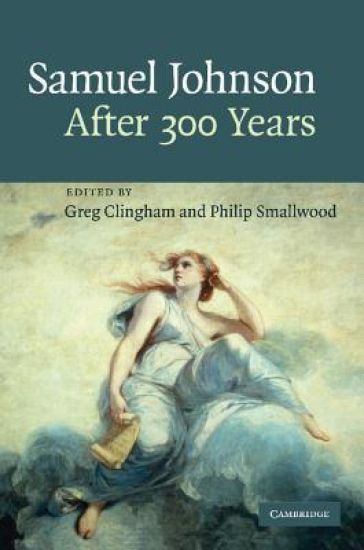
Samuel Johnson after 300 Years

Samuel Johnson after 300 Years

Cambridge University Press
2012
pokkari
To mark the tercentenary of Samuel Johnson's birth in 2009, the specially-commissioned essays contained here review his scholarly reputation. An international team of experts reflects authoritatively on the various dimensions of literary, historical, critical and ethical life touched by Johnson's extraordinary achievement. The volume distinctively casts its net widely and combines consistently innovative thinking on Johnson's historical role with a fresh sense of present criticism. Chapters cover subjects as diverse as Johnson's moral philosophy, his legal thought, his influence on Jane Austen, and the question of the Johnson canon. The contributors examine the larger theoretical and scholarly contexts in which it is now possible to situate his work, and from which it may often be necessary to differentiate it. All the contributors have a distinguished record of scholarship in eighteenth-century studies, Johnson scholarship, and cultural history and theory.