Kirjojen hintavertailu. Mukana 12 571 054 kirjaa ja 12 kauppaa.

Kirjahaku

Etsi kirjoja tekijän nimen, kirjan nimen tai ISBN:n perusteella.

1000 tulosta hakusanalla Spender

Spenser's Allegory

Spenser's Allegory

Isabel Gamble Maccaffrey

Princeton University Press
2016
sidottu
Isabel MacCaffrey contends that, in allegory, the mind makes a model of itself, and she shows that The Faerie Queene, mirroring as it does the mind's structure, is both a treatise on and an example of the central role that imagination plays in human life. Viewing the poem as a model of Spenser's universe, the author investigates the poet's theory of knowledge and the role of imagination in the construction of cosmic models. She begins with a survey of theories of the imagination and the creation of fictions, establishing a context in which allegorical images may be understood throughout the European allegorical tradition to which The Faerie Queene belongs. Isabel MacCaffrey's new readings show that insofar as Spenser's poem concerns modes of knowledge, it offers the reader an anatomy of its own composition, an analysis of imagination in its varied relations to the world. Originally published in 1976. The Princeton Legacy Library uses the latest print-on-demand technology to again make available previously out-of-print books from the distinguished backlist of Princeton University Press. These editions preserve the original texts of these important books while presenting them in durable paperback and hardcover editions. The goal of the Princeton Legacy Library is to vastly increase access to the rich scholarly heritage found in the thousands of books published by Princeton University Press since its founding in 1905.
Spenser and Literary Pictorialism

Spenser and Literary Pictorialism

John B. Bender

Princeton University Press
2016
sidottu
Focusing, framing, scanning--the language of film--and Gombrich's studies in the psychology of perception are used by John Bender to isolate pictorial effects and devices in literature. The theory that he proposes, grounded in his analysis of Spenser, "the painter of poets," discriminates between the descriptive and the pictorial in poetry. Originally published in 1972. The Princeton Legacy Library uses the latest print-on-demand technology to again make available previously out-of-print books from the distinguished backlist of Princeton University Press. These editions preserve the original texts of these important books while presenting them in durable paperback and hardcover editions. The goal of the Princeton Legacy Library is to vastly increase access to the rich scholarly heritage found in the thousands of books published by Princeton University Press since its founding in 1905.

Spenser's Allegory of Justice in Book Five of the Fairie Queen
"The importance of Dunseath's study is that it proposes an original interpretation of the allegory of The Faerie Queene, Book V, and a fresh theory of its poetic function...It brings new material into play, and offers a sensible, integrated reading of many of the poem's most important passages, so that it may well prove a pace-setter for this kind of Spenserian study."--Alastair Fowler, Brasenose College, Oxford. Originally published in 1968. The Princeton Legacy Library uses the latest print-on-demand technology to again make available previously out-of-print books from the distinguished backlist of Princeton University Press. These editions preserve the original texts of these important books while presenting them in durable paperback and hardcover editions. The goal of the Princeton Legacy Library is to vastly increase access to the rich scholarly heritage found in the thousands of books published by Princeton University Press since its founding in 1905.
Spenser, Ronsard, and DuBellay

Spenser, Ronsard, and DuBellay

Alfred W. Satterthwaite

Princeton University Press
2016
sidottu
Although it has been recognized that Edmund Spenser's poetry owes a debt to the work of the French poets of the Pleiade, particularly to Joachim du Bellay and Pierre de Ronsard, there has been no critical analysis of this relationship. Mr. Satterthwaite compares the work of the three poets, showing the relation between the English movement to write quantitative verse and the French experiments in vers mesures. He discusses the attitudes of the poets to their Muses and to contemporary literature, their ideas of time and mutability, their moral (or amoral) views of literature and of life their religious orientation, and their use of the Platonic and neo-Platonic theories that were a part of the inherited culture of the Renaissance. Originally published in 1960. The Princeton Legacy Library uses the latest print-on-demand technology to again make available previously out-of-print books from the distinguished backlist of Princeton University Press. These editions preserve the original texts of these important books while presenting them in durable paperback and hardcover editions. The goal of the Princeton Legacy Library is to vastly increase access to the rich scholarly heritage found in the thousands of books published by Princeton University Press since its founding in 1905.

Spenserian Allegory and Elizabethan Biblical Exegesis

Spenserian Allegory and Elizabethan Biblical Exegesis

Margaret Christian

Manchester University Press
2016
sidottu
Edmund Spenser famously conceded to his friend Walter Raleigh that his method in The Faerie Queene 'will seeme displeasaunt' to those who would 'rather have good discipline delivered plainly in way of precepts, or sermoned at large'. Spenser's allegory and Elizabethan biblical exegesis is the first book-length study to clarify Spenser's comparison by introducing readers to the biblical typologies of contemporary sermons and liturgies. The result demonstrates that 'precepts ... sermoned at large' from lecterns and pulpits were themselves often 'clowdily enwrapped in allegoricall devises'. In effect, routine churchgoing prepared Spenser's first readers to enjoy and interpret The Faerie Queene.A wealth of relevant quotations invites readers to adopt an Elizabethan mindset and encounter the poem afresh. The 'chronicle history' cantos, Florimell's adventures, the Souldan episode, Mercilla's judgment on Duessa and even the two stanzas that close the Mutabilitie fragment, all come into sharper focus when juxtaposed with contemporary religious rhetoric.
Spenserian Satire

Spenserian Satire

Rachel Hile

Manchester University Press
2016
sidottu
Scholars of Edmund Spenser have focused much more on his accomplishments in epic and pastoral than his work in satire. Scholars of early modern English satire almost never discuss Spenser. However, these critical gaps stem from later developments in the canon rather than any insignificance in Spenser's accomplishments and influence on satiric poetry. This book argues that the indirect form of satire developed by Spenser served during and after Spenser's lifetime as an important model for other poets who wished to convey satirical messages with some degree of safety. The book connects key Spenserian texts in The Shepheardes Calender and the Complaints volume with poems by a range of authors in the late sixteenth and early seventeenth centuries, including Joseph Hall, Thomas Nashe, Tailboys Dymoke, Thomas Middleton and George Wither, to advance the thesis that Spenser was seen by his contemporaries as highly relevant to satire in Elizabethan England.An electronic edition of this book is freely available under a Creative Commons (CC BY-NC-ND) licence.
Spencerville

Spencerville

Nelson DeMille

Little, Brown Book Group
2001
nidottu
After twenty-five years of working in the shadowy world of espionage Keith Landry is on his way home. Driving along the highway, humming a few bars of 'Homeward Bound', the twenty-five years' service he has given the US government are fast becoming a distant memory.He is safe. He is alone. And life has never felt sweeter as the signs for hometown Spencerville come into view.Keith Landry has promised himself no more violence, no more death. But a chance meeting with childhood sweetheart Annie Baxter makes it a promise he cannot keep.As passion is rekindled between them, jealousy flares. For Annie is married to a violent and sadistic bully: the man who runs Spencerville, Sheriff Baxter. And he won't tolerate any man near his wife. Especially Keith Landry.
Spenser and Ovid

Spenser and Ovid

Syrithe Pugh

Ashgate Publishing Limited
2005
sidottu
In Spenser and Ovid, Syrithe Pugh gives the first sustained account of Ovid's presence in the Spenser canon, uncovering new evidence to reveal the thematic and formal debts many of Spenser's poems owe to Ovid, particularly when considered in the light of an informed understanding of all of Ovid's work. Pugh's reading presents a challenge to New Historicist assumptions, as she contests both the traditional insistence on Virgil as Spenser's prime classical model and the idea it has perpetuated of Spenser as Elizabeth I's imperial propagandist. In fact, Pugh locates Ovid's importance to Spenser precisely in his counter-Virgilian world view, with its high valuation of faithful love, concern for individual freedom, distrust of imperial rule, and the poet's claim to vatic authority in opposition to political power. Her study spans Spenser's career from the inaugural Shepheardes Calender to what was probably his last poem, The Mutabilitie Cantos, and embraces his work in the genres of pastoral, love poetry, and epic romance.
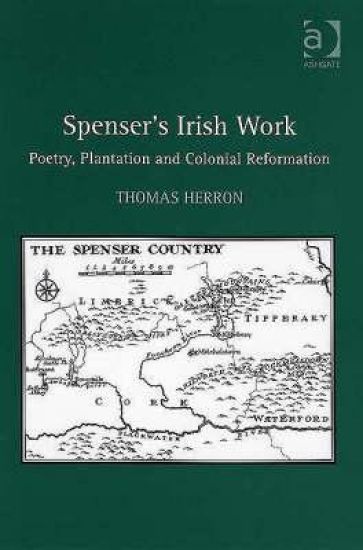
Spenser's Irish Work

Spenser's Irish Work

Thomas Herron

Ashgate Publishing Limited
2007
sidottu
Exploring Edmund Spenser's writings within the historical and aesthetic context of colonial agricultural reform in Ireland, his adopted home, this study demonstrates how Irish events and influences operate in far more of Spenser's work than previously suspected. Thomas Herron explores Spenser's relation to contemporary English poets and polemicists in Munster, such as Sir Walter Raleigh, Ralph Birkenshaw and Parr Lane, as well as heretofore neglected Irish material in Elizabethan pageantry in the 1590s, such as the famously elaborate state performances at Elvetham and Rycote. New light is shed here on the Irish significance of both the earlier and later Books of The Fairie Queene. Herron examines in depth Spenser's adaptation of the paradigm of the laboring artist for empire found in Virgil's Georgics, which Herron weaves explicitly with Spenser's experience as an administrator, property owner and planter in Ireland. Taking in history, religion, geography, classics and colonial studies, as well as early modern literature and Irish studies, this book constitutes a valuable addition to Spenser scholarship.
Spenser and the Poetics of Pastoral

Spenser and the Poetics of Pastoral

David R. Shore

McGill-Queen's University Press
1985
sidottu
The Shepheardes Calender (1579) signalled Spenser's desire to assume the role of an English Virgil and at the same time his readiness to leave behind the pastoral world of his apprenticeship and his early persona, Colin Clout. Yet Spenser was twice to return to the pastoral world of Colin Clout, first in Colin Clouts Come Home Againe (written 1591, published 1595), and then again in the sixth and last complete book of The Faerie Queene. In Spenser and the Poetics of Pastoral, David Shore considers the structure of the moral eclogues of the Calender as it defines the pastoral vision that informs and unifies the entire poem. He then examines the themes of poetic idealism and courtly corruption in Colin Clout and sees in their confrontation Spenser's questioning of the public foundations of the poet's heroic endeavour. Finally, he considers Calidore's pastoral retreat in The Faerie Queene and finds in it support for the argument that Spenser's greatest poem is essentially complete. Pastoral is a highly self-conscious genre, especially in Spenser's explorations of the imaginative world of Colin Clout. By bringing together Spenser's three versions of that world, Spenser and the Poetics of Pastoral contributes to a richer appreciation of the pastoral works themselves and to a better understanding of the shape of Spenser's literary career as a whole.
Spenser's Supreme Fiction

Spenser's Supreme Fiction

Jon A. Quitslund

University of Toronto Press
2001
sidottu
In Spenser's Supreme Fiction, Jon A. Quitslund offers a rich analysis of The Faerie Queene and of several texts contributing to the revival of Platonism stimulated by Marsilio Ficino's labours as a translator and interpreter of Plato and the ancient Neoplatonists. To the old issue of the scope and character of Spenser's Platonism, Quitslund brings fresh insights from contemporary views on gender and identity, intertextuality, and the centrality of fiction within all aspects of Renaissance culture. He argues that Spenser sought authority for his poem by grounding its narrative in a divinely ordained natural order, intelligible in terms derived from the ancient sources of poetry and philosophy. Passages central to the poet's world-making project are shown to be intertextually linked to Book VI of the Aeneid and to Plato's Symposium, regarded in the commentaries of Landino and Ficino as explanations of the gentile prisca theologia, a cosmology parallel to the tenets of Christianity. The first half of the book examines Spenser's representation of the macrocosm and its replication in human nature's lesser world in the light of divergent tendencies within humanism. The legacy of Plato is shown to be especially important in the esoteric tradition, which made the province of natural philosophy part of the soul's itinerary back to its otherworldly origins. In the second half, The Faerie Queene is interpreted as an unfolding pattern: the dynamic order of nature is flawed but not fallen, and seen against that background, human culture contains in its myths and images both corruptions of natural impulses and aspirations to transcend the limits imposed by mortality.
Spenser's Ruins and the Art of Recollection

Spenser's Ruins and the Art of Recollection

Rebeca Helfer

University of Toronto Press
2012
sidottu
What is the art of memory? Rebeca Helfer's intertextual study Spenser's Ruins and the Art of Recollection offers a fresh perspective on the significance of this ancient mnemonic technique to Edmund Spenser's writing and, through this lens, explores the art’s complex historical and literary reception. Beginning with the origins of mnemonic strategies in epic tales, Helfer examines how the art of memory speaks to debates about poetry and its place in culture from Plato to Spenser's present day. As Helfer argues, ruins provide memorial spaces for an ongoing dialogue about how story relates to history, and how both relate to edification and empire-building. Through detailed, intertextual readings of The Shepheardes Calender, The Faerie Queene, the Complaints, and other Spenserian works, Helfer demonstrates how the art of memory shapes Spenser's theory and practice of poetry as well as his political view, throughout his career. More broadly, Spenser's Ruins and the Art of Recollection points to new ways of understanding the importance of this art within literary studies.
Slenderman

Slenderman

Kathleen Hale

GROVE PRESS / ATLANTIC MONTHLY PRESS
2022
sidottu
The first full account of the Slenderman stabbing, a true crime narrative of mental illness, the American judicial system, the trials of adolescence, and the power of the internetOn May 31, 2014, in the Milwaukee suburb of Waukesha, Wisconsin, two twelve-year-old girls attempted to stab their classmate to death. Morgan Geyser and Anissa Weier's violence was extreme, but what seemed even more frightening was that they committed their crime under the influence of a figure born by the internet: the so-called "Slenderman." Yet the even more urgent aspect of the story, that the children involved suffered from undiagnosed mental illnesses, often went overlooked in coverage of the case.Slenderman: Online Obsession, Mental Illness, and the Violent Crime of Two Midwestern Girls tells that full story for the first time in deeply researched detail, using court transcripts, police reports, individual reporting, and exclusive interviews. Morgan and Anissa were bound together by their shared love of geeky television shows and animals, and their discovery of the user-uploaded scary stories on the Creepypasta website could have been nothing more than a brief phase. But Morgan was suffering from early-onset childhood schizophrenia. She believed that she had seen Slenderman long before discovering him online, and the only way to stop him from killing her family was to bring him a sacrifice: Morgan's best friend Payton "Bella" Leutner, whom Morgan and Anissa planned to stab to death on the night of Morgan's twelfth birthday party. Bella survived the attack, but was deeply traumatized, while Morgan and Anissa were immediately sent to jail, and the severity of their crime meant that they would be prosecuted as adults. There, as Morgan continued to suffer from worsening mental illness after being denied antipsychotics, her life became more and more surreal.Slenderman is both a page-turning true crime story and a search for justice.
Spenser and the Discourses of Reformation England

Spenser and the Discourses of Reformation England

Richard Mallette

University of Nebraska Press
1997
sidottu
Spenser and the Discourses of Reformation England is a wide-ranging exploration of the relationships among literature, religion, and politics in Renaissance England. Richard Mallette demonstrates how one of the great masterpieces of English literature, Edmund Spenser's The Faerie Queene, reproduces, criticizes, parodies, and transforms the discourses of England during that remarkable political and literary era. According to Mallette, The Faerie Queene not only represents Reformation values but also challenges, questions, and frequently undermines Protestant assumptions. Building upon recent scholarship, particularly new historicism, Protestant poetics, feminism, and gender theory, this ambitious study traces The Faerie Queene's linkage of religion to political and social realms. Mallette's study expands traditional theological conceptions of Renaissance England, showing how the poem incorporates and transmutes religious discourses and thereby tests, appraises, and questions their avowals and assurances. The book's focus on religious discourses leads Mallette to examine how such matters as marriage, gender, the body, revenge, sexuality, and foreign policy were represented—in both traditional and subversive ways—in Spenser's influential masterpiece. A bold and finely argued contribution to our understanding of Spenser, Reformation thought, and Renaissance literature and society, Mallette's study will add to the ongoing reassessment of England during this important period.
Spenser Allusions

Spenser Allusions

The University of North Carolina Press
2011
nidottu
The chronological arrangement of entries depends on the earliest-known appearance of each allusion: in manuscript, under year of composition; in book form, under year of publication. The usefulness of the catalog is increased by alphabetical indexes of the names of allusion makers and the titles of works in which the allusion appear, the names of persons alluded to, and the Spenserian passage to which individual allusions occur. Originally published in 1973. A UNC Press Enduring Edition -- UNC Press Enduring Editions use the latest in digital technology to make available again books from our distinguished backlist that were previously out of print. These editions are published unaltered from the original, and are presented in affordable paperback formats, bringing readers both historical and cultural value.
Sender

Sender

Ike Holter

Northwestern University Press
2019
nidottu
Ike Holter’s Sender thrives on the contrast between order and chaos and the tensions that emerge as we leave childhood and adolescence behind to contend with the demands of “adulting.” In this comedy, Holter presents us with four millennial friends wrestling with these issues. While each is at a different stage of “growing up,” one of the friends has disappeared and has been presumed dead. Yet, at the beginning of the play, he returns and completely upends the balance established in his absence. This witty, foul mouthed, and razor-sharp play asks: “What does growing up mean . . . and is it even desired in this day and age?”Sender is one of seven plays in Holter’s Rightlynd Saga, all to be published by Northwestern University Press. Modeled on August Wilson’s iconic series exploring African American life in Pittsburgh, Holter’s plays are set in Chicago’s fictional fifty-first ward. The other plays in the cycle are Exit Strategy, Lottery Day, Prowess, Red Rex, Rightlynd, and The Wolf at the End of the Block.
Sendero Luminoso in Context

Sendero Luminoso in Context

John M. Bennett

Scarecrow Press
1998
sidottu
El Sendero Luminoso—The Shining Path—is Peru's long-standing Maoist revolutionary group that has significantly shifted the entire landscape of Peruvian political, social, and cultural life in fundamental ways. Emerging from the fractured leftist movements of the 1960s, The Shining Path has garnered world-wide attention as a unique, self-sufficient revolutionary group. The focus of the bibliography is on major works dealing with The Shining Path, articles and studies published in Latin American and other related scholarly journals, and Peruvian books that deal directly with the effects wrought by The Shining Path upon Peru. Also included are titles that do not deal directly with The Shining Path but discuss in depth the political context which nurtured the development of revolutionary groups such as The Shining Path and MRTA (Tupac Amaru), the Peruvian guerrilla group that captured world attention in 1997 by holding the Japanese embassy hostage for months. Approximately 1500 entries are included in this thorough bibliography. Short annotations highlight important aspects of the source. The bibliography is segmented into helpful subject areas that provide a cohesive sphere of information concerning the intersections of The Shining Path and Peruvian life, as well as interest in the revolutionary movement abroad. A helpful index completes this work.
Spencer'S Amoretti

Spencer'S Amoretti

William Clarence Johnson

Bucknell University Press,U.S.
1990
sidottu
This work analyzes Spenser's setting of the entire Amoretti courtship against a backdrop of sacred time and his efforts to demonstrate the interpenetration of the divine and the human. The eighty-nine sonnets are shown to be sequential in their complex pattern of balanced themes, structural frameworks, developing images, and clusters of etymological wordplay.