Education for all is a bold, audacious statement. But that is the very goal of open education. Can you imagine a world where access to education materials is free? Where teachers and learners have the right to reuse, revise, remix, localize and translate those materials? Where copies of textbooks and course materials can be retained without cost? Can you imagine a world where teachers and learners co-create education together? A world where learners engage in assignments that generate global public goods benefiting everyone? You may say this isn't possible, but open educators around the world have been doing this for years. Building on the work of luminaries such as those featured in this book, open education has grown into a global movement transforming education. Each year, Open Education Global opens up nominations for awards to the entire global open education community. As part of the 10th anniversary of these awards, OEGlobal is publishing this Education For All book, collecting all ten years of award winners into a single volume. This book is a celebration of their achievements.
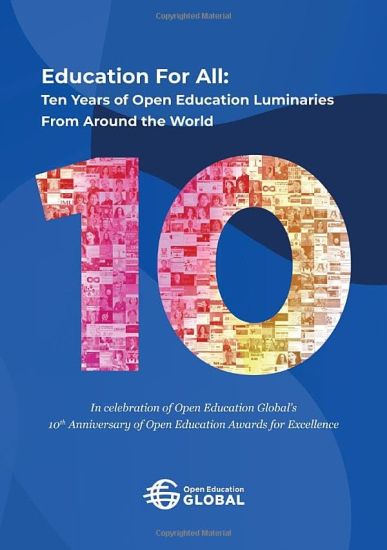
Education for all is a bold, audacious statement. But that is the very goal of open education. Can you imagine a world where access to education materials is free? Where teachers and learners have the right to reuse, revise, remix, localize and translate those materials? Where copies of textbooks and course materials can be retained without cost? Can you imagine a world where teachers and learners co-create education together? A world where learners engage in assignments that generate global public goods benefiting everyone? You may say this isn't possible, but open educators around the world have been doing this for years. Building on the work of luminaries such as those featured in this book, open education has grown into a global movement transforming education. Each year, Open Education Global opens up nominations for awards to the entire global open education community. As part of the 10th anniversary of these awards, OEGlobal is publishing this Education For All book, collecting all ten years of award winners into a single volume. This book is a celebration of their achievements.
This work has been selected by scholars as being culturally important and is part of the knowledge base of civilization as we know it.This work is in the public domain in the United States of America, and possibly other nations. Within the United States, you may freely copy and distribute this work, as no entity (individual or corporate) has a copyright on the body of the work.Scholars believe, and we concur, that this work is important enough to be preserved, reproduced, and made generally available to the public. To ensure a quality reading experience, this work has been proofread and republished using a format that seamlessly blends the original graphical elements with text in an easy-to-read typeface.We appreciate your support of the preservation process, and thank you for being an important part of keeping this knowledge alive and relevant.
The Philosophy of Hegel by W.T. Stace is a comprehensive overview of the philosophical ideas and concepts developed by the German philosopher Georg Wilhelm Friedrich Hegel. Stace provides a detailed analysis of Hegel's philosophy, including his views on metaphysics, epistemology, ethics, and political theory.The book begins with an introduction to Hegel's life and work, followed by a discussion of his philosophical method, which is based on the idea of dialectical reasoning. Stace then delves into Hegel's ideas on the nature of reality, including his famous concept of the Absolute Spirit.The book also covers Hegel's views on knowledge and perception, as well as his theories of morality and freedom. Stace explores Hegel's political philosophy, including his ideas on the state and civil society, and the relationship between individual freedom and social order.Overall, The Philosophy of Hegel provides a detailed and accessible introduction to the ideas of one of the most influential philosophers in Western thought. It is an essential read for anyone interested in the history of philosophy or the development of modern Western thought.This is a new release of the original 1924 edition.This scarce antiquarian book is a facsimile reprint of the old original and may contain some imperfections such as library marks and notations. Because we believe this work is culturally important, we have made it available as part of our commitment for protecting, preserving, and promoting the world's literature in affordable, high quality, modern editions, that are true to their original work.
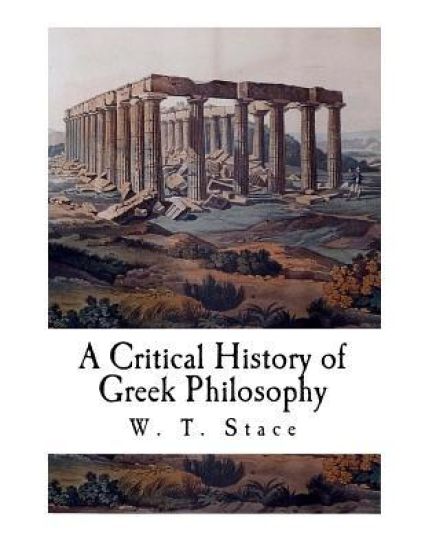
A Critical History of Greek Philosophy by W. T. Stace. A Great Introduction to Philosophy. This book contains the substance, and for the most part the words, of a course of public lectures delivered during the first three months of 1919. The original division into lectures has been dropped, the matter being more conveniently redivided into chapters. The audience to whom the lectures were delivered was composed of members of the general public, and not only of students. For the most part they possessed no previous knowledge of philosophy. Hence this book, like the original lectures, assumes no previous special knowledge, though it assumes, of course, a state of general education in the reader. Technical philosophical terms are carefully explained when first introduced; and a special effort has been made to put philosophical ideas in the clearest way possible. But it must be remembered that many of the profoundest as well as the most difficult of human conceptions are to be found in Greek philosophy. Such ideas are difficult in themselves, however clearly expressed. No amount of explanation can ever render them anything but difficult to the unsophisticated mind, and anything in the nature of "philosophy made easy" is only to be expected from quacks and charlatans.
The Economic Impacts of the Advanced Encryption Standard, 1996-2017 evaluates the net social benefits of advanced encryption standards (AES). This is one of many areas where the National Institute for Standards and Technology (NIST) has promoted innovation and industrial competitiveness to ensure that public and private computer systems can protect the confidentiality, availability, and integrity of digital information in the face of ever more powerful computers and developments in the field of cryptography.After an introductory chapter, Chapter 2 provides the ABCs of cryptography as it applies to the AES and an introduction to the computer networks that employ encryption systems. It further delves into the evolution of NIST's role as the Federal Government's authority on the computer security of civilian-focused agencies, the AES competition (1997-2000), and subsequent cryptographic validation programs including what these validation programs reveal about the composition of the encryption product market. Chapter 3 characterizes how the AES program and subsequent dependent industry standards have functioned as economic policy tools that reduced the economic barriers of the 1990s to the development, commercialization, and application of cryptographic technologies, as well as their continuing indirect role in supporting the quality of encryption systems, reducing encryption system risks, and facilitating the growth of related industries. This chapter also places the AES program in an industrial organizational context by describing the economic value chain of which the AES program is a part. Chapter 4 discusses the selection of pre-survey interviews with subject matter experts, the design of the survey instrument, and survey execution. Chapter 5 describes survey results, compares selected qualitative survey findings to pre-survey expectations, describes the three-tiered approach to estimating economic impact in context of actual survey results, and reports the costs of NIST's AES program for 1996-2017. Chapter 6 presents the results of the three-tiered approach to estimating the overall economic impacts of the AES program. Chapter 7 provides a summary and conclusion of the analysis.
Qualitative Methods in Public Health: A Field Guide for Applied Research, 2nd Edition provides a practical orientation to conducting effective qualitative research in the public health sphere. With thorough examination and simple explanations, this book guides you through the logic and workflow of qualitative approaches, with step-by-step guidance on every phase of the research. Students learn how to identify and make use of theoretical frameworks to guide your study, design the study to answer specific questions, and achieve their research goals. Data collection, analysis, and interpretation are given close attention as the backbone of a successful study, and expert insight on reporting and dissemination helps you get your work noticed. This second edition features new examples from global health, including case studies specifically illustrating study design, web and mobile technologies, mixed methods, and new innovations in information dissemination. Pedagogical tools have been added to help enhance your understanding of research design and implementation, and extensive appendices show you how these concepts work in practice. Qualitative research is a powerful tool for public health, but it's very easy to get it wrong. Careful study design and data management are critical, and it's important to resist drawing conclusions that the data cannot support. This book shows you how to conduct high-quality qualitative research that stands up to review.
Washington State University (WSU) is a remarkable place, over the years educating hundreds of thousands, conducting innovative research in a wide variety of disciplines, and earning numerous intercollegiate athletics titles. Originally named The Agricultural College, Experiment Station and School of Science of the State of Washington, the school first opened on a wintry 1892 morning with six professors. Today, the institution has more than 2,600 faculty positions and annually awards over 7,000 degrees on multiple campuses--now exceeding 260,000 total since its first graduating class of seven.In Leading the Crimson and Gray, multiple authors chronicle the lives and legacies of those who served in one of WSU's most visible roles--president. These executives were responsible for raising funds, shaping strategic visions, addressing faculty and student concerns, attending to fiscal issues, and interacting with lawmakers and business leaders. There were early bitter battles over the Pullman location and curriculum. Other eras brought student unrest and social upheaval, wars, protests, and severe economic depression and recession.Their accomplishments were substantial. Early presidents launched the college, expanded the academic program beyond agriculture and science, established general education requirements, and took key steps toward eventual university status. Later presidents supported athletic achievement, strengthened enrollment, obtained legislative support for a capital construction bond referendum, increased research grants and contracts, completed major construction projects, effectively faced massive state allocation cuts, and won bipartisan state legislative backing for a new medical school. Combined, George W. Lilley, John W. Heston, Enoch A. Bryan, Ernest O. Holland, Wilson M. Compton, C. Clement French, W. Glenn Terrell, Samuel H. Smith, V. Lane Rawlins, and Elson S. Floyd left a legacy that makes the Cougar Nation proud.
Washington State University (WSU) is a remarkable place, over the years educating hundreds of thousands, conducting innovative research in a wide variety of disciplines, and earning numerous intercollegiate athletics titles. Originally named The Agricultural College, Experiment Station and School of Science of the State of Washington, the school first opened on a wintry 1892 morning with six professors. Today, the institution has more than 2,600 faculty positions and annually awards over 7,000 degrees on multiple campuses--now exceeding 260,000 total since its first graduating class of seven.In Leading the Crimson and Gray, multiple authors chronicle the lives and legacies of those who served in one of WSU's most visible roles--president. These executives were responsible for raising funds, shaping strategic visions, addressing faculty and student concerns, attending to fiscal issues, and interacting with lawmakers and business leaders. There were early bitter battles over the Pullman location and curriculum. Other eras brought student unrest and social upheaval, wars, protests, and severe economic depression and recession.Their accomplishments were substantial. Early presidents launched the college, expanded the academic program beyond agriculture and science, established general education requirements, and took key steps toward eventual university status. Later presidents supported athletic achievement, strengthened enrollment, obtained legislative support for a capital construction bond referendum, increased research grants and contracts, completed major construction projects, effectively faced massive state allocation cuts, and won bipartisan state legislative backing for a new medical school. Combined, George W. Lilley, John W. Heston, Enoch A. Bryan, Ernest O. Holland, Wilson M. Compton, C. Clement French, W. Glenn Terrell, Samuel H. Smith, V. Lane Rawlins, and Elson S. Floyd left a legacy that makes the Cougar Nation proud.