Vse znajut skazku bratev Grimm "Belosnezhka i sem gnomov". Znamenitaja detskaja pisatelnitsa Sofja Prokofeva sozdala na ee osnove tselyj tsikl novykh prikljuchenij Belosnezhki. Pervuju iz skazok etogo tsikla my i predlagaem vashemu vnimaniju.Skazka "Belosnezhka i prints Teodor" povestvuet o prekrasnoj docheri korolja, kotoruju prijutili v lesu gnomy, spasaja ot gneva zloj machekhi, korolevy Morgandy. I kakie by kozni ni stroila koroleva svoej padcheritse, dobroe serdtse Belosnezhki, druzheljubie gnomov i ljubov printsa Teodora preodolejut vse nevzgody i koldovskie chary.Dlja mladshego shkolnogo vozrasta.
O cuidado e o carinho, o amor e a responsabilidade de se ter um pet convivendo conosco em nosso lar, t o importante como o cuidado e respeito com os seres humanos. Nascemos todos para aprender a li o de amar.
Teodora era una mujer casada que vivia en Egipto. Un joven enamorado de ella recurrio a una hechicera que con pocimas y palabras la sedujo. Tras el incidente la santa tomo ropas de hombre, entro en un monasterio y haciendose llamar Teodoro admiro a todos con su devocion. Poco despues una ventera del lugar la acuso de ser el padre del hijo que habia tenido con un viajero. Y, sorprendentemente, Teodora acepto la paternidad del nino, abandono expulsada el convento, y cuido de la criatura como si de su hijo se tratase. Pasados unos anos, suplico de nuevo la entrada en el monasterio donde fue admitida con la condicion de no abandonar nunca su celda. Solo tras su muerte se descubrio que era una mujer. Se cuenta que el nino que Teodora cuido llego con el tiempo a ser abad del monasterio.
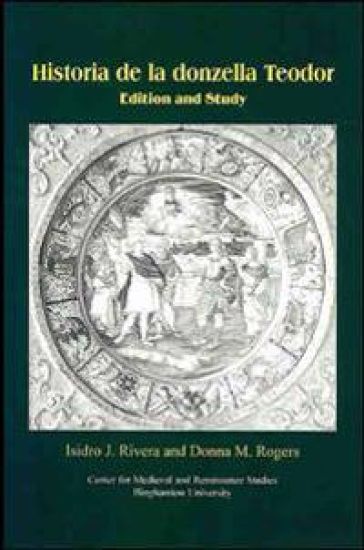
The first English edition and critical study of an anonymous thirteenth-century text about the disputations of a learned young woman with a series of wise men. This is the first English edition and critical study of the Historia de la Donzella Teodor, an anonymous thirteenth-century text about the disputations of a learned young woman with a series of wise men. The text recounts the story of a young slave who is offered to the king in the hopes of saving her master from financial ruin. Intrigued by claims of her superior intelligence, the Caliph orders his court scholars to quiz the girl, Teodor, who, in each of the examinations, demonstrates unparalleled skills and triumphs over the scholars. Based on the five extant manuscripts of the thirteenth-century Teodor, the present edition will be of immediate interest to scholars and students of medieval Spanish literature and a valuable resource for those interested in Hispano-Arabic literary and cultural contact, and-due to the complete semi-paleographic transcriptions of all the witnesses-to historical linguists. Since the critical material is in English, it will reach an audience beyond the Iberian peninsula, and further comparative research in medieval literary studies.
En berättelse från en trolig och visionär om den dolda verkligheten för alla de människor som en gång har deltagit i eller betraktat krigshändelser i sin närmiljö. Och som ett faktum av detta kunnat göra det till en verklihet som ligger just runt ditt eget kvartershörn. Här möter vi de lite småborgerliga paret Greta och Zoran. De kommer från olika världar, men möts och blir så småningom en del av ett större sammanhang. Vi möter Gretas föräldrar som haft en restaurang. Denna var egentligen en kuliss för andra aktiviter. Vidare möter vi många av Zorans vänner eller skall vi kalla dem sammanarbetspartners. Det blir en resa i Italien och genom Europa och tillbaka hemmet i Pesaro.
Almayer's Folly, published in 1895, is Joseph Conrad's first novel. Set in the late 19th century, it centers on the life of the Dutch trader Kaspar Almayer in the Borneo jungle and his relationship to his mixed heritage daughter Nina.Plot Almayer's Folly is about a poor businessman who dreams of finding a hidden gold mine and becoming very wealthy. He is a white European, married to a native Malayan; they have one daughter named Nina. He fails to find the goldmine, and comes home saddened. Previously, he had heard that the British were to conquer the Pantai River, and he had built a large, lavish house near where he resided at the time, in order to welcome the invading country to the native land. However, the conquest never took place, and the house remained unfinished. Some passing Dutch seamen had called the house "Almayer's Folly". Now, Almayer continually goes out for long trips, but eventually he stops doing so and stays home with his hopeless daydreams of riches and splendor. His native wife loathes him for this. One day, a Malayan prince, Dain Maroola, came to see Almayer about trading, and while there he falls in love with Nina. Mrs. Almayer kept arranging meetings for Nina and Dain. She wanted them to marry so her daughter could stay native, because she was highly distrustful of the white men and their ways. Dain left but vowed to return to help Almayer find the gold mine. When he does return, he goes straight to Lakamba, a Malayan rajah, and told him that he found the gold mine and that some Dutchmen had captured his ship. The rajah tells him to kill Almayer before the Dutch arrive because he is not needed to find the gold now. The following morning, an unidentifiable native corpse is found floating in the river, wearing an ankle bracelet very similar to Dain's. Almayer was distraught because Dain was his only chance at finding the secret mine. (The corpse was actually of his slave, who had died when a canoe overturned. Mrs. Almayer suggested that Dain put his anklet and ring on the body.)....... Joseph Conrad (Polish pronunciation: born Jozef Teodor Konrad Korzeniowski; 3 December 1857 - 3 August 1924) was a Polish-British writer regarded as one of the greatest novelists to write in the English language.He joined the British merchant marine in 1878, and was granted British nationality in 1886. Though he did not speak English fluently until he was in his twenties, he was a master prose stylist who brought a non-English sensibility into English literature. He wrote stories and novels, many with a nautical setting, that depict trials of the human spirit in the midst of an impassive, inscrutable universe. Conrad is considered an early modernist, though his works still contain elements of 19th-century realism. His narrative style and anti-heroic characters have influenced many authors, including T. S. Eliot, William Faulkner, Graham Greene, and Salman Rushdie. Many films have been adapted from, or inspired by, Conrad's works. Writing in the heyday of the British Empire, Conrad drew on, among other things, his native Poland's national experiences, and his personal experiences in the French and British merchant navies, to create short stories and novels that reflect aspects of a European-dominated world - including imperialism and colonialism - while profoundly exploring human psychology............
The Nigger of the 'Narcissus': A Tale of the Sea (1897) is a novella by Joseph Conrad. Because of its quality compared to earlier works, some have described it as marking the start of Conrad's major, or middle, period;others have placed it as the best work of his early, or first, period. Preface--The author's preface to the novel, regarded as a manifesto of literary impressionism, is considered one of Conrad's most significant pieces of non-fiction writing.This preface begins with the line: "A work that aspires, however humbly, to the condition of art should carry its justification in every line". **Plot** The title character, James Wait, is a dying West Indian black sailor on board the merchant ship Narcissus sailing from Bombay to London. Wait, suffering from tuberculosis, becomes seriously ill during the voyage, and his plight arouses the humanitarian sympathies of many of the crew. However, the ship's master Captain Alistoun and an old sailor named Singleton remain concerned primarily with their duties and appear indifferent to Wait's condition. Off the Cape of Good Hope the ship capsizes onto her beam-ends with half her hull submerged, and the crew clings onto the deck for an entire night and day, waiting in silence for the ship to turn over the rest of the way and sink. Alistoun refuses to allow the masts to be severed, which might allow the hull to right itself. Five of the men, realizing that Wait is unaccounted for, climb down to his cabin and rescue him at their own peril. When the storm passes and a wind returns, Alistoun directs the weary men to catch the wind, which succeeds in righting the ship. Later in the voyage Alistoun prevents a near-mutiny led by a slippery Cockney named Donkin. Wait eventually succumbs and dies within sight of land, as Singleton had predicted he would. **History** The work, written in 1896 and partly based on Conrad's experiences of a voyage from Bombay to London, began as a short story but developed into a novella of some 53,000 words. As it grew, Conrad began to think of its being serialized. After Smith Elder had rejected it for the Cornhill Magazine, William Ernest Henley accepted it for the New Review, and Conrad wrote to his agent, Garnett, "Now I have conquered Henley, I ain't 'fraid o' the divvle himself " Some years later, in 1904, Conrad described this acceptance as "the first event in my writing life which really counted".In the United States, the novel was first published under the title The Children of the Sea: A Tale of the Forecastle, at the insistence by the publisher, Dodd, Mead and Company, that no one would buy or read a book with the word "nigger" in its title, not because the word was deemed offensive, but because a book about a black man would not sell.In 2009, WordBridge Publishing published a new edition titled The N-Word of the Narcissus, which completely excised the word "nigger" from the text. According to the publishers, the offensive word may have led readers to avoid the book, and thus by getting rid of it the work was made more accessible. 8] Although praised by some, others denounced the change as censorship. Joseph Conrad (Polish pronunciation: born Jozef Teodor Konrad Korzeniowski; 3 December 1857 - 3 August 1924) was a Polish-British writer regarded as one of the greatest novelists to write in the English language.He joined the British merchant marine in 1878, and was granted British nationality in 1886. Though he did not speak English fluently until he was in his twenties, he was a master prose stylist who brought a non-English sensibility into English literature. He wrote stories and novels, many with a nautical setting, that depict trials of the human spirit in the midst of an impassive, inscrutable universe. Conrad is considered an early modernist, though his works still contain elements of 19th-century realism. ....
The 18th century was a wealth of knowledge, exploration and rapidly growing technology and expanding record-keeping made possible by advances in the printing press. In its determination to preserve the century of revolution, Gale initiated a revolution of its own: digitization of epic proportions to preserve these invaluable works in the largest archive of its kind. Now for the first time these high-quality digital copies of original 18th century manuscripts are available in print, making them highly accessible to libraries, undergraduate students, and independent scholars.The Age of Enlightenment profoundly enriched religious and philosophical understanding and continues to influence present-day thinking. Works collected here include masterpieces by David Hume, Immanuel Kant, and Jean-Jacques Rousseau, as well as religious sermons and moral debates on the issues of the day, such as the slave trade. The Age of Reason saw conflict between Protestantism and Catholicism transformed into one between faith and logic -- a debate that continues in the twenty-first century.++++The below data was compiled from various identification fields in the bibliographic record of this title. This data is provided as an additional tool in helping to insure edition identification: ++++British LibraryT121537The preface signed in MS.: J. T. van der Kemp.Edin i.e. Edinburgh]: expressus typis Ad. Neill et Sociorum, prostat Londini Caroli Dilly, 1781. xv, 1],527, 1]p.; 8
In the decades following the collapse of state socialism at the end of 1980s, disabled people in Central and Eastern Europe endured economic marginalisation, cultural devaluation and political disempowerment. Some of the mechanisms producing these injustices were inherited from state socialism, while others emerged with postsocialist neoliberalisation.State socialism promised social security guaranteed by the public, and postsocialist neoliberalisation promised independent living underpinned by the market. This book argues that both promises failed as far as disabled people were concerned, drawing on a wide range of scholarly reports and analyses, policy documents, legislation, and historical accounts, as well as on disability studies and social justice theory. Besides differences, the book also illuminates continuities between state socialism and postsocialist capitalism, providing on this basis a more general and historically grounded critique of contemporary neoliberalisation and its impact on individual and collective life.The book will appeal to anyone interested in disability studies and postsocialism, as well as social policy, social movements and critical theory. It will also be of interest to professionals involved in disability-related service provision, as well as to disability activists and policy makers.
Problems in Real Analysis: Advanced Calculus on the Real Axis features a comprehensive collection of challenging problems in mathematical analysis that aim to promote creative, non-standard techniques for solving problems. This self-contained text offers a host of new mathematical tools and strategies which develop a connection between analysis and other mathematical disciplines, such as physics and engineering. A broad view of mathematics is presented throughout; the text is excellent for the classroom or self-study. It is intended for undergraduate and graduate students in mathematics, as well as for researchers engaged in the interplay between applied analysis, mathematical physics, and numerical analysis. Key features: *Uses competition-inspired problems as a platform for training typical inventive skills; *Develops basic valuable techniques for solving problems in mathematical analysis on the real axis and provides solid preparation for deeper study of real analysis; *Includes numerous examples and interesting, valuable historical accounts of ideas and methods in analysis; *Offers a systematic path to organizing a natural transition that bridges elementary problem-solving activity to independent exploration of new results and properties.
Height 1079 was the name of the mountain where the nine members of the Dyatlov trekking group perished in 1959. The bizarre circumstances of their death and the ensuing frenzy surrounding the incident brought to attention the original name given to the place by the local Mansi people - Kholat Syakhl, or Dead (Barren) Mountain. Until now, there has been no plausible explanation of what actually happened on that fateful night of February 1, 1959. This book offers a startling new theory, based on well-documented evidence rather than wild speculations, that finally ties together all of known facts about the Dyatlov mystery into a credible sequence of causes and effects.This book is available in Russian https: //www.amazon.com/dp/B08V3GYL9V