Kirjojen hintavertailu. Mukana 11 433 407 kirjaa ja 12 kauppaa.

Kirjahaku

Etsi kirjoja tekijän nimen, kirjan nimen tai ISBN:n perusteella.

1000 tulosta hakusanalla Wauter Mannaert

Water, Climate Change and the Boomerang Effect
In line with COP21 agreements, state-led climate change mitigation and adaptation actions are being undertaken to transition to carbon-neutral, green economies. However, the capacity of many countries for action is limited and may result in a ‘boomerang effect’, defined as the unintended negative consequences of such policies and programmes on local communities and their negative feedbacks on the state. To avoid this effect, there is a need to understand the policy drivers, decision-making processes, and impacts of such action, in order to determine the ways and means of minimizing negative effects and maximizing mutually beneficial policy outcomes. This book directly engages the policy debates surrounding water resources and climate actions through both theoretical and comparative case studies. It develops the ‘boomerang effect’ concept and sets it in relation to other conceptual tools for understanding the mixed outcomes of state-led climate change action, for example ‘backdraft’ effect and ‘maldevelopment’. It also presents case studies illustrative of the consequences of ill-considered state-led policy in the water sector from around the world. These include Africa, China, South Asia, South America, the Middle East, Turkey and Vietnam, and examples of groundwater, hydropower development and forest hydrology, where there are often transboundary consequences of a state's policies and actions. In this way, the book adds empirical and theoretical insights to a still developing debate regarding the appropriate ways and means of combating climate change without undermining state and social development.
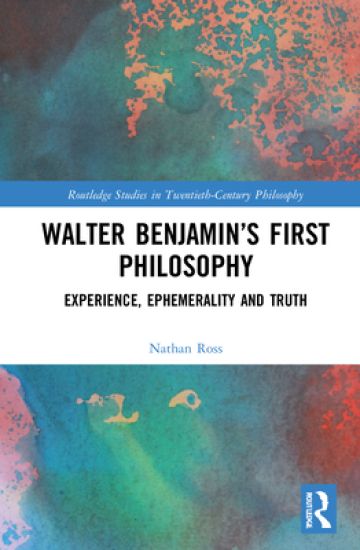
Walter Benjamin’s First Philosophy
This book provides a study of Walter Benjamin’s first philosophy in two senses: it focuses on his early philosophy as a source of insight into his later works, and it explores his thinking about the nature of truth, method, experience, the relation of body and mind, and the limits of human knowledge.While most attention is paid to Benjamin’s later works, his writings from roughly 1914-1925 explore philosophical themes and develop a critical method. This book argues that this early work founds a series of original and lasting questions and insights. Benjamin understands experience as a broken continuum of diverse forms of spiritual expression, each of which is ephemeral. This leads Benjamin to a series of thought figures: the notion of language as a medium of experience; a philosophy of perception based in the natural history of the human body; an emphasis on mimesis as a faculty of creative assimilation; and a discovery of memory as a power for excavation of meaning in past experience. This book demonstrates that the need for a new understanding of the metaphysical structure of experience, as well as a new conception of truth, play a special role in shaping Benjamin’s subsequent work.Walter Benjamin’s First Philosophy will be of interest to scholars and advanced students working on the thought of Walter Benjamin, 20th-century Continental philosophy, comparative literature, and modern German thought.
Walter Benjamin’s First Philosophy

Walter Benjamin’s First Philosophy

Nathan Ross

TAYLOR FRANCIS LTD
2023
nidottu
This book provides a study of Walter Benjamin’s first philosophy in two senses: it focuses on his early philosophy as a source of insight into his later works, and it explores his thinking about the nature of truth, method, experience, the relation of body and mind, and the limits of human knowledge.While most attention is paid to Benjamin’s later works, his writings from roughly 1914-1925 explore philosophical themes and develop a critical method. This book argues that this early work founds a series of original and lasting questions and insights. Benjamin understands experience as a broken continuum of diverse forms of spiritual expression, each of which is ephemeral. This leads Benjamin to a series of thought figures: the notion of language as a medium of experience; a philosophy of perception based in the natural history of the human body; an emphasis on mimesis as a faculty of creative assimilation; and a discovery of memory as a power for excavation of meaning in past experience. This book demonstrates that the need for a new understanding of the metaphysical structure of experience, as well as a new conception of truth, play a special role in shaping Benjamin’s subsequent work.Walter Benjamin’s First Philosophy will be of interest to scholars and advanced students working on the thought of Walter Benjamin, 20th-century Continental philosophy, comparative literature, and modern German thought.
Water Management in China’s Power Sector

Water Management in China’s Power Sector

Xiawei Liao; Jim W. Hall

TAYLOR FRANCIS LTD
2023
nidottu
This book examines water resource management in China’s electric power sector and the implications for energy provision in the face of an emerging national water crisis and global climate change. Over 75% of China’s current electricity comes from coal. Coal-fired power plants are reliant on water, with plants using significant volumes of water every year, yet water resources are unevenly distributed. In the face of serious environmental concerns and increasing electricity demand, this book examines the environmental impacts that coal power plants have on water resources and the impact water availability has on the electricity sector in a country with a significant number of water-scarce provinces and a large number of power plants located on inland waterways. It discusses the water impacts and constraints for transforming the electric power sector away from coal to renewable energy sources, such as hydropower and concentrated solar power. The book adopts a mix-method approach, combining a plant-level quantitative analysis on water impacts and dependencies in China’s electricity sector and a qualitative analysis of relevant institutions in both sectors. By reviewing policy and institution cases in China’s water and electricity sectors, the book provides important recommendations calling for coordinated institutions to shift away from the current paradigm where water and electricity are governed independently. Enriching the water-energy nexus literature, this book will be of great interest to students and scholars working on water resource management, energy industries and Chinese environmental policy, as well as policymakers and practitioners in those fields.
Water and Wastewater Pipeline Assessment Technologies
Water and wastewater infrastructure are a somewhat invisible, yet critical, part of modern life. Incredibly, many buried assets have been in service for 50-100 years and are still in good condition. Conversely, other systems fail well before their predicted design lives, causing property damage, injury, and even loss of life. In many cases, early detection could have prevented catastrophic failure, and understanding the state of underground infrastructure has become a key priority for many municipalities. Industry has responded with a number of new and innovative technologies for condition assessment, however, understanding these tools can be difficult, as many vendors treat their proprietary systems as trade secrets. Water and Wastewater Pipeline Assessment Technologies: Classification Systems, Sensors, and Results Interpretation provides a thorough guide to the technical workings of some of the most popular water and wastewater assessment technologies available, including CCTV crawlers, acoustic listening devices, laser sensors, 360° video cameras, pipe penetrating radar, and more. Features: Presents an overview of current technologies in CCTV inspection, including next generation video formats, high-definition resolution, and fisheye/sidescan technology. Provides helpful tips and tricks to cut through technical jargon and identify the technological specifications to compare between multiple vendors. Examines the pros and cons of competing technologies including laser and lidar, and provides an overview of unique approaches such as Pipe Penetrating Radar, Focused Electrode Leak Location, and more. Highlights the importance of coding standards, data management, and software tools that can be leveraged to create a successful asset management program.Water and Wastewater Pipeline Assessment Technologies: Classification Systems, Sensors, and Results Interpretation provides a mixture of theory and real-world, practical considerations ranging from deployment tips and data exchange formats to the technical limitations of different technologies. The book is a valuable resource for municipal employees, project engineers, and others involved in designing and implementing major inspection programs.
Water in World History

Water in World History

Ellen F. Arnold

TAYLOR FRANCIS LTD
2024
nidottu
This book takes a thematic approach to the global history of water, covering a wide range of human interactions with water and the ways in which it carries both life and death.Water is one of the most common and valuable natural resources for the survival of individual people and civilizations. As the Anthropocene brings the unpredictable challenges of climate change, population growth, and global industrialization and urbanism, issues of water scarcity and availability will be ever-growing, and both the presence and absence of water can be sources of far-reaching disaster. The book argues that a deeper understanding of water’s history is essential for navigating these changes. The chapters discuss water and religion, floods and disasters, water engineering and waterpower, the history of drinking water, water parks and leisure, the history of underwater exploration, and the history of drought and water scarcity. Each chapter is global in scope and is told over a broad chronology, with complementary case studies.Water in World History is an accessible introduction to water history and is an ideal resource for undergraduate students in environmental history and world history courses.
Water in World History

Water in World History

Ellen F. Arnold

TAYLOR FRANCIS LTD
2024
sidottu
This book takes a thematic approach to the global history of water, covering a wide range of human interactions with water and the ways in which it carries both life and death.Water is one of the most common and valuable natural resources for the survival of individual people and civilizations. As the Anthropocene brings the unpredictable challenges of climate change, population growth, and global industrialization and urbanism, issues of water scarcity and availability will be ever-growing, and both the presence and absence of water can be sources of far-reaching disaster. The book argues that a deeper understanding of water’s history is essential for navigating these changes. The chapters discuss water and religion, floods and disasters, water engineering and waterpower, the history of drinking water, water parks and leisure, the history of underwater exploration, and the history of drought and water scarcity. Each chapter is global in scope and is told over a broad chronology, with complementary case studies.Water in World History is an accessible introduction to water history and is an ideal resource for undergraduate students in environmental history and world history courses.
Water for the Americas
The chapters in this volume are peer reviewed editions of the papers presented at the 7th meeting of the Rosenberg International Forum on Water Policy which was held in Buenos Aires, Argentina on November 15-17, 2010. The theme for Forum VII was Water for the Americas: Challenges and Opportunities. This Forum was unique in examining the water problems of the Americas and identifying water management experience gleaned in other parts of the world that might be useful in addressing the problems of the Americas. The sessions illustrated how the water problems of the Americas are common problems, differing only in degree from basin to basin. There was unanimity among the participants about the need for all inhabitants of the Americas to work together to ensure that everyone has access to adequate quantities of healthy water supplies and to appropriate sanitation services. This volume’s approach is to identify different responses and policies that address common issues and learn from contrasts and experiences. The value and potential that this approach affords is that it provides critical judgments about what has worked well and what needs to be done to gain a better future for the Americas’ water resources and society. Some issues covered in the volume are so pressing and urgent, chief among them is serving the unserved, that any delays putting out new facilities in many a rural areas of Central America may cost lives and reduce the outlook for children. Additionally, the volume makes clear that the outlook for the poorest and the future of hundreds of growing cities are threatened by climate change. This book looks into the future by analyzing present and relevant data and gains insight from the different developmental stages of the hemisphere.
Water and Historic Settlements

Water and Historic Settlements

Yaaminey Mubayi

TAYLOR FRANCIS LTD
2022
sidottu
This book explores the manner in which human societies understood and managed scarce water resources. Focusing on the arid, rain shadow region of Marathwada, it documents the panoramic history of this region’s most important resource – water. It shows how water delineates the establishment of political authority, marks the intersection of networks of trade and pilgrimage and is the bearer of identity through community memories.The book foregrounds how, as a material as well as a ritual and symbolic element, water flows across the boundaries of caste, sect and religion, bringing communities together and linking the past with the present. It not only analyses textual and archaeological sources but also focuses on oral narratives and their potential to provide consensual as well as alternative narratives of the historical and cultural landscape of Ellora–Khuldabad–Daulatabad. It also shows how water has been framed in myriad forms in human history – as a ritual, allegorical element present in the myths and cosmology that order the sacred geography of pilgrimage centres, as a physical tangible presence manipulated through human technology to sustain the population and finally, as a subliminal driver for historic agency, its often hidden, underground presence underwriting the region’s vitality over the past millennium.A nuanced history of water over millennia, this book will be of great interest to scholars and researchers of environmental history, historical geography, South Asian studies, heritage studies and environmental studies.
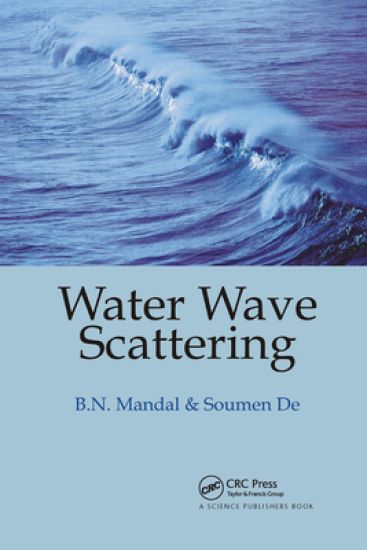
Water Wave Scattering

Water Wave Scattering

Birendra Nath Mandal; Soumen De

CRC Press
2020
nidottu
The theory of water waves is most varied and is a fascinating topic. It includes a wide range of natural phenomena in oceans, rivers, and lakes. It is mostly concerned with elucidation of some general aspects of wave motion including the prediction of behaviour of waves in the presence of obstacles of some special configurations that are of interest to ocean engineers. Unfortunately, even the apparently simple problems appear to be difficult to tackle mathematically unless some simplified assumptions are made. Fortunately, one can assume water to be an incompressible, in viscid and homogeneous fluid. The linearised theory of water waves is based on the assumption that the amplitude of the motion is small compared to the wave length. If rotational motion is assumed, then the linearised theory of water waves is essentially concerned with solving the Laplace equation in the water region together with linearised boundary condition. There are varied classes of problems that have been/are being studied mathematically in the literature within the framework of linearised theory of water waves for last many years. Scattering by obstacles of various geometrical configurations is one such class of water wave problems. This book is devoted to advanced mathematical work related to water wave scattering. Emphasis is laid on the mathematical and computational techniques required to study these problems mathematically.The book contains nine chapters. The first chapter is introductory in nature. It includes the basic equations of linearised theory for a single layer fluid, a two-layer fluid, solution of dispersion equations, and a general idea on scattering problems and the energy identity in water with a free surface. Chapter 2 is concerned with wave scattering involving thin rigid plates of various geometrical configurations, namely, plane vertical barriers or curved barriers, inclined barriers, horizontal barrier, and also thin elastic vertical plate. For the horizontal case, the barrier is submerged below an ice-cover modelled as a thin elastic plate floating on water. Chapter 3 discusses wave scattering by a rectangular trench by using Galerkin technique. Chapter 4 involves wave scattering by a dock by using Carleman singular integral equation followed by reduction to Riemann-Hilbert problems. Chapter 5 involves several wave scattering problems involving discontinuities at the upper surface of water by using the Wiener-Hopf technique, by reduction to Carleman singular integral equations. Chapter 6 considers scattering by a long horizontal circular cylinder either half immersed or completely submerged. In chapter 7, some important energy identities are derived for scattering problems in a single-layer and also in a two-layer fluid. Chapter 8 is concerned with wave scattering in a two-layer fluid by a thin vertical plate and by a long horizontal circular cylinder submerged in either of the two layers. Chapter 9 is the final chapter which considers a number of wave scattering problems in a single-layer or a two-layer fluid with variable bottom topography by using a simplified perturbation analysisIt is hoped that this book will be useful to researchers on water waves. The several wave scattering problems presented in the book are mostly based on the research work carried out by the authors and their associates.
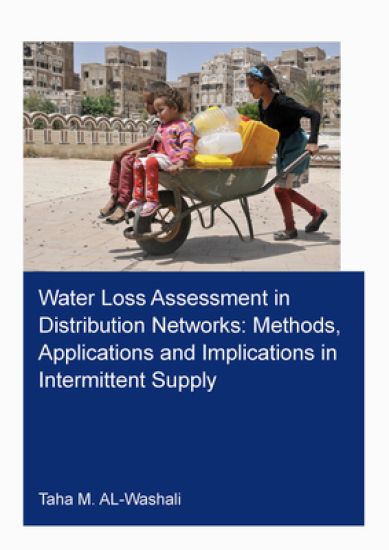
Water Loss Assessment in Distribution Networks
Water utilities worldwide lose 128 billion cubic meters annually, causing annual monetary losses estimated at USD 40 billion. Most of these losses occur in developing countries (74%). This calls for rethinking the challenges facing water utilities in developing countries, foremost of which is the assessment of water losses in intermittent supply networks. Water loss assessment methods were originally developed in continuous supply systems, and their application in intermittently operated networks (in developing countries) is hindered by the widespread use of household water tanks and unauthorised consumption. This study provides an extensive review of existing methods and (software) tools for water loss assessment. In addition, several new methods were developed, which offer improved water loss assessment in intermittent supply. As the volume of water loss varies monthly and annually according to the amount of supplied water, this study proposes procedures to normalise the volume of water loss in order to enable water utilities to monitor and benchmark their performance on water loss management. The study also developed a novel method of estimating apparent losses using routine data of WWTP inflows, enabling future real-time monitoring of losses in networks. Different methods have also been suggested to estimate the unauthorised consumption in networks. This study found that minimum night flow analysis can still be applied in intermittent supply if an area of the network is supplied for several days. Furthermore, this study concluded that water meter performance is enhanced in intermittent supply conditions. However, continuous supply in the presence of float-valves significantly reduces the accuracy of water meters. Finally, this study provides guidance and highlights several knowledge gaps in order to improve the accuracy of water loss assessment in intermittent supply. Accurate assessment of water loss is a prerequisite for reliable leakage modelling and minimisation as well as planning for, and monitoring of water loss management in distribution networks.
Water Governance in Bolivia

Water Governance in Bolivia

Nasya Sara Razavi

TAYLOR FRANCIS LTD
2022
sidottu
This book examines water remunicipalization in Cochabamba since the Water War, offering innovative methodological and theoretical conceptualizations of what it means to be "public," helping to move debates on water services beyond the paralyzing binary of public versus private with a focus on the contested terrain of community engagement around water services. The Cochabamba Water War of 2000 brought together city residents of all stripes to mobilize against water privatization and gain back public control of the city’s water utility. This event catapulted anti-privatization movements around the world, but two decades later, the water movement’s vision of democratic water provision remains largely unfulfilled and the city suffers from a protracted water crisis. Building a typology of participation, this book explores the difficulty in rebuilding a strong public water service in Cochabamba by analyzing the different, and often incompatible, understandings and interpretations of social control and public participation. Applying this framework to the Bolivian context, and more specifically to the water and sanitation sector in Cochabamba, the book uncovers whose interests are served, and which groups are included or excluded from decision-making and access to water. This exercise illustrates how, in their implementation, participatory practices are not linear and can be distorted or appropriated towards different ends. This book will be of great interest to students and scholars of water governance, natural resource management, public policy, social movements and Latin American studies.
Water Governance in Bolivia

Water Governance in Bolivia

Nasya Sara Razavi

TAYLOR FRANCIS LTD
2024
nidottu
This book examines water remunicipalization in Cochabamba since the Water War, offering innovative methodological and theoretical conceptualizations of what it means to be "public," helping to move debates on water services beyond the paralyzing binary of public versus private with a focus on the contested terrain of community engagement around water services. The Cochabamba Water War of 2000 brought together city residents of all stripes to mobilize against water privatization and gain back public control of the city’s water utility. This event catapulted anti-privatization movements around the world, but two decades later, the water movement’s vision of democratic water provision remains largely unfulfilled and the city suffers from a protracted water crisis. Building a typology of participation, this book explores the difficulty in rebuilding a strong public water service in Cochabamba by analyzing the different, and often incompatible, understandings and interpretations of social control and public participation. Applying this framework to the Bolivian context, and more specifically to the water and sanitation sector in Cochabamba, the book uncovers whose interests are served, and which groups are included or excluded from decision-making and access to water. This exercise illustrates how, in their implementation, participatory practices are not linear and can be distorted or appropriated towards different ends. This book will be of great interest to students and scholars of water governance, natural resource management, public policy, social movements and Latin American studies.
Water, Earth, and Man

Water, Earth, and Man

TAYLOR FRANCIS LTD
2023
nidottu
First published in 1969, Water, Earth, and Man, was written to demonstrate the advantages of adopting a unified view of the earth and social sciences. The book considers the connection between an understanding of physical environments and an understanding of social environments. It explores the hydrologic cycle and highlights the significance of the relationship between natural environments and the activities of humankind, drawing together physical and human geography to produce a highly detailed study.
Water, Earth, and Man
First published in 1969, Water, Earth, and Man, was written to demonstrate the advantages of adopting a unified view of the earth and social sciences. The book considers the connection between an understanding of physical environments and an understanding of social environments. It explores the hydrologic cycle and highlights the significance of the relationship between natural environments and the activities of humankind, drawing together physical and human geography to produce a highly detailed study.
Water, Sustainable Development and the Nexus
Water is intricately linked with food security, energy security, and sustainable development. As the world is moving towards sustainable development goals, it is critical to recognize the role of water in attaining these goals. The Water-Energy-Food Nexus draws attention to the complex and interrelated nature of global resource systems and forces us to think about how a decision in one sector impacts other interlinked sectors as well. This book looks at the three dimensions of sustainable developmentenvironment, economics and society – and how water is linked with them and explores the nexus approach as a framework to look at the issues and identify solutions.
Water Hyacinth
The water hyacinth is a disruptive factor in aquatic ecosystem management and ecosystem services, and causes problems in fisheries, transportation waterways, irrigation, hydropower generation, and water resources. To address these concerns, it is necessary to integrate past studies with current research and innovations to identify where the knowledge gap is and to creatively assess and solve the problems in a global context. This book provides comprehensive coverage of new research and technological innovations for the application of controlling, managing, harvesting, postharvest processing and utilizing the water hyacinth.
Water Histories of South Asia
This book surveys the intersections between water systems and the phenomenology of visual cultures in early modern, colonial and contemporary South Asia. Bringing together contributions by eminent artists, architects, curators and scholars who explore the connections between the environmental and the cultural, the volume situates water in an expansive relational domain. It covers disciplines as diverse as literary studies, environmental humanities, sustainable design, urban planning and media studies. The chapters explore the ways in which material cultures of water generate technological and aesthetic acts of envisioning geographies, and make an intervention within political, social and cultural discourses. A critical interjection in the sociologies of water in the subcontinent, the book brings art history into conversation with current debates on climate change by examining water’s artistic, architectural, engineering, religious, scientific and environmental facets from the 16th century to the present.This is one of the first books on South Asia’s art, architecture and visual history to interweave the ecological with the aesthetic under the emerging field of eco art history. The volume will be of interest to scholars and general readers of art history, Islamic studies, South Asian studies, urban studies, architecture, geography, history and environmental studies. It will also appeal to activists, curators, art critics and those interested in water management.
Water Wells - Monitoring, Maintenance, Rehabilitation
Throughout the world, boreholes and tubewells operate inefficiently or have been abandoned. Diagnosis of the problems requires hydrogeological and operational information, which is often not available because appropriate monitoring has not taken place. Guidelines on cost effective monitoring and maintenance need to be established; information on successful rehabilitation techniques is needed. This book forms the proceedings of a conference organised to exchange practical experience and scientific knowledge on these aspects of water wells.
Water and the Environment

Water and the Environment

John Gowing; Luis Santos Pereira

CRC Press
2019
nidottu
Water and Environment addresses imbalances between availability and demand, degradation of surface and ground waters, inter-sectorial, inter-regional and international competition in water management. With contributions from internationally distinguished experts at the first Inter-Regional Conference on Environment-Water: Innovative Issues in Irrigation and Drainage.Water and Environment will be invaluable to policy-makers, planners, irrigation engineers, researchers, and postgraduate students specializing in irrigation and canal engineering, water pollution and water quality. It will be indispensable to libraries and universities with courses in water quality, pollution and environmental engineering.