

Kirjahaku
Etsi kirjoja tekijän nimen, kirjan nimen tai ISBN:n perusteella.
1000 tulosta hakusanalla Alexander


Alexander Herzen and the Birth of Russian Socialism, 1812-1855
Martin Malia
Harvard University Press
1961
sidottu
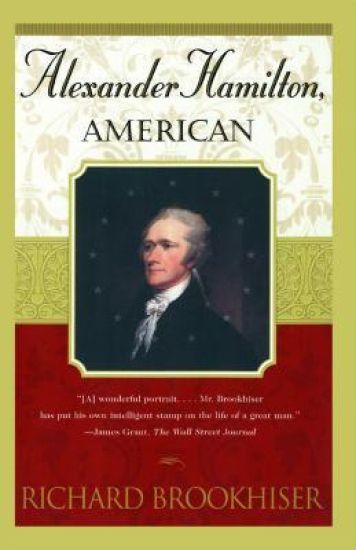
Alexander Hamilton is one of the least understood, most important, and most impassioned and inspiring of the founding fathers. At last Hamilton has found a modern biographer who can bring him to full-blooded life; Richard Brookhiser. In these pages, Alexander Hamilton sheds his skewed image as the "bastard brat of a Scotch peddler," sex scandal survivor, and notoriously doomed dueling partner of Aaron Burr. Examined up close, throughout his meteoric and ever-fascinating (if tragically brief) life, Hamilton can at last be seen as one of the most crucial of the founders. Here, thanks to Brookhiser's accustomed wit and grace, this quintessential American lives again.

Alexander and the Terrible, Horrible, No Good, Very Bad Day
Judith Viorst
Atheneum Books for Young Readers
1972
sidottu
He could tell it was going to be a terrible, horrible, no good, very bad day. He went to sleep with gum in his mouth and woke up with gum in his hair. When he got out of bed, he tripped over his skateboard and by mistake dropped his sweater in the sink while the water was running. He could tell it was going to be a terrible, horrible, no good, very bad day. It was a terrible, horrible, no good, very bad day. Nothing at all was right. Everything went wrong, right down to lima beans for supper and kissing on TV. What do you do on a day like that? Well, you may think about going to Australia. You may also be glad to find that some days are like that for other people too.
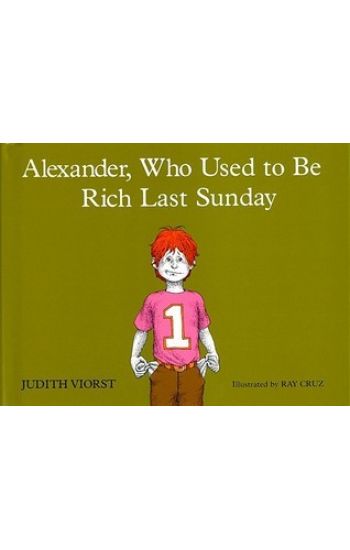
Alexander, Who Used to be Rich Last Sunday
Judith Viorst
Atheneum Books for Young Readers
1978
sidottu
Anthony has two dollars and three quarters and one dime and seven nickels and eighteen pennies. Nicholas has one dollar and two quarters and five dimes and five nickels and thirteen pennies. Alexander has... bus tokens. And even when he's rich, pretty soon all he has is bus tokens. He was rich. Last Sunday. Grandma Betty and Grandpa Louie came and gave Anthony and Nicholas and Alexander each a dollar. Alexander was saving his. Maybe for a walkie-talkie. And then there was bubble gum, some bets with Anthony and Nicholas (that Alexander lost), a snake rental, a garage sale, and all kinds of other things to spend money on. And now all he has is bus tokens. When he used to be rich last Sunday.

Alexander y El Dia Terrible, Horrible, Espantoso, Horroroso
Judith Viorst; Ray Cruz
Atheneum Books for Young Readers
1989
sidottu
Alexander se dio cuenta de que iba a ser un dia terrible couando se desperto y se encontro chicle en el pelo. Y aun fue peor... Su mejor amigo lo abandono. No ten ia postre en su bolsa del almuerzo. Y para colmo, habia habas verdes en la comida y besos en la television! Este cuento clasico de Judith Viorst, ahora en espanol, sera sin lugar a duda del agrado de los lectores de todas las edades, como lo ha sido hasta ahora.
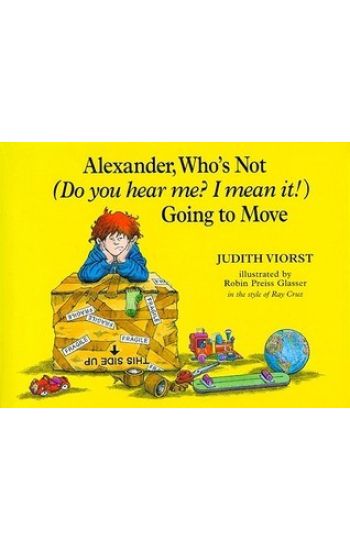
Alexander, Who's Not (Do You Hear Me? I Mean It!) Going to Move
Judith Viorst
Atheneum Books for Young Readers
1995
sidottu
When Alexander feels mad or dad he wants to move to Australia. But most of the time he likes it right where he is. So when his mom and dad say that they're moving a thousand miles away, Alexander decides that he's not going. Never, Not ever. No way. Uh uh. N.O. For how can he leave his best friend or his favorite sitter or Seymour the cleaners? he'd rather stay and live in a tree house or cave. And even though Nick calls him puke-face and Anthony says he's immature, he's not (Do you hear me? I mean it ) going to move.

Alexander and the Terrible, Horrible, No Good, Very Bad Day
Judith Viorst
Atheneum Books for Young Readers
1987
nidottu
On a day when everything goes wrong for him, Alexander is consoled by the thought that other people have bad days too.
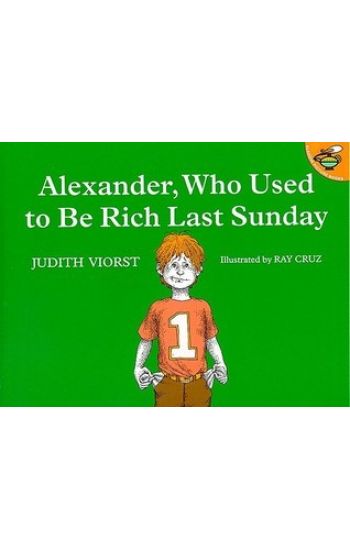
Alexander, Who Used to be Rich Last Sunday
Judith Viorst
Atheneum Books for Young Readers
1987
nidottu
Alexander grapples with money management in this beloved picture book from Judith Viorst, author of Alexander and the Terrible, Horrible, No Good, Very Bad Day. Last Sunday, Alexander's grandparents gave him a dollar--and he was rich. There were so many things that he could do with all of that money! He could buy as much gum as he wanted, or even a walkie-talkie, if he saved enough. But somehow the money began to disappear...

Alexander y El Dia Terrible, Horrible, Espantoso, Horroroso
Judith Viorst; Ray Cruz
Atheneum Books for Young Readers
1989
nidottu
Alexander se dio cuenta de que iba a ser un dia terrible couando se desperto y se encontro chicle en el pelo. Y aun fue peor... Su mejor amigo lo abandono. No ten ia postre en su bolsa del almuerzo. !Y para colmo, habia habas verdes en la comida y besos en la television! Este cuento clasico de Judith Viorst, ahora en espanol, sera sin lugar a duda del agrado de los lectores de todas las edades, como lo ha sido hasta ahora.
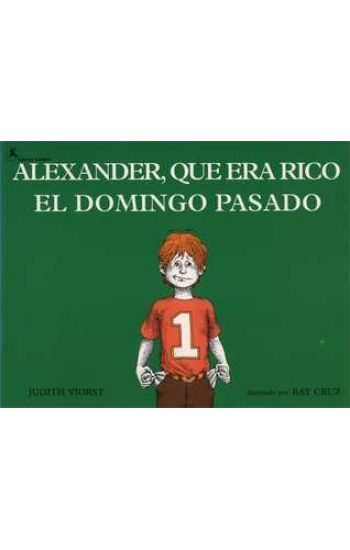
Alexander, Que Era Rico El Domingo Pasado
Judith Viorst; Ray Cruz
Atheneum Books for Young Readers
1989
nidottu
El domingo pasado, los abuelitos de Alexander le dieron un dolar. !Era rico! !Habia tantas cosas que podi hacer con todo ese dinero! Podi comprarse todos los chicles que deseaba, o quiza un radiotrsmisor, si ahorrara suficiente dinero. Pero, de alguna manera, el dinero empezo a desaparecer... Esta edicio en espanol de uno de los libros mas populares de Jusith Viorst encantara a los lectores de todas las edades.

Alexander, Who's Not (Do You Hear Me? I Mean It!) Going to Move
Judith Viorst
Atheneum Books for Young Readers
1998
nidottu
Alexander is not going to leave his best friend Paul. Or Rachel, the best babysitter in the world. Or the Baldwins, who have a terrific dog named Swoozie. Or Mr. and Mrs. Oberdorfer, who always give great treats on Halloween. Who cares if his father has a new job a thousand miles away? Alexander is not -- Do you hear him? He Means it -- going to move. Alexander's back, facing another of childhood's trials and tribulations with Judith Viorst's trademark humor and keen sense of what's important to kids.
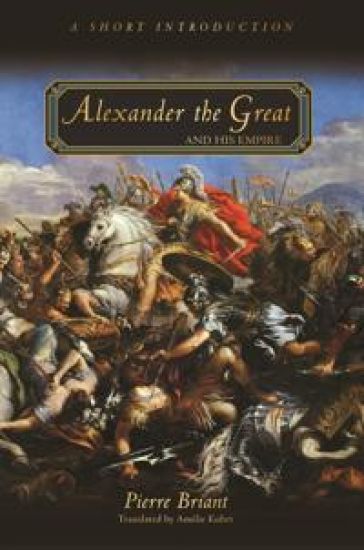
This is the first publication in English of Pierre Briant's classic short history of Alexander the Great's conquest of the Persian empire, from the Mediterranean to Central Asia. Eschewing a conventional biographical focus, this is the only book in any language that sets the rise of Alexander's short-lived empire within the broad context of ancient Near Eastern history under Achaemenid Persian rule, as well as against Alexander's Macedonian background. As a renowned historian of both the Macedonians and the Persians, Briant is uniquely able to assess Alexander's significance from the viewpoint of both the conquerors and the conquered, and to trace what changed and what stayed the same as Alexander and the Hellenistic world gained ascendancy over Darius's Persia. After a short account of Alexander's life before his landing in Asia Minor, the book gives a brief overview of the major stages of his conquest. This background sets the stage for a series of concise thematic chapters that explore the origins and objectives of the conquest; the nature and significance of the resistance it met; the administration, defense, and exploitation of the conquered lands; the varying nature of Alexander's relations with the Macedonians, Greeks, and Persians; and the problems of succession following Alexander's death. For this translation, Briant has written a new foreword and conclusion, updated the main text and the thematic annotated bibliography, and added a substantial appendix in which he assesses the current state of scholarship on Alexander and suggests some directions for future research. More than ever, this masterful work provides an original and important perspective on Alexander and his empire.
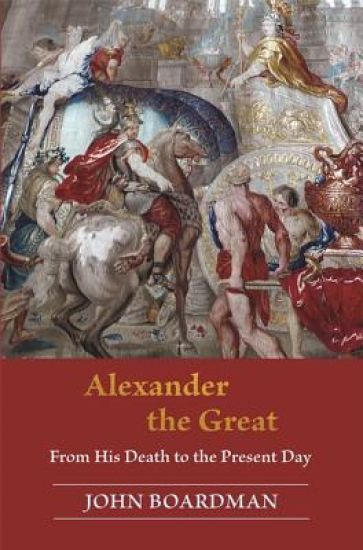
An illustrious scholar presents an elegant, concise, and generously illustrated exploration of Alexander the Great’s representations in art and literature through the agesJohn Boardman is one of the world’s leading authorities on ancient Greece, and his acclaimed books command a broad readership. In this book, he looks beyond the life of Alexander the Great in order to examine the astonishing range of Alexanders created by generations of authors, historians, and artists throughout the world—from Scotland to China.Alexander’s defeat of the Persian Empire in 331 BC captured the popular imagination, inspiring an endless series of stories and representations that emerged shortly after his death and continues today. An art historian and archaeologist, Boardman draws on his deep knowledge of Alexander and the ancient world to reflect on the most interesting and emblematic depictions of this towering historical figure.Some of the stories in this book relate to historical events associated with Alexander’s military career and some to the fantasy that has been woven around him, and Boardman relates each with his customary verve and erudition. From Alexander’s biographers in ancient Greece to the illustrated Alexander “Romances” of the Middle Ages to operas, films, and even modern cartoons, this generously illustrated volume takes readers on a fascinating cultural journey as it delivers a perfect pairing of subject and author.

Alexander von Humboldt and the United States
Eleanor Jones Harvey
PRINCETON UNIVERSITY PRESS
2020
sidottu
The enduring influence of naturalist and explorer Alexander von Humboldt on American art, culture, and politicsAlexander von Humboldt (1769–1859) was one of the most influential scientists and thinkers of his age. A Prussian-born geographer, naturalist, explorer, and illustrator, he was a prolific writer whose books graced the shelves of American artists, scientists, philosophers, and politicians. Humboldt visited the United States for six weeks in 1804, engaging in a lively exchange of ideas with such figures as Thomas Jefferson and the painter Charles Willson Peale. It was perhaps the most consequential visit by a European traveler in the young nation's history, one that helped to shape an emerging American identity grounded in the natural world.In this beautifully illustrated book, Eleanor Jones Harvey examines how Humboldt left a lasting impression on American visual arts, sciences, literature, and politics. She shows how he inspired a network of like-minded individuals who would go on to embrace the spirit of exploration, decry slavery, advocate for the welfare of Native Americans, and extol America's wilderness as a signature component of the nation's sense of self. Harvey traces how Humboldt's ideas influenced the transcendentalists and the landscape painters of the Hudson River School, and laid the foundations for the Smithsonian Institution, the Sierra Club, and the National Park Service.Alexander von Humboldt and the United States looks at paintings, sculptures, maps, and artifacts, and features works by leading American artists such as Albert Bierstadt, George Catlin, Frederic Church, and Samuel F. B. Morse.Published in association with the Smithsonian American Art Museum, Washington, DCExhibition ScheduleSmithsonian American Art Museum, Washington, DCSeptember 18, 2020–January 3, 2021
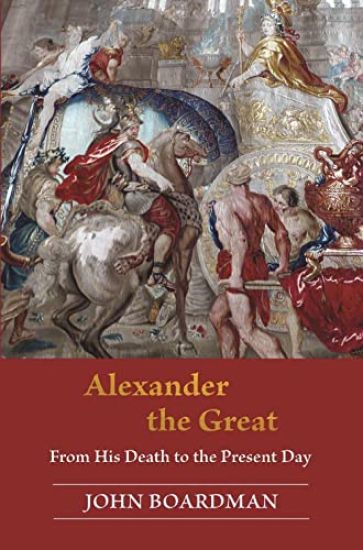
An elegant, concise, and generously illustrated exploration of Alexander the Great’s representations in art and literature through the agesIn this book, John Boardman, one of the world’s leading authorities on ancient Greece, looks beyond the life of Alexander the Great in order to examine the astonishing range of Alexanders created by generations of authors, historians, and artists throughout the world—from Scotland to China. John Boardman draws on his deep knowledge of Alexander and the ancient world to reflect on the most interesting and emblematic depictions of this towering historical figure. From Alexander’s biographers in ancient Greece to the illustrated Alexander “Romances” of the Middle Ages to operas, films, and even modern cartoons, this generously illustrated volume takes readers on a fascinating journey.
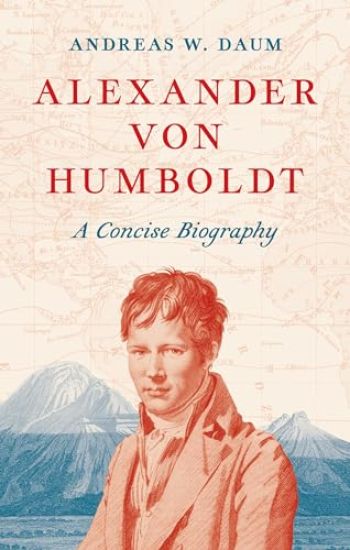
An engaging account of the life and work of the legendary polymath Alexander von HumboldtIn this lucid biography, Andreas Daum offers a succinct and novel interpretation of the life and oeuvre of Alexander von Humboldt (1769-1859). A Prussian nobleman born into the age of European Enlightenment, Humboldt was a contemporary of Napoleon, Simón Bolívar, and Charles Darwin. As a naturalist and scholar, he traveled the world, from the Americas to Central Asia, and recorded his observations in multiple volumes. Humboldt is still admired today for his interdisciplinary outreach and ecological awareness.Moving beyond the conventional views of Humboldt as either intellectual superhero or gentleman colonizer, Daum’s incisive account focuses on Humboldt in the context of the tumultuous period of history in which he lived. Humboldt embodied the contradictions that marked the age of Atlantic Revolutions. He became a critic of slavery and embraced the emerging civil society but remained close to authoritarian rulers. He dedicated his life to scientific research yet was driven by emotional impulses and pleaded for an aesthetic appreciation of nature. Daum introduces a man passionately striving to establish a “cosmic” understanding of nature while grappling with the era’s explosion of knowledge.This book provides the first concise biography of Humboldt, covering all periods of his life, exploring his personality, the vast range of his works, and his intellectual networks. Daum helps us understand Humboldt as a seminal historical figure and illuminates the role of science at the dawn of the global world.
Alexander Pope and the Traditions of Formal Verse Satire
Howard D. Weinbrot
Princeton University Press
2014
pokkari
Ranging over the tradition of verse satire from the Roman poets to their seventeenth- and eighteenth-century imitators in England and France, Howard D. Weinbrot challenges the common view of Alexander Pope as a Horatian satirist in a Horatian age. Originally published in 1982. The Princeton Legacy Library uses the latest print-on-demand technology to again make available previously out-of-print books from the distinguished backlist of Princeton University Press. These editions preserve the original texts of these important books while presenting them in durable paperback and hardcover editions. The goal of the Princeton Legacy Library is to vastly increase access to the rich scholarly heritage found in the thousands of books published by Princeton University Press since its founding in 1905.

What is the precise relation between the "Pope" of the poems and the Pope of history? Seeking to clarify the nature of the intimate link between the historical self and the idealized self of the poetry, Dustin Griffin examines the various ways in which Pope's poems may be said to be self-expressive. He brings a sensitive critical reading of the texts and an impressive knowledge of the poet's life and writings to his discussion of poems from the entire range of the poet's career. The author argues that Pope is present in his poems as a private person whose special imaginative and psychological concerns emerge because they are expressed publicly. In some poems, Pope confronts quite openly his fervent moral idealism with his powerful aggressive feelings, and he explores his conflicting impulses toward retirement and engagement. In others, he reveals impulses and attractions that he would not admit to full consciousness in his letters. Pope is also present as poet-protagonist, self-consciously attempting to present and master a body of poetic material. Professor Griffin's study recovers some of the personal energy that invigorates Pope's greatest poems and makes them strikingly self-expressive products of an imagination intrigued and often at odds with itself and, yet more sharply, with the world. Originally published in 1979. The Princeton Legacy Library uses the latest print-on-demand technology to again make available previously out-of-print books from the distinguished backlist of Princeton University Press. These editions preserve the original texts of these important books while presenting them in durable paperback and hardcover editions. The goal of the Princeton Legacy Library is to vastly increase access to the rich scholarly heritage found in the thousands of books published by Princeton University Press since its founding in 1905.