Kirjojen hintavertailu. Mukana 12 016 292 kirjaa ja 12 kauppaa.

Kirjahaku

Etsi kirjoja tekijän nimen, kirjan nimen tai ISBN:n perusteella.

1000 tulosta hakusanalla D.B.G. Heuser

Advances and Technical Standards in Neurosurgery

Advances and Technical Standards in Neurosurgery

L. Symon; J. Brihaye; F. Cohadon; B. Guidetti; F. Loew; J. D. Miller; H. Nornes; E. Pásztor; M. G. Ya?argil; B. Pertuiset

Springer Verlag GmbH
2011
nidottu
As an addition to the European postgraduate training system for young neurosurgeons we began to publish in 1974 this series devoted to Advances and Technical Standards in Neurosurgery which was later sponsored by the European Association of Neurosurgical Societies. The fact that the English language is well on the way to becoming the international medium at European scientific conferences is a great asset in terms of mutual understanding. Therefore we have decided to publish all contributions in English, regardless of the native language of the authors. All contributions are submitted to the entire editorial board before publication of any volume. Our series is not intended to compete with the publications of original scientific papers in other neurosurgical journals. Our intention is, rather, to present fields of neurosurgery and related areas in which important recent advances have been made. The contributions are written by specialists in the given fields and constitute the first part of each volume. In the second part of each volume, we publish detailed descriptions Of standard operative procedures, furnished by experienced clinicians; in these articles the authors describe the techniques they employ and explain the advantages, difficulties and risks involved in the various procedures. This part is intended primarily to assist young neurosurgeons in their post­ graduate training. However, we are convinced that it will also be useful to experienced, fully trained neurosurgeons.

Advances and Technical Standards in Neurosurgery

Advances and Technical Standards in Neurosurgery

L. Symon; J. Brihaye; F. Cohadon; B. Guidetti; F. Loew; J. D. Miller; H. Nornes; E. Pásztor; B. Pertuiset; M. G. Ya?argil

Springer Verlag GmbH
2012
nidottu
As an addition to the European postgraduate training system for young neurosurgeons we began to publish in 1974 this series devoted to Advances and Technical Standards in Neurosurgery which was later sponsored by the European Association of Neurosurgical Societies. The fact that the English language is well on the way to becoming the international medium at European scientific conferences is a great asset in terms of mutual understanding. Therefore we have decided to publish all contributions in English, regardless of the native language of the authors. All contributions are submitted to the entire editorial board before publication of any volume. Our series is not intended to compete with the publications of original scientific papers in other neurosurgical journals. Our intention is, rather, to present fields of neurosurgery and related areas in which important recent advances have been made. The contributions are written by specialists in the given fields and constitute the first part of each volume. In the second part of each volume, we publish detailed descriptions of standard operative procedures, furnished by experienced clinicians; in these articles the authors describe the techniques they employ and explain the advantages, difficulties and risks involved in the various procedures. This part is intended primarily to assist young neurosurgeons in their post­ graduate training. However, we are convinced that it will also be useful to experienced, fully trained neurosurgeons.
Advances and Technical Standards in Neurosurgery

Advances and Technical Standards in Neurosurgery

L. Symon; J. Brihaye; B. Guidetti; F. Loew; J. D. Miller; H. Nornes; E. Pásztor; B. Pertuiset; M. G. Ya?argil

Springer Verlag GmbH
2011
nidottu
As an addition to the European postgraduate training system for young neurosurgeons we began to publish in 1974 this series devoted to Advances and Technical Standards in Neurosurgery which was later sponsored by the European Association of Neurosurgical Societies. The fact that the English language is well on the way to becoming the international medium at European scientific conferences is a great asset in terms of mutual understanding. Therefore we have decided to publish all contributions in English, regardless of the native language of the authors. All contributions are submitted to the entire editorial board before publication of any volume. Our series is not intended to compete with the publications of original scientific papers in other neurosurgical journals. Our intention is, rather, to present fields of neurosurgery and related areas in which important recent advances have been made. The contributions are written by specialists in the given fields and constitute the first part of each volume. In the second part of each volume, we publish detailed descriptions of standard operative procedures, furnished by experienced clinicians; in these articles the authors describe the techniques they employ and explain the advantages, difficulties and risks involved in the various procedures. This part is intended primarily to assist young neurosurgeons in their post­ graduate training. However, we are convinced that it will also be useful to experienced, fully trained neurosurgeons.

Advances and Technical Standards in Neurosurgery

Advances and Technical Standards in Neurosurgery

L. Symon; J. Brihaye; B. Guidetti; F. Loew; J. D. Miller; H. Nornes; E. Pásztor; B. Pertuiset; M. G. Ya?argil

Springer Verlag GmbH
2011
nidottu
As an addition to the European postgraduate training system for young neurosurgeons we began to publish in 1974 this series devoted to Advances and Technical Standards in Neurosurgery which was later sponsored by the European Association of Neurosurgical Societies. The fact that the English language is well on the way to becoming the international medium at European scientific conferences is a great asset in terms of mutual understanding. Therefore we have decided to publish all contributions in English, regardless of the native language of the authors. All contributions are submitted to the entire editorial board before publication of any volume. is not intended to compete with the publications of original Our series scientific papers in other neurosurgical journals. Our intention is, rather, to present fields of neurosurgery and related areas in which important recent advances have been made. The contributions are written by specialists in the given fields and constitute the first part of each volume. In the second part of each volume, we publish detailed descriptions of standard operative procedures, furnished by experienced clinicians; in these articles the authors describe the techniques they employ and explain the advantages, difficulties and risks involved in the various procedures. This part is intended primarily to assist young neurosurgeons in their post­ graduate training. However, we are convinced that it will also be useful to experienced, fully trained neurosurgeons.

Advances and Technical Standards in Neurosurgery

Advances and Technical Standards in Neurosurgery

L. Symon; J. Brihaye; B. Guidetti; F. Loew; J. D. Miller; H. Nornes; E. Pásztor; B. Pertuiset; M. G. Ya?argil

Springer Verlag GmbH
2011
nidottu
As an addition to the European postgraduate training system for young neurosurgeons we began to publish in 1974 this series devoted to Advances and Technical Standards in Neurosurgery which was later sponsored by the European Association of Neurosurgical Societies. The fact that the English language is well on the way to becoming the international medium at European scientific conferences is a great asset in terms of mutual understanding. Therefore we have decided to publish all contributions in English, regardless of the native language of the authors. All contributions are submitted to the entire editorial board before publication of any volume. Our series is not intended to compete with the publications of original scientific papers in other neurosurgical journals. Our intention is, rather, to present fields of neurosurgery and related areas in which important recent advances have been made. The contributions are written by specialists in the given fields and constitute the first part of each volume. In the second part of each volume, we publish detailed descriptions of standard operative proce.dures, furnished by experienced clinicians; in these articles the authors describe the techniques they employ and explain the advantages, difficulties and risks involved in the various procedures. This part is intended primarily to assist young neurosurgeons-in their post- graduate training. However, we are convinced that it will also be useful to experienced, fully trained neurosurgeons.
Das Altern und seine Beschwerden

Das Altern und seine Beschwerden

Erwin Risak; A.I. Amreich; B. Breitner; H. v. Chihari; W. Denk; W. Ehart; O. Gerke; M. Gundel; K. Haslinger; G. Hofer; G. Homann; F. Lejeune; K.D. Lindner; E. Navrattil; A. Sattler

Springer Verlag GmbH
1942
nidottu
Dieser Buchtitel ist Teil des Digitalisierungsprojekts Springer Book Archives mit Publikationen, die seit den Anfängen des Verlags von 1842 erschienen sind. Der Verlag stellt mit diesem Archiv Quellen für die historische wie auch die disziplingeschichtliche Forschung zur Verfügung, die jeweils im historischen Kontext betrachtet werden müssen. Dieser Titel erschien in der Zeit vor 1945 und wird daher in seiner zeittypischen politisch-ideologischen Ausrichtung vom Verlag nicht beworben.
Tunnelling ’94

Tunnelling ’94

Vidar Aarvold; I. L. J. Chudleigh; N. S. Webb; G. A. Featherstone; Manfred Bandmann; H. Ramisch; Uwe Beckmann; B. J. Cole; H. J. Lees; Walter Dietz; D. F. Fawcett; P. J. Chapman; D. A. Barratt; M. P. O’Reilly; John Temporal; Jon Baston-Pitt; F. J. Fredriksen; Roald Aabøe; G. J. Hasle; D. A. Hobson; D. C. Gilchrist; Sandor Jancsecz; Walter Steiner; J. P. Farrow; P. M. Claye; R. B. Warren; M. A. Ginary; R. Matthews; H. Kruizenga; C. R. Weeks; T. R. Winterton; Y. Leblais; L. Leblond; Yannis Malios; J. Y. Peron; P. Marcheselli

Springer-Verlag New York Inc.
2013
nidottu
It is now more than twenty years since a proposal was first mooted to hold an international tunnelling symposium in Britain. At the time of the first symposium, held in London in 1976, the Channel Tunnel pro­ ject had just been shelved. Last weekend a charity walk was held in the finished tunnel, which will be open for business later in the year. Tunnels have figured prominently, and at times spectacularly, in the development of national and international links and it is hoped that such links gather pace in the future. It is particularly pleasing that Alastair Biggart of Storebrelt has agreed to deliver the twenty-sixth Sir Julius Wernher Memorial Lecture of the Institution of Mining and Metallurgy, entitled 'The changing face of tunnelling', at the start of this event. * Although almost every edition of the technical journals on tunnelling reports another £1 billion scheme somewhere in the world, it would be unfair of me to suggest that tunnelling is restricted to these prestigious schemes for major transport links. Much of the work that makes mod­ ern life possible receives hardly a mention outside the technical press and one suspects that society at large applies the 'out of sight, out of mind' attitude even more readily to underground construction than it does to other forms of engineering. Clearly, there is a contiiming need to improve the capacity and performance of our infrastructure, while hav­ ing a careful regard for the environment.
Advances and Open Problems in Federated Learning

Advances and Open Problems in Federated Learning

Peter Kairouz; H. Brendan McMahan; Brendan Avent; Aurélien Bellet; Mehdi Bennis; Arjun Nitin Bhagoji; Kallista Bonawit; Zachary Charles; Graham Cormode; Rachel Cummings; Rafael G. L. D’Oliveira; Hubert Eichner; Salim El Rouayheb; David Evans; Josh Gardner; Zachary Garrett; Adrià Gascón; Badih Ghazi; Phillip B. Gibbons; Marco Gruteser; Zaid Harchaoui; Chaoyang He; Lie He; Zhouyuan Huo; Ben Hutchinson; Justin Hsu; Martin Jaggi; Tara Javidi; Gauri Joshi; Mikhail Khodak; Jakub Konecný; Aleksandra Korolova; Farinaz Koushanfar

Now Publishers Inc
2021
nidottu
The term Federated Learning was coined as recently as 2016 to describe a machine learning setting where multiple entities collaborate in solving a machine learning problem, under the coordination of a central server or service provider. Each client’s raw data is stored locally and not exchanged or transferred; instead, focused updates intended for immediate aggregation are used to achieve the learning objective. Since then, the topic has gathered much interest across many different disciplines and the realization that solving many of these interdisciplinary problems likely requires not just machine learning but techniques from distributed optimization, cryptography, security, differential privacy, fairness, compressed sensing, systems, information theory, statistics, and more. This monograph has contributions from leading experts across the disciplines, who describe the latest state-of-the art from their perspective. These contributions have been carefully curated into a comprehensive treatment that enables the reader to understand the work that has been done and get pointers to where effort is required to solve many of the problems before Federated Learning can become a reality in practical systems. Researchers working in the area of distributed systems will find this monograph an enlightening read that may inspire them to work on the many challenging issues that are outlined. This monograph will get the reader up to speed quickly and easily on what is likely to become an increasingly important topic: Federated Learning.
Climate Change and Cotton Production in Modern Farming Systems

Climate Change and Cotton Production in Modern Farming Systems

Michael P Bange; J. Baker; P. Bauer; K. J. Broughton; G. Constable; Q. Luo; D. M. Oosterhuis; Y. Osanai; P. Payton; D. T. Tissue; K Reddy; B. K. Singh

CABI Publishing
2016
nidottu
Throughout the world cotton is broadly adapted to growing in temperate, sub-tropical, and tropical environments, but growth may be challenged by future climate change. Production may be directly affected by changes in crop photosynthesis and water use due to rising CO2 and changes in regional temperature patterns. Indirect effects may result from a range of government regulations aimed at climate change mitigation. While there is certainty that future climate change will impact cotton production systems; there will be opportunities to adapt. This review begins to provide details for the formation of robust frameworks to evaluate the impact of projected climatic changes, highlight the risks and opportunities with adaptation, and details the approaches for investment in research. Ultimately, it is a multi-faceted systems-based approach that combines all elements of the cropping system that will provide the best insurance to harness the change that is occurring, and best allow cotton industries worldwide to adapt. Given that there will be no single solution for all of the challenges raised by climate change and variability, the best adaptation strategy for industry will be to develop more resilient systems. Early implementation of adaptation strategies, particularly in regard to enhancing resilience, has the potential to significantly reduce the negative impacts of climate change now and in the future.
CAD and Robotics in Architecture and Construction

CAD and Robotics in Architecture and Construction

A. Bijl; O. Akin; C.-C. Chen; B. Dave; S. Pithavadian; Y. E. Kalay; A. C. Harfmann; L. M. Swerdloff; R. Krishnamurti; G. Schmitt; J.-C. Robert; J. Weeks; U. Flemming; R. Coyne; T. Glavin; M. Rychener; L. Koskela; R. Hynynen; M. Kallavuo; K. Kahkönen; J. Salokivi; A. H. Bridges; A. Polistina; W. L. Whittaker; Y. Hasegawa; C. Abel; A. H. Slocum; R. Kangari; E. Bandari; M.-C. Wanner; M. Skibniewski; P. Derrington; C. Hendrickson; R. F. Woodbury; W. T. Keirouz; I. J. Oppenheim; D. R. Rehak; C. F. Earl; N. Kano; J. L. Crowley

Kluwer Academic Publishers
1986
nidottu
After two decades, data processing has finally, and probably forever, found its niche among civil engineering and construction (CEC) professionnals, through word processors, digitizing tables, management software, and increasingly via drawing software and computer-aided design (CAD), recently, robots have even started invading work sites. What are the main trends of CAD and robotics in the field of architecture and civil enginee­ ring? What type of R&D effort do university and industrial laboratories undertake to devise the professional software that will be on the market in the next three to five years? These are the issues which will be addressed during this symposium. To this effect, we have planned concurrently an equipment and software show, as well as a twofold conference. Robotic is just starting in the field of civil engineering and construction. A pioneer, the Civil Engineering Departement of Carnegie-Mellon University, in the United States, organized the first two international symposia, in 1984 and 1985 in Pittsburgh. This is the third meeting on the subject (this year, however, we have also included CAD). It constitutes the first large international symposium where CAD experts, specialists in architecture and CEC robotics will meet. From this standpoint, it should be an ideal forum for exchanging views and expe­ riences on a wide range of topics, and we hope it will give rise to novel applications and new syntheses. This symposium is intented for scientists, teachers, students and also for manufacturers and all CEC professionals.
Mikroelektronik 89

Mikroelektronik 89

A. Lechner; M. Schrödl; R. Weiß; E. Brenner; P. Seifter; W. Kosta; G. Raimann; F. Furtner; D. Kirchner; H. Bühler; B. Nemsic; W. Jerono; G. Horak; R. Messaros; F. Seifert; P. Fey; A. Goßlau; A. Gottwald; W. Gáspár-Ruppert; P. Kreuzgruber; A. L. Scholtz; W. Smutny; P. Koschnick; W. Schulz; R. Schwarze; Peter W. Fröhling; Robert Casari; E. Fugger; P. Spinadel; J. Niwinski; L. Prager; E. Schauer; G. Rigler; K. Moshammer; H. Arnold; W. Pribyl; R. Röhrer; W. A. Halang; K. Barbier; F. Schiestl; C. Blind; H. Kamper

Springer Verlag GmbH
1989
nidottu
Die Informationstagung "Mikroelektronik" findet im Rahmen der ie (Internationale Fachmesse für industrielle Elektronik) seit dem Jahr 1975 im Abstand von zwei Jahren statt. Die Einzelbeiträge der Tagung 1989 werden in dem vorliegenden Band in übersichtlicher Form präsentiert; sie geben einen guten Überblick über den aktuellen Stand der Technik und über Trends auf dem Gebiet der Mikroelektronik. Berichte über konkrete Anwendungen, Methoden und Entwicklungen werden leicht verständlich vorgestellt. Die Autoren kommen aus Industrie und Forschung; dadurch ist gewährleistet, daß sowohl theorie- als auch praxisbezogene Erkenntnisse und Produkte behandelt werden. Der Band umfaßt folgende Themenkreise: Mensch-Maschine-Schnittstellen, Mobilkommunikation, Flexible Automation und Qualitätssicherung, Sensoren und Interfaces.
Auditory System

Auditory System

E. de Boer; W. Connor; H. Davis; J.J. Eggermont; R. Galambos; C.D. Geisler; G.M. Gerken; H.E. von Gierke; C.S. Hallpike; E.Jr. Hawkins; S.A. Hillyard; W.D. Keidel; D.E. Parker; T.W. Picton; W. Rudmose; F.B. Simmons; G. Stange; C.R. Steele; J. Tonndorf; M.E. Wigand; F. Zöllner

Springer-Verlag Berlin and Heidelberg GmbH Co. K
2011
nidottu
after heated and often bitter debates, SIEBENMANN'S opinion finally prevailed, i. e. , a contribution to cochlear lesions due to vibrations of the floor transmitted via bone conduction could not be demonstrated. For one thing, it was hard to see how appreciable amounts of energy could reach the ears in this manner, considering the attenuation that is bound to occur across each of the many joints along the pathway involved. In some older audiological surveys conducted in industry (e. g. , TEMKIN, 1933), groups of workmen were found who displayed signs of apical-turn lesions, i. e. , low-tone hearing losses for air and for bone. Such lesions could not be expected to results from exposure to air-borne sounds because of the low-frequency attenu­ ation of the middle ear. Although WITTMAACK'S explanation, which was frequently invoked in such reports, does no longer appear tenable, such apical-turn lesions could conceivably be caused by bone conduction components of high-intensity noise in the sense of BEKESY (1948). - As far as I am aware of, no newer studies have been conducted in this problem area, and the older experiments and/or surveys were done at times before signal parameters could be precisely controlled or measured. A detailed, critical review of the older studies on the potential contribution of bone-conducted energy to industrial hearing loss and its underlying pathology may be found in Werner (1940) who, incidently, favored SIEBENMANN'S point of VIew.
Development of Sensory Systems

Development of Sensory Systems

C. M. Bate; V. McMillan Carr; P. P. C. Graziadei; H. V. B. Hirsch; A. Hughes; D. Ingle; A. G. Leventhal; G. A. Monti Graziadei; E. W. Rubel; R. Saxod; A. B. Scheibel; M. E. Scheibel; J. Silver

Springer-Verlag Berlin and Heidelberg GmbH Co. K
2011
nidottu
This preface is addressed to the reader who wishes to inquire into the prevailing concepts, hypotheses and theories about development of sensory systems and wants to know how they are exemplified in the following chapters. I believe that science is hypothesis and theory and that the growth and evolution of any branch of science can be measured by the degree to which its theories have been reified. By that standard, one must conc1ude that developmental neuro­ biologie is in its infancy. The rapid accumulation of observations which has occurred in this branch of science in the past century leads to progress only to the extent that the facts validate or falsify hypotheses. The following chapters show that we have a plethora of facts but a dearth of hypotheses. Another index of the maturity of any branch of science is its level of historical self-awareness. Because the history of any branch of science is essentially the history of ideas and of the rise and fall of theories, the level of historical awareness is related to the extent to which reification of its hypothetical constructs has advanced. It is largely because few theories of development of sensory systems, or indeed, of developmental neurobiology, have progressed far in the process of reification that the his tory of developmental neurobiology remains unwritten. The subject of this volume is hardly mentioned in the many books devoted to the history of related disciplines.
Allgemeine Strahlentherapeutische Methodik

Allgemeine Strahlentherapeutische Methodik

Olof Dahl; Lee E. Farr; Sylvia Fedoruk; P. F. Hahn; Ulrich K. Henschke; B. S. Hilaris; H. Kuttig; David G. Mahan; L. D. Marinelli; Bengt Mårtenson; Aldo Perussia; James S. Robertson; Kurt E. Scheer; Lennart Sundbom; Rune Walstam; T. A. Watson; Günter Weitzel; Graeme P. Welch

Springer-Verlag Berlin and Heidelberg GmbH Co. K
2013
nidottu
Bereits im Vorwort zu Band XVII l dieses Handbuches wurde darauf hingewiesen, wie sehr die Moglichkeit der Strahlentherapie durch die EinfUhrung der in Beschleunigern erzeugten ultraharten Strahlungen und die Anwendung der von kunstlichen Radio- nukliden ausgehenden Strahlungen erweitert worden sind. Der vorerwahnte Band beschrankte sich auf die Grundlagen der Strahlentherapie und behandelt nur die Methoden der Strahlentherapie mit Rontgenstrahlen. 1m Gegensatz hierzu werden in dem hier vorliegenden Band jetzt die Moglichkeiten der Therapie mit Corpuscularstrahlen, d. h. schnellen Elektronen, energiereichen Neutronen und schweren Teilchen, wie Protonen und Deuteronen beschrieben. AuBerdem enthalt der zweite Band zum Thema Methoden der Strahlentherapie in zahlreichen von auf den einzelnen Spezial- gebieten besonders erfahrenen Autoren verfaBten Beitragen Beschreibungen uber die Therapie mit Strahlungen, die von den kunstlich erzeugten radioaktiven Stoffen aus- gehen. Hierzu gehort vor aHem die Telegammatherapie mit 60CO und 137CS, die Nah- bestrahlung und Kontaktbestrahlung mit umschlossenen radioaktiven Stoffen, die inter- stitielle Implantationstherapie, sowie die Therapie mit inkorporierten, offenen Radio- nukliden. Viele dieser Methoden haben sich in jahrelanger Praxis bereits bestens bewahrt und sind aus der modernen Strahlentherapie nicht mehr wegzudenken. Ihre Technologie wurde eingehend beschrieben. Andere Methoden sind vielleicht geeignet, in der Zukunft Eingang in die Praxis zu finden und deshalb nicht weniger interessant. Der vorliegende Band enthalt auBerdem einen Abschnitt uber die Bewegungs- bestrahlung, da diese Technik in gleicher Weise mit konventioncllen und ultraharten Rontgenstrahlen als auch mit den Gammastrahlen kunstlicher Radionuklide und ultraharten Rontgenstrahlen von Beschleunigern durchgefiihrt werden kann.
Rheumatologie C

Rheumatologie C

M. Aufdermaur; G. L. Bach; J.-M. Engel; R. Filchner; F. Graser; E. Gundel; H. Hess; F. Husmann; H. Kather; H. Kerl; G. Klein; W. Krämer; H. Kresbach; H. Leinisch; S. Marghescu; R. Maurach; W. Miehle; W. Mohr; H. Müller-Fassbender; D. Pongratz; W. Schmidt-Vanderheyden; P. Schneider; B. Simon; G. Stöckl; S. Stotz; F. Strian; F. J. Wagenhäuser; A. Weintraub; D. Wessinghage; H. Mathies

Springer-Verlag Berlin and Heidelberg GmbH Co. K
2012
nidottu
Bearbeitet von zahlreichen Fachwissenschaftlern
Modern Methods of Plant Analysis / Moderne Methoden der Pflanzenanalyse

Modern Methods of Plant Analysis / Moderne Methoden der Pflanzenanalyse

H. F. Linskens; M. V. Tracey; Ulrich Beiss; Fay Bendall; Walter Björk; F. Bohlmann; Hans G. Boman; Richard Braun; W. Heinen; Manfred Hesse; Eduard Hofmann; J. R. Hudson; Rüdiger Knapp; Rudolf Lambert; Carlos O. Miller; Gerhard Pfleiderer; B. D. Sanwal; Hans Schmid; Shoji Shibata; Herbert Stern; Wolfgang Sucrow; Josef Tobiška; F. W. Zilliken

Springer-Verlag Berlin and Heidelberg GmbH Co. K
2012
nidottu
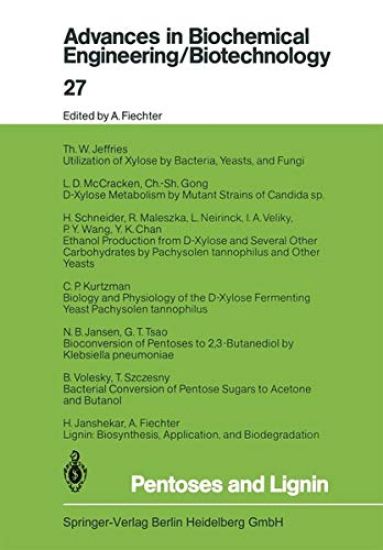
Pentoses and Lignin

Pentoses and Lignin

Y. K. Chan; A. Fiechter; Ch.-Sh. Gong; N. B. Jansen; H. Janshekar; Th. W. Jeffries; C. P. Kurtzman; R. Maleszka; L. D. McCracken; L. Neirinck; H. Schneider; T. Szczesny; G. T. Tsao; I. A. Veliky; B. Volesky; P. Y. Wang

Springer-Verlag Berlin and Heidelberg GmbH Co. K
2013
nidottu
Fortschritte der Chemie Organischer Naturstoffe / Progress in the Chemistry of Organic Natural Products

Fortschritte der Chemie Organischer Naturstoffe / Progress in the Chemistry of Organic Natural Products

N. H. Andersen; St. F. Brady; C. M. Harris; Th. M. Harris; E. Hecker; K. B. Hindley; D. N. McGregor; J. A. Marshall; J. C. Roberts; R. Schmidt; G. N. Schrauzer; G. A. Swan; Ch. Tamm; H. Wagner; E. Winterfeldt

Springer Verlag GmbH
2011
nidottu
The verrucarins and roridins are secondary metabolites of the soil fungi Myrothecium verrucaria (Albertini et Schweinitz) Ditmar ex Fries and Myrothecium roridum Tode ex Fries. The species Myrothecium belongs to the fungi imperfecti, order of Moniliales, family Tubercularia- ceae (30, 17, 32). The distinction between these and other closely related fungal species is difficult. It has been studied and discussed by various authors (82, 16, 55, 75, 62, 43). Myrothecium species are parasitic on leaves of Gardenia, tomatoes, violets, kidney beans, snapdragons and other common plants. They are also found on decaying tissue and in soil. It was known earlier that cultures of the two species mentioned exhibit cellulolytic properties due to the presence of a very active cellulase which was used for the treatment of cellulose during the production of textiles [for leading references see (42, 66)]. The first investigation of the secondary metabolites of these micro- organisms was carried out by BRIAN and MCGOWAN (16). They isolated a crystalline compound, designated as glutinosin and assigned the formula C4sH60016, from cultures of Metarrhizium glutinosum S. Pope, which in fact is a Myrothecium species (82, 55). Glutinosin exhibited anti- fungal activity. Eight years later BOWDEN and SCHANTZ (14) described the isolation and characterization of a dermatitic or skinirritating crystal- line compound melting at 38 , and possessing the formula C H 04, 1s 22 from culture filtrates of Myrothecium verrucaria. They suspected the presence of additional biologically active substances.
Somatische Problemen

Somatische Problemen

W M C Van Aalderen; M J I J Albers; A C E de Blécourt; G Bleijenberg; H Boxma; C Braet; O F Brouwer; B Derkx; H J y Van Drie; M Van Dijk; A M Van Furth; T M Van Gemert; R a Hirasing; H W C Hofland; E C a M Houdijk; L W a De Jong; R C J De Jonge; L J Kalverdijk; J K W Kieboom; C Kluft; C M F Kneepkens; H Knoop; F J M Van Leerdam; M M H Lub; T G J De Meij; E a J Peeters; S Scholten; A B Sprikkelman; D Tibboel; H L G Ter Waarbeek; J Walstra; B Wijnberg-Williams

Bohn Stafleu Van Loghum
2009
pokkari