Kirjojen hintavertailu. Mukana 12 016 292 kirjaa ja 12 kauppaa.

Kirjahaku

Etsi kirjoja tekijän nimen, kirjan nimen tai ISBN:n perusteella.

1000 tulosta hakusanalla Emile Chevalier

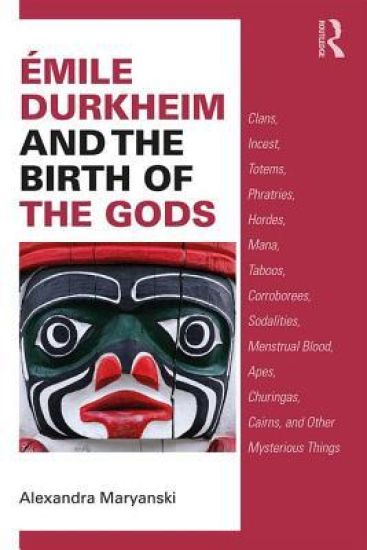
Émile Durkheim and the Birth of the Gods

Émile Durkheim and the Birth of the Gods

Alexandra Maryanski

Routledge
2018
sidottu
The Birth of the Gods is dedicated to Durkheim's effort to understand the basis of social integration. Unlike most social scientists, then and now, Durkheim concluded that humans are naturally more individualistic than collectivistic, that the primal social unit for humans is the macro-level unit ('the horde'), rather than the family, and that social cohesion is easily disrupted by human self-interest. Hence, for Durkheim, one of the "gravest" problems facing sociology is how to mold these human proclivities to serve the collective good. The analysis of elementary religions, Durkheim believed, would allow social scientists to see the fundamental basis of solidarity in human societies, built around collective representations, totems marking sacred forces, and emotion-arousing rituals directed at these totems. The first half of the book traces the key influences and events that led Durkheim to embrace such novel generalizations. The second part makes a significant contribution to sociological theory with an analysis that essentially "tests" Durkheim's core assumptions using cladistic analysis, social network tools and theory, and data on humans closest living relatives—the great apes. Maryanski marshals hard data from primatology, paleontology, archaeology, genetics, and neuroscience that enlightens and, surprisingly, confirms many of Durkheim’s speculations. These data show that integration among both humans and great apes is not so much group or kin oriented, per se, but orientation to a community standing outside each individual that includes a sense of self, but also encompassing a cognitive awareness of a "sense of community" or a connectedness that transcends sensory reality and concrete social relations. This "community complex," as Maryanski terms it, is what Durkheim was beginning to see, although he did not have the data to buttress his arguments as Maryanski is able to do.
Émile Durkheim and the Birth of the Gods

Émile Durkheim and the Birth of the Gods

Alexandra Maryanski

Routledge
2018
nidottu
The Birth of the Gods is dedicated to Durkheim's effort to understand the basis of social integration. Unlike most social scientists, then and now, Durkheim concluded that humans are naturally more individualistic than collectivistic, that the primal social unit for humans is the macro-level unit ('the horde'), rather than the family, and that social cohesion is easily disrupted by human self-interest. Hence, for Durkheim, one of the "gravest" problems facing sociology is how to mold these human proclivities to serve the collective good. The analysis of elementary religions, Durkheim believed, would allow social scientists to see the fundamental basis of solidarity in human societies, built around collective representations, totems marking sacred forces, and emotion-arousing rituals directed at these totems. The first half of the book traces the key influences and events that led Durkheim to embrace such novel generalizations. The second part makes a significant contribution to sociological theory with an analysis that essentially "tests" Durkheim's core assumptions using cladistic analysis, social network tools and theory, and data on humans closest living relatives—the great apes. Maryanski marshals hard data from primatology, paleontology, archaeology, genetics, and neuroscience that enlightens and, surprisingly, confirms many of Durkheim’s speculations. These data show that integration among both humans and great apes is not so much group or kin oriented, per se, but orientation to a community standing outside each individual that includes a sense of self, but also encompassing a cognitive awareness of a "sense of community" or a connectedness that transcends sensory reality and concrete social relations. This "community complex," as Maryanski terms it, is what Durkheim was beginning to see, although he did not have the data to buttress his arguments as Maryanski is able to do.

Emile Durkheim, 1858-1917: A Collection of Essays

Emile Durkheim, 1858-1917: A Collection of Essays

Emile Durkheim; Kurt H. Wolff

Literary Licensing, LLC
2011
sidottu
Emile Durkheim, 1858-1917: A Collection Of Essays is a book written by the renowned French sociologist Emile Durkheim. The book is a compilation of essays that were written by Durkheim throughout his career. It provides readers with a comprehensive insight into Durkheim's ideas on sociology, religion, and social theory. The book is divided into three main parts, each of which focuses on a different aspect of Durkheim's work. The first part of the book covers Durkheim's early work on sociology, including his ideas on social facts and the division of labor. The second part of the book focuses on Durkheim's work on religion, including his theories on the role of religion in society and the concept of the sacred. The final part of the book covers Durkheim's later work on social theory, including his ideas on the nature of social solidarity and the relationship between the individual and society. Overall, Emile Durkheim, 1858-1917: A Collection Of Essays is an essential read for anyone interested in the history of sociology and the work of one of its most influential figures.With Translations And A Bibliography.This scarce antiquarian book is a facsimile reprint of the old original and may contain some imperfections such as library marks and notations. Because we believe this work is culturally important, we have made it available as part of our commitment for protecting, preserving, and promoting the world's literature in affordable, high quality, modern editions, that are true to their original work.
Emile, or Treatise on Education

Emile, or Treatise on Education

Jean-Jacques Rousseau

Lulu.com
2018
sidottu
Emile, or On Education, examines the nature of education and of man, instructing the reader on how to raise a child to live a harmonious, philosophically rich life. Written in an order of the child's upbringing, the text discusses how best to teach a young person values which they can take to their ultimate benefit. The titular 'Emile' is the name of child who undergoes such tutoring. In praising the ideas of earlier thinkers, Rousseau compliments physical education and the honing of intellect, emphasizing that the child must not learn simply from books, but also from venturing out and experiencing the tangible world and reality before them. One portion of the text is notable for what were then considered stark criticisms of religion and philosophy. As a result, Emile was banned in France and elsewhere at the time of publication. The famously derisive Voltaire condemned most of the book, but praised the portion which resulted in its banning - Profession of Faith of the Savoyard Vicar.
Emile, or Treatise on Education

Emile, or Treatise on Education

Jean-Jacques Rousseau

Lulu.com
2018
pokkari
Emile, or On Education, examines the nature of education and of man, instructing the reader on how to raise a child to live a harmonious, philosophically rich life. Written in an order of the child's upbringing, each part of the text discusses how best to teach a young person values which they can take onward to their ultimate benefit. The titular 'Emile' is the name of child who undergoes the tutoring. In praising the ideas of earlier thinkers, Rousseau compliments physical education and honing of intellect, emphasizing that the child must not learn simply from books, but also from venturing out and experiencing the tangible world and reality before them. One part of the text is notable for what were then considered stark criticisms of religion and philosophy. As a result, Emile was banned in France and elsewhere at the time of publication. The famously derisive Voltaire condemned most of the book, but praised the portion which resulted in its banning - Profession of Faith of the Savoyard Vicar.