Kirjojen hintavertailu. Mukana 11 627 220 kirjaa ja 12 kauppaa.

Kirjahaku

Etsi kirjoja tekijän nimen, kirjan nimen tai ISBN:n perusteella.

1000 tulosta hakusanalla Forrest Roth

Bunkers, Pits & Other Hazards

Bunkers, Pits & Other Hazards

Forrest L. Richardson; Mark K. Fine

John Wiley Sons Inc
2006
sidottu
As every golfer knows, hazards are the heart and soul of the game. This single-source reference is ideal if you're charged with caring for or overseeing the improvement of a golf course. Authors, and golf course designers, Forrest Richardson and Mark Fine trace the history, planning, psychology, design, construction, and maintenance associated with all forms of hazards, providing a comprehensive catalog of the world's most famous hazards.
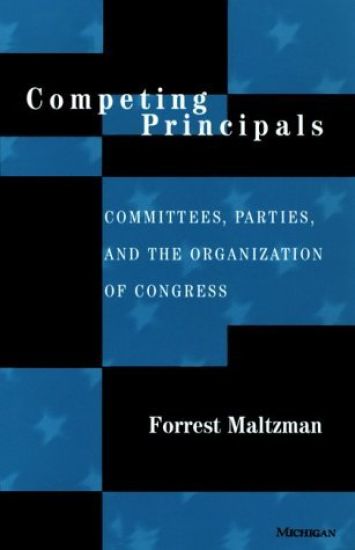
Competing Principals

Competing Principals

Forrest Maltzman

The University of Michigan Press
1998
nidottu
Since Woodrow Wilson, political scientists have recognized the importance of congressional committees in the policy-making process. Congressional committees often determine what legislation will reach the floor of the House or Senate and what form that legislation will take. In spite of the broad consensus on the importance of congressional committees, there is little agreement on what explains committee action. Committees are alternately viewed as agents of the chamber, the party caucuses, or constituencies outside the institution. Each theory suggests a different distribution of power in the policy-making process.Forrest Maltzman argues that none of these models fully captures the role performed by congressional committees and that committee members attempt to balance the interests of the chamber, the party caucus, and outside constituencies. Over time, and with the changing importance of a committee's agenda to these groups, the responsiveness of members of committees will vary. Maltzman argues that the responsiveness of the committee to these groups is driven by changes in procedure, the strength of the party caucus, and the salience of a committee's agenda. Maltzman tests his theory against historical data.This book will appeal to social scientists interested in the study of Congress and legislative bodies, as well as those interested in studying the impact of institutional structure on the policy-making process."This specialized study, of value to congressional scholars and partisan activists, enriches an understanding of the increasingly predictable patterns of committee variety." --ChoiceForrest Maltzman is Assistant Professor of Political Science, George Washington University.
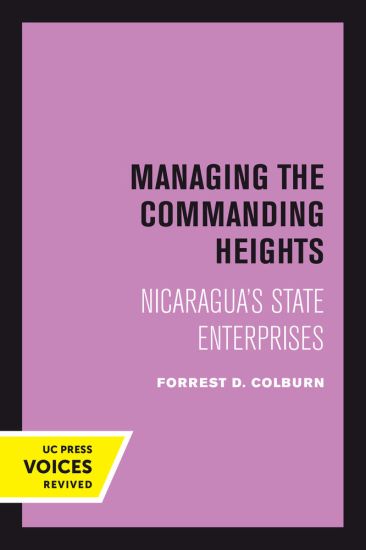
Managing the Commanding Heights

Managing the Commanding Heights

Forrest D. Colburn

University of California Press
2018
pokkari
Revolutions have often occurred in poor countries. Although triumphant revolutionaries may lack the resources to assume complete responsibility for their country’s economy, they do tend to nationalize what Lenin called the “commanding heights”—those enterprises that meet the strategic needs of the polity. How these enterprises are administered is consequential, and at times decisive, for the course of revolutionary change. In Managing the Commanding Heights, Forrest D. Colburn explores the Sandinistas’ management of Nicaragua’s state enterprises, with an emphasis on the critical agrarian sector. Central to the book are three lively and instructive case studies that provide a penetrating glimpse into life in post-revolutionary Nicaragua. In analyzing these cases, Colburn explains the intentions of the Sandinista elite and links them with choices made at individual enterprises. Colburn argues that state enterprises have been politically useful but economically unsuccessful. Even with the unseen political advantages of state enterprises, the pronounced financial losses of nationalized farms and factories exacerbate the economic—and ultimately political—vulnerability of a regime already weakened by counterrevolution. The evidence demonstrates trenchant limitations to a revolutionary state’s capacity to improve popular welfare. State capacity is undermined by multiple factors: international constraints on the autonomy of post-revolutionary regimes, sheer poverty, the unintended but inevitable political manipulation of the economy, the lack of managerial ability among even well-intentioned elites, and a revolutionary mentalité that erodes rationality. These same difficulties have bedeviled other post-revolutionary regimes, notably those in Africa. Managing the Commanding Heights is essential reading for anyone interested in the dynamics of revolutionary regimes and the possibilities for radical change in poor countries. This title is part of UC Press's Voices Revived program, which commemorates University of California Press’s mission to seek out and cultivate the brightest minds and give them voice, reach, and impact. Drawing on a backlist dating to 1893, Voices Revived makes high-quality, peer-reviewed scholarship accessible once again using print-on-demand technology. This title was originally published in 1990.
Post-Revolutionary Nicaragua

Post-Revolutionary Nicaragua

Forrest D. Colburn

University of California Press
2022
pokkari
This title is part of UC Press's Voices Revived program, which commemorates University of California Press’s mission to seek out and cultivate the brightest minds and give them voice, reach, and impact. Drawing on a backlist dating to 1893, Voices Revived makes high-quality, peer-reviewed scholarship accessible once again using print-on-demand technology. This title was originally published in 1986.
Post-Revolutionary Nicaragua

Post-Revolutionary Nicaragua

Forrest D. Colburn

University of California Press
2022
sidottu
This title is part of UC Press's Voices Revived program, which commemorates University of California Press’s mission to seek out and cultivate the brightest minds and give them voice, reach, and impact. Drawing on a backlist dating to 1893, Voices Revived makes high-quality, peer-reviewed scholarship accessible once again using print-on-demand technology. This title was originally published in 1986.
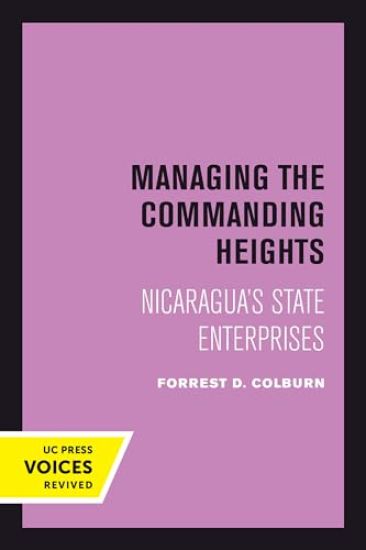
Managing the Commanding Heights

Managing the Commanding Heights

Forrest D. Colburn

University of California Press
2024
sidottu
Revolutions have often occurred in poor countries. Although triumphant revolutionaries may lack the resources to assume complete responsibility for their country’s economy, they do tend to nationalize what Lenin called the “commanding heights”—those enterprises that meet the strategic needs of the polity. How these enterprises are administered is consequential, and at times decisive, for the course of revolutionary change. In Managing the Commanding Heights, Forrest D. Colburn explores the Sandinistas’ management of Nicaragua’s state enterprises, with an emphasis on the critical agrarian sector. Central to the book are three lively and instructive case studies that provide a penetrating glimpse into life in post-revolutionary Nicaragua. In analyzing these cases, Colburn explains the intentions of the Sandinista elite and links them with choices made at individual enterprises. Colburn argues that state enterprises have been politically useful but economically unsuccessful. Even with the unseen political advantages of state enterprises, the pronounced financial losses of nationalized farms and factories exacerbate the economic—and ultimately political—vulnerability of a regime already weakened by counterrevolution. The evidence demonstrates trenchant limitations to a revolutionary state’s capacity to improve popular welfare. State capacity is undermined by multiple factors: international constraints on the autonomy of post-revolutionary regimes, sheer poverty, the unintended but inevitable political manipulation of the economy, the lack of managerial ability among even well-intentioned elites, and a revolutionary mentalité that erodes rationality. These same difficulties have bedeviled other post-revolutionary regimes, notably those in Africa. Managing the Commanding Heights is essential reading for anyone interested in the dynamics of revolutionary regimes and the possibilities for radical change in poor countries. This title is part of UC Press's Voices Revived program, which commemorates University of California Press’s mission to seek out and cultivate the brightest minds and give them voice, reach, and impact. Drawing on a backlist dating to 1893, Voices Revived makes high-quality, peer-reviewed scholarship accessible once again using print-on-demand technology. This title was originally published in 1990.

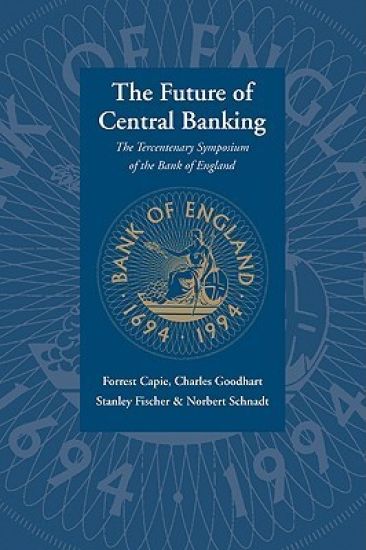
The Future of Central Banking

The Future of Central Banking

Forrest Capie; Stanley Fischer; Charles Goodhart; Norbert Schnadt

Cambridge University Press
2008
pokkari
This volume contains two major papers prepared for the Bank of England's Tercentenary Symposium in June 1994. The first, by Forrest Capie, Charles Goodhart and Norbert Schnadt, provides an authoritative account of the evolution of central banking. It traces the development of both the monetary and financial stability concerns of central banks, and includes individual sections on the evolution and constitutional positions of 31 central banks from around the world. The second paper, by Stanley Fischer, explores the major policy dilemmas now facing central bankers: the extent to which there is a short-term trade-off between inflation and growth; the choice of inflation targets; and the choice of operating procedures. Important contributions by leading central bankers from around the world, and the related Per Jacobsen lecture by Alexander Lamfalussy, are also included in the volume.
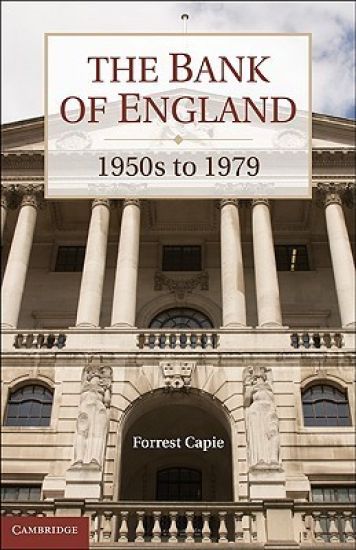
The Bank of England

The Bank of England

Forrest Capie

Cambridge University Press
2010
sidottu
This history of the Bank of England takes its story from the 1950s to the end of the 1970s. This period probably saw the peak of the Bank's influence and prestige, as it dominated the financial landscape. One of the Bank's central functions was to manage the exchange rate. It was also responsible for administering all the controls that made up monetary policy. In the first part of the period, the Bank did all this with a remarkable degree of freedom. But economic policy was a failure, and sluggish output, banking instability and rampant inflation characterised the 1970s. The pegged exchange rate was discontinued, and the Bank's freedom of movement was severely constrained, as new approaches to policy were devised and implemented. The Bank lost much of its freedom of movement but also took on more formal supervision.
The Future of Central Banking

The Future of Central Banking

Forrest Capie; Stanley Fischer; Charles Goodhart; Norbert Schnadt

Cambridge University Press
1995
sidottu
This volume contains two major papers prepared for the Bank of England’s Tercentenary Symposium in June 1994. The first, by Forrest Capie, Charles Goodhart and Norbert Schnadt, provides an authoritative account of the evolution of central banking. It traces the development of both the monetary and financial stability concerns of central banks, and includes individual sections on the evolution and constitutional positions of 31 central banks from around the world. The second paper, by Stanley Fischer, explores the major policy dilemmas now facing central bankers: the extent to which there is a short-term trade-off between inflation and growth; the choice of inflation targets; and the choice of operating procedures. Important contributions by leading central bankers from around the world, and the related Per Jacobsen lecture by Alexander Lamfalussy, are also included in the volume.
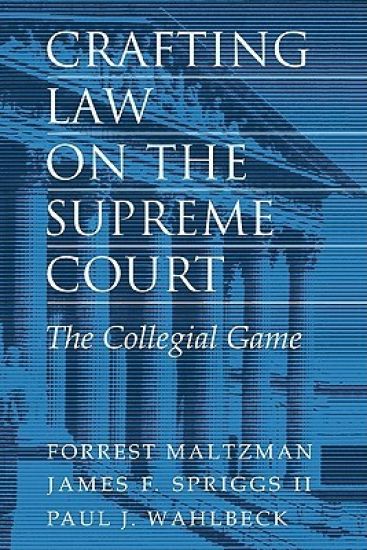
Crafting Law on the Supreme Court

Crafting Law on the Supreme Court

Forrest Maltzman; James F. Spriggs; Paul J. Wahlbeck

Cambridge University Press
2000
sidottu
Material is gleaned from internal memos circulated among justices on the Supreme Court to systematically account for the building of majority opinions. The authors argue that at the heart of this process are policy-seeking justices who are constrained by the choices made by the other justices. By strategically using threats, signals, and persuasion, justices attempt to influence the behavior of their colleagues on the bench. Evidence derived from the recently released papers of justices Brennan, Douglas, Marshall, and Powell is used to test the authors' theory of opinion writing. The portrait of the Supreme Court that emerges stands in sharp contrast to the conventional portrait where justices act solely on the basis of the law or their personal policy preferences. This book provides a fascinating glimpse of how the Court crafts the law.
Crafting Law on the Supreme Court

Crafting Law on the Supreme Court

Forrest Maltzman; James F. Spriggs; Paul J. Wahlbeck

Cambridge University Press
2000
pokkari
Material is gleaned from internal memos circulated among justices on the Supreme Court to systematically account for the building of majority opinions. The authors argue that at the heart of this process are policy-seeking justices who are constrained by the choices made by the other justices. By strategically using threats, signals, and persuasion, justices attempt to influence the behavior of their colleagues on the bench. Evidence derived from the recently released papers of justices Brennan, Douglas, Marshall, and Powell is used to test the authors’ theory of opinion writing. The portrait of the Supreme Court that emerges stands in sharp contrast to the conventional portrait where justices act solely on the basis of the law or their personal policy preferences. This book provides a fascinating glimpse of how the Court crafts the law.