Kirjojen hintavertailu. Mukana 11 627 466 kirjaa ja 12 kauppaa.

Kirjahaku

Etsi kirjoja tekijän nimen, kirjan nimen tai ISBN:n perusteella.

1000 tulosta hakusanalla Franchesca Collins

Casa Rossa

Casa Rossa

Francesca Marciano

Vintage Publishing
2012
pokkari
A haunting story of what happens when family secrets collide with history, Casa Rossa moves from the duplicity of Italy's role in the 1930s to the dark years of Red Brigade's terrorism in the seventies.
Thermal Inertia in Energy Efficient Building Envelopes

Thermal Inertia in Energy Efficient Building Envelopes

Francesca Stazi

Butterworth-Heinemann Inc
2017
nidottu
The design and construction of the appropriate building envelope is one of the most effective ways for improving a building’s thermal performance. Thermal Inertia in Energy Efficient Building Envelopes provides the optimal solutions, tools and methods for designing the energy efficient envelopes that will reduce energy consumption and achieve thermal comfort and low environmental impact. Thermal Inertia in Energy Efficient Building Envelopes provides experimental data, technical solutions and methods for quantifying energy consumption and comfort levels, also considering dynamic strategies such as thermal inertia and natural ventilation. Several type of envelopes and their optimal solutions are covered, including retrofit of existing envelopes, new solutions, passive systems such as ventilated facades and solar walls. The discussion also considers various climates (mild or extreme) and seasons, building typology, mode of use of the internal environment, heating profiles and cross-ventilation
Advanced Building Envelope Components

Advanced Building Envelope Components

Francesca Stazi

Butterworth-Heinemann Inc
2019
nidottu
Advanced Building Envelope Components: Comparative Experiments focuses on the latest research in innovative materials, systems and components, also providing a detailed technical explanation on what this breakthrough means for building exteriors and sustainability. Topics include a discussion of transparent envelope components, including intelligent kinetic skins, such as low-e coatings, high vs. low silver content in glass, solar control coatings, such as silver vs. niobium vs. tin, and more. In addition, opaque envelope components are also presented, including opaque dynamic facades, clay lining vs. plasterboard and nano clayed foams.
Social Justice through Inclusion

Social Justice through Inclusion

Francesca R. Jensenius

Oxford University Press Inc
2017
sidottu
Across the world, governments design and implement policies with the explicit goal of promoting social justice. But can such institutions change entrenched social norms? And what effects should we expect from differently designed policies? Francesca R. Jensenius' Social Justice through Inclusion is an empirically rich study of one of the most extensive electoral quota systems in the world: the reserved seats for the Scheduled Castes (SCs, the former "untouchables") in India's legislative assemblies. Combining evidence from quantitative datasets from the period 1969-2012, archival work, and in-depth interviews with politicians, civil servants, and voters across India, the book explores the long-term effects of electoral quotas for the political elite and the general population. It shows that the quota system has played an important role in reducing caste-based discrimination, particularly at the elite level. Interestingly, this is not because the system has led to more group representation - SC politicians working specifically for SC interests - but because it has made possible the creation and empowerment of a new SC elite who have gradually become integrated into mainstream politics. This is a study of India, but the findings and discussions have broader implications. Policies such as quotas are usually supported with arguments about various assumed positive long-term consequences. The nuanced discussions in this book shed light on how electoral quotas for SCs have shaped the incentives for politicians, parties, and voters, and indicate the trade-offs inherent in how such policies of group inclusion are designed.
Social Justice through Inclusion

Social Justice through Inclusion

Francesca R. Jensenius

Oxford University Press Inc
2017
nidottu
Across the world, governments design and implement policies with the explicit goal of promoting social justice. But can such institutions change entrenched social norms? And what effects should we expect from differently designed policies? Francesca R. Jensenius' Social Justice through Inclusion is an empirically rich study of one of the most extensive electoral quota systems in the world: the reserved seats for the Scheduled Castes (SCs, the former "untouchables") in India's legislative assemblies. Combining evidence from quantitative datasets from the period 1969-2012, archival work, and in-depth interviews with politicians, civil servants, and voters across India, the book explores the long-term effects of electoral quotas for the political elite and the general population. It shows that the quota system has played an important role in reducing caste-based discrimination, particularly at the elite level. Interestingly, this is not because the system has led to more group representation - SC politicians working specifically for SC interests - but because it has made possible the creation and empowerment of a new SC elite who have gradually become integrated into mainstream politics. This is a study of India, but the findings and discussions have broader implications. Policies such as quotas are usually supported with arguments about various assumed positive long-term consequences. The nuanced discussions in this book shed light on how electoral quotas for SCs have shaped the incentives for politicians, parties, and voters, and indicate the trade-offs inherent in how such policies of group inclusion are designed.
Roman Luxuria

Roman Luxuria

Francesca Romana Berno

Oxford University Press
2023
sidottu
In classical Latin, luxuria means 'desire for luxury'; it is linked with the ideas of excess and deviation from a standard. It is in most cases labelled as a vice which contrasts with the innate frugal nature of the Romans. Latin authors do not see it as endemic but as an import from the East in the aftermath of military conquests--and as a cause of fatal decline. Following these etymological and semantic origins, Roman Luxuria: A Literary and Cultural History discusses the influence of Greek culture on the Roman concept and the peculiar characteristics of Roman luxuria. It analyses Roman views on luxuria through close readings in historical order from Cato the Elder, who regards luxuria as the opposite of the ideal Roman way of life, to the Christian poet Prudentius, who represents it in an allegorical fight with Sobriety. The book attends both to key authors and to wider literary genres, such as historiography and satire. Particular consideration is given to the rhetorical device of personification, which can be traced from the first appearances of luxuria in Latin literature to those of late antiquity. Berno devotes detailed attention to Seneca the Younger, whose work is often preoccupied with this passion. Seneca both defends himself from the charge of luxuria and violently attacks it in others, describing it as the archenemy of a philosophical life. Along the centuries, the focus on luxuria shifts from the economic sphere (and the waste of money) to the erotic, to the extent that in the Christian world it becomes one of the Seven Capital Sins representing the vice of lust.
The Invention of Custom

The Invention of Custom

Francesca Iurlaro

Oxford University Press
2021
sidottu
The concept of customary international law, although differently formulated, is already present in early modern European debates on natural law and the law of nations. However, no scholarly monograph has, until now, addressed the relationship between custom and the European natural law and ius gentium tradition. This book tells that neglected story, and offers a solid conceptual framework to contextualize and understand the 'problematic of custom', namely how to identify its normative content. Natural law doctrines, and the different ways in which they help construct human reason, provided custom with such normative content. This normative content consists of a set of fundamental moral values that help identify the status of custom as either a fundamental feature or an original source of ius gentium. This book explores what cultural values and practices facilitated the emergence of custom and rendered it into as a source of the law of nations, and how they did so. Two crucial issues form the core of the book's analysis. Firstly, it qualifies the nature of the interrelation between natural law and ius gentium, explaining why it matters in relation to our understanding of the idea of custom. Second, the book claims that the process of custom formation as a source of law calls into question the role of the authority of history. The interpretation of the past through this approach can thus be described as one of 'invention'.
East of Delhi

East of Delhi

Francesca Orsini

OXFORD UNIVERSITY PRESS INC
2023
sidottu
Like many societies across the world, the region of Awadh in North India has been bilingual throughout its history. But literary histories of the region often indicate otherwise. In the early twentieth century, colonists recodified literary histories separately according to language, detached written literature from oral literature, and reimagined the entangled literary past according to their own ideas about language, literature, and Indian history. At the same time, multilingualism remained resilient and acquired new uses. East of Delhi: Multilingual Literary Culture and World Literature examines literature produced, practiced, and circulated in and out of North India, focusing on the region of Awadh, from the beginning of recorded vernacular literature in the late fourteenth century to the colonial era of the early twentieth century. This book considers texts in a wide range of genres-courtly, devotional, and popular-composed in the main languages of the region: Hindavi, Persian, Brajbhasha, Urdu. Individual chapters focus on narratives, devotional song-poems and didactic works, local courtly literary practices, and multilingual education as recorded in biographical dictionaries-anthologies. Author Francesca Orsini suggests that this multilingual and multi-genre approach is better suited to capturing the texture, complexity, and dynamics of literature in the world, and of literary history, than approaches that focus only on global circulation or models that draw centers and peripheries on a single global map.
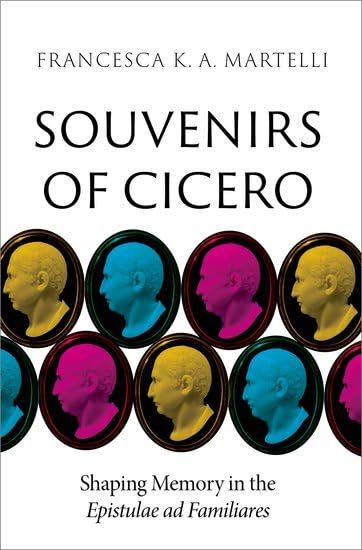
Souvenirs of Cicero

Souvenirs of Cicero

Francesca K. A. Martelli

OXFORD UNIVERSITY PRESS INC
2024
sidottu
Cicero's letters have figured prominently in some of western modernity's most cherished illusions about the immediacy of its encounter with Classical antiquity. Celebrated since their discovery in the Renaissance for their intimate mode of self-expression, they have been prized since then for the unparalleled proximity they appear to lend to the events and leading figures of the late Republic. However, the letters were only organized into books and collections and published assuch by editors after Cicero's death, and are therefore also the products of a later era. Souvenirs of Cicerois a study of the narratives that the letter collections plot, and of the belated, post-Republican perspectives that shape them. It focuses on theEpistulae ad Familiares, the collection that incorporates Cicero's widest cast of correspondents, and which has been most vulnerable to the modern editorial impulse to reorganize the letter collections along chronological lines. This book attempts to reverse that impulse by appraising the collection in the format transmitted from antiquity and attending to its status as an artefact of the later imperial age. Francesca K. A. Martelli traces the social, political and technological agencies that shaped this letter collection in antiquity, and elucidates the interests that these editorial interventions serve both for ancient readers and for our interpretation of the letters today. Integrating close readings of the letters with hypotheses drawn from contemporary media theory, she makes the case for considering Cicero's letters as residual media, which haunt subsequent history with the Republic's lost futures as they circulate beyond their own era.
Palestinian Refugees in International Law

Palestinian Refugees in International Law

Francesca P. Albanese; Lex Takkenberg

Oxford University Press
2020
sidottu
The Palestinian refugee question, resulting from the events surrounding the birth of the state of Israel seventy years ago, remains one of the largest and most protracted refugee crises of the post-WWII era. Numbering over six million in the Middle East alone, Palestinian refugees' status varies considerably according to the state or territory 'hosting' them, the UN agency assisting them and political circumstances surrounding the Israeli-Palestinian conflict these refugees are naturally associated with. Despite being foundational to both the experience of the Palestinian refugees and the resolution of their plight, international law is often side-lined in political discussions concerning their fate. This compelling new book, building on the seminal contribution of the first edition (1998), offers a clear and comprehensive analysis of various areas of international law (including refugee law, human rights law, humanitarian law, the law relating to stateless persons, principles related to internally displaced persons, as well as notions of international criminal law), and probes their relevance to the provision of international protection for Palestinian refugees and their quest for durable solutions.
Palestinian Refugees in International Law

Palestinian Refugees in International Law

Francesca P. Albanese; Lex Takkenberg
Oxford University Press
2020
nidottu
The Palestinian refugee question, resulting from the events surrounding the birth of the state of Israel seventy years ago, remains one of the largest and most protracted refugee crises of the post-WWII era. Numbering over six million in the Middle East alone, Palestinian refugees' status varies considerably according to the state or territory 'hosting' them, the UN agency assisting them and political circumstances surrounding the Israeli-Palestinian conflict these refugees are naturally associated with. Despite being foundational to both the experience of the Palestinian refugees and the resolution of their plight, international law is often side-lined in political discussions concerning their fate. This compelling new book, building on the seminal contribution of the first edition (1998), offers a clear and comprehensive analysis of various areas of international law (including refugee law, human rights law, humanitarian law, the law relating to stateless persons, principles related to internally displaced persons, as well as notions of international criminal law), and probes their relevance to the provision of international protection for Palestinian refugees and their quest for durable solutions.
A Primer on Stable Isotopes in Ecology

A Primer on Stable Isotopes in Ecology

Francesca Cotrufo; Yamina Pressler

Oxford University Press
2023
sidottu
In the past few decades, the field of ecology has made huge advancements thanks to stable isotopes. Ecologists need to understand the principles of stable isotopes to fully appreciate many studies in their discipline. Ecologists also need to be aware of isotopic approaches to enrich their “toolbox” for further advancing the discipline. A Primer on Stable Isotopes in Ecology is a concise and foundational resource for anyone interested in acquiring theoretical and practical knowledge for the application of stable isotopes in ecology. Readers will gain a more in-depth and complete knowledge of stable isotopes and explore isotopic methods used in ecological research, learning about stable isotope definitions, measurement, ecological processes, and applications in research. Chapters include in-depth descriptions of stable isotopes and their notation, isotope fractionation, isotope mixing, heavy isotope enrichment, and quantification methods by mass spectrometry and laser spectroscopy. The text guides readers to think "isotopically” to better understand research conducted using stable isotopes. The book also provides basic practical skills and activities to apply stable isotope methods in ecological research. It includes 5 activities through which readers can apply their knowledge to real-world problems and improve their skills for interpreting and using stable isotopes in ecological research. This book is designed for students and scientists from different backgrounds who share the common interest in stable isotopes.
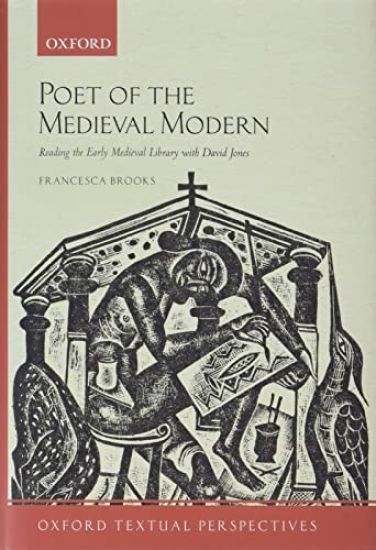
Poet of the Medieval Modern

Poet of the Medieval Modern

Francesca Brooks

Oxford University Press
2021
sidottu
The early Middle Ages provided twentieth-century poets with the material to re-imagine and rework local, religious, and national identities in their writing. Poet of the Medieval Modern focuses on a key figure within this tradition, the Anglo-Welsh poet and artist David Jones (1895-1974): representing the first extended study of the influence of early medieval English culture and history on Jones and his novel-length late modernist poem The Anathemata (1952). Jones's second major poetic project after In Parenthesis (1937), The Anathemata fuses Jones's visual and verbal arts to write a Catholic history of Britain as told through the history of man-as-artist. Drawing on unpublished archival material including manuscripts, sketches, correspondence, and, most significantly, the marginalia from David Jones's Library, this volume reads with Jones in order to trouble the distinction between poetry and scholarship. Placing this underappreciated figure firmly at the centre of new developments in Modernist and Medieval Studies, Poet of the Medieval Modern brings the two fields into dialogue and argues that Jones uses the textual and material culture of the early Middle Ages--including Old English prose and poetry, Anglo-Latin hagiography, early medieval stone sculpture, manuscripts, and historiography--to re-envision British Catholic identity in the twentieth-century long poem. Jones returned to the English record to seek out those moments where the histories of the Welsh had been elided or erased. At a time when the Middle Ages are increasingly weaponised in far-right and nationalist political discourse, the book offers a timely discussion of how the early medieval past has been resourced to both shore-up and challenge English hegemonies across modern British culture.
Poet of the Medieval Modern

Poet of the Medieval Modern

Francesca Brooks

Oxford University Press
2021
nidottu
The early Middle Ages provided twentieth-century poets with the material to re-imagine and rework local, religious, and national identities in their writing. Poet of the Medieval Modern focuses on a key figure within this tradition, the Anglo-Welsh poet and artist David Jones (1895-1974): representing the first extended study of the influence of early medieval English culture and history on Jones and his novel-length late modernist poem The Anathemata (1952). Jones's second major poetic project after In Parenthesis (1937), The Anathemata fuses Jones's visual and verbal arts to write a Catholic history of Britain as told through the history of man-as-artist. Drawing on unpublished archival material including manuscripts, sketches, correspondence, and, most significantly, the marginalia from David Jones's Library, this volume reads with Jones in order to trouble the distinction between poetry and scholarship. Placing this underappreciated figure firmly at the centre of new developments in Modernist and Medieval Studies, Poet of the Medieval Modern brings the two fields into dialogue and argues that Jones uses the textual and material culture of the early Middle Ages--including Old English prose and poetry, Anglo-Latin hagiography, early medieval stone sculpture, manuscripts, and historiography--to re-envision British Catholic identity in the twentieth-century long poem. Jones returned to the English record to seek out those moments where the histories of the Welsh had been elided or erased. At a time when the Middle Ages are increasingly weaponised in far-right and nationalist political discourse, the book offers a timely discussion of how the early medieval past has been resourced to both shore-up and challenge English hegemonies across modern British culture.
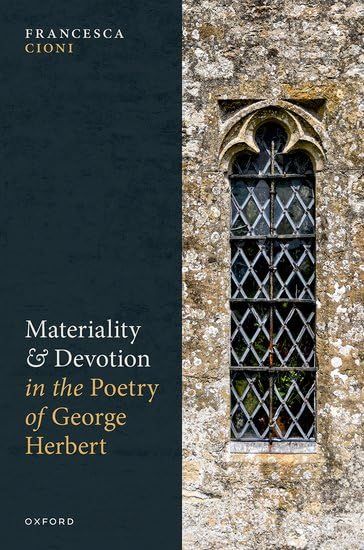
Materiality and Devotion in the Poetry of George Herbert

Materiality and Devotion in the Poetry of George Herbert

Francesca Cioni

Oxford University Press
2024
sidottu
George Herbert, his contemporaries, and readers inhabited a world of material things that were spiritually animated but deeply troubling. Habitual providential and typological interpretation imbued matter with meaning, and connected it with the rest of Creation; using material things was an act of interpretation, devotion an act of habitual reading. Materialist philosophies rejected distinctions between body and soul; injunctions to continuous prayer made every place and every bodily motion a potential house of and vehicle for prayer. At the same time Protestant doctrine and Church of England policy, expressed in sermons, visitation articles and works of theology as well as devotional manuals, prayer books and even physiologies and biographies, policed the ways and conditions in which material things, bodies, and spaces might be properly used in devotion. Herbert's Temple is built, read, and used in this world of continual textual and material 'reading'. By a close reading of The Temple, this book explores how Herbert and his readers understood, experienced, and used material objects in devotion. The Temple is an edifice built of paper and ink, of Biblical allusion, and of analogy to both physical churches and spiritual communities of believers: a material and spiritual, literal, and figurative construction. In his verse, Herbert plays with the boundaries between material and spiritual presence, and between literal and figurative signification; in its devotional poetics material and spiritual meanings inform one another and its readers' devotional lives. Materiality and Devotion in the Poetry of George Herbert focuses in turn on three of the most significant kinds of material things seventeenth-century English believers encountered in devotion: their bodies, church buildings, and books.
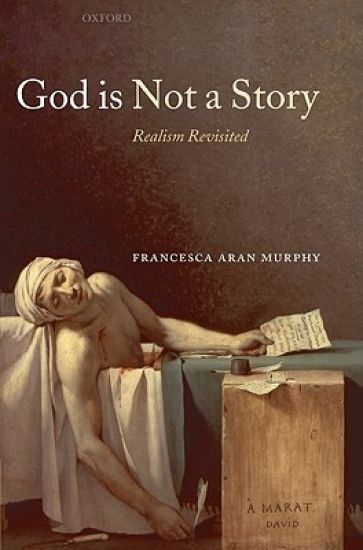
God Is Not a Story

God Is Not a Story

Francesca Aran Murphy

Oxford University Press
2007
sidottu
A challenging critique of narrative theologies, including the works of George Lindbeck, Robert Jenson, and Herbert McCabe. Francesca Aran Murphy argues that the use of the concept of story or narrative in theology is circular and self-referential, and that the widespread notion that the role of the theologian is to 'tell God's story' has not helped theology to advance the reality of its doctrines. Murphy contends that the scriptural revelation on which Christian theology depends is not a story or a plot but a dramatic encounter between mysterious, free, and unpredictable persons. She offers her own alternative approach, making use of cinema and film theory, and engaging in particular in a dialogue with the work of Hans Urs von Balthasar.
Europe's Advantage

Europe's Advantage

Francesca Carnevali

Oxford University Press
2005
sidottu
This is the first book to explore the causes of the decline of British manufacturing in the 20th century by focusing on the troubled relationship between banks and small firms in a comparative historical perspective. Since the mid-1970s, the 'rediscovery' of small firms and of the important role they have played in the economies of continental Europe have occupied a substantial part of the literature on the sources of economic competitiveness. In Britain, the relationship between banks and industry has been the object of intense speculation since before the First World War. Since then banks have been accused by the business community, academics and politicians of neglecting industrial finance and by doing so of reducing the competitiveness of British firms. By comparing the rise of small firms in France, Germany and Italy and their decline in Britain this book analyses how the structure of these countries' banking systems has affected small firms' growth. This analysis is placed in the historical context of the political economy of these four countries, to show how banking and industrial structures developed over the century as a consequence of the state's need to mediate between different social and economic groups. This approach allows the author to show why British banking came to be so concentrated and the negative impact that this had on the supply of finance to small firms. The experiences of France, Germany and Italy show alternative structures and policy responses towards small firms.
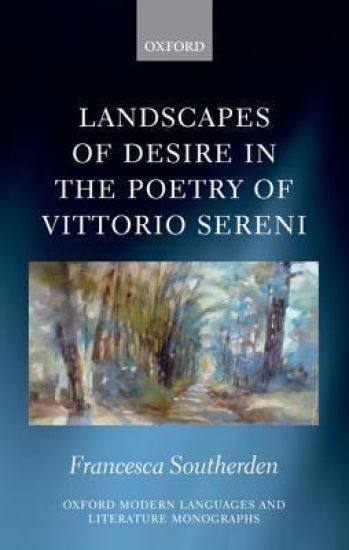
Landscapes of Desire in the Poetry of Vittorio Sereni

Landscapes of Desire in the Poetry of Vittorio Sereni

Francesca Southerden

Oxford University Press
2012
sidottu
Landscapes of Desire in the Poetry of Vittorio Sereni is the first book-length study in English on Vittorio Sereni (1913-83), one of the major figures of Italian twentieth-century poetry. It argues that a key innovation of Sereni's poetry is constituted in the way in which, from Frontiera [Frontier] (1941) to Stella variabile [Variable Star] (1981), he reworks the boundaries of poetic space to construct a lyric 'I' radically repositioned in the textual universe with respect to its predecessors: an 'I' that is decentred, in limine, and struggles to subordinate the world to its point of view. Through an interdisciplinary framework that bridges psychoanalytic, linguistic, and poetic theory, two main dimensions of Sereni's work are revisited and reassessed. The first is the role of liminality, which is presented as a condition of writing and as the mark of a desiring subject whose most desired object is the complete poem or total identity that elude him. The second is Sereni's relationship to the Italian poetic tradition, including Dante, Petrarch, Leopardi, and Montale, who mediate his contact with a textual beyond that slips further and further from view. The study maps, through close-reading, the poet's evolving use of deictic reference (spatio-temporal coordinates, demonstratives, personal pronouns) and the progressive transformation of the poem into a place of frustrated desire that occludes fulfilment. It argues that Sereni's particular brand of experimentalism develops from this point and that he represents a unique moment in the history of twentieth-century Italian poetry in the way in which he adapts pre-existing models of lyric discourse to new modes of expression.
Caring for a Living

Caring for a Living

Francesca Degiuli

Oxford University Press Inc
2016
sidottu
Today's world is aging at a great speed, and although increased longevity represents one of the greatest achievements of the last century, the extension of life expectancy does not necessarily correspond to an extension of healthy lives. Aging populations, particularly those with a high percentage of the oldest old, are often burdened with chronic conditions that require extended long-term care. Deciding who provides said care, and in what forms, are key problems that will soon affect a growing number of post-industrial high- and mid-income countries. ^iCaring for a Living^r contributes to this debate by exploring the organization of long-term care in Italy, a country already in the midst of an eldercare crisis. There, the answer to this problem has taken the shape of home eldercare assistance, an arrangement whereby long-term care services are bought in the market in the form of private and individualized assistance by families sometimes with economic support provided by the State. The providers of these services, commonly known as "badanti" (minders), are, for the most part, im/migrant women coming from different areas of the world. ^iCaring for a Living^r analyzes the emergence and development of this arrangement and the role that the state, Italian families, and workers themselves play in shaping and in defining it. The author provides timely insights on: the nature of long-term care and its requirements; the specific needs of families facing this issue; the changing role of the neoliberal State; and the ways in which global political and economic processes influence and shape an apparently individually based solution to long-term care. This book is ideal for graduate courses in sociology and anthropology, specifically in courses related to gender and migration, work and women, social inequality, and immigration studies.
Troy, Unincorporated

Troy, Unincorporated

Francesca Abbate

University of Chicago Press
2012
nidottu
Daily it storms: dams give out, a lake in the next county empties, every river swells. And the story says this is love, this is hope, Silly. It's sorry, but it means to keep the afternoon as I left it: folding chairs at a folding table and the light wasp-colored, an old postcard of this was a factory town. And him (who won't be you, not again, nor still) setting the kettle on the ancient stove. On the table, a receipt he'd written on - something about God handing the world back to Job. A meditation on the nature of betrayal, the constraints of identity, and the power of narrative, the lyric monologues in "Troy", "Unincorporated" offer a retelling of Chaucer's tragedy "Troilus and Criseyde". The tale's unrooted characters now find themselves adrift in the industrialized farmlands, strip malls, and half-tenanted "historic" downtowns of south-central Wisconsin, including the real, and literally unincorporated, town of Troy. Allusive and often humorous, they retain an affinity with Chaucer, especially in terms of their roles: Troilus, the courtly lover, suffers from depression. Pandarus, the hardworking catalyst who brings the lovers together in Chaucer's poem, is here a car mechanic. Aware of themselves as literary constructs, the narrator and characters in "Troy", "Unincorporated" are paradoxically driven by the desire to be autonomous creatures - tale tellers rather than tales told. Thus, through "Troy", "Unincorporated" follows Chaucer's plot, it moves beyond Chaucer to posit a possible fate for Criseyde on this "litel spot of erthe."