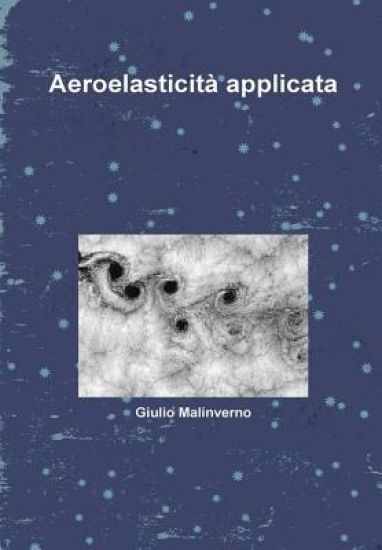
I fenomeni aeroelastici costituiscono la summa dello studio delle strutture aeronautiche e dei fenomeni aerodinamici. Sebbene si pensa che questi fenomeni siano confinati esclusivamente al campo aeronautico, in realta occorrono laddove il moto dei fluidi interagisce in maniera retroattiva con le strutture, coinvolgendo eventualmente altri campi e fenomeni. Il libro inizia con l'intrudizone del concetto di aeroelasticita e di sistema retroazionato, procedendo con l'analisi di sistemi semplificati e non, per poi discutere dei metodi classici di risoluzione del problema nonche degli approcchi moderni. Inizialmente nato come revisione degli appunti presi durante le lezion idi aeroelasticita applicata presso il corso di ingegneria aerospaziale del Politecnico di Milano tenuto dal prof. Paolo Mantegazza, il testo e stato poi ampliato includendo esercizi specifici, appendici sulla progettazione meccanica e approfondimenti sull'aeroelasticita in campi non aeronautici
This book presents a theory of the general dynamic economic equilibrium which is a development of the static theory of Walras and Pareto. The work has built up an analytical model of the effective, current movement of an economic system, founded on the logic of the individual changing programmes - a basis for finding out the laws of all types of endogenous and exogenous movements of the economy. Indeed, the model can be used in the treatment of the typical problems of dynamic economics, by means of the author's method of variational dynamic analysis.
This work has been selected by scholars as being culturally important, and is part of the knowledge base of civilization as we know it. This work was reproduced from the original artifact, and remains as true to the original work as possible. Therefore, you will see the original copyright references, library stamps (as most of these works have been housed in our most important libraries around the world), and other notations in the work.This work is in the public domain in the United States of America, and possibly other nations. Within the United States, you may freely copy and distribute this work, as no entity (individual or corporate) has a copyright on the body of the work.As a reproduction of a historical artifact, this work may contain missing or blurred pages, poor pictures, errant marks, etc. Scholars believe, and we concur, that this work is important enough to be preserved, reproduced, and made generally available to the public. We appreciate your support of the preservation process, and thank you for being an important part of keeping this knowledge alive and relevant.
This work has been selected by scholars as being culturally important, and is part of the knowledge base of civilization as we know it. This work was reproduced from the original artifact, and remains as true to the original work as possible. Therefore, you will see the original copyright references, library stamps (as most of these works have been housed in our most important libraries around the world), and other notations in the work.This work is in the public domain in the United States of America, and possibly other nations. Within the United States, you may freely copy and distribute this work, as no entity (individual or corporate) has a copyright on the body of the work.As a reproduction of a historical artifact, this work may contain missing or blurred pages, poor pictures, errant marks, etc. Scholars believe, and we concur, that this work is important enough to be preserved, reproduced, and made generally available to the public. We appreciate your support of the preservation process, and thank you for being an important part of keeping this knowledge alive and relevant.
The 18th century was a wealth of knowledge, exploration and rapidly growing technology and expanding record-keeping made possible by advances in the printing press. In its determination to preserve the century of revolution, Gale initiated a revolution of its own: digitization of epic proportions to preserve these invaluable works in the largest archive of its kind. Now for the first time these high-quality digital copies of original 18th century manuscripts are available in print, making them highly accessible to libraries, undergraduate students, and independent scholars.Delve into what it was like to live during the eighteenth century by reading the first-hand accounts of everyday people, including city dwellers and farmers, businessmen and bankers, artisans and merchants, artists and their patrons, politicians and their constituents. Original texts make the American, French, and Industrial revolutions vividly contemporary.++++The below data was compiled from various identification fields in the bibliographic record of this title. This data is provided as an additional tool in helping to insure edition identification: ++++British LibraryT088115 Dublin]: London: printed, Dublin re-printed by George Faulkner, bookseller, 1736. iv,61, 3]p., plate: port.; 8
I fenomeni aeroelastici costituiscono la summa dello studio delle strutture aeronautiche e dei fenomeni aerodinamici. Sebbene si pensa che questi fenomeni siano confinati esclusivamente al campo aeronautico, in realta occorrono laddove il moto dei fluidi interagisce in maniera retroattiva con le strutture, coinvolgendo eventualmente altri campi e fenomeni. Il libro inizia con l'intrudizone del concetto di aeroelasticita e di sistema retroazionato, procedendo con l'analisi di sistemi semplificati e non, per poi discutere dei metodi classici di risoluzione del problema nonche degli approcchi moderni. Inizialmente nato come revisione degli appunti presi durante le lezion idi aeroelasticita applicata presso il corso di ingegneria aerospaziale del Politecnico di Milano tenuto dal prof. Paolo Mantegazza, il testo e stato poi ampliato includendo esercizi specifici, appendici sulla progettazione meccanica e approfondimenti sull'aeroelasticita in campi non aeronautici.
The book is about WWII and recounts with details and realism the suffering of an entire village population north of Cassino during the frigid months of 1943-1944, forced by the Germans to evacuate with their children and aging parents, without much food and clothing, likely to die by a bullet, starvation, or freezing in a mountainside. It is a true story of tragic events afflicting innocent people, living in caves and huts pervious to rain and hardly protective against the bitter winter, and also a historical and human account that reveals the true nature and instinct of people while risking their lives for survival every day. It exposes the unsung tragedy of civilians in a ravaging war as lived by a ten-year-old for nine months.
The development of lasers emitting ultrafast pulses with durations of femtoseconds or picoseconds has opened up a range of spectroscopic applications in many disciplines. Based largely on the author’s graduate and training courses, this book offers a complete overview of the topic. After reviewing the unique properties of short pulses, it explores laser systems that create them as well as a range of novel spectroscopic applications and techniques. The text also includes online supporting material, such animations, computer programs, and applets.
Steve Butcher is young, Australian and living in Scotland. He is a tabloid photographer. He is also disillusioned. His life isn't one of Page 3 Girls and celebrities. Instead, his morals and ethics are compromised every day. Thankfully, his life also revolves around beer, football, cable TV and, occasionally, women. It is through these he maintains his sanity. Set against the contrasting beauty of the seasons, Steve views his world through the eyes of an outsider. He discovers a country steeped in history, a city of intense beauty and a passionate people. By the time Steve's fourth Scottish winter - a particularly fierce one - arrives, he is over working for the tabs. When a nasty sniffle turns into an even nastier head cold and he is forced to spend hours at a time sitting in his car on a succession of dubious snatches, he is at his wits end...
Six years ago, in June 1977, the first international conference on chaos in classical dynamical systems took place here in Como. For the first time, physicists, mathematicians, biologists, chemists, economists, and others got together to discuss the relevance of the recent progress in nonlinear classical dynamics for their own research field. Immediately after, pUblication of "Nonlinear Science Abstracts" started, which, in turn, led to the Physica D Journal and to a rapid increase of the research activity in the whole area with the creation of numerous "Nonlinear Centers" around the world. During these years great progress has been made in understanding the qualitative behavior of classical dynamical systems and now we can appreciate the beautiful complexity and variety of their motion. Meanwhile, an increasing number of scientists began to wonder whether and how such beautiful structures would persist in quantum motion. Indeed, mainly integrable systems have been previously con sidered by Quantum Mechanics and therefore the problem is open how to describe the qualitative behavior of systems whose classical limit is non-integrable. The present meeting was organized in view of the fact that scientists working in different fields - mathematicians, theoretical physicists, solid state physicists, nuclear physicists, chemists and others - had common problems. Moreover, we felt that it was necessary to clarify some fundamental questions concerning the logical basis for the discussion including the very definition of chaos in Quantum Mechanics.
For people with severe/profound and multiple disabilities, managing the basic necessities of daily life often poses myriad challenges. Despite great odds, advances in assistive technology are making a difference in these individuals’ lives. Advances in microswitches, voice outcome communication aids, and computer-based systems are creating new opportunities for living independently, improving basic life skills, and reducing problem behaviors among individuals with combined motor, sensory, and intellectual disabilities.This unique volume examines how education and rehabilitation can improve the lives of even those individuals most affected by severe/profound and multiple disabilities. Interventions currently in use and in experimental stages are surveyed in terms of how they work and their applicability to clients with various needs. In addition, it examines the characteristics of developmentally disabled populations and offers guidelines for choosing suitable technologies. It presents empirical evidence on the advances in improving interaction with caregivers, control of the home environment, handling self-care tasks, and other core skills. Assistive Technology examines interventions that are innovative, respectful of the dignity of clients, and practical for ongoing use, including:• Microswitches in habilitation programs.• Speech-generating devices for communication and social development.• Instructional technology for promoting academic, work, and leisure skills.• Assistive technology for promoting ambulation.• Orientation systems for promoting movement indoors.• Assistive technology for reducing problem behaviors.A state-of-the-art guide to a growing field, Assistive Technology is an invaluable resource for researchers, clinicians, graduate students as well as clinicians and allied professionals in developmental psychology, rehabilitation and rehabilitative medicine,learning and instruction, occupational therapy, speech-language pathology, and educational technology.