Kirjojen hintavertailu. Mukana 12 595 353 kirjaa ja 12 kauppaa.

Kirjahaku

Etsi kirjoja tekijän nimen, kirjan nimen tai ISBN:n perusteella.

1000 tulosta hakusanalla Harald Taglinger

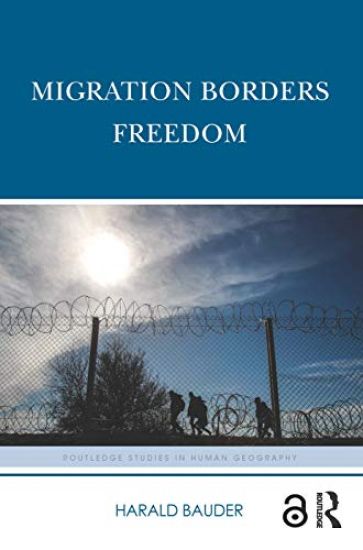
Migration Borders Freedom

Migration Borders Freedom

Harald Bauder

Routledge
2018
nidottu
International borders have become deadly barriers of a proportion rivaled only by war or natural disaster. Yet despite the damage created by borders, most people can’t – or don’t want to – imagine a world without them. What alternatives do we have to prevent the deadly results of contemporary borders?In today’s world, national citizenship determines a person’s ability to migrate across borders. Migration Borders Freedom questions that premise. Recognizing the magnitude of deaths occurring at contemporary borders worldwide, the book problematizes the concept of the border and develops arguments for open borders and a world without borders. It explores alternative possibilities, ranging from the practical to the utopian, that link migration with ideas of community, citizenship, and belonging. The author calls into question the conventional political imagination that assumes migration and citizenship to be responsibilities of nation states, rather than cities. While the book draws on the theoretical work of thinkers such as Ernst Bloch, David Harvey, and Henry Lefebvre, it also presents international empirical examples of policies and practices on migration and claims of belonging. In this way, the book equips the reader with the practical and conceptual tools for political action, activist practice, and scholarly engagement to achieve greater justice for people who are on the move.
Business Cycle Theory, Part I Volume 1
These volumes contain key texts from the period 1860-1939 on Business Cycle Theory. It covers a long list of Anglo-Saxon writers, as well as the most important contributions from the French, German, Italian, Russian and Swedish debates. The older business cycle theories presented here richly elucidate the complex interaction between real, monetary and structural change factors in economic systems — the close association between historical and analytical methods providing a fertile source of inspiration for current researchers in the field. In Volume I of this edition, a number of chapters from early classics are presented. After 1860, the idea of a regular business cycle, formulated by Clément Juglar, was increasingly recognised as a recurrent phenomenon. This edition begins with Juglar’s analysis of crises from a monetary standpoint and John Stuart Mill’s analysis of the role of an excessive credit expansion as a characteristic and fuel for speculation. Also included are two key chapters of Marx’s work: his growth model as it is specified in the extended schemes of reproduction and his comments on crisis theory. The final sections present key chapters by Jevons on his theory of sun-spots; Hobson and Mummery’s linking of depressions in trade with insufficient consumption and excessive thrift; Marshall on price fluctuations on as the prevailing endogenous characteristic of cyclical fluctuations and his belief in the existence of a ten year cycle; Mitchell’s analysis of the imbalance between costs and prices that develops over the cycle; Kitchin’s distinction between movements of economic variables composed of either major or trade cycles and minor cycles averaging 40 months; and Kuznets attempt to give a rationale to the secondary secular movements he discovered.
Business Cycle Theory, Part I Volume 2
In the mid-19th century, the business cycle was increasingly recognized as a recurrent phenomenon. This edition contains key texts from the range of literature in the field. It covers many Anglo-Saxon writers as well as contributions from the French, German, Italian, Russian and Swedish debates.
Business Cycle Theory, Part I Volume 3
In the mid-19th century, the business cycle was increasingly recognized as a recurrent phenomenon. This edition contains key texts from the range of literature in the field. It covers many Anglo-Saxon writers as well as contributions from the French, German, Italian, Russian and Swedish debates.
Business Cycle Theory, Part I Volume 4
In the mid-19th century, the business cycle was increasingly recognized as a recurrent phenomenon. This edition contains key texts from the range of literature in the field. It covers many Anglo-Saxon writers as well as contributions from the French, German, Italian, Russian and Swedish debates.
Field-theory (RLE Social Theory)
This is an important account of the development of the ‘field-theory’ approach in the social sciences. Harald Mey concentrates on the writers from the 1930s to the present day who have used this approach to the study of the individual and of society, and gives a clear exposition of such ‘field-theory’ application in its many differing forms. In addition, the author shows how a concept which was initially useful in the physical sciences came to be used first by psychologists, and subsequently by sociologists and others in related disciplines, in their search for answers to the problems presented by the study of society. Mey describes how the use of the ‘field-theory’ perspective has fared when applied to specific areas of social research – education, personal relationships, group behaviour. He also compares the ‘field-theory’ approach to the study of societies with the structural/functional approach, and explains why he believes ‘field-theory’ has a number of advantages over the structural/functional approach, especially when it comes to the dynamic problem of social change.
Global Climate and Energy Governance

Global Climate and Energy Governance

Harald L. Heubaum

Routledge
2021
sidottu
Tracing the changing activities of international bureaucracies active in global climate and energy governance, this book provides an in-depth analysis of processes of institutional innovation and governance integration between the two fields.It shows that rather than the consequence of a designed strategy, governance integration – the convergence of approaches and practices among different actors within one or between two or more governance architectures – has come as the result of organizational changes arising from the international bureaucracies’ various efforts to pursue and broaden their mandate in a complex and dynamic global policy environment. Each of the three cases analyzed (the UNFCCC Secretariat, the IEA Secretariat and the World Bank) began their life focused on particular activities that today, following periods of sustained organizational change, make up only part of their operations. Beyond creating greater synergies for cooperation across the governance architectures, improving policies, and mobilizing greater investment to tackle the climate emergency, the book shows governance integration to have contributed to preserving and expanding the role and relevance of all three international bureaucracies.This book will be of interest to students and scholars of global climate and energy governance, climate policy, and international organizations and their bureaucratic arms. Practitioners will find this book useful in thinking about why innovation in governance emerges and how it may be directed.
Field-theory (RLE Social Theory)
This is an important account of the development of the ‘field-theory’ approach in the social sciences. Harald Mey concentrates on the writers from the 1930s to the present day who have used this approach to the study of the individual and of society, and gives a clear exposition of such ‘field-theory’ application in its many differing forms. In addition, the author shows how a concept which was initially useful in the physical sciences came to be used first by psychologists, and subsequently by sociologists and others in related disciplines, in their search for answers to the problems presented by the study of society. Mey describes how the use of the ‘field-theory’ perspective has fared when applied to specific areas of social research – education, personal relationships, group behaviour. He also compares the ‘field-theory’ approach to the study of societies with the structural/functional approach, and explains why he believes ‘field-theory’ has a number of advantages over the structural/functional approach, especially when it comes to the dynamic problem of social change.