Kirjojen hintavertailu. Mukana 11 627 220 kirjaa ja 12 kauppaa.

Kirjahaku

Etsi kirjoja tekijän nimen, kirjan nimen tai ISBN:n perusteella.

1000 tulosta hakusanalla Jacques Derrida

Den oändliga dialogen

Den oändliga dialogen

Jacques Derrida; Hans-Georg Gadamer; Sven-Olov Wallenstein

Bokförlaget Faethon
2022
nidottu
»När jag här talar om dialog måste jag medge att jag använder ett ord som av otaliga goda eller dåliga skäl, ch jag ska inte trötta er med att återge dem, under lång tid kommer att förbli främmande för min vokabulär, likt ett främmande språk som skulle kräva omsorgsfulla översättningar med många förbehåll. Och då jag preciserar vad som avses med »inre dialog« gläder jag mig åt att redan ha låtit Gadamer tala i mig.« Den oändliga dialogen innehåller två texter om Paul Celan: Jacques Derridas »Vädurar. Mellan två oändligheter, dikten« och Hans-Georg Gadamers text om Celans diktsvit »Andningskristall«. Båda är översatta av Sven-Olov Wallenstein, som också skrivit ett efterord.
Antonin Artaud

Antonin Artaud

Paule Thévenin; Jacques Derrida

MIT Press
2019
sidottu
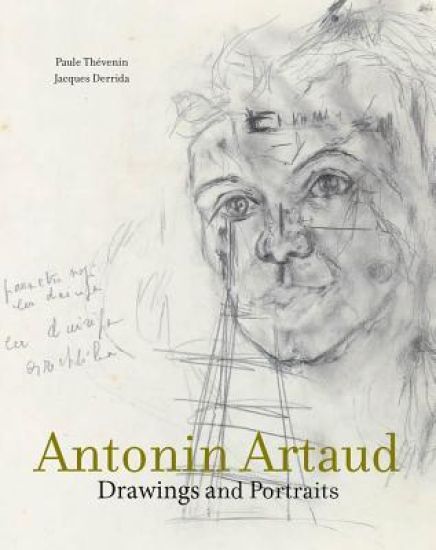
Philosophical and biographical accounts of Antonin Artaud's late visual work, all reproduced in color.Antonin Artaud (1896-1948)-stage and film actor, director, writer, and visual artist-was a man of rage and genius. Expelled from the Surrealist movement for his refusal to renounce the theatre, he founded the Theater of Cruelty and wrote The Theater and Its Double, one of the key twentieth-century texts on the topic. Artaud spent nine years at the end of his life in asylums, undergoing electroshock treatments. Released to the care of his friends in 1946, he began to draw again.This book presents drawings and portraits from this late resurgence, all in color. Accompanying the images are texts by by Artaud's longtime friend and editor Paule Thevenin and the philosopher Jacques Derrida."We won't be describing any paintings," Derrida warns the reader. Derrida struggles with Artaud's peculiar language, punctuating his text with agitated footnotes and asides (asking at one point, "How will they translate this?"). Thevenin offers a more straightforward biographical and historical account. (It was on the walls of her apartment that Derrida first saw Artaud's paintings and drawings.) These two texts were previously published by the MIT Press in The Secret Art of Antonin Artaud without the artwork that is their subject. This book brings together art and text for the first time in English.
Deconstruction and Pragmatism

Deconstruction and Pragmatism

Simon Critchley; Jacques Derrida; Ernesto Laclau; Richard Rorty

Routledge
1996
sidottu
Deconstruction and pragmatism constitute two of the major intellectual influences on the contemporary theoretical scene; influences personified in the work of Jacques Derrida and Richard Rorty. Both Rortian pragmatism, which draws the consequences of post-war developments in Anglo-American philosophy, and Derridian deconstruction, which extends and troubles the phonomenological and Heideggerian influence on the Continental tradition, have hitherto generally been viewed as mutually exclusive philosophical language games.The purpose of this volume is to bring deconstruction and pragmatism into critical confrontation with one another through staging a debate between Derrida and Rorty, itself based on discussions that took place at the College International de Philosophie in Paris in 1993. The ground for this debate is layed out in introductory papers by Simon Critchley and Ernesto Laclau, and the remainder of the volume records Derrida's and Rorty's responses to each other's work. Chantal Mouffe gives an overview of the stakes of this debate in a helpful preface.
Deconstruction and Pragmatism

Deconstruction and Pragmatism

Simon Critchley; Jacques Derrida; Ernesto Laclau; Richard Rorty

Routledge
1996
nidottu
Deconstruction and pragmatism constitute two of the major intellectual influences on the contemporary theoretical scene; influences personified in the work of Jacques Derrida and Richard Rorty. Both Rortian pragmatism, which draws the consequences of post-war developments in Anglo-American philosophy, and Derridian deconstruction, which extends and troubles the phonomenological and Heideggerian influence on the Continental tradition, have hitherto generally been viewed as mutually exclusive philosophical language games.The purpose of this volume is to bring deconstruction and pragmatism into critical confrontation with one another through staging a debate between Derrida and Rorty, itself based on discussions that took place at the College International de Philosophie in Paris in 1993. The ground for this debate is layed out in introductory papers by Simon Critchley and Ernesto Laclau, and the remainder of the volume records Derrida's and Rorty's responses to each other's work. Chantal Mouffe gives an overview of the stakes of this debate in a helpful preface.
Deconstruction and Criticism

Deconstruction and Criticism

Harold Bloom; Jacques Derrida

Continuum International Publishing Group Ltd.
2004
nidottu
Five essential and challenging essays by leading post-modern theorists on the art and nature of interpretation: Jacques Derrida, Harold Bloom, Geoffrey Hartman, Paul de Man, and J. Hillis Miller.
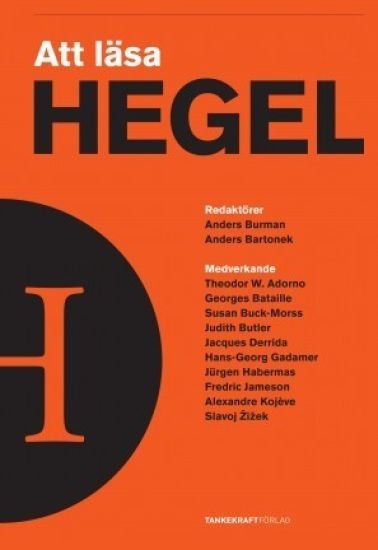
Att läsa Hegel

Att läsa Hegel

Judith Butler; Slavoj Zizek; Fredric Jameson; Susan Buck-Morss; Jacques Derrida; Jurgen Habermas

Tankekraft Förlag
2012
kartonkisidos
Georg Wilhelm Friedrich Hegel utgör på många sätt portalfiguren för de senaste två århundradenas filosofi och politiska teori. Såväl marxismen som existentialismen, fenomenologin och den kritiska teorin, ja även den moderna analytiska filosofin, uppstod till stor del som reaktioner på hans tänkande och den hegelianism som utvecklades efter hans död. Föreliggande antologi samlar tio tongivande läsningar av Hegel, skrivna av några av den så kallade kontinentalfilosofiska traditionens mest betydelsefulla företrädare. På olika sätt fokuserar samtliga texter på Hegels politiska tänkande. Särskilt uppmärksammas den berömda utläggningen i Andens fenomenologi om begäret, kampen om erkännandet och den dialektiska relationen mellan herren och slaven, men även Hegels idé om det borgerliga samhället och hans syn på staten diskuteras i flera av bidragen. Sammantaget visar texterna att det finns goda skäl att betrakta Hegel som den förste moderne filosofen. Bokens redaktörer, idéhistorikern Anders Burman och filosofen Anders Bartonek, är verksamma vid Södertörns högskola.
Aporias

Aporias

Derrida Jacques

Stanford University Press
1993
pokkari
"My death—is it possible?" That is the question asked, explored, and analyzed in Jacques Derrida's new book. "Is my death possible?" How is this question to be understood? How and by whom can it be asked, can it be quoted, can it be an appropriate question, and can it be asked in the appropriate moment, the moment of "my death"? One of the aporetic experiences touched upon in this seminal essay is the impossible, yet unavoidable experience that "my death" can never subject to an experience that would be properly mine, that I can have, and account for, yet that there is, at the same time, nothing closer to me and more properly mine than "my death." This book bears a special significance because in it Derrida focuses on an issue that has informed the whole of his work up to the present. For the last thirty years, Derrida has repeatedly, in various contexts and various ways, broached the question of aporia. Making it his central concern here Derrida stakes out a new frontier, at which the debate with his work must take place from now on: the debate about the aporia between singularity and generality, about the national, linguistic, and cultural specificity of experience and the trans-national, trans-cultural law that protects this specificity of experience and of the necessity to continue working in the tradition of critique and of the idea of critique, yet the corresponding necessity to transcend it without compromising it; the aporetical obligation to host the foreigner and the alien and yet to respect him, her, or it as foreign. The foreign or the foreigner has always been considered a figure of death, and death a figure of the foreign. How this figure has been treated in the analytic of death in Heidegger's Being in Time is explored by Derrida in analytical tour de force that will not fail to set new standards for the discussion of Heidegger and for dealing with philosophical texts, with their limits and their aporias. The detailed discussion of the theoretical presuppositions of recent cultural histories of death (Ariès, for example) and of psychological theorizations of death (including Freud's) broaden the scope of Derrida's investigation and indicate the impact of the aporia of "my death" for any possible theory.
Points...

Points...

Derrida Jacques

Stanford University Press
1995
pokkari
This volume collects twenty-three interviews given over the course of the last two decades by Jacques Derrida. It illustrates the extraordinary breadth of his concerns, touching upon such subjects as the teaching of philosophy, sexual difference and feminine identity, the media, AIDS, language and translation, nationalism, politics, and Derrida's early life and the history of his writings. Often, as in the interview on Heidegger, or that on drugs, or on the nature of poetry, these interviews offer not only an introduction to other discussions, but something available nowhere else in his work. When did feminist discourse become an indispensable consideration for deconstruction? What was the impact on Derrida's work of his being an Algerian Jew growing up during World War II? Is there an ineradicable gap between language-based attitude such as those found in a deconstruction and subjectivity-oriented critical models such as those developed by Foucault and Lacan? Such questions as these are answered with great thoughtfulness and intensity. Derrida's oral style is patient, generous, and helpful. His tone varies with the questioners and the subject matter—militant, playful, strategic, impassioned, analytic: difference in modulation can sometimes be heard within the same dialogue. The informality of the interview process frequently leads to the most succinct and lucid explications to be found of many of the most important and influential aspects of Derrida's thought. Sixteen of the interviews appear here for the first time in English, including an interview, conducted especially for this volume, concerning the recent exchange of letters in the New York Review of Books.
On the Name

On the Name

Derrida Jacques

Stanford University Press
1995
pokkari
"The name: What does one call thus? What does one understand under the name of name? And what occurs when one gies a name? What does one give then? One does not offer a thing, one delivers nothing, and still something comes to be, which comes down to giving that which one does not have, as Plotinus said of the Good. What happens, above all, when it is necessary to sur-name, renaming there where, precisely, the name comes to be found lacking? What makes the proper name into a sort of sur-name, pseudonym, or cryptonym at once singular and singularly untranslatable?" Jacques Derrida thus poses a central problem in contemporary language, ethics, and politics, which he addresses in a liked series of the three essays. Passions: "An Oblique Offering" is a reflection on the question of the response, on the duty and obligation to respond, and on the possibility of not responding—which is to say, on the ethics and politics of responsibility. Sauf le nom (Post Scriptum) considers the problematics of naming and alterity, or transcendence, raised inevitably by a rigorous negative theology. Much of the text is organized around close readings of the poetry of Angelus Silesius. The final essay, Khora, explores the problem of space or spacing, of the word khora in Plato's Tmaeus. Even as it places and makes possible nothing less than the whole world, khora opens and dislocates, displaces, all the categories that govern the production of that world, from naming to gender. In addition to readers in philosophy and literature, Khora will be of special interest to those in the burgeoning field of "space studies"(architecture, urbanism, design).
Resistances of Psychoanalysis

Resistances of Psychoanalysis

Derrida Jacques

Stanford University Press
1998
pokkari
In the three essays that make up this stimulating and often startling book, Jacques Derrida argues against the notion that the basic ideas of psychoanalysis have been thoroughly worked through, argued, and assimilated. The continuing interest in psychoanalysis is here examined in the various "resistances" to analysis—conceived not only as a phenomenon theorized at the heart of psychoanalysis, but as psychoanalysis's resistance to itself, an insusceptibility to analysis that has to do with the structure of analysis itself. Derrida not only shows how the interest of psychoanalysis and psychoanalytic writing can be renewed today, but these essays afford him the opportunity to revisit and reassess a subject he first confronted (in an essay on Freud) in 1966. They also serve to clarify Derrida's thinking about the subjects of the essays—Freud, Lacan, and Foucault—a thinking that, especially with regard to the last two, has been greatly distorted and misunderstood.The first essay, on Freud, is a tour de force of close reading of Freud's texts as philosophical reflection. By means of the fine distinctions Derrida makes in this analytical reading, particularly of The Interpretation of Dreams, he opens up the realm of analysis into new and unpredictable forms—such as meeting with an interdiction (when taking an analysis further is "forbidden" by a structural limit).Following the essay that might be dubbed Derrida's "return to Freud," the next is devoted to Lacan, the figure for whom that phrase was something of a slogan. In this essay and the next, on Foucault, Derrida reencounters two thinkers to whom he had earlier devoted important essays, which precipitated stormy discussions and numerous divisions within the intellectual milieus influenced by their writings. In this essay, which skillfully integrates the concept of resistance into larger questions, Derrida asks in effect: What is the origin and nature of the text that constitutes Lacanian psychoanalysis, considering its existence as an archive, as teachings, as seminars, transcripts, quotations, etc.?Derrida's third essay may be called not simply a criticism but an appreciation of Foucault's work: an appreciation not only in the psychological and rhetorical sense, but also in the sense that it elevates Foucault's thought by giving back to it ranges and nuances lost through its reduction by his readers, his own texts, and its formulaic packaging.
Adieu to Emmanuel Levinas

Adieu to Emmanuel Levinas

Derrida Jacques

Stanford University Press
1999
pokkari
This volume contains the speech given by Derrida at Emmanuel Levinas's funeral on December 27, 1995, and his contribution to a colloquium organized to mark the first anniversary of Levinas's death. For both thinkers, the word adieu names a fundamental characteristic of human being: the salutation or benediction prior to all constative language (in certain circumstances, one can say adieu at the moment of meeting) and that given at the moment of separation, sometimes forever, as at the moment of death, it is also the a-dieu, for God or to God before and in any relation to the other. In this book, Derrida extends his work on Levinas in previously unexplored directions via a radical rereading of Totality and Infinity and other texts, including the lesser-known talmudic readings. He argues that Levinas, especially in Totality and Infinity, bequeaths to us an "immense treatise of hospitality," a meditation on the welcome offered to the other. The conjunction of an ethics of pure prescription with the idea of an infinite and absolute hospitality confronts us with the most pressing political, juridical, and institutional concerns of our time. What, then, is an ethics and what is a politics of hospitality? And what, if it ever is, would be a hospitality surpassing any ethics and any politics we know? As always, Derrida raises these questions in the most explicit of terms, moving back and forth between philosophical argument and the political discussion of immigration laws, peace, the state of Israel, xenophobia—reminding us with every move that thinking is not a matter of neutralizing abstraction, but a gesture of hospitality for what happens and still may happen.
Monolingualism of the Other

Monolingualism of the Other

Derrida Jacques

Stanford University Press
1998
pokkari
“I have but one language—yet that language is not mine.” This book intertwines theoretical reflection with historical and cultural particularity to enunciate, then analyze this conundrum in terms of the author’s own relationship to the French language. The book operates on three levels. At the first level, a theoretical inquiry investigates the relation between individuals and their “own” language. It also explores the structural limits, desires, and interdictions inherent in such “possession,” as well as the corporeal aspect of language (its accents, tones, and rhythms) and the question of the “countability” of languages (that is, their discreteness or factual givenness). At the second level, the author testifies to aspects of his acculturation as an Algerian Jew with respect to language acquisition, schooling, citizenship, and the dynamics of cultural-political exclusion and inclusion. At the third level, the book is comparative, drawing on statements from a wide range of figures, from the Moroccan Abdelkebir Khatibi to Franz Rosenzweig, Gershom Scholem, Hannah Arendt, and Emmanuel Levinas. Since one of the book’s central themes is the question of linguistic and cultural identity, its argument touches on several issues relevant to the current debates on multiculturalism. These issues include the implementation of colonialism in the schools, the tacit or explicit censorship that excludes other (indigenous) languages from serious critical consideration, the investment in an ideal of linguistic purity, and the problematics of translation. The author also reveals the complex interplay of psychological factors that invests the subject of identity with the desire to recover a “lost” language of origin and with the ambition to master the language of the colonizer.
Of Hospitality

Of Hospitality

Derrida Jacques; Dufourmantelle Anne

Stanford University Press
2000
pokkari
These two lectures by Jacques Derrida, "Foreigner Question" and "Step of Hospitality/No Hospitality," derive from a series of seminars on "hospitality" conducted by Derrida in Paris, January 1996. His seminars, in France and in America, have become something of an institution over the years, the place where he presents the ongoing evolution of his thought in a remarkable combination of thoroughly mapped-out positions, sketches of new material, and exchanges with students and interlocutors. As has become a pattern in Derrida's recent work, the form of this presentation is a self-conscious enactment of its content. The book consists of two texts on facing pages. "Invitation" by Anne Dufourmantelle appears on the left (an invitation that of course originates in a response), clarifying and inflecting Derrida's "response" on the right. The interaction between them not only enacts the "hospitality" under discussion, but preserves something of the rhythms of teaching. The volume also characteristically combines careful readings of canonical texts and philosophical topics with attention to the most salient events in the contemporary world, using "hospitality" as a means of rethinking a range of political and ethical situations. "Hospitality" is viewed as a question of what arrives at the borders, in the initial surprise of contact with an other, a stranger, a foreigner. For example, Antigone is revisited in light of the question of impossible mourning; Oedipus at Colonus is read via concerns that also apply to teletechnology; the trial of Socrates is brought into conjunction with the televised funeral of François Mitterrand.
Without Alibi

Without Alibi

Derrida Jacques

Stanford University Press
2002
pokkari
This book brings together for the first time five recent essays by Jacques Derrida, which advance his reflections on many issues: lying, perjury, forgiveness, confession, the profession of faith, and, most recently, cruelty, sovereignty, and capital punishment. Strongly linked by their attention to "performatives" and the "as if," the essays show the necessity of thinking beyond the category of acts that are possible for a subject. Derrida argues forcefully that thought must engage with the im-possible, that is, the order of the unforeseeable event, the absolute future still to come. This acute awareness of the limits of performative programs informs the essays throughout and attunes them closely to events of a world undergoing "globalization." The first essay, "History of the Lie," reviews some classic and modern definitions of the lie (Augustine, Rousseau, Kant, Koyré, Arendt), while renewing questions about what is called lying, as distinguished from other forms of nontruth. This inventive analysis is followed by "Typewriter Ribbon," which examines at length the famous lie recounted by Rousseau in his Confessions, when he perjured himself by accusing another of his own crime. Paul de Man's reading of this textual event is at the center of Derrida's patient, at times seriously funny analyses. "Le parjure, Perhaps" engages with a remarkable novel by Henri Thomas that fictionalizes the charge of perjury brought against Paul de Man in the 1950s. Derrida's extraordinary fineness as a reader and thinker of fiction here treats, to profound effect, the "fatal experience of perjury." The two final essays, "The University Without Condition" and "Psychoanalysis Searches the States of Its Soul," address the institutions of the university and of psychoanalysis as sites from which to resist and deconstruct the nontruth or phantasm of sovereignty. For the university, the principle of truth remains at the core of its resistance; for psychoanalysis, there is the obligation to remain true to what may be, Derrida suggests, its specific insight: into psychic cruelty. Resistance to the sovereign cruelty of the death penalty is just one of the stakes indicated by the last essay, which is the text of a keynote address to the "States General of Psychoanalysis" held in Paris, July 2000. Especially for this volume, Derrida has written "Provocation: Forewords," which reflects on the title Without Alibi while taking up questions about relations between deconstruction and America. This essay-foreword also responds to the event of this book, which Peggy Kamuf in her introduction presents as event of resistance. Without Alibi joins two other books by Derrida that Kamuf has translated for Stanford University Press: Points . . .: Interviews, 1974-1994 (1994) and Resistances of Psychoanalysis (1998).
The Instant of My Death /<I>Demeure</I>

The Instant of My Death /<I>Demeure</I>

Blanchot Maurice; Derrida Jacques

Stanford University Press
2000
pokkari
This volume records a remarkable encounter in critical and philosophical thinking: a meeting of two of the great pioneers in contemporary thought, Maurice Blanchot and Jacques Derrida, who are also bound together by friendship and a complex relation to their own pasts. More than a literary text with critical commentary, it constitutes an event of central significance for contemporary philosophical, literary, and political concerns. The book consists of The Instant of My Death, a powerful short prose piece by Blanchot, and an extended essay by Derrida that reads it in the context of questions of literature and of bearing witness. Blanchot's narrative concerns a moment when a young man is brought before a firing squad during World War II and then suddenly finds himself released from his near death. The incident, written in the third person, is suggestively autobiographical—from the title, several remarks in the text, and a letter Blanchot wrote about a similar incident in his own life—but only insofar as it raises questions for Blanchot about what such an experience might mean. The accident of near death becomes, in the instant the man is released, the accident of a life he no longer possesses. The text raises the question of what it means to write about a (non)experience one cannot claim as one's own, and as such is a text of testimony or witness. Derrida's reading of Blanchot links the problem of testimony to the problem of the secret and to the notion of the instant. It thereby provides the elements of a more expansive reassessment of literature, testimony, and truth. In addressing the complex relation between writing and history, Derrida also implicitly reflects on questions concerning the relation between European intellectuals and World War II.
Veils

Veils

Cixous Helene; Derrida Jacques

Stanford University Press
2002
sidottu
Something of a historical event, this book combines loosely "autobiographical" texts by two of the most influential French intellectuals of our time. "Savoir," by Hélène Cixous, is a brief but densely layered account of her experience of recovered sight after a lifetime of severe myopia, an experience that ends with the unexpected turn of grieving for what is lost. Her literary inventiveness mines the coincidence in French between the two verbs savoir (to know) and voir (to see). Jacques Derrida's "A Silkworm of One's Own" complexly muses on a host of autobiographical, philosophical, and religious motifs—including his varied responses to "Savoir." The two texts are accompanied by six beautiful and evocative drawings that play on the theme of drapery over portions of the body. Veils suspends sexual difference between two homonyms: la voile (sail) and le voile (veil). A whole history of sexual difference is enveloped, sometimes dissimulated here—in the folds of sails and veils and in the turns, journeys, and returns of their metaphors and metonymies. However foreign to each other they may appear, however autonomous they may be, the two texts participate in a common genre: autobiography, confession, memoirs. The future also enters in: by opening to each other, the two discourses confide what is about to happen, the imminence of an event lacking any common measure with them or with anything else, an operation that restores sight and plunges into mourning the knowledge of the previous night, a "verdict" whose threatening secret remains out of reach by our knowledge.
Veils

Veils

Cixous Helene; Derrida Jacques

Stanford University Press
2002
pokkari
Something of a historical event, this book combines loosely "autobiographical" texts by two of the most influential French intellectuals of our time. "Savoir," by Hélène Cixous, is a brief but densely layered account of her experience of recovered sight after a lifetime of severe myopia, an experience that ends with the unexpected turn of grieving for what is lost. Her literary inventiveness mines the coincidence in French between the two verbs savoir (to know) and voir (to see). Jacques Derrida's "A Silkworm of One's Own" complexly muses on a host of autobiographical, philosophical, and religious motifs—including his varied responses to "Savoir." The two texts are accompanied by six beautiful and evocative drawings that play on the theme of drapery over portions of the body. Veils suspends sexual difference between two homonyms: la voile (sail) and le voile (veil). A whole history of sexual difference is enveloped, sometimes dissimulated here—in the folds of sails and veils and in the turns, journeys, and returns of their metaphors and metonymies. However foreign to each other they may appear, however autonomous they may be, the two texts participate in a common genre: autobiography, confession, memoirs. The future also enters in: by opening to each other, the two discourses confide what is about to happen, the imminence of an event lacking any common measure with them or with anything else, an operation that restores sight and plunges into mourning the knowledge of the previous night, a "verdict" whose threatening secret remains out of reach by our knowledge.
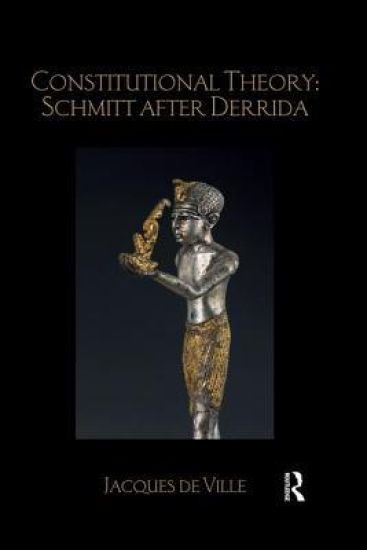
Constitutional Theory: Schmitt after Derrida

Constitutional Theory: Schmitt after Derrida

Jacques de Ville

Birkbeck Law Press
2019
nidottu
This book advances a new reading of the central works of Carl Schmitt and, in so doing, rethinks the primary concepts of constitutional theory. In this book, Jacques de Ville engages in a close analysis of a number of Schmitt’s texts, including Dictatorship (1921), The Concept of the Political (1927), Constitutional Theory (1928), Land and Sea (1942), Ex Captivitate Salus (1950), The Nomos of the Earth (1950) and The Theory of the Partisan (1963). This engagement takes place from the perspective of constitutional theory and focuses specifically on concepts or themes such as sovereignty, the state, the political, constituent power, democracy, representation, the constitution and human rights. The book seeks to rethink the structure of these concepts in line with Derrida’s analysis of Schmitt’s texts on the concept of the political in Politics of Friendship (1993). This happens by way of an analysis of Derrida’s engagement with Freud and other psychoanalysts. Although the main focus in the book is on Schmitt’s texts, it further examines two texts of Derrida (Khora (1993) and Fors: The Anglish Words of Nicholas Abraham and Maria Torok (1976)), by reading these alongside Schmitt’s own reflections on the positive concept of the constitution.