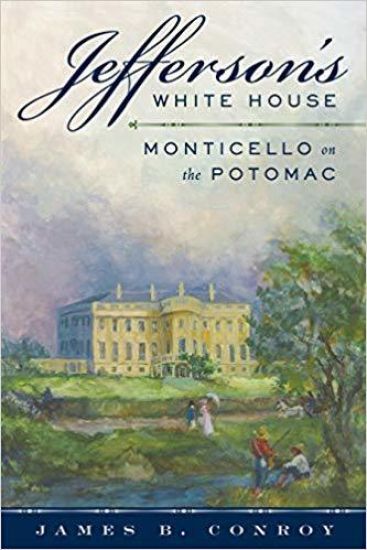
As the first president to occupy the White House for an entire term, Thomas Jefferson shaped the president’s residence, literally and figuratively, more than any of its other occupants. Remarkably enough, however, though many books have immortalized Jefferson’s Monticello, none has been devoted to the vibrant look, feel, and energy of his still more famous and consequential home from 1801 to `1809. In Monticello on the Potomac, James B. Conroy, author of the award-winning Lincoln’s White House offers a vivid, highly readable account of how life was lived in Jefferson’s White House and the young nation’s rustic capital.
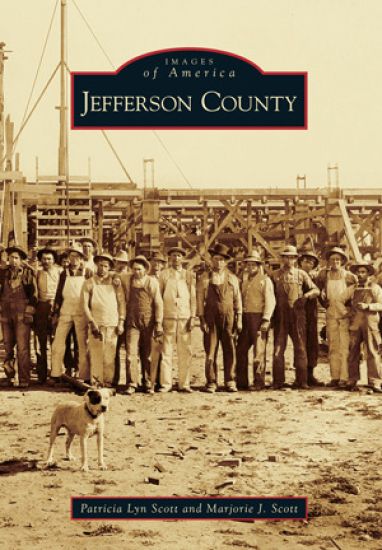
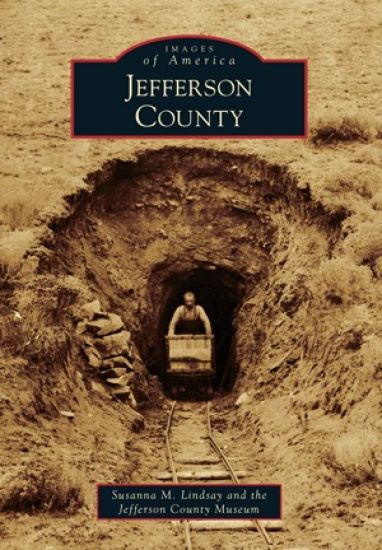
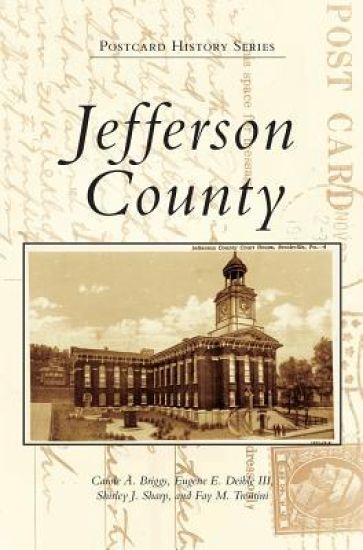
Situated among the rolling hills of north central Pennsylvania, Jefferson County was formed in 1804. Brookville became the county seat in 1830 by virtue of its location at the confluence of the North Fork Creek and Sandy Lick Creek, forming Redbank Creek, and its centrality in the more than 1,000 square miles that comprised the original county. Settlers timbered, farmed, and rafted products to market when water was high. With the completion of the Allegheny Valley low-grade railroad in 1874 and the Buffalo, Rochester & Pittsburgh Railroad in 1882, mining dominated the area. Rail transportation made possible the development of glass, iron, silk, sheet metal, clothing, and furniture factories. During World War II, several companies manufactured materials in support of the Allies. Today, timbering flourishes, as do the powdered metal and glass container industries. The Allegheny National and Cook forests to the north and historic Brookville, Punxsutawney Phil, and the nationally renowned Coolspring Power Museum all attract many tourists.
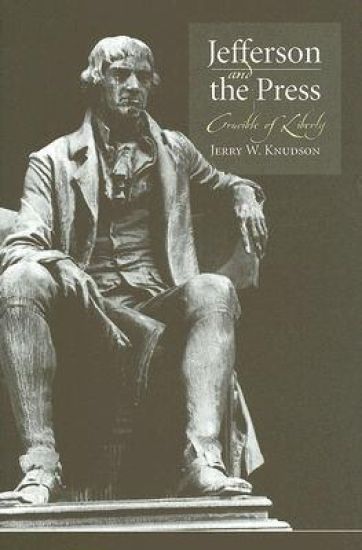
Neither fair nor balanced, journalistic warfare during America's first transfer of power. With the exception of Abraham Lincoln, no president prior to the twentieth century has been more vilified by the U.S. news media than Thomas Jefferson. ""Jefferson and the Press"" demonstrates the power of the press in the early years of the Republic. Four-fifths of the young nation's 235 newspapers were Federalist, but, as Jerry W. Knudson explains, the minority Republican newspapers combated these odds through direct invectives and vehemently candid editorials. Knudson details the editorial responses of four Federalist and four Republican newspapers in wide circulation to six major episodes of the Jeffersonian era: the election of 1800-1801, the return of Thomas Paine from revolutionary France, the Louisiana Purchase, the Hamilton-Burr duel, the impeachment of Supreme Court Justice Samuel Chase, and the economic embargo of 1807-1809. Rocked by domestic scandals, the American nation read accounts in Federalist papers that demonized Jefferson and in Republican papers that lauded the president's achievements. Knudson profiles the men projecting these radically different views - savvy editors who embraced their ability to channel public opinion and who often became famous personalities in their own right, including Samuel Harrison Smith of National Intelligencer in Washington, D.C., and William Duane of Philadelphia's Aurora. He shows these editors to have been sophisticated political ""scribblers"" who fearlessly printed what they thought with bluntness and ferocity that might shock even twenty-first-century readers. Concerned with how these charged verbal skirmishes in the press both molded and reflected public opinion, Knudson reveals the power, abrasiveness, and polarizing effects of a free but quite partisan press as the only source of public information during the young nation's first major shift in leadership. Diverging from accepted views, he frames his argument to illustrate that newspapers reached their height of influence and malevolence during Jefferson's presidency rather than that of Andrew Jackson in the 1820s and 1830s.
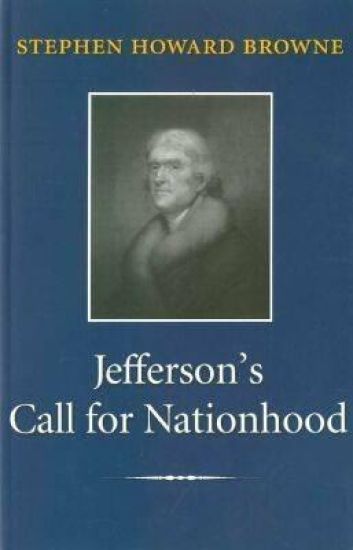
Widely celebrated in its own time, Thomas Jefferson's first inaugural address commands the regard of Americans from across the political spectrum. Delivered as the young nation found itself embroiled in bitter partisan struggles, the speech has been halled as the Sermon on the Mount of good government. Curiously, this masterpiece - the full text of which is reproduced in this volume - has never received sustained analysis. Here, Stephen Howard Browne describes its origins, composition, meaning, and delivery. His well-crafted argument and accessible prose offer a model of analysis for rhetorical scholars and students and an added dimension to the history of the early republic and the understanding of American political thought.
Widely celebrated in its own time, Thomas Jefferson's first inaugural address commands the regard of Americans from across the political spectrum. Delivered as the young nation found itself embroiled in bitter partisan struggles, the speech has been halled as the Sermon on the Mount of good government. Curiously, this masterpiece - the full text of which is reproduced in this volume - has never received sustained analysis. Here, Stephen Howard Browne describes its origins, composition, meaning, and delivery. His well-crafted argument and accessible prose offer a model of analysis for rhetorical scholars and students and an added dimension to the history of the early republic and the understanding of American political thought.
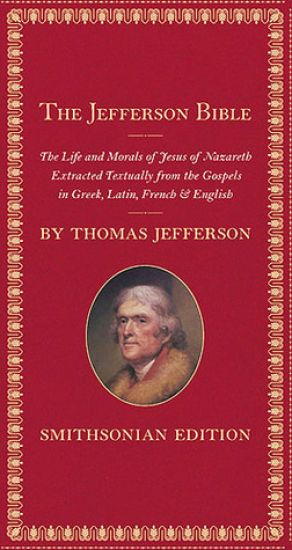
The Jefferson Bible, or The Life and Morals of Jesus of Nazareth as it is formally titled, was Thomas Jefferson's effort to extract what he considered the pertinent doctrine of Jesus by removing sections of the New Testament containing supernatural aspects as well as perceived misinterpretations he believed had been added by the Four Evangelists. Using a razor, Jefferson cut and arranged selected verses from the books of Matthew, Mark, Luke, and John in chronological order, mingling excerpts from one text to those of another in order to create a single narrative. After completion of The Life and Morals, about 1820, Jefferson shared it with a number of friends, but he never allowed it to be published during his lifetime. The most complete form Jefferson produced was inherited by his grandson, Thomas Jefferson Randolph, and was published in 1895 by the National Museum in Washington. Once published in black-and-white facsimile by the Government Printing Office in 1900 as a gift for new members of Congress, the Jefferson Bible has never before been published in color in its complete form. The Jefferson Bible, Smithsonian Edition is an exact facsimile reproduction based on the original copy in the Smithsonian collections. The Jefferson Bible, Smithsonian Edition is as beautiful an object as was so painstakingly crafted by Thomas Jefferson himself.
Jefferson Square was a multi-million dollar culture center…but there was nothing at all cultural about some of the things that happened there during its grand opening in the Sixties. At the Repertory Theater, a play called Confessional was in rehearsal. Some called it dramatic literature. Others considered it a tasteless exploitation of the playwright’s former marriage to America’s queen of sex. In the expensive interior of Symphony Hall, the brilliant and erratic conductor of the Jefferson Square Symphony Orchestra was working feverishly on a new concerto while his private life was rushing toward its own scandalous crescendo. In the board room, the dream of the state’s governor for a presidential nomination was interrupted by the discovery that Jefferson Square was making this rich man richer. And in the executive offices, where architects’ drawings were still being argued over, Jefferson Square’s recently hired cultural director was being tempted to destroy what he had been employed to hold together. Jefferson Square provides a fascinating glimpse of life behind the scenes in the midst of the creation of a new urban cultural epicenter, a symbol of the gentrification forcing out longtime neighborhood inhabitants. From the glitz and the glamor of Jefferson Square proper, to the hardships faced by residents of the condemned projects in the area, Gerson brings microcosms of the Sixties to Technicolor life.

![Jefferson County, [West] Virginia, 1814-1824 Personal Property Tax Lists](/covers/9781585498710.jpg)
![Jefferson County, [West] Virginia, 1825-1841 Personal Property Tax Lists](/covers/9781585498727.jpg)
![Jefferson County, [West] Virginia, 1802-1813 Personal Property Tax Lists](/covers/9781585498741.jpg)
![Jefferson County, [West] Virginia, Death Records, 1853-1880](/covers/9781585499335.jpg)