Kirjojen hintavertailu. Mukana 12 052 853 kirjaa ja 12 kauppaa.

Kirjahaku

Etsi kirjoja tekijän nimen, kirjan nimen tai ISBN:n perusteella.

1000 tulosta hakusanalla Jeffrey B Perry

Overseas Research

Overseas Research

Christopher B. Barrett; Jeffrey Cason; Erin C. Lentz

Routledge
2020
sidottu
When conducting research in developing countries, an ability to negotiate a bewildering array of cultural and logistical obstacles is essential. Overseas Research: A Practical Guide distills essential lessons from scores of students and scholars who have collected data and done fieldwork abroad, including how to prepare for the field, how and where to find funding for one’s fieldwork, issues of personal safety and security, and myriad logistical and relational issues. By encouraging researchers to think through the challenges of research before they begin it, Overseas Research will help prepare fieldworkers for the practical, logistical, and psychological considerations of very demanding work, help save valuable time, make the most of scarce financial resources, and enhance the quality of the field research. This third edition contains new material on social media, including representation of research subjects/collaborators, students’ digital branding and image, and representing universities abroad when posting publicly. It also covers emerging technologies such as solar panels for power in remote locations, new ways of digitally sending and receiving money, and incorporates more perspectives of women, LGBTQ+ people, and people of color researching abroad.The book will be of interest to overseas fieldworkers, and also to undergraduates in subjects such as anthropology, economics, geography, history, international studies, politics, sociology, and development studies.

Overseas Research

Overseas Research

Christopher B. Barrett; Jeffrey Cason; Erin C. Lentz

Routledge
2020
nidottu
When conducting research in developing countries, an ability to negotiate a bewildering array of cultural and logistical obstacles is essential. Overseas Research: A Practical Guide distills essential lessons from scores of students and scholars who have collected data and done fieldwork abroad, including how to prepare for the field, how and where to find funding for one’s fieldwork, issues of personal safety and security, and myriad logistical and relational issues. By encouraging researchers to think through the challenges of research before they begin it, Overseas Research will help prepare fieldworkers for the practical, logistical, and psychological considerations of very demanding work, help save valuable time, make the most of scarce financial resources, and enhance the quality of the field research. This third edition contains new material on social media, including representation of research subjects/collaborators, students’ digital branding and image, and representing universities abroad when posting publicly. It also covers emerging technologies such as solar panels for power in remote locations, new ways of digitally sending and receiving money, and incorporates more perspectives of women, LGBTQ+ people, and people of color researching abroad.The book will be of interest to overseas fieldworkers, and also to undergraduates in subjects such as anthropology, economics, geography, history, international studies, politics, sociology, and development studies.

Principles of Psychopharmacology for Mental Health Professionals

Principles of Psychopharmacology for Mental Health Professionals

Jeffrey E. Kelsey; Charles B. Nemeroff; D. Jeffrey Newport

John Wiley Sons Inc
2006
nidottu
Principles of Psychopharmacology for Mental Health Professionals addresses the current "split" model of mental health care, in which physicians provide pharmaco-therapy while non-prescribing practitioners oversee other services such as psychotherapy. Bringing these two areas together, this book familiarizes mental health professionals with the medications used to treat psychiatric disorders. Prepared by world-renowned psychopharmacologists and psychiatrists, this useful resource helps non-prescribing practitioners understand when and why a given medication is appropriate to use, when it is not indicated, and what potential side effects may occur. Also discussed are the appropriate times in therapy when a referral for a medication evaluation is indicated as well as how to broach this issue with the patient. Recognizing that there are almost always a number of medications from which to choose, the authors combine research outcomes with their extensive clinical experience to highlight the important considerations in selecting one medication over another. As an educational tool, the text encourages and supports clinicians who wish to increase patients' understanding of treatment. After an introduction and overview, chapters cover: * Basics of psychopharmacology * Attention-deficit hyperactivity disorder * Mood disorders * Sleep disorders * Schizophrenia * Cognitive disorders * Anxiety disorders * Personality disorders * Substance use disorders * Traumatic brain injury * Eating disorders * Side effects Every chapter includes diagnostic considerations, history of medication treatments, and emerging trends for each disease. Principles of Psychopharmacology for Mental Health Professionals lays out what psychotherapists and other mental health practitioners need to know about psychotropic medications, giving them and their patients an invaluable guide to the full array of treatments available.
Floodplains

Floodplains

Jeffrey J. Opperman; Peter B. Moyle; Eric W. Larsen; Joan L. Florsheim; Amber D. Manfree

University of California Press
2017
pokkari
Floodplains provides an overview of floodplains and their management in temperate regions. It synthesizes decades of research on floodplain ecosystems, explaining hydrologic, geomorphic, and ecological processes and how under appropriate management these processes can provide benefits to society ranging from healthy fish populations to flood-risk reduction. Drawing on the framework of reconciliation ecology, the authors explore how new concepts for floodplain ecosystem restoration and management can increase these benefits. Additionally, they use case studies from California's Central Valley and other temperate regions to show how innovative management approaches are reshaping rivers and floodplains around the world.
Shared Wisdom

Shared Wisdom

Jeffrey H. Mahan; Barbara B. Troxell; Carol J. Allen

Abingdon Press
1993
pokkari
Ministry is enriched when its practitioners are involved in a serious process of peer reflection on their ministry. Case study, the method advocate here, is one significant way for such reflection to take place. Readers will learn techniques for writing case studies and how to use imagination ad analogy to provoke theological reflection.
From Punk Rock to Contemporary Art. (aka More Stuck-Up Crap)

From Punk Rock to Contemporary Art. (aka More Stuck-Up Crap)

D.B. Burkeman; Jeffrey Deitch

RIZZOLI INTERNATIONAL PUBLICATIONS
2022
sidottu
Cheap, democratic, easy to tag, and not always fast to fade, the sticker has been an ever-present medium from the New York and London underground punk scenes to skate culture and political expression. Featuring more than 3,000 images of stickers from the global world of street expression where DIY culture meets music, graffiti, design, and branding Stickers 2 is a comprehensive record of an art form whose appeal lies in the juxtaposition of transience and significance. STICKERS 2 illustrates the timeline of this pastime, from counterculture to politics, it s 2019 chapters include - Music: Punk Rock to Electronic music, Skateboarding, Streetwear, Graffiti, Fine Art, Political Activism, however Volume 2 goes even further than its predecessor, with chapters on the origins of Surf culture and the BMX bike world. STICKERS 2 : extravagantly illustrated with more than 3,000 images of sticker graphics, organized by categories and themes, the book includes works by such diverse artists as Tom Sachs, Jenny Holzer, BANKSY, Neckface, Marilyn Minter, ESPO and Barry McGee; to amateurs who tag the streets anonymously. With texts from writers from many celebrated walks of life including Jeffery Deitch, INVADER, C.R.Stecyk, Mark Mothersbaugh, Paul Gorman and Stikman, among many others Stickers 2 reveals not only the cutting edge of sticker art but also the personal relationships that fine artists, street artists and pedestrians alike share with the medium. The is volume boasts an unparalleled collection of 125 removable stickers bound into its back pages. These sheets are by group of artists that is truly extraordinary. The list includes -Jenny Holzer, Barry McGee, INVADER, Marylin Minter, Erik Parker, SWOON, FUTURA, Robert Lazzarini, Kenzo Minami, Kostas Seremetis, Kristen Liu-Wong, Anthony Lister, Ron English, Ryan McGuinnes, BAST, D*Face, Shepard Fairey, FAILE, Skullphone, Tara McPherson, Peter Schuyff, Swoon, & James Hyde + more. Essential cultural history - Jeffrey Deitch A must-have for the discriminating sticker collector - Ed Templeton Every sticker is a memory for someone! - Maya Hayuk
Reading the Social Body

Reading the Social Body

Catherine B. Burroughs; Jeffrey Ehrenreich

University of Iowa Press
1993
nidottu
The overarching argument of Reading the Social Body is that the body is cultural rather than "natural." Some of the essays treat the social construction of bodies that have actually existed in human history; others discuss the representation of bodies in artistic contexts; all recognize that everything visible to the human body--from posture and costume to the width of an eyebrow or a smile--is determined by and shaped in response to a particular culture.
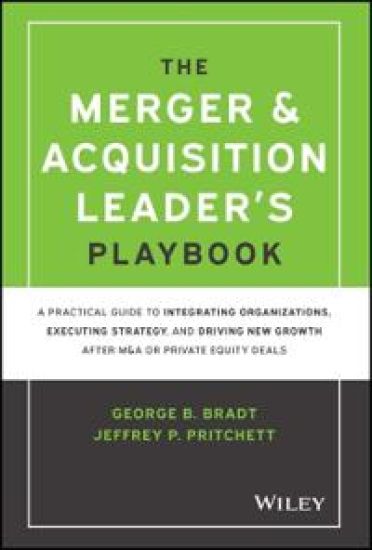
The Merger & Acquisition Leader's Playbook

The Merger & Acquisition Leader's Playbook

George B. Bradt; Jeffrey P. Pritchett

JOHN WILEY SONS INC
2022
sidottu
Make your next merger or acquisition one for the ages Meant to create value potentially fueled by synergies, the reality is that most mergers and acquisitions fail. It’s estimated that 83% of mergers and acquisitions do not hit their desired results. The Merger & Acquisition Leader’s Playbook tells you why most mergers fail. More importantly, it tells you how to make your next one a sweeping success. In the book, a team of private equity experts deliver a masterful walkthrough of how to integrate organizations by driving commercial success, instead of focusing purely on cutting costs. Readers will find: Concrete strategies for increasing the odds of success and reducing the risk of failure – of a new merger or acquisitionA comprehensive, easily deployed and implemented plan to realize synergiesProven tools, techniques, and tricks of the trade to help leaders stay on top of their latest merger and keep everything on trackA must-read resource for business leaders considering a fresh merger or acquisition, The Merger & Acquisition Leader's Playbook: A Practical Guide to Integrating Organizations, Executing Strategy, and Driving New Growth after M&A or Private Equity Deals will also earn a place in the libraries of investors, agents, corporate service providers, and consultants trying to get two or more businesses to pull in the same direction.
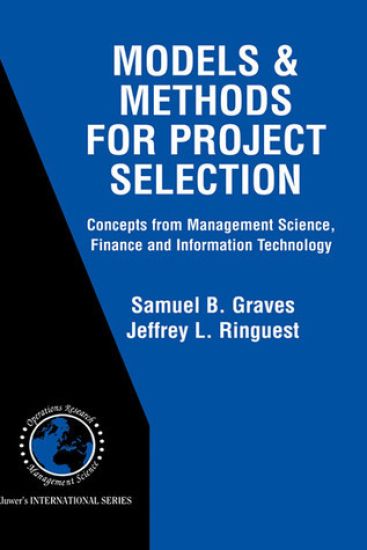
Models & Methods for Project Selection

Models & Methods for Project Selection

Samuel B. Graves; Jeffrey L. Ringuest

Springer-Verlag New York Inc.
2002
sidottu
Models & Methods for Project Selection systematically examines in this book treatment the latest work in the field of project selection modeling. The models presented are drawn from mathematical programming, decision theory, and finance. These models are examined in two categorical streams: the management science stream and the financial model stream. The book describes the assumptions and limitations of each model and provides appropriate solution methodologies. Its organization follows three main themes: *Criteria for Choice: Chapters 1-3 investigate the effect of the choice of optimization criteria on the results of the portfolio optimization problem. *Risk and Uncertainty: Chapters 4-7 deal with uncertainty in the project selection problem. *Non-Linearity and Interdependence: These chapters deal with problems of non-linearity and interdependence as they arise in the project selection problem. Chapters 8, 9 and 10 present solution methodologies, which can be used to solve these most general project selection models.
The PKU Paradox

The PKU Paradox

Diane B. Paul; Jeffrey P. Brosco

Johns Hopkins University Press
2014
pokkari
In a lifetime of practice, most physicians will never encounter a single case of PKU. Yet every physician in the industrialized world learns about the disease in medical school and, since the early 1960s, the newborn heel stick test for PKU has been mandatory in many countries. Diane B. Paul and Jeffrey P. Brosco's beautifully written book explains this paradox. PKU (phenylketonuria) is a genetic disorder that causes severe cognitive impairment if it is not detected and treated with a strict and difficult diet. Programs to detect PKU and start treatment early are deservedly considered a public health success story. Some have traded on this success to urge expanded newborn screening, defend basic research in genetics, and confront proponents of genetic determinism. In this context, treatment for PKU is typically represented as a simple matter of adhering to a low-phenylalanine diet. In reality, the challenges of living with PKU are daunting. In this first general history of PKU, a historian and a pediatrician explore how a rare genetic disease became the object of an unprecedented system for routine testing. The PKU Paradox is informed by interviews with scientists, clinicians, policymakers, and individuals who live with the disease. The questions it raises touch on ongoing controversies about newborn screening and what happens to blood samples collected at birth.
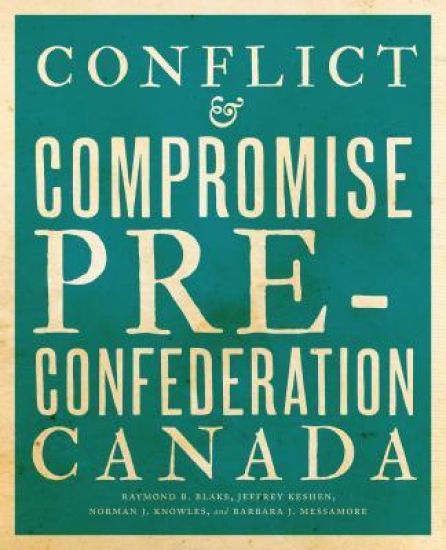
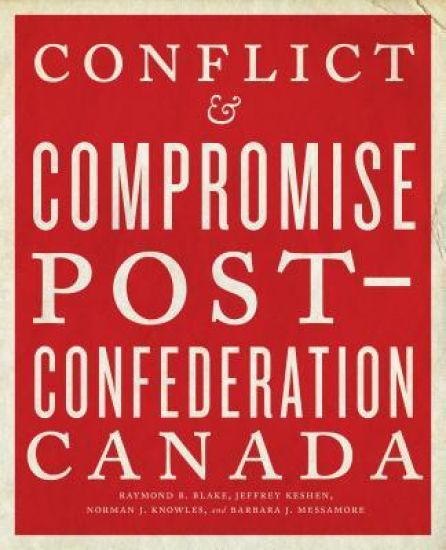
Conflict and Compromise

Conflict and Compromise

Raymond B. Blake; Jeffrey Keshen; Norman J. Knowles; Barbara J. Messamore

University of Toronto Press
2017
pokkari
Driven by its strong narrative, Conflict and Compromise presents Canadian history chronologically, allowing a better understanding of the interrelationships between events. Its main objective is to demonstrate that although Canadian history has been marked by cleavages and conflicts, there has been a continual process of negotiation and a need for compromise which has enabled Canada to develop into arguably one of the most successful and pluralistic countries in the world. The authors have drawn from all genres characterizing the present state of Canadian historiography, including social, military, cultural, political, and economic approaches. In doing so their aim is to challenge readers to engage with debates and interpretations about the past rather than simply to study for an exam. The first volume begins with the history of Canada's Indigenous inhabitants prior to the arrival of Europeans and ends with the nation-building project that got underway iun 1864. The book is illustrated with over 50 images, maps, and figures, all designed to support its mission to provoke intellectual curiosity.
Conflict and Compromise

Conflict and Compromise

Raymond B. Blake; Jeffrey Keshen; Norman J. Knowles; Barbara J. Messamore

University of Toronto Press
2017
sidottu
Driven by its strong narrative, Conflict and Compromise presents Canadian history chronologically, allowing a better understanding of the interrelationships between events. Its main objective is to demonstrate that although Canadian history has been marked by cleavages and conflicts, there has been a continual process of negotiation and a need for compromise which has enabled Canada to develop into arguably one of the most successful and pluralistic countries in the world. The authors have drawn from all genres characterizing the present state of Canadian historiography, including social, military, cultural, political, and economic approaches. In doing so their aim is to challenge readers to engage with debates and interpretations about the past rather than simply to study for an exam. The first volume begins with the history of Canada's Indigenous inhabitants prior to the arrival of Europeans and ends with the nation-building project that got underway iun 1864. The book is illustrated with over 50 images, maps, and figures, all designed to support its mission to provoke intellectual curiosity.
Conflict and Compromise

Conflict and Compromise

Raymond B. Blake; Jeffrey Keshen; Norman J. Knowles; Barbara J. Messamore

University of Toronto Press
2017
pokkari
Driven by its strong narrative, Conflict and Compromise presents Canadian history chronologically, allowing a better understanding of the interrelationships between events. Its main objective is to demonstrate that although Canadian history has been marked by cleavages and conflicts, there has been a continual process of negotiation and a need for compromise which has enabled Canada to develop into arguably one of the most successful and pluralistic countries in the world. The authors have drawn from all genres characterizing the present state of Canadian historiography, including social, military, cultural, political, and economic approaches. In doing so their aim is to challenge readers to engage with debates and interpretations about the past rather than simply to study for an exam. The second volume begins with the nation-building project that got underway in 1864 and ends in the present. The book is illustrated with over 60 images, maps, and figures, all designed to support its mission to provide intellectual curiosity.
Conflict and Compromise

Conflict and Compromise

Raymond B. Blake; Jeffrey Keshen; Norman J. Knowles; Barbara J. Messamore

University of Toronto Press
2017
sidottu
Driven by its strong narrative, Conflict and Compromise presents Canadian history chronologically, allowing a better understanding of the interrelationships between events. Its main objective is to demonstrate that although Canadian history has been marked by cleavages and conflicts, there has been a continual process of negotiation and a need for compromise which has enabled Canada to develop into arguably one of the most successful and pluralistic countries in the world. The authors have drawn from all genres characterizing the present state of Canadian historiography, including social, military, cultural, political, and economic approaches. In doing so their aim is to challenge readers to engage with debates and interpretations about the past rather than simply to study for an exam. The second volume begins with the nation-building project that got underway in 1864 and ends in the present. The book is illustrated with over 60 images, maps, and figures, all designed to support its mission to provide intellectual curiosity.
Models & Methods for Project Selection

Models & Methods for Project Selection

Samuel B. Graves; Jeffrey L. Ringuest

Springer-Verlag New York Inc.
2012
nidottu
Models & Methods for Project Selection systematically examines in this book treatment the latest work in the field of project selection modeling. The models presented are drawn from mathematical programming, decision theory, and finance. These models are examined in two categorical streams: the management science stream and the financial model stream. The book describes the assumptions and limitations of each model and provides appropriate solution methodologies. Its organization follows three main themes: *Criteria for Choice: Chapters 1-3 investigate the effect of the choice of optimization criteria on the results of the portfolio optimization problem. *Risk and Uncertainty: Chapters 4-7 deal with uncertainty in the project selection problem. *Non-Linearity and Interdependence: These chapters deal with problems of non-linearity and interdependence as they arise in the project selection problem. Chapters 8, 9 and 10 present solution methodologies, which can be used to solve these most general project selection models.
Paradox and Imperatives in Health Care

Paradox and Imperatives in Health Care

Jeffrey C. Bauer; ummer Steven B.

CRC Press Inc
2014
sidottu
The Paradox: Americans are not as healthy as people in dozens of comparable countries that spend 30 percent less on health care, and our medical marketplace overall is plagued by persistent problems of cost, quality, and access. Yet, the world’s best individual health systems are located in the U.S.—each a unique result of visionary leadership and private initiative, not government-driven health reform.The Imperatives: Due to powerful new forces explained in this book, medical spending has stopped growing. Purchasers, payers, and patients are no longer willing or able to keep paying more. To stay in business and improve population health, providers and their business partners must eliminate the shameful waste generated by inefficient and ineffective production processes.The Solution: Simply repairing or repealing the Affordable Care Act will not get us where we want to go. The fundamental roadblock is a wasteful system, not uninsured Americans. Reform needs to be immediately redirected to creating the best health care system that 17 percent of GDP can buy. Money saved by taking the new path to reform can then be used to improve population health through access for all. Paradox and Imperatives in Health Care is the roadmap for getting there. Supplies updated perspectives on health care’s problems and solutionsDetails the reasons why government-driven reform does not solve problemsProvides a justification for regulatory relief tied to performance improvementSuggests specific new policies for a better approach to desired outcomesPresents content written expressly for busy executives and policy makers