Kirjojen hintavertailu. Mukana 11 244 527 kirjaa ja 12 kauppaa.

Kirjahaku

Etsi kirjoja tekijän nimen, kirjan nimen tai ISBN:n perusteella.

1000 tulosta hakusanalla Joseph Butler

Joseph Conrad's Heart of Darkness

Joseph Conrad's Heart of Darkness

Oxford University Press Inc
2004
nidottu
Heart of Darkness, Joseph Conrad's fictional account of a journey up the Congo river in 1890, raises important questions about colonialism and narrative theory. This casebook contains materials relevant to a deeper understanding of the origins and reception of this controversial text, including Conrad's own story 'An Outpost of Progress', together with a little-known memoir by one of Conrad's oldest English friends, a brief history of the Congo Free State by Sir Arthur Conan Doyle, and a parody of Conrad by Max Beerbohm. A wide range of theoretical approaches are also represented, examining Conrad's text in terms of cultural, historical, textual, stylistic, narratological, post-colonial, feminist, and reader-response criticism. The volume concludes with an interview in which Conrad compares his adventures on the Congo with Mark Twain's experiences as a Mississippi pilot.
Joseph Babinski

Joseph Babinski

Jacques MD Philippon; Jacques MD Poirier

Oxford University Press Inc
2008
sidottu
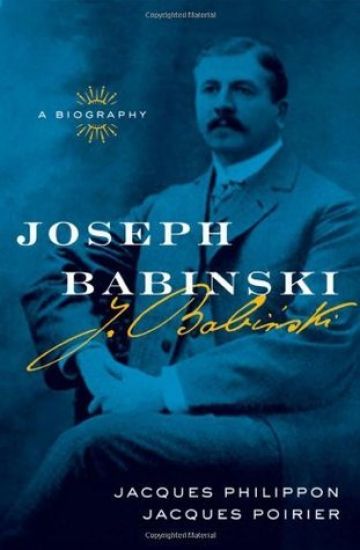
The life and work of Joseph Babinski (1857-1932) has been revisited by two French physicians whose enthusiasm for the subject is reflected in the depth and breadth of documentary sources. From Babinski's Polish roots, his father (an intrepid revolutionist, his brother(the gold miner and famous gastronome Ali-Bab to the Babinski circle, his friends, his colleagues and his disciples, the reader will find a refreshing perspective on a particularly fascinating period in French medicine. His scientific contribution is analyzed in detail, with for the first time a complete bibliography of his publications. These includes not only the Babinski Sign, but also the earlier and heretofore less-known concerning pathological anatomy and histology, the papers on cutaneous and tendinous reflexes, cerebellar and vestibular semeiology, hysteria and pithiatism, localization of spinal cord compression s and the birth of French neurosurgery.
Joseph Smith, Jr.

Joseph Smith, Jr.

Oxford University Press Inc
2009
nidottu
Mormon founder Joseph Smith is one of the most controversial figures of nineteenth-century American history, and a virtually inexhaustible subject for analysis. In this volume, fifteen scholars offer essays on how to interpret and understand Smith and his legacy. Including essays by both Mormons and non-Mormons, this wide-ranging collection is the only available survey of contemporary scholarly opinion on the extraordinary man who started one of the fastest growing religious traditions in the modern world.
Joseph Smith's Gold Plates

Joseph Smith's Gold Plates

Richard Lyman Bushman

OXFORD UNIVERSITY PRESS INC
2023
sidottu
Renowned historian Richard Lyman Bushman presents a vibrant history of the objects that gave birth to a new religion. According to Joseph Smith, in September of 1823 an angel appeared to him and directed him to a hill near his home. Buried there Smith found a box containing a stack of thin metal sheets, gold in color, about six inches wide, eight inches long, piled six or so inches high, bound together by large rings, and covered with what appeared to be ancient engravings. Exactly four years later, the angel allowed Smith to take the plates and instructed him to translate them into English. When the text was published, a new religion was born. The plates have had a long and active life, and the question of their reality has hovered over them from the beginning. Months before the Book of Mormon was published, newspapers began reporting on the discovery of a "Golden Bible." Within a few years over a hundred articles had appeared. Critics denounced Smith as a charlatan for claiming to have a wondrous object that he refused to show, while believers countered by pointing to witnesses who said they saw the plates. Two hundred years later the mystery of the gold plates remains. In this book renowned historian of Mormonism Richard Lyman Bushman offers a cultural history of the gold plates. Bushman examines how the plates have been imagined by both believers and critics--and by treasure-seekers, novelists, artists, scholars, and others--from Smith's first encounter with them to the present. Why have they been remembered, and how have they been used? And why do they remain objects of fascination to this day? By examining these questions, Bushman sheds new light on Mormon history and on the role of enchantment in the modern world.
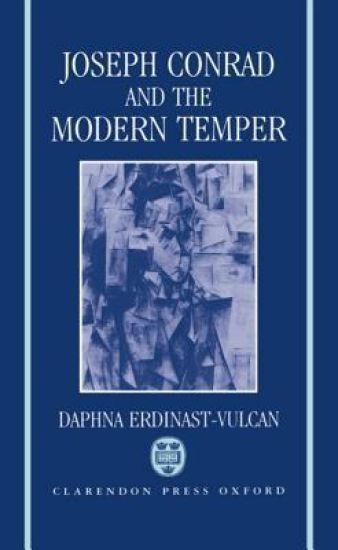
Joseph Conrad and the Modern Temper

Joseph Conrad and the Modern Temper

Daphna Erdinast-Vulcan

Clarendon Press
1991
sidottu
A study which relates Conrad's work to the crisis of modernity in the late nineteenth century, this book discusses 'faultlines' - ambiguities and apparent aesthetic ruptures - in nine of the major novels and novellas. These faultlines are diagnosed as the symptoms of an unresolved tension between Conrad's temperamental affinity with the Nietzschean outlook and his fierce ideological rejection of its ultimate implications. Presenting Conrad as 'a modernist at war with modernity', the author studies the perpetual tug-of-war between the artistic will to meaning and the writer's susceptibility to the modern temper, both as a theme and as a structuring principle in his work. The modes of this struggle are defined as the 'failure of myth', the 'failure of metaphysics', and the 'failure of textuality'. This continuously forceful and original inquiry draws on the work of Nietzsche, Vaihinger, Bakhtin, Heller, and MacIntyre, amongst others, to present the ethical and epistemological issues which are interwoven with Conrad's aesthetics.
Joseph Scaliger: I: Textual Criticism and Exegesis
This volume is the first half of an intellectual biography of Joseph Scaliger (1540-1609), the greatest classical scholar of his time. Anthony Grafton describes Scaliger's early work as an editor of and commentator on classical texts, setting this into the wider context of classical scholarship in the Renaissance. At the same time he interprets the major changes that Scaliger's work underwent, as responses to pressures exerted by his social situation and emotional life.
Joseph Conrad and the Anthropological Dilemma

Joseph Conrad and the Anthropological Dilemma

John W. Griffith

Clarendon Press
1995
sidottu
This is the first detailed analysis of Conrad's early fiction, which as a response to his travels in so-called primitive cultures: Malaysia, Borneo and the Congo. As a sensitive observer of other peoples and a notable emigré, he was profoundly aware of the psychological impact of travel, and much of his early fiction potrays both literal and figurative voyages of Europeans into other cultures. By situating Conard's work in relation to other writings on `primitive' peoples, John Griffith shows how his fiction draws on a prominent anthropological and biological dilemma: he constantly posed the question of how to bridge conceptual and cultural gaps between various peoples. As John Griffith demonstrates, this was a dilemma which coincided with a larger Victorian debate regarding the progression or retrogression of European civilization. Lively and original, Joseph Conard and the Anthropological Dilemma will be essential reading for all scholars and students of Conrad and for all those interested in wider questions regarding the colonial cross-cultural encounter.
Joseph Addison

Joseph Addison

Oxford University Press
2021
sidottu
Joseph Addison: Tercentenary Essays is a collection of fifteen essays by a team of internationally recognized experts specially commissioned to commemorate the three hundredth anniversary of Addison's death in 2019. Almost exclusively known now as the inventor and main author of The Spectator, probably the most widely read and imitated prose work of the eighteenth century, Addison also produced important and influential work across a broad gamut of other literary modes--poems, verse translations, literary criticism, periodical journalism, drama, opera, travel writing. Much of this work is little known nowadays even in specialist academic circles; Addison is often described as the most neglected of the eighteenth century's major writers. This volume is the first collection to address the full range and variety of Addison's career and writings. Its fifteen chapters fall into three groupings: the first set study Addison's work in modes other than the literary periodical (poetry, translation, travel writing, drama); the second set address The Spectator from a variety of disciplinary perspectives (literary-critical, sociological and political, bibliographical); and the final set explore Addison's reception within several cultural spheres (philosophy, horticulture, art history), by individual writers or across larger historical periods (the Romantic age, the Victorian age), and in Britain and Europe, especially France. The volume provides an overdue and appropriately diverse memorial to one of the dominant men of letters of the Georgian era.
Joseph Conrad

Joseph Conrad

Yael Levin

Oxford University Press
2020
sidottu
The book builds on current interventions in modernist scholarship in order to rethink Joseph Conrad's contribution to literary history. It utilizes emerging critical modernisms, the work of Henri Bergson and Gilles Deleuze, and late modernist fiction, to stage an encounter between Conrad and a radically different literary tradition. It does so in order to uncover critical blind spots that have limited our appreciation of his poetics. The purpose of this investigation is threefold: first, to participate in recent critical attempts to correct a neglect of ontological preoccupations in Conrad's writing and uncover the author's exploration of a human subject beyond the Cartesian cogito. Second, to demonstrate the manner in which such an exploration is accompanied by the reconfiguration of the very building blocks of fiction: character, narration, focalization, language and plot have to be rethought to accommodate a subject who is no longer conceived of as autonomous and whole but is rendered permeable and interdependent. Third, to show how this redrawing of the literary imaginary communicates with the projects of late modernist writers such as Samuel Beckett, writers whose literary endeavours have long been held separate from Conrad's. In the spirit of current re-examinations of modernism and critical endeavours to think it anew outside the commonplaces that once defined it, this study returns to Conrad's art with an eye to twentieth-century shifts in the way we process, understand and evaluate information. Thematic, stylistic and philosophical instantiations of the slow are offered here as a gauge for this meaningful transformation.
Joseph Scaliger: II: Historical Chronology

Joseph Scaliger: II: Historical Chronology

Anthony Grafton

Clarendon Press
1993
sidottu
During the fifteenth and sixteenth centuries technical chronology, the study of calendars and of dates in ancient and medieval history, was both a fashionable and a controversial discipline. Theologians debated the dates of the Creation, the Flood, and the Crucifixion. Astronomers and historians argued about the identity of the eclipses that could supply absolute dates for events long past. Classical scholars reconstructed the religious beliefs and political practices that had governed the Greek and Roman calendars. Clerics and consultant experts, finally, debated what was to be done to mend the obviously faulty calendar of the western Church. Poliziano and Pico, Luther and Melanchthon, Copernicus and Kepler all studied and wrote about chronology. Late in the 1570s Joseph Scaliger (1540-1609) turned his attention to this field. He had already established himself as an innovative and ingenious editor of Latin texts, as the first volume of this study showed. But he now became one of the most celebrated scholars in Europe. He synthesized the work of dozens of other scholars, many of them now forgotten. He started or took part in many technical debates. And on such central problems as the date and nature of the Last Supper, the reliability of the various Old Testament texts, and the worth of the fragmentary historians of the ancient Near East, he showed remarkable erudition and insight. This book tells the stories of chronology and of Scaliger himself. It describes the scholarly circles in which he moved - above all the University of Leiden, the most innovative in Europe, where he spent the last decade and a half of his life. And it reconstructs his relations with contemporary scholars and scientists - notably Tycho Brahe and Johannes Kepler - and his remarkable, if wholly unofficial, career as a teacher. It is a sequel to volume I: Textual Criticism and Exegesis, published in 1983.
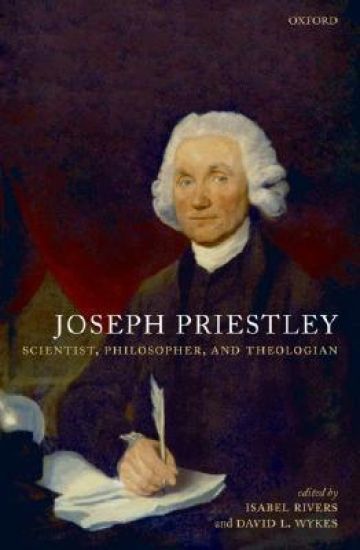
Joseph Priestley

Joseph Priestley

Oxford University Press
2008
sidottu
Joseph Priestley was one of the most remarkable thinkers of the eighteenth century. Best known today as the scientist who discovered oxygen, he also made major contributions in the fields of education, politics, philosophy, and theology. This collection of essays by a team of experts covers the full range of Priestley's work and provides a new and up to date account of all his activities, together with a summary of his life and an account of his last years in America. The book will re-establish him as a major intellectual figure in Britain and America in the second half of the eighteenth century.
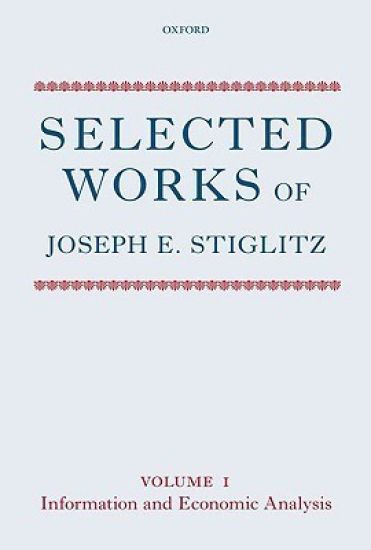
Selected Works of Joseph E. Stiglitz

Selected Works of Joseph E. Stiglitz

Joseph E. Stiglitz

Oxford University Press
2008
sidottu
This is the first volume in a new, definitive, six-volume edition of the works of Joseph Stiglitz, one of today's most distinguished and controversial economists. Stiglitz was awarded the Nobel Prize in Economics in 2001 for his work on asymmetric information and is widely acknowledged as one of the pioneers in the field of modern information economics and more generally for his contributions to microeconomics. Volume I includes a number of classic papers which helped to form the foundations for the field of the economics of information. Stiglitz reflects on his work and the field more generally throughout the volume by including substantial original introductions to the Selected Works, the volume as a whole, and each part within the volume. The volume includes a number of foundational papers, specifically looking at market equilibrium with adverse selection, moral hazard, and screening. This volume sets out the basic concepts underlying the economics of information, while volume II goes a step further by applying and extending these concepts in a number of different settings in labour, capital, and product markets.
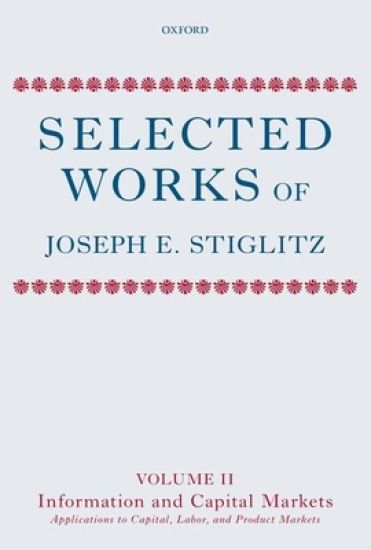
Selected Works of Joseph E. Stiglitz

Selected Works of Joseph E. Stiglitz

Joseph E. Stiglitz

Oxford University Press
2013
sidottu
This is the second of six volumes in a series of selected scientific papers by one of the world's most distinguished economists. Volume I presented the basic concepts in the Economics of Information, showing that markets in which information was imperfect or asymmetric (where some individuals know things that others don't) behave markedly different from how they would if information were perfect. Volume II, with papers written between 1969 and 2009, explores the implications of the New Information Paradigm for labor, capital, and product markets. This New Paradigm, for which Stiglitz was awarded the Nobel Memorial Prize in Economics in 2001, has fundamentally changed the way we think about every aspect of economics, raising new questions on corporate governance, and leading us to reconsider old questions on corporate finance, the relationship between finance and the economy, and the theory of economic incentives. While this volume focuses on the application of basic principles, it also extends the theory in important ways, showing the fruitfulness of Stiglitz's research strategy. In doing so, the papers set the ground for questioning some prevailing doctrines: key market phenomena cannot be explained by markets with rational expectations, even when information is imperfect. It demonstrates that how societies organize the obtainment, processing, and transmitting of information is as important as how they organize the production and distribution of goods. Indeed, the two issues are inseparable. The papers thus lay the foundations of a New Institutional Economics, not only describing how institutions (like sharecropping or banks) work and affect resource allocations, but why they arise and take on particular forms.
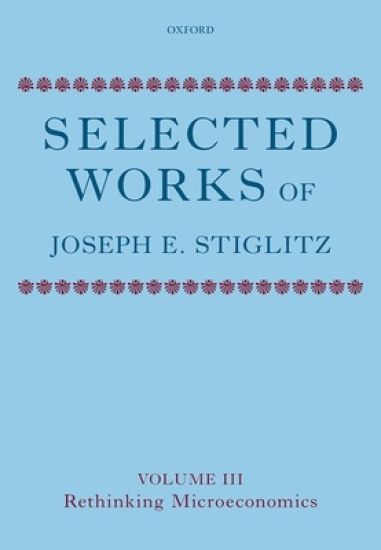
Selected Works of Joseph E. Stiglitz

Selected Works of Joseph E. Stiglitz

Joseph E. Stiglitz

Oxford University Press
2019
sidottu
This is the third volume in a new, definitive, six-volume edition of the works of Joseph Stiglitz, one of today's most distinguished and controversial economists. Stiglitz was awarded the Nobel Prize in Economics in 2001 for his work on asymmetric information and is widely acknowledged as one of the pioneers in the field of modern information economics and more generally for his contributions to microeconomics. Volume III contains a selection of Joseph E. Stiglitz's work on microeconomics. It questions well-established tenets, including many that are so fundamental they are almost taken for granted, covering basic concepts of risk and markets; the management of risk; the theory of the firm; the economics of organization; and theory of human behaviour. Stiglitz reflects on his work and the field more generally throughout the volume by including substantial original introductions to the Selected Works, the volume as a whole, and each part within the volume.
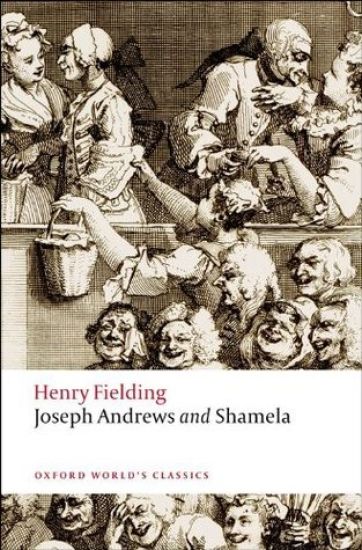
Joseph Andrews and Shamela

Joseph Andrews and Shamela

Henry Fielding

Oxford University Press
2008
nidottu
'I beg as soon as you get Fielding's Joseph Andrews, I fear in Ridicule of your Pamela and of Virtue in the Notion of Don Quixote's Manner, you would send it to me by the very first Coach.' (George Cheyne in a letter to Samuel Richardson, February 1742) Both Joseph Andrews (1742) and Shamela (1741) were prompted by the success of Richardson's Pamela (1740), of which Shamela is a splendidly bawdy parody. But in Shamela Fielding also demonstrates his concern for the corruption of contemporary society, politics, religion, morality, and taste. The same themes - together with a presentation of love as charity, as friendship, and in its sexual taste - are present in Joseph Andrews, Fielding's first novel. It is a work of considerable literary sophistication and satirical verve, but its appeal lies also in its spirit of comic affirmation, epitomized in the celebrated character of Parson Adams. This revised and expanded edition follows the text of Joseph Andrews established by Martin C. Battestin for the definitive Wesleyan Edition of Fielding's works. The text of Shamela is based on the first edition, and two substantial appendices reprint the preliminary matter from Conyers Middleton's Life of Cicero and the second edition of Richardson's Pamela (both closely parodied in Shamela). A new introduction by Thomas Keymer situates Fielding's works in their critical and historical contexts. ABOUT THE SERIES: For over 100 years Oxford World's Classics has made available the widest range of literature from around the globe. Each affordable volume reflects Oxford's commitment to scholarship, providing the most accurate text plus a wealth of other valuable features, including expert introductions by leading authorities, helpful notes to clarify the text, up-to-date bibliographies for further study, and much more.
Joseph Severn, A Life

Joseph Severn, A Life

Sue Brown

Oxford University Press
2009
sidottu
This biography of Joseph Severn (1793-1879), the best known but most controversial of Keats's friends, is based on a mass of newly discovered information, much of it still in private hands. Severn accompanied the dying Keats to Italy, nursed him in Rome and reported on his last weeks there in a famous series of moving letters. After Keats's death in relative obscurity, Severn pressed hard for an early biography and a more fitting memorial in the Protestant Cemetery in Rome. In the nineteenth century Severn's friendship with Keats was seen as a model of devoted masculine companionship and he was reburied by popular acclaim next to Keats in 1882. In the twentieth century, by contrast, he was denigrated as an unreliable, self-promoting witness. Sue Brown's book fills a major gap in studies of Keats and his circle. It reassesses Severn's character, friendship with Keats, and influence on the posthumous development of the poet's fame and provides new information on Keats's death. The significance of Severn's artistic career has previously been downplayed. This book offers the first full assessment of his work and of his turbulent spell as British Consul in Rome from 1860 to 1871. Keats was not Severn's only famous friend. For most of his adult life Severn was at the heart of the large, lively British community in Rome welcoming amongst others Gladstone, who became his most important patron, Ruskin, Walter Scott, Wordsworth, Turner, Samuel Palmer, David Wilkie, and many more. He maintained long friendships with Leigh Hunt, Mary Shelley, Charles Eastlake, Richard Monckton Milnes, amongst others, and enjoyed a rich family life.
Joseph of Arimathea

Joseph of Arimathea

William John Lyons

Oxford University Press
2014
sidottu
Joseph of Arimathea: A Study in Reception History examines the extensive and convoluted afterlives of a minor biblical character who nevertheless plays a major role in three pivotal scenes in the passion of Jesus Christ as presented by the four canonical Gospels: the request to Pilate for the body, the descent from the cross, and the burial of Jesus' corpse. Characterised in subtly different ways by each Evangelist, these sparse biblical Josephs were expanded, expounded, translated, harmonised, and extended by early literary sources and developed thematically by the artistic traditions of the Renaissance. In the Medieval Period, Joseph arrived, by 'fortuitous' accident, in the British Isles, becoming an iconic figure for English nationalists (through the Glastonbury tradition) and for British Imperialists (through Parry's musical setting of Blake's Jerusalem). Twentieth-century developments in church life, film, literature, spiritualism, and studies of the historical Joseph round out what such a minor character can accomplish, given a sufficient richness in original texts and the right opportunities afforded by later cultural developments. In Joseph of Arimathea's case, certain aspects proved highly adaptable, especially the sharp contrast provided by his portrayal as a bold active figure in the Gospel of Mark and as a fearful passive character in the Gospel of John, the attractiveness of his wealth and nobility to those who considered themselves of similar (or much higher) status, and the opportunities provided by his swift appearance and departure from the most important event in Christianity's foundational documents.
Joseph of Arimathea

Joseph of Arimathea

William John Lyons

Oxford University Press
2014
nidottu
Joseph of Arimathea: A Study in Reception History examines the extensive and convoluted afterlives of a minor biblical character who nevertheless plays a major role in three pivotal scenes in the passion of Jesus Christ as presented by the four canonical Gospels: the request to Pilate for the body, the descent from the cross, and the burial of Jesus' corpse. Characterised in subtly different ways by each Evangelist, these sparse biblical Josephs were expanded, expounded, translated, harmonised, and extended by early literary sources and developed thematically by the artistic traditions of the Renaissance. In the Medieval Period, Joseph arrived, by 'fortuitous' accident, in the British Isles, becoming an iconic figure for English nationalists (through the Glastonbury tradition) and for British Imperialists (through Parry's musical setting of Blake's Jerusalem). Twentieth-century developments in church life, film, literature, spiritualism, and studies of the historical Joseph round out what such a minor character can accomplish, given a sufficient richness in original texts and the right opportunities afforded by later cultural developments. In Joseph of Arimathea's case, certain aspects proved highly adaptable, especially the sharp contrast provided by his portrayal as a bold active figure in the Gospel of Mark and as a fearful passive character in the Gospel of John, the attractiveness of his wealth and nobility to those who considered themselves of similar (or much higher) status, and the opportunities provided by his swift appearance and departure from the most important event in Christianity's foundational documents.
Joseph Banks: A Life

Joseph Banks: A Life

Patrick O'Brian

University of Chicago Press
1997
nidottu
One of our greatest writers about the sea has written an engrossing story of one of history's most legendary maritime explorers. Patrick O'Brian's biography of naturalist, explorer and co-founder of Australia, Joseph Banks, is narrative history at its finest. Published to rave reviews, it reveals Banks to be a man of enduring importance, and establishes itself as a classic of exploration. "It is in his description of that arduous three-year voyage on the ship Endeavor] that Mr. O'Brian is at his most brilliant. . . . He makes us understand what life within this wooden world was like, with its 94 male souls, two dogs, a cat and a goat."-Linda Colley, New York Times "An absorbing, finely written overview, meant for the general reader, of a major figure in the history of natural science."-Frank Stewart, Los Angeles Times " This book is] the definitive biography of an extraordinary subject."-Robert Taylor, Boston Globe "His skill at narrative and his extensive knowledge of the maritime history . . . give him a definite leg up in telling this . . . story."-Tom Clark, San Francisco Chronicle
Joseph's Dilemma

Joseph's Dilemma

Matthew J. Marohl

James Clarke Co Ltd
2010
nidottu
'When Mary had been engaged to Joseph, but before they lived together, she was found to be with child from the Holy Spirit' (1:18). We are made to assume that Joseph discovers that Mary is pregnant, but that he does not know that she is with child from the Holy Spirit. Joseph must decide what he will do with Mary. The discussion of this verse generally focuses on two questions. First, did Joseph suspect Mary of adultery? Second, if he did suspect Mary of adultery, what were his options? If Joseph reveals that Mary is pregnant she will be killed. If Joseph conceals Mary's pregnancy, he will be opposing the law of the Lord. What is a 'righteous' man to do? Marohl's study of honor killings, be they modern or ancient, opens up new avenues of interpretation for "The Gospel of Matthew's" infancy narrative. It is a pattern that is to be replicated in the lives of the Jesus followers.