Kirjojen hintavertailu. Mukana 12 595 353 kirjaa ja 12 kauppaa.

Kirjahaku

Etsi kirjoja tekijän nimen, kirjan nimen tai ISBN:n perusteella.

1000 tulosta hakusanalla Madison Moore

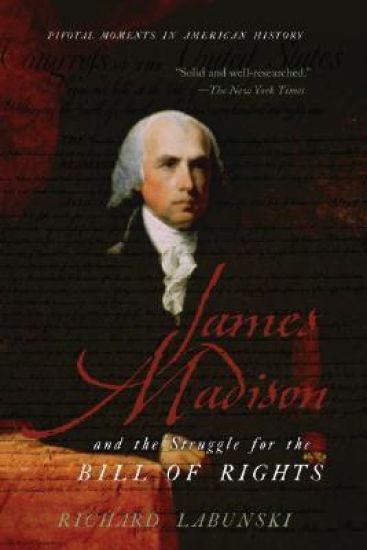
James Madison and the Struggle for the Bill of Rights

James Madison and the Struggle for the Bill of Rights

Richard Labunski

Oxford University Press Inc
2008
nidottu
Today we hold the Constitution in such high regard that we can hardly imagine how hotly contested was its adoption. In fact, many of the thirteen states saw fierce debate over the document, and ratification was by no means certain. Virginia, the largest and most influential state, approved the Constitution by the barest of margins, and only after an epic political battle between James Madison and Patrick Henry. Now Richard Labunski offers a dramatic account of a time when the entire American experiment hung in the balance, only to be saved by the most unlikely of heroes--the diminutive and exceedingly shy Madison. Here is a vividly written account of not one but several major political struggles which changed the course of American history. Labunski takes us inside the sweltering converted theater in Richmond, where for three grueling weeks, the soft-spoken Madison and the charismatic Patrick Henry fought over whether Virginia should ratify the Constitution. The stakes were enormous. If Virginia voted no, George Washington could not become president, New York might follow suit and reject the Constitution, and the young nation would be thrust into political chaos. But Madison won the day by a handful of votes, mollifying Anti-Federalist fears by promising to add a bill of rights to the Constitution. To do this, Madison would have to win a seat in the First Congress. Labunski shows how the vengeful Henry prevented Madison's appointment to the Senate and then used his political power to ensure that Madison would run against his good friend, Revolutionary War hero James Monroe, in a House district teeming with political enemies. Overcoming great odds, Madison won by a few hundred votes, allowing him to attend the First Congress and sponsor the Bill of Rights. Packed with colorful details about life in early America, this compelling and important narrative is the first serious book about Madison written in many years. It will return this under-appreciated patriot to his rightful place among the Founding Fathers and shed new light on a key turning point in our nation's history.
The Papers of James Madison, Volume 6

The Papers of James Madison, Volume 6

James Madison

University of Chicago Press
1967
sidottu
During the first four months of 1783, when the United States was neither wholly at war nor wholly at peace, a cluster of difficult problems confronted James Madison and his fellow delegates in Congress. Faced with the interlocking issues of finance, demobilization, and foreign affairs, Congress held many contentious sessions early in the year. The sparseness of the official journal enhances the value of the notes on debates, recorded by Madison, for illuminating the discussions.
The Papers of James Madison

The Papers of James Madison

James Madison

University of Chicago Press
1970
sidottu
During the first six of the ten months covered by this volume, Madison completed his initial period of service as a delegate from Virginia in the Congress of the Confederation. His correspondence with Thomas Jefferson and Edmund Randolph, as well as his other papers, reveal the mounting difficulties besetting him and his fellow nationalists who sought to preserve a union among the thirteen states. The major problems, which included demobilizing the discontented army, obtaining public revenue, funding the Confederation debt, pressing the British to evacuate their military posts, enforcing the preliminary articles of peace, creating a public domain in the West, locating a provisional or permanent capital of the Confederation, and negotiating commercial treaties with European powers, fostered sectionalism, factionalism, and an emphasis upon state sovereignty. As a prominent member of Congress, Madison sought legislative and constitutional remedies for this menacing divisiveness. To him the maintenence of the new nation embodied the greatest trust ever confided to a political society, for it was the last and fairest experiment in favor of the rights of human nature. Early in December, after an absence of over three years, Madison returned to Montpelier, his father's estate. There during the winter of 1783-1784, he studied law, renewed old friendships, and canvassed the residents of Orange County for support of his candidacy for election to the House of Delegates of the Virginia General Assembly. maintenance
James Madison on the Constitution and the Bill of Rights
Morgan provides a comprehensive, consistent, and unified analysis of Madison's political philosophy using Madison's views on the Constitution and the Bill of Rights as the focus. Morgan looks at all that Madison wrote on these topics before, during, and after the adoption of the Constitution. He argues that Madison's constitutional philosophy was shaped by his view that there was an inherent conflict between limited government and accountability on the one hand, and the tendency of all to exercise autonomous, unrestricted power. . . . His second thesis is that Madison was propelled to become a constitutional reformer not by any desire to curb democracy but by the need to preserve both the union and republican government. Morgan emphasizes the impact of the American experience in shaping Madison's thought as well as its eclectic character. ChoiceJames Madison stands out among the founding fathers of the U.S. government because of his analytical and creative political insight into the framing and explaining of the Constitution and the Bill of Rights. Madison became a constitutional reformer in order to preserve a republican government strong enough to fulfill what he felt was the destiny of the United States. This volume casts further light on Madison's beliefs through a comprehensive examination of his writing.This is not a simple task: there are substantial difficulties involved in developing a comprehensive consistent, and unified analysis of Madison's political thought. Madison's writings were extensive, and must be carefully perused in order to separate the rhetoric of his public exposition from the essence of his private thought. Furthermore, Madison never denied his aim of justifying and explaining the Constitution by sacrificing pure theory to the requirements of the prevailing political situation. Nonetheless, author Morgan has used the simplest possible interpretations of Madison's writings to reveal a clear and overriding thesis that gives unity and focus to his thought. This focus relates to the continuing tensions between the democratic idea of accountability and the tendency of all governments to seek autonomy, especially in the conduct of foreign relations.
Eleven Madison Park

Eleven Madison Park

Daniel Humm; Will Guidara

Little, Brown Company
2011
sidottu
Eleven Madison Park is one of New York City's preeminent fine-dining establishments, where Chef Daniel Humm marries the latest culinary techniques with classical technique.Under Chef Humm's leadership, the restaurant has soared to new heights and has become one of the premier dining destinations in the world. Eleven Madison Park: The Cookbook is a sumptuous tribute to the unforgettable experience of dining in the restaurant. The book features more than 125 sophisticated recipes, arranged by season, adapted for the home cook, and accompanied by stunning full-color photographs by Francesco Tonelli.
Eleven Madison Park: The Plant-Based Chapter

Eleven Madison Park: The Plant-Based Chapter

Daniel Humm

LITTLE, BROWN COMPANY
2024
sidottu
For 25 years, Eleven Madison Park has opened the eyes of diners to the exquisite possibilities inside ingredients. When Daniel Humm announced in 2021 that the restaurant would reopen after the pandemic with a new plant-based mission, it made international headlines.Today, Eleven Madison Park is the first and only plant-based restaurant to have been awarded three Michelin stars. Now, in this beautiful limited-edition set of books, Chef Humm traces the creative journey that accompanied this ground-breaking transition to vegan cooking. It is an astonishing, revelatory look inside the mind of one of the world's most interesting chefs.This slipcased set is bound in cloth printed with watercolours by renowned artist Sarah Crowder. It contains three volumes, and each set is signed by Chef Humm and individually hand-numbered:* A portfolio containing a letter from Daniel Humm and six of his illustrations, drawn from his recipe-inspiration workbooks, printed on fine watercolour paper* Recipes: A book containing the fully detailed recipes for Eleven Madison Park's ground-breaking seasonal menus-including observations from the kitchen team and photography by Francesco Tonelli-revealing how they create their magic.* Backstage: A work of photojournalism by photographer Ye Fan, who was granted unprecedented full access to Eleven Madison Park from the pandemic through its reopening. Never before has a restaurant kitchen at this level been documented in this way. This edition is limited to 11,000 copies. Its publication is a landmark event in the history of fine dining and cookbook publishing.
James Madison. is he a hypocrite or not?
James Madison is a fourth president of the United states, a statesman and the father of the United states constitution. On the other hand, his lavish lifestyle through the use of slavery and his conflictions about it sound hypocritical and that leaves the questions- is he a hypocrite?
Dolley Madison

Dolley Madison

Catherine Allgor

Routledge
2019
sidottu
First Lady of the United States and America's "Queen of Hearts," Dolley Madison fashioned an unofficial role for herself in the new administration of the United States, helping to answer the nation's need for ceremony and leaving footprints for centuries of presidential wives to follow. Assisting her husband, James Madison, she helped to promote national unity, modeling a political behavior that stressed civility and empathy. Together, their approach fueled bipartisanship in a country still assembling a political identity.About the Lives of American Women series: selected and edited by renowned women's historian Carol Berkin, these brief biographies are designed for use in undergraduate courses. Rather than a comprehensive approach, each biography focuses instead on a particular aspect of a women's life that is emblematic of her time, or which made her a pivotal figure in the era. The emphasis is on a 'good read', featuring accessible writing and compelling narratives, without sacrificing sound scholarship and academic integrity. Primary sources at the end of each biography reveal the subject's perspective in her own words. Study questions and an annotated bibliography support the student reader.
Eleven Madison Park: The Next Chapter

Eleven Madison Park: The Next Chapter

Daniel Humm; Will Guidara

Ten Speed Press
2019
sidottu
From one of the world's top dining destinations, New York's three-Michelin-starred restaurant Eleven Madison Park, comes an updated single-volume collection of more than 80 recipes, stories, food photographs, and watercolor paintings from celebrated chef Daniel Humm. Originally published as a two-volume, signed edition and limited to only 11,000 print copies, this revised edition of Eleven Madison Park: The Next Chapter refashions the deluxe slipcase edition into a high-quality, single volume with more than 30 new recipes and photographs and nearly 15 new stories and watercolors reflecting the latest dishes developed at the restaurant. This collection reflects on the time during which Eleven Madison Park garnered scores of accolades, including four stars from the New York Times, three Michelin stars, seven James Beard Foundation awards, and the number one spot on the World's 50 Best Restaurants list. In this fresh package, the author shares more than 80 recipes, stunning photographs, lush watercolors, and personal stories describing his unparalleled culinary journey and inspiration.
James Madison

James Madison

Richard Brookhiser

Basic Books
2013
pokkari
James Madison led one of the most influential and prolific lives in American history, and his story,although all too often overshadowed by his more celebrated contemporaries,is integral to that of the nation. Madison helped to shape our country as perhaps no other Founder: collabourating on the Federalist Papers and the Bill of Rights, resisting government overreach by assembling one of the nation's first political parties (the Republicans, who became today's Democrats), and taking to the battlefield during the War of 1812, becoming the last president to lead troops in combat. In this penetrating biography, eminent historian Richard Brookhiser presents a vivid portrait of the Father of the Constitution," an accomplished yet humble statesman who nourished Americans' fledgling liberty and vigorously defended the laws that have preserved it to this day.
James Madison and the Spirit of Republican Self-Government

James Madison and the Spirit of Republican Self-Government

Colleen A. Sheehan

Cambridge University Press
2009
pokkari
In a study that combines an in-depth examination of Madison's National Gazette essays of 1791–2 with a study of The Federalist, Colleen Sheehan traces the evolution of Madison's conception of the politics of communication and public opinion throughout the Founding period, demonstrating how 'the sovereign public' would form and rule in America. Contrary to those scholars who claim that Madison dispensed with the need to form an active and virtuous citizenry, Sheehan argues that Madison's vision for the new nation was informed by the idea of republican self-government, whose manifestation he sought to bring about in the spirit and way of life of the American people. Madison's story is 'the story of an idea' - the idea of America.
James Madison and the Spirit of Republican Self-Government

James Madison and the Spirit of Republican Self-Government

Colleen A. Sheehan

Cambridge University Press
2009
sidottu
In a study that combines an in-depth examination of Madison's National Gazette essays of 1791–2 with a study of The Federalist, Colleen Sheehan traces the evolution of Madison's conception of the politics of communication and public opinion throughout the Founding period, demonstrating how 'the sovereign public' would form and rule in America. Contrary to those scholars who claim that Madison dispensed with the need to form an active and virtuous citizenry, Sheehan argues that Madison's vision for the new nation was informed by the idea of republican self-government, whose manifestation he sought to bring about in the spirit and way of life of the American people. Madison's story is 'the story of an idea' - the idea of America.