Kirjojen hintavertailu. Mukana 11 342 296 kirjaa ja 12 kauppaa.

Kirjahaku

Etsi kirjoja tekijän nimen, kirjan nimen tai ISBN:n perusteella.

1000 tulosta hakusanalla Markus Breuning

Phase-Space Optics: Fundamentals and Applications

Phase-Space Optics: Fundamentals and Applications

Markus Testorf; Bryan Hennelly; Jorge Ojeda-Castaneda

McGraw-Hill Professional
2009
sidottu
Publisher's Note: Products purchased from Third Party sellers are not guaranteed by the publisher for quality, authenticity, or access to any online entitlements included with the product.A comprehensive cross section of phase-space opticsThis definitive volume highlights an elegant, unified approach to optical rays, waves, and system design using cutting-edge phase-space techniques. Phase-Space Optics: Fundamentals and Applications details theoretical concepts of phase space as well as novel engineering applications in specific disciplines. This authoritative guide includes full coverage of sampling, superresolution imaging, and the phase-space interpretation of ultrafast optics. Work with Wigner optics, analyze phase-space equations, develop wave propagation models, and gain a new understanding of optical sources and systems. Discover how to:Describe optical phenomena using Wigner and ambiguity functionsPerform phase-space rotations using ray transformation matricesInfluence the trade-off between pupil size and depth of fieldAnalyze and design optical signals using the Radon-Wigner transformAccomplish superresolution by squeezing phase spaceInterpret the intimate relationship between radiometry and coherenceUse basic algebra to discover self-imaging, Fresnel diffraction, and the Talbot effectDevelop discrete models, sampling criteria, and interpolation formulaeWork with ultrafast processes and complex space-time structures

The Strategic Management of High Technology Contracts

The Strategic Management of High Technology Contracts

Markus Nordberg; Alain Verbeke

Elsevier Science Ltd
1999
sidottu
High technology research laboratories are under constant pressure from the governments that support them to generate secondary utilities such as technology transfer and spin-offs. As buyers, such organisations are often used by governments to stimulate innovation by their suppliers, under tight budgetary constraints and within the rigid institutional frameworks applied to public research organisations. This book addresses the design of efficient buyer-supplier contracts within the institutional boundaries faced by the buyer and focuses in particular on vertical buyer-supplier linkages as a source of supplier core competencies in a cost- and technology-driven environment. Based on a study of manufacturing contracts commissioned by the European Laboratory for Particle Physics (CERN), the book aims to answer two questions. First, what is the most efficient governance structure for organising buyer-supplier relationships, given the presence of specific institutional boundaries, high technological complexity and environmental uncertainty? Secondly, irrespective of the presence of such an efficient governance structure, what type of impact could technology-oriented government contracts have on supplier core competencies?
Pervasive Games

Pervasive Games

Markus Montola; Jaakko Stenros; Annika Waern

Focal Press US
2009
nidottu
Quickly emerging from the fast-paced growth of mobile communications and wireless technologies, pervasive games take gaming away from the computer screen and back to the three-dimensional world. Now games can be designed to be played in public spaces like shopping malls, conferences, museums and other non-traditional game venues. Game designers need to understand how to use the world as a gamespace-and both the challenges and advantages of doing so. This book shows how to change the face of play-who plays, when and where they play and what that play means to all involved. The authors explore aspects of pervasive games that concern game designers: what makes these games compelling, what makes them possible today and how they are made. For game researchers, it provides a solid theoretical, philosophical and aesthetic understanding of the genre. Pervasive Games covers everything from theory and design to history and marketing.
The Science of Grapevines

The Science of Grapevines

Markus Keller

Academic Press Inc
2015
sidottu
The Science of Grapevines: Anatomy and Physiology is an introduction to the physical structure of the grapevine, its various organs, their functions and their interactions with the environment. Beginning with a brief overview of the botanical classification (including an introduction to the concepts of species, cultivars, clones, and rootstocks), plant morphology and anatomy, and growth cycles of grapevines, The Science of Grapevines covers the basic concepts in growth and development, water relations, photosynthesis and respiration, mineral uptake and utilization, and carbon partitioning. These concepts are put to use to understand plant-environment interactions including canopy dynamics, yield formation, and fruit composition, and concludes with an introduction to stress physiology, including water stress (drought and flooding), nutrient deficiency and excess, extreme temperatures (heat and cold), and the impact and response to of other organisms. Based on the author’s years of teaching grapevine anatomy as well as his research experience with grapevines and practical experience growing grapes, this book provides an important guide to understanding the entire plant.
The Science of Grapevines

The Science of Grapevines

Markus Keller

Academic Press Inc
2020
nidottu
The Science of Grapevines, Third Edition reflects the latest insights into cultivar relationships, vascular transport, hormone action, and stress responses of grapevines. Based on the author’s many years of teaching, research and practical experience with grapevines and grape production, the book is completely revised and updated, presenting a comprehensive introduction on the physical structure of the grapevine, its organs, their functions, and their environmental interactions. While many concepts discussed are broadly applicable to plants in general, the focus is on grapevines, especially cultivated grapevines. This book enables readers to use these concepts in their own scientific research or in practical production systems. Scientifically grounded and integrating discoveries in other plant species, the book explores the physiological processes underlying grapevine form and function, their developmental and environmental control, and their implications for practical vineyard management.
Judgment, Decision-Making, and Embodied Choices
Judgment, Decision-Making, and Embodied Choices introduces a new concept of embodied choices which take sensorimotor experiences into account when limited time and resources forces a person to make a quick decision. This book combines areas of cognitive psychology and movement science, presenting an integrative approach to understanding human functioning in everyday scenarios. This is the first book focusing on the role of the gut as a second brain, introducing the link to risky behavior. The book's author engages readers by providing real-life experiences and scenarios connecting theory to practice.
Writing Religion

Writing Religion

Markus Dressler

Oxford University Press Inc
2015
nidottu
In the late 1980s, the Alevis, at that time thought to be largely assimilated into the secular Turkish mainstream, began to assert their difference as they never had before. The question of Alevism's origins and its relation to Islam and to Turkish culture became a highly contested issue. According to the dominant understanding, Alevism is part of the Islamic tradition, although located on its margins. It is further assumed that Alevism is intrinsically related to Anatolian and Turkish culture, carrying an ancient Turkish heritage, leading back into pre-Islamic Central Asian Turkish pasts. Dressler argues that this knowledge about the Alevis-their demarcation as "heterodox" but Muslim and their status as carriers of Turkish culture-is in fact of rather recent origins. It was formulated within the complex historical dynamics of the late Ottoman Empire and the first years of the Turkish Republic in the context of Turkish nation-building and its goal of ethno-religious homogeneity.
An Introduction to the Model Penal Code

An Introduction to the Model Penal Code

Markus D. Dubber

Oxford University Press Inc
2015
sidottu
In this second edition of his introductory overview of the Model Penal Code (now titled: An Introduction to the Model Penal Code), Markus Dubber retains the book's original goal, approach, and structure as a companion to the Code. He reflects the Code's aim to present an accessible, comprehensive, and systematic account of American criminal law. This book unlocks the Code's potential as a key to the study of American criminal law for law students and teachers, and for anyone else with an interest in getting a sense of the basic contours of American criminal law. The content of the original edition has been thoroughly revised with citations to primary and secondary materials checked, updated, and supplemented where appropriate. The American Law Institute's ongoing revision of the Code's sentencing and sexual offense provisions has been taken into account. Also, the comparative analysis found sporadically throughout the original version of the book has been expanded in places to provide additional context. As one of the world's most sophisticated criminal codes, the Model Penal Code also serves as an excellent platform for comparative analysis, particularly with code-based civil law systems that are often difficult to place alongside opinion-based common law systems.
An Introduction to the Model Penal Code

An Introduction to the Model Penal Code

Markus D. Dubber

Oxford University Press Inc
2015
nidottu
In this second edition of his well-received introductory overview of the Model Penal Code, Markus Dubber retains the book's original aim to serve as an accessible companion to the Code. Professor Dubber unlocks the Model Penal Code's potential as a key to the study of American criminal law for law students and teachers, and for anyone else with an interest in understanding the basic contours of American criminal law. While the book's general goal and basic approach remain unchanged, its content has been thoroughly revised. Citations to primary and secondary materials have been updated and supplemented where appropriate. The American Law Institute's ongoing revision of the Code's sentencing and sexual offense provisions has been taken into account. Also, the comparative analysis found sporadically throughout the original edition has been expanded in places to provide additional context.
The Dual Penal State

The Dual Penal State

Markus D. Dubber

Oxford University Press
2021
nidottu
In The Dual Penal State, Markus Dubber addresses the rampant use of penal power in Western liberal democracies. The interference with the autonomy of the very persons upon whose autonomy the legitimacy of state power is supposed to rest is systemically normalized, rather than continuously scrutinized. The fundamental challenge of the penal paradox-the prima facie illegitimacy of modern punishment-remains unaddressed and unresolved. Focusing on the United States and Germany, and drawing on his influential account of the patriarchal origins of police power, Dubber exposes the persistence of a two-sided criminal justice regime: the dual penal state. The dual penal state combines principled punishment of equals under the rule of law, on one side, with punitive discipline of others under the rule of police, on the other. Slavery has long played a central role in drawing the line between the two sides of the dual penal state. In Europe, the slave appears in the classic and still foundational accounts of liberal punishment (from Beccaria to Kant) as the paradigmatic other beyond the protection of law, not a legal subject but a mere object of the master's or the state's discretionary discipline. In America, the patriarchal power to police portrays the continuum from the antebellum slaveholder's whipping of his slaves in private and the racial terror perpetrated by slave patrols in public, to the apartheid regime of Jim Crow and the treatment of prisoners as "slaves of the state," and eventually to the late 20th century's systemic racial violence of the “war on crime" and the widespread killing of Black suspects by an increasingly militarized and armed police force that triggered the global Black Lives Matter movement.
Bach in the World

Bach in the World

Markus Rathey

OXFORD UNIVERSITY PRESS INC
2022
sidottu
Johann Sebastian Bach's works are often classified as either sacred or secular. While this distinction is fraught, it seems to provide a useful way to distinguish between Bach's vocal works for the liturgy and those he wrote to honor courts and members of the nobility. But even so, the lines cannot be drawn clearly. The political and social systems of the time relied on religion as an ideological foundation, and public displays of political power almost always included religious rituals and thus required some form of sacred music. Social constructs, such as class and gender, were also embedded in religious frameworks. In Bach in the World, author Markus Rathey offers a new exploration of how Bach's music functioned as an agent of affective communication within rituals, such as the installation of the town council, and as a place where socio-political norms were perpetuated and sometimes even challenged. The book does so by analyzing public manifestations of the social order during Bach's time in large-scale celebrations, processions, public performances, and visual displays.
Oxford Handbook of Ethics of AI

Oxford Handbook of Ethics of AI

Markus Dubber; Frank Pasquale; Sunit Das

Oxford University Press Inc
2021
nidottu
This volume tackles a quickly-evolving field of inquiry, mapping the existing discourse as part of placing current developments in historical context; at the same time, breaking new ground in taking on novel subjects and pursuing fresh approaches. The term "A.I." is used to refer to a broad range of phenomena, from machine learning and data mining to artificial general intelligence. The recent advent of more sophisticated AI systems, which function with partial or full autonomy and are capable of tasks which require learning and 'intelligence', presents difficult ethical questions, and has drawn concerns from many quarters about individual and societal welfare, democratic decision-making, moral agency, and the prevention of harm. This work ranges from explorations of normative constraints on specific applications of machine learning algorithms today-in everyday medical practice, for instance-to reflections on the (potential) status of AI as a form of consciousness with attendant rights and duties and, more generally still, on the conceptual terms and frameworks necessarily to understand tasks requiring intelligence, whether "human" or "A.I."
Common Heritage or Common Burden?

Common Heritage or Common Burden?

Markus G. Schmidt; Elliot L. Richardson

Oxford University Press
1989
sidottu
Common Heritage or Common Burden? contains a comprehensive and authoritative assessment of the US role in the negotiations on the UN Convention on the Law of the Sea and particularly in the negotiations on one of the remaining commons, the ocean floor beyond national jurisdiction. The author first examines the US view of the lawfulness of deep seabed mining under international law. He reviews the bureaucratic struggles, within the US Administration and the Congress, concerning the options to be pursued at the Conference; analyses the US position in the seabed negotiations from 1974 to 1980; and casts a fresh look both on the Reagan Administration's `policy review' of 1981-1982 which threatened the Conference's outcome, and current US oceans policy which remains an impediment to the Convention's early entry into force. The study suggests that despite significant compromises negotiated between the US and developing countries at the Conference up to 1980, the emerging seabed regime was not as widely endorsed by US officials as is generally assumed. Drawing on material collected from interviews with many key negotiators, the study contributes to a better understanding of domestic and international decision-making procedures and the dynamics of international negotiations.
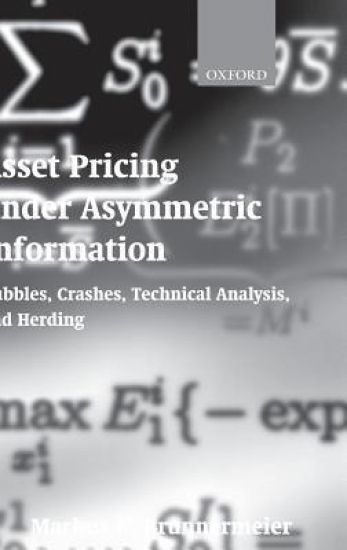
Asset Pricing under Asymmetric Information

Asset Pricing under Asymmetric Information

Markus K. Brunnermeier

Oxford University Press
2001
sidottu
Asset prices are driven by public news and information that is often dispersed among many market participants. These agents try to infer each other's information by analyzing price processes. In the past two decades, theoretical research in financial economics has significantly advanced our understanding of the informational aspects of price processes. This book provides a detailed and up-to-date survey of this important body of literature. The book begins by demonstrating how to model asymmetric information and higher-order knowledge. It then contrasts competitive and strategic equilibrium concepts under asymmetric information. It also illustrates the dependence of information efficiency and allocative efficiency on the security structure and the linkage between both efficiency concepts. No-Trade theorems and market breakdowns due to asymmetric information are then explained, and the existence of bubbles under symmetric and asymmetric information is investigated. The remainder of the survey is devoted to contrasting different market microstructure models that demonstrate how asymmetric information affects asset prices and traders' information , which provide a theoretical explanation for technical analysis and illustrate why some investors "chase the trend." The reader is then introduced to herding models and informational cascades, which can arise in a setting where agents' decision-making is sequential. The insights derived from herding models are used to provide rational explanations for stock market crashes. Models in which all traders are induced to search for the same piece of information are then presented to provide a deeper insight into Keynes' comparison of the stock market with a beauty contest. The book concludes with a brief summary of bank runs and their connection to financial crises.
The Economics of the Global Response to HIV/AIDS

The Economics of the Global Response to HIV/AIDS

Markus Haacker

Oxford University Press
2016
sidottu
The global response to HIV/AIDS has been a major aspect of global health and development policy over the last three decades. The book illustrates the devastating health impacts of the epidemic, with life expectancy in some countries falling to the lowest levels observed anywhere, and the remarkable success of the global HIV/AIDS response in reversing such extreme outcomes. Concerns about the implications of HIV/AIDS for economic development have played a role in motivating the global HIV/AIDS response. However, evidence on the impacts of HIV/AIDS on economic growth or poverty is weak, and the magnitude and relevance of such economic effects appears trivial compared to the consequences for life and health. Because of the success in extending access to treatment globally, HIV/AIDS has effectively transitioned into a chronic disease. This means that HIV/AIDS absorbs not only a substantial chunk of current global and national financial resources, but that these spending needs are projected to persist over decades. The costs of the HIV/AIDS response thus resemble a long-term financial liability, shaped by past and current policies. Relatedly, the calculus of cost-effectiveness of HIV/AIDS interventions has changed. People who become infected with HIV can now expect to not die because of AIDS; at the same time, each HIV infection results in medical needs and expenditures extending over decades. The book presents a framework for integrating these financial consequences and the transmission dynamics of HIV in the analysis of cost-effectiveness of HIV/AIDS interventions and in the design of HIV/AIDS programs.
The Dual Penal State

The Dual Penal State

Markus D. Dubber

Oxford University Press
2018
sidottu
The Dual Penal State addresses one of today's most pressing social and political issues: the rampant, at best haphazard, and ever-expanding use of penal power by states ostensibly committed to the enlightenment-based legal-political project of Western liberal democracy. Penal regimes in these states operate in a wide field of ill-considered and barely constrained violence where radical and prolonged interference with citizens, upon whose autonomy the legitimacy of state power supposedly rests, has been utterly normalized. At its heart, the crisis of modern penality is a crisis of the liberal project itself and the penal paradox is the sharpest formulation of the general paradox of power in a liberal state: the legitimacy of state sovereignty in the name of personal autonomy. To capture the depth and range of the crisis of contemporary penality in ostensibly liberal states the book adopts a fresh approach. It uses historical and comparative analysis to reveal the fundamental distinction between two conceptions of penal power - penal law and penal police - that runs through Western legal-political history: one rooted in autonomy, equality, and interpersonal respect, and the other in heteronomy, hierarchy, and patriarchal power. This dual penal state analysis illuminates how the law/police distinction manifests itself in various penal systems, from the American war on crime to the ahistorical methods of German criminal law science.
Criminal Law

Criminal Law

Markus Dubber; Tatjana Hörnle

Oxford University Press
2016
nidottu
Criminal Law: A Comparative Approach presents a systematic and comprehensive analysis of the substantive criminal law of two major jurisdictions: the United States and Germany. Presupposing no familiarity with either U.S. or German criminal law, the book will provide criminal law scholars and students with a rich comparative understanding of criminal law's foundations and central doctrines. All foreign-language sources have been translated into English; cases and materials are accompanied by heavily cross-referenced introductions and notes that place them within the framework of each country's criminal law system and highlight issues ripe for comparative analysis. Divided into three parts, the book covers foundational issues - such as constitutional limits on the criminal law - before tackling the major features of the general part of the criminal law and a selection of offences in the special part. Throughout, readers are exposed to alternative approaches to familiar problems in criminal law, and as a result will have a chance to see a given country's criminal law doctrine, on specific issues and in general, from the critical distance of comparative analysis.
Constituent Power in the European Union

Constituent Power in the European Union

Markus Patberg

Oxford University Press
2020
sidottu
The euro crisis, rising Euroscepticism, and Brexit have once again highlighted the European Union's unresolved legitimacy deficit. Increasingly, citizens claim to have been illegitimately excluded from decisions about the future of European integration. Movements such as DiEM25 call into question the authority of the states as the 'masters of the treaties'. At the same time, political theory's debate about the EU has become ever more academic. The discipline is preoccupied with the production and refinement of abstract models of democratic constitutionalism whose connection to real politics is thin. This book seeks to develop a new approach to EU legitimacy by reorienting the debate from the question of how the supranational polity should ideally be organized to the question of who is entitled to make that decision and how. To that end, it reformulates the classical notion of constituent power for the context of European integration. This account challenges conventional theoretical assumptions regarding the EU's ultimate source of legitimacy and enables political theory to put to the test the claims of those who challenge the established mode of EU constitutional politics.
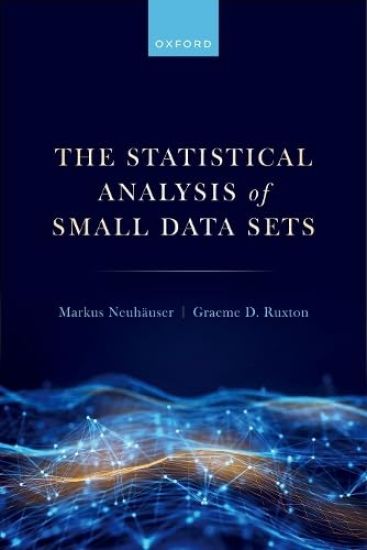
The Statistical Analysis of Small Data Sets

The Statistical Analysis of Small Data Sets

Markus Neuhäuser; Graeme D. Ruxton

Oxford University Press
2024
sidottu
We live in the era of big data. However, small data sets are still common for ethical, financial, or practical reasons. Small sample sizes can cause researchers to seek out the most powerful methods to analyse their data, but they may also be wary that some methodologies and assumptions may not be appropriate when samples are small. The book offers advice on the statistical analysis of small data sets for various designs and levels of measurement, helping researchers to analyse such data sets, but also to evaluate and interpret others' analyses. The book discusses the potential challenges associated with a small sample, as well as the ways in which these challenges can be mitigated. General topics with strong relevance to small sample sizes such as meta-analysis, sequential and adaptive designs, and multiple testing are introduced. While the focus is on hypothesis tests and confidence intervals, Bayesian analyses are also covered. Code written in the statistical software R is presented to carry out the proposed methods, many of which are not limited to use on small data sets, and the book also discusses approaches to computing the power or the necessary sample size, respectively.
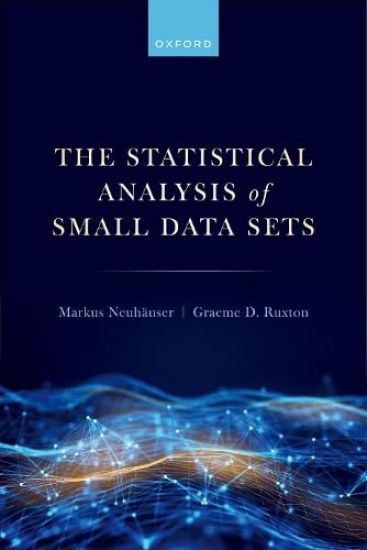
The Statistical Analysis of Small Data Sets

The Statistical Analysis of Small Data Sets

Markus Neuhäuser; Graeme D. Ruxton

Oxford University Press
2024
nidottu
We live in the era of big data. However, small data sets are still common for ethical, financial, or practical reasons. Small sample sizes can cause researchers to seek out the most powerful methods to analyse their data, but they may also be wary that some methodologies and assumptions may not be appropriate when samples are small. The book offers advice on the statistical analysis of small data sets for various designs and levels of measurement, helping researchers to analyse such data sets, but also to evaluate and interpret others' analyses. The book discusses the potential challenges associated with a small sample, as well as the ways in which these challenges can be mitigated. General topics with strong relevance to small sample sizes such as meta-analysis, sequential and adaptive designs, and multiple testing are introduced. While the focus is on hypothesis tests and confidence intervals, Bayesian analyses are also covered. Code written in the statistical software R is presented to carry out the proposed methods, many of which are not limited to use on small data sets, and the book also discusses approaches to computing the power or the necessary sample size, respectively.