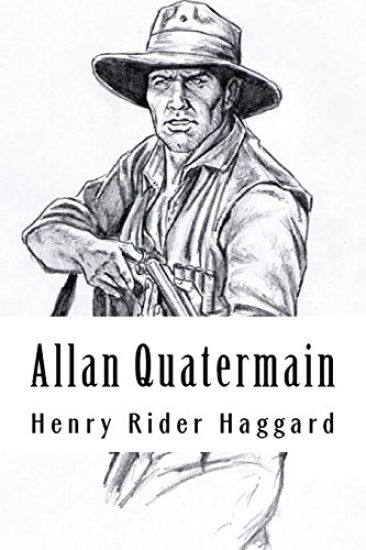
This novel is the final volume of the Allan Quatermain saga, and it comprises the fourth part of a loosely linked series begun with Allan and the Holy Flower. Once more Quatermain takes the hallucinogenic taduki drug, as he did in previous novels, and he finds himself reliving as Wi, an civilized man living in the barbaric ice age as part of a clan of cavemen.
My Dear Macumazahn, It was your native name which I borrowed at the christening of that Allen who has become as well known to me as any other friend I have. It is therefore fitting that I should dedicate to you this, his last tale-the story of his wife, and the history of some further adventures which befell him. They will remind you of many an African yarn-that with the baboons may recall an experience of your own which I did not share. And perhaps they will do more than this. Perhaps they will bring back to you some of the long past romance of days that are lost to us. The country of which Allan Quatermain tells his tale is now, for the most part, as well known and explored as are the fields of Norfolk. Where we shot and trekked and galloped, scarcely seeing the face of civilized man, there the gold-seeker builds his cities.
A week had passed since the funeral of my poor boy Harry, and one evening I was in my room walking up and down and thinking, when there was a ring at the outer door. Going down the steps I opened it myself, and in came my old friends Sir Henry Curtis and Captain John Good, RN. They entered the vestibule and sat themselves down before the wide hearth, where, I remember, a particularly good fire of logs was burning.'It is very kind of you to come round, ' I said by way of making a remark; 'it must have been heavy walking in the snow.'They said nothing, but Sir Henry slowly filled his pipe and lit it with a burning ember. As he leant forward to do so the fire got hold of a gassy bit of pine and flared up brightly, throwing the whole scene into strong relief, and I thought, What a splendid-looking man he is Calm, powerful face, clear-cut features, large grey eyes, yellow beard and hair - altogether a magnificent specimen of the higher type of humanity. Nor did his form belie his face. I have never seen wider shoulders or a deeper chest. Indeed, Sir Henry's girth is so great that, though he is six feet two high, he does not strike one as a tall man. As I looked at him I could not help thinking what a curious contrast my little dried-up self presented to his grand face and form. Imagine to yourself a small, withered, yellow-faced man of sixty-three, with thin hands, large brown eyes, a head of grizzled hair cut short and standing up like a half-worn scrubbing-brush - total weight in my clothes, nine stone six - and you will get a very fair idea of Allan Quatermain, commonly called Hunter Quatermain, or by the natives 'Macumazahn' - Anglic/CHAR: e grave/, he who keeps a bright look-out at night, or, in vulgar English, a sharp fellow who is not to be taken in
Brother John, who has been wandering in Africa for years, confides to Allan a huge and rare orchid, the largest ever found. Allan arrives to England with the flower and there he meets Mr. Stephen Somers. Due to a mixup at auction, Somers ends up paying a huge sum for a particularly rare flower. His Father agrees to cover the cost of the flower but also disinherits his son. Stephen resolves to sell the flower and use it to finance an expedition to Africa to recover a live specimen of the huge orchid Allan brought back with him.
This sequel to King Solomon's Mines is based on Rider Haggard's own experiences in Africa. During their search for a white race reputed to live near Mount Kenya, Allan Quatermain and his companions undergo a series of dangerous and thrilling adventures. The dramatic and often poetic story reveals Victorian preoccupations with evolution, race, sexuality, and the "New Woman".
Once more Quatermain takes the hallucinogenic drug and gets to see a previous incarnation of himself-a life he lived thousands of years ago, when he was Wi, a tribal leader during the last great ice age.
Allan Quatermain is the protagonist of H. Rider Haggard's 1885 novel King Solomon's Mines and its sequels. Allan Quatermain was also the title of a book in this sequence.
Allan's Wife and Other Tales is a collection of Allan Quatermain stories by H. Rider Haggard, first published in London by Spencer Blackett in December 1889. The title story was new, with its first publication intended for the collection, but two unauthorized editions appeared earlier in New York, based on pirated galley proofs. The other three stories first appeared in an anthology and periodicals in 1885, 1887, and 1886.
It may be remembered that in the last pages of his diary, written just before his death, Allan Quatermain makes allusion to his long dead wife, stating that he has written of her fully elsewhere. When his death was known, his papers were handed to myself as his literary executor. Among them I found two manuscripts, of which the following is one. The other is simply a record of events wherein Mr. Quatermain was not personally concerned - a Zulu novel, the story of which was told to him by the hero many years after the tragedy had occurred. But with this we have nothing to do at present.
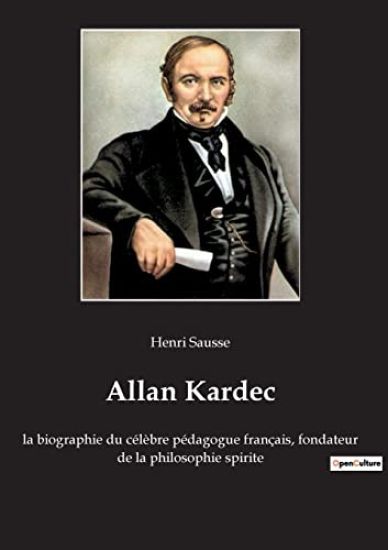
Consid r comme le p re du Spiritisme en France, Allan Kardec de son vrai nom Hyppolyte L on Denizard Rivail est n le 3 octobre 1804 Lyon dans une famille de magistrats. Fid le disciple d'Allan Kardec, Henri sausse consacra toute sa vie, et toute son nergie d fendre et diffuser la doctrine spirite. Sa vie est le reflet de la foi in branlable qui animait son me: J'avais 18 ans lorsque j'ai lu Le Livre des Esprits d'Allan Kardec, et ce fut une illumination soudaine de tout mon tre. Je n'eus pas besoin de preuves pour une doctrine qui r pondait toutes les questions, r solvait tous les probl mes de mani re satisfaire la raison et la conscience. D'ailleurs, les preuves taient en moi-m me. C' tait comme des voix lointaines qui me parlaient de vies vanouies; l' vocation d'un pass oubli , tout un monde de souvenirs se r veillait avec son cort ge de maux, de sang et de larmes. Bient t les lectures compl mentaires suivirent, puis plus tard, lorsque ma maturit parut suffisante pour bien comprendre, vinrent les ph nom nes convaincants, d cisifs. Aujourd'hui, la doctrine des Esprits, condens e, coordonn e par Allan Kardec est adopt e par des foules de croyants et de penseurs dans le centre et le midi de l'Europe depuis le Portugal jusqu'en Roumanie ainsi qu'en Am rique du Centre et du Sud (Br sil). Dans plusieurs milieux, des Instituts, des Universit s lui ont fait une place dans leur programme; on peut pr voir, d'apr s l' volution g n rale de la spiritualit , l'heure o la doctrine des vies successives p n trera dans l'enseignement populaire et id aliste de tous les pays. (L on Denis)
Allan Kaprow is regarded as a key figure of the 1960s happening scene. Little known, however, are the "activities" that he developed in California during the 1970s - exercises for couples, realised without an audience on the basis of a written score. They constitute an attempt to create a participatory art form intended to enable participants to engage actively in the shaping of interpersonal relationships. For the first time, the activities are explored with all their formal and thematic complexity, and discussed in detail. Examined in conjunction with the procedures and concerns of the social sciences and psycho-disciplines in the 1970s, they emerge as an independent, exciting contribution to a new discourse on intimacy. On Allan Kaprow's work after the HappeningsNew art- and cultural-historical perspectives on the participatory art of the 1970sLook Inside
Allan's Wife - And other Tales is an unchanged, high-quality reprint of the original edition of 1889. Hansebooks is editor of the literature on different topic areas such as research and science, travel and expeditions, cooking and nutrition, medicine, and other genres. As a publisher we focus on the preservation of historical literature. Many works of historical writers and scientists are available today as antiques only. Hansebooks newly publishes these books and contributes to the preservation of literature which has become rare and historical knowledge for the future.