Kirjojen hintavertailu. Mukana 11 244 527 kirjaa ja 12 kauppaa.

Kirjahaku

Etsi kirjoja tekijän nimen, kirjan nimen tai ISBN:n perusteella.

1000 tulosta hakusanalla Debbie Sharp

Oxford Reading Tree: Level 5A: Floppy's Phonics: Sounds and Letters: Book 35

Oxford Reading Tree: Level 5A: Floppy's Phonics: Sounds and Letters: Book 35

Debbie Hepplewhite; Roderick Hunt

Oxford University Press
2011
nidottu
There are 12 books at Level 5. Level 5: Book 25 'Alternative Spellings' Book 26 'Alternative Spellings' Book 27 'Alternative Spellings' Book 28 'Alternative Spellings' Book 29 'Alternative Spellings' Book 30 'Alternative Spellings' Level 5 More A: Book 31 'Alternative Spellings' Book 32 'Alternative Spellings' Book 33 'Alternative Spellings' Book 34 'Alternative Spellings' Book 35 'Alternative Spellings' Book 36 'Alternative Spellings' Each sound/alternative spelling is explored through an Oxford Reading Tree scene, first the children should read the decodable word lists, before trying to find the words within the picture. Consolidation activities include spelling activities and reading short texts. There are a total of 42 books in this series from Level 1 to Level 5 (Letters and Sounds Phase 1 to Phase 5)

Oxford Reading Tree: Level 5A: Floppy's Phonics: Sounds and Letters: Book 36

Oxford Reading Tree: Level 5A: Floppy's Phonics: Sounds and Letters: Book 36

Debbie Hepplewhite; Roderick Hunt

Oxford University Press
2011
nidottu
There are 12 books at Level 5. Level 5: Book 25 'Alternative Spellings' Book 26 'Alternative Spellings' Book 27 'Alternative Spellings' Book 28 'Alternative Spellings' Book 29 'Alternative Spellings' Book 30 'Alternative Spellings' Level 5 More A: Book 31 'Alternative Spellings' Book 32 'Alternative Spellings' Book 33 'Alternative Spellings' Book 34 'Alternative Spellings' Book 35 'Alternative Spellings' Book 36 'Alternative Spellings' Each sound/alternative spelling is explored through an Oxford Reading Tree scene, first the children should read the decodable word lists, before trying to find the words within the picture. Consolidation activities include spelling activities and reading short texts. There are a total of 42 books in this series from Level 1 to Level 5 (Letters and Sounds Phase 1 to Phase 5)
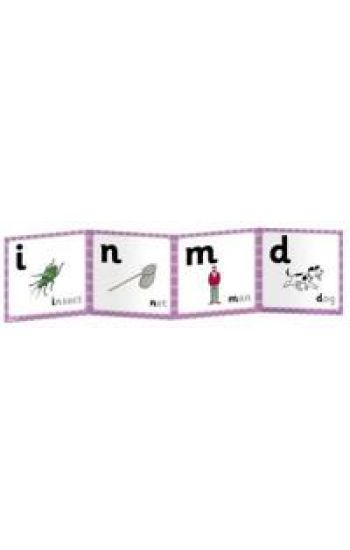
Oxford Reading Tree: Floppy's Phonics Teaching Programme: Frieze

Oxford Reading Tree: Floppy's Phonics Teaching Programme: Frieze

Debbie Hepplewhite; Roderick Hunt

Oxford University Press
2011
juliste
This Frieze shows the key mnemonic pictures and words that feature throughout the programme. Each poster strip matches one Sounds Book, so the Frieze can be put on the wall as the children learn each set of sounds and built up as you progress through the programme. They feature capital and lower case letters to support handwriting.
Oxford Reading Tree: Floppy's Phonics: Flashcards

Oxford Reading Tree: Floppy's Phonics: Flashcards

Debbie Hepplewhite; Roderick Hunt

Oxford University Press
2011
muu
Teach new letter-sound correspondences and revise previously taught sound and graphemes with these large format flashcards. They feature a key mnemonic picture and word for each grapheme which are used throughout the programme. They include a list of decodable words on the back of the card to model blending and segmenting. The grapheme on each card has finger-tracing lines to support the correct writing of letter shapes.
Research Methods for the Biosciences

Research Methods for the Biosciences

Debbie Holmes; Peter Moody; Diana Dine; Laurence Trueman

Oxford University Press
2016
nidottu
Scientific research is a proven and powerful tool for discovering the answers to biological questions. As such, today's students need to be well-versed in experimental design, analysis, and the communication of research. Furthermore, they must appreciate how all of these aspects are interlinked--how, for example, statistics can be used to inform the design of a particular experiment. As a resource which skillfully integrates all of the key aspects relating to biological research, Research Methods for the Biosciences is the perfect guide for undergraduates. The exceptionally clear layout takes students through choosing a project and planning their research; collecting, evaluating, and analyzing their data; and finally reporting their results. Research methods, which can often seem abstract, are brought to life through the use of examples taken from real undergraduate research. Friendly guidance and advice is provided throughout the text, and little prior knowledge or mathematical experience is required. Since statistics is a subject best learned through doing, frequent worked examples appear throughout Part Two 'Handling your data', showing step-by-step how to carry out the various statistical tests. In addition, online software walkthroughs and video screencasts clearly demonstrate how to use software such as SPSS, Minitab, Excel and R to carry out statistical analyses. Online Resource Centre The Online Resource Centre to accompany Research Methods for the Biosciences features: For students: · New video screencasts showing how to carry out statistical tests using software · Statistical software walkthroughs for SPSS, Excel, and Minitab · Additional statistical tests not included in the main text · Full details of calculations given in the in-text boxes · Interactive and printable decision tree, to help you design your experiment · Interactive and printable risk assessment form · Integrative exercises to help students test their understanding of the topics in the book For lecturers: · A test bank of questions · Figures from the book available to download
The Child's View of the Third Reich in German Literature
This book examines the ways in which German authors have used the child's perspective to present the Third Reich. It considers how children at this time were brought up and educated to accept unquestioningly National Socialist ideology, and thus questions the possibility of a traditional naive perspective on these events. Authors as diverse as Günter Grass, Siegfried Lenz, and Christa Wolf, together with many less well-known writers, have all used this perspective, and this raises the question as to why it is such a popular means of confronting the enormity of the Third Reich. This study asks whether this perspective is an evasive strategy, a means of gaining new insights into the period, or a means of discovering a new language which had not been tainted by Nazism. This raises and addresses issues central to a post-war aesthetic in German writing.
Private Property and Public Power

Private Property and Public Power

Debbie Becher

Oxford University Press Inc
2014
sidottu
When governments use eminent domain to transfer property between private owners, Americans are outraged-or so most media and academic accounts would have us believe. But these accounts obscure a much more complex reality in American conceptions of property. In this book, Debbie Becher presents the first comprehensive study of a city's eminent domain acquisitions, exploring how and why the City of Philadelphia took properties between 1992 and 2007 and which takings led to protests. She uses original data-collected from city offices and interviews with over a hundred residents, business owners, community leaders, government representatives, attorneys, and appraisers-to explore how eminent domain really works. Becher surprises readers by finding that the city took over 4,000 private properties, or one out of every hundred such properties in Philadelphia, during her study period. Furthermore, these takings only rarely provoked opposition-a fact that established views on property are ill-equipped to explain. To investigate how Americans judge the legitimacy of eminent domain, Becher devotes several chapters to two highly controversial sets of takings for redevelopment projects. The American Street takings were intended to win popular support for redevelopment and initially succeeded in doing so, but it ended as a near total failure and embarrassment. The Jefferson Square takings initially faced vociferous opposition, but they eventually earned residents' approval and became a political showpiece. Becher uncovers evidence that Americans judge eminent domain through a social conception of property as an investment of value, committed over time, that government is responsible for protecting. This conception has never been described in sociological, legal, political, or economic scholarship, and it stands in stark contrast to the arguments of libertarian and left-leaning activists and academics. But recognizing property as investment, Becher argues, may offer a firm new foundation for more progressive urban policies.
Private Property and Public Power

Private Property and Public Power

Debbie Becher

Oxford University Press Inc
2014
nidottu
When governments use eminent domain to transfer property between private owners, Americans are outraged-or so most media and academic accounts would have us believe. But these accounts obscure a much more complex reality in American conceptions of property. In this book, Debbie Becher presents the first comprehensive study of a city's eminent domain acquisitions, exploring how and why the City of Philadelphia took properties between 1992 and 2007 and which takings led to protests. She uses original data-collected from city offices and interviews with over a hundred residents, business owners, community leaders, government representatives, attorneys, and appraisers-to explore how eminent domain really works. Becher surprises readers by finding that the city took over 4,000 private properties, or one out of every hundred such properties in Philadelphia, during her study period. Furthermore, these takings only rarely provoked opposition-a fact that established views on property are ill-equipped to explain. To investigate how Americans judge the legitimacy of eminent domain, Becher devotes several chapters to two highly controversial sets of takings for redevelopment projects. The American Street takings were intended to win popular support for redevelopment and initially succeeded in doing so, but it ended as a near total failure and embarrassment. The Jefferson Square takings initially faced vociferous opposition, but they eventually earned residents' approval and became a political showpiece. Becher uncovers evidence that Americans judge eminent domain through a social conception of property as an investment of value, committed over time, that government is responsible for protecting. This conception has never been described in sociological, legal, political, or economic scholarship, and it stands in stark contrast to the arguments of libertarian and left-leaning activists and academics. But recognizing property as investment, Becher argues, may offer a firm new foundation for more progressive urban policies.
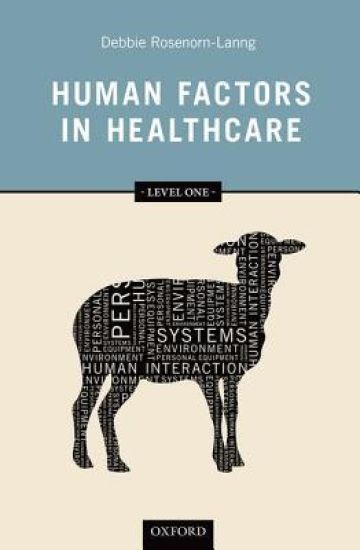
Human Factors in Healthcare

Human Factors in Healthcare

Debbie Rosenorn-Lanng

Oxford University Press
2014
nidottu
The majority of errors, litigation, and complaints in the health service are due to 'human factors', yet the term is still not widely understood and is sometimes used interchangeably to refer to team training or communication skills. Although including these, the subject of 'human factors' goes far beyond this to look at systems, environmental influences, and interactions with equipment, in addition to self-awareness and human interaction. All of these aspects are captured in Human Factors in Healthcare and are built into a new framework: the SHEEP model, which breaks down into five key areas: Systems, Human Interaction, Environment, Equipment, and Personal, providing a structured way to focus on adopting 'safety positive' behaviours. Written in a clear and engaging way, the book is ideal for clinicians and non-clinicians alike. Through the use of relevant real world healthcare examples and exercises the book encourages interaction and thinking, as well as illustrating how mistakes can be avoided. The book also sets out ways on how to improve the experience of patients and staff across healthcare, in particular focusing on how to improve patient safety. In light of regular news reports about patient care, Human Factors in Healthcare presents a timely and proactive approach to these issues and is essential reading for doctors, nurses, managers, and everyone working in the healthcare profession.
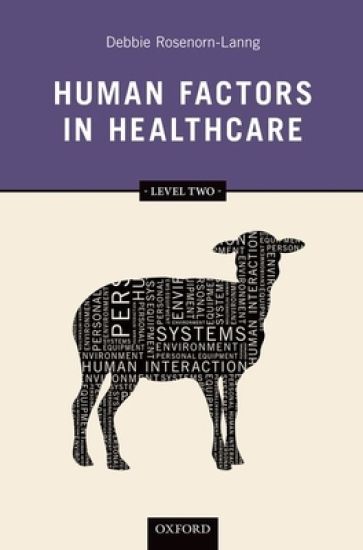
Human Factors in Healthcare: Level Two

Human Factors in Healthcare: Level Two

Debbie Rosenorn-Lanng

Oxford University Press
2015
nidottu
Building on Level One, this volume of Human Factors in Healthcare continues to enhance and develop the SHEEP model, delving deeper into the challenges of leadership, conflict resolution, and decision making that healthcare professionals currently face. Presenting the five components of the SHEEP framework; Systems, Human Interaction, Environment, Equipment, and Personal, this book allows readers to develop their own human factors based approach within their workplace. Through a wealth of real-life examples of errors and patient safety issues drawn from the author's experience from over twenty years in healthcare, it enables the identification of potential patient safety pitfalls and offers solutions on how to avoid them. Written in a clear and engaging style, this is a valuable resource for guiding healthcare professionals including doctors and nurses through the requirements of the human factors-based approach to leadership, conflict resolution, and decision making. See also: Human Factors in Healthcare: Level One 978-0-19-967060-4
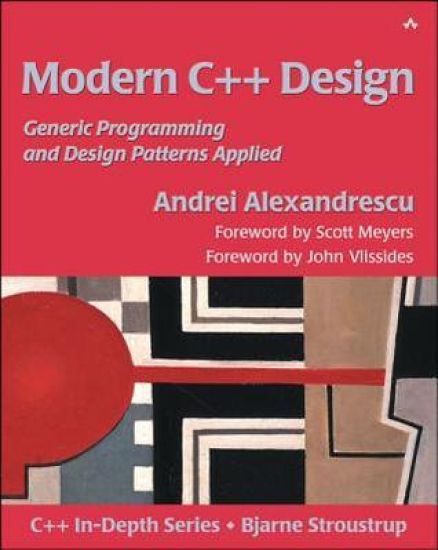
Modern C++ Design

Modern C++ Design

Debbie Lafferty; Andrei Alexandrescu

Addison Wesley
2001
nidottu
In Modern C++ Design, Andrei Alexandrescu opens new vistas for C++ programmers. Displaying extraordinary creativity and programming virtuosity, Alexandrescu offers a cutting-edge approach to design that unites design patterns, generic programming, and C++, enabling programmers to achieve expressive, flexible, and highly reusable code. This book introduces the concept of generic components—reusable design templates that produce boilerplate code for compiler consumption—all within C++. Generic components enable an easier and more seamless transition from design to application code, generate code that better expresses the original design intention, and support the reuse of design structures with minimal recoding. The author describes the specific C++ techniques and features that are used in building generic components and goes on to implement industrial strength generic components for real-world applications. Recurring issues that C++ developers face in their day-to-day activity are discussed in depth and implemented in a generic way. These include: Policy-based design for flexibilityPartial template specializationTypelists—powerful type manipulation structuresPatterns such as Visitor, Singleton, Command, and FactoriesMulti-method engines For each generic component, the book presents the fundamental problems and design options, and finally implements a generic solution.
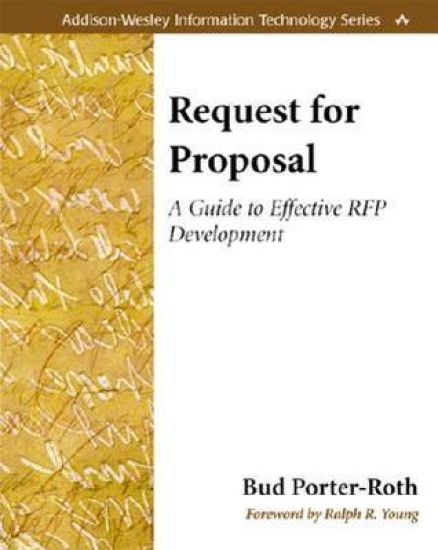
Request for Proposal

Request for Proposal

Debbie Lafferty; Bud Porter-Roth

Addison Wesley
2002
nidottu
When done right, RFPs enable businesses and government agencies to fairly evaluate competing proposals while reviewing the broadest possible range of potential solutions. All too often, however, RFPs fail to meet these goals, because their creators simply don't understand how to create them effectively. In this book, the world's leading RFP consultant offers realistic, specific, start-to-finish guidance for every professional called upon to write RFPs. Bud Porter-Roth covers every step of the RFP process, offering specific language examples that demonstrate both best practices and worst practices to avoid. He shows how to ensure that RFPs contain information that is sufficiently accurate and detailed; how to ensure clarity of presentation, structure, and organization that encourages productive responses; and how to avoid the most common pitfalls of the RFP process. The book includes detailed coverage of writing each section of the typical RFP, including administrative, technical, management, pricing, and evaluation sections; as well as extensive practical guidance on planning and preparation. Appendices present complete RFP examples, preparation instructions, analysis tools, calendars, and other resources for jumpstarting RFP development.
The Design of Books

The Design of Books

Debbie Berne

THE UNIVERSITY OF CHICAGO PRESS
2024
nidottu
Seasoned designer Debbie Berne presents an accessible introduction to book design for authors, editors, and other book people. Design is central to the appeal, messaging, and usefulness of books, but to most readers, it’s mysterious or even invisible. Through interiors as well as covers, designers provide structure and information that shape the meaning and experience of books. In The Design of Books, Debbie Berne shines a light on the conventions and processes of her profession, revealing both the aesthetic and market-driven decisions designers consider to make books readable and beautiful. In clear, unstuffy language, Berne reveals how books are put together, with discussions of production considerations, typography and fonts, page layouts, use of images and color, special issues for ebooks, and the very face of each book: the cover. The Design of Books speaks to readers and directly to books’ creators—authors, editors, and other publishing professionals—helping them to become more informed partners in the design of their projects. Berne lays out the practical steps at each stage of the design process, providing insight into who does what when and offering advice for authors on how to be effective advocates for their ideas while also letting go and trusting their manuscripts with teams of professionals. She includes guidance as well for self-publishing authors, including where to find a designer, what to expect from that relationship, and how to art direct your own book. Throughout, Berne teaches how understanding the whats, hows, and whys of book design heightens our appreciation of these cherished objects and helps everyone involved in the process to create more functional, desirable, and wonderful books.
Top 150 Unusual Things to See in Alberta

Top 150 Unusual Things to See in Alberta

Debbie Olsen

FIREFLY BOOKS LTD
2022
pokkari
Have you ever wanted to dine in a water tower, explore the site of a former beaver ranch or take a scenic potty break in a mountain-top outhouse? Top 150 Unusual Things to See in Alberta is the ultimate guide for travellers looking for the quirky, unique and inspiring side of Alberta. Travel writer and author Debbie Olsen, a proud Albertan who’s visited nearly every corner of the province, has assembled a list of over 150 unusual places, things to see and events that make Alberta one-of-a-kind — from its dozens of roadside attractions and surprising landforms to its fascinating historical sites and off-beat museums. Organized into four regions — South of Calgary, Calgary to Edmonton, the Rocky Mountains and North of Edmonton — this guidebook takes you on a journey across the province, with lively text that sheds light on each location’s interesting history, as well as maps, contact information, fact boxes and colour photographs that bring the spots to life. Here are just a few of the unusual, obscure and intriguing things you’ll read about: The Fort Museum, Macleod: the birthplace of the RCMP Musical Ride; Maggie’s Diner, Tack and Feed, High River: the set of the hit TV show Heartland; Donalda and District Museum, Donalda: the world’s largest collection of oil lamps; World Famous Gopher Hole Museum, Torrington: Alberta’s first gopher museum; Abraham Lake’s Ice Bubbles: the world’s most beautiful ice bubbles; Lake Minnewanka and Minnewanka Landing: the site of Banff’s sunken ghost town; Fort Chipewyan Ice Road: the winter road that connects Fort McMurray to Fort Chipewyan; Wood Buffalo National Park’s Beaver Dam: the world’s largest beaver dam, which can be seen from space. The book also features themed entries, such as museums that celebrate Alberta’s energy production, unusual roadside attractions, unusual bathrooms (for regular people), unusual festivals and events, and unusual foods invented in Alberta. Top 150 Unusual Things to See in Alberta is a fun and entertaining jaunt for armchair travellers and road trippers alike.
Energy & You

Energy & You

Debbie Moses

Tellwell Talent
2021
pokkari
Your Energy Field is affected by many thingswhether you believe it or notwhether you understand it or not.Understanding it is not important unless you're the curious type like me.Just clearing it is the key to a more grounded, fulfilling life.This book is a basic, simple way to start to do just that. Feel more ALIVE than ever before.Allow Me to Help You Help Yourself. Let's Begin.Energy & You Deeper, will be on shelves this fallBe sure to continue the journey to the Inner You
Energy & You

Energy & You

Debbie Moses

Tellwell Talent
2021
sidottu
Your Energy Field is affected by many thingswhether you believe it or notwhether you understand it or not.Understanding it is not important unless you're the curious type like me.Just clearing it is the key to a more grounded, fulfilling life.This book is a basic, simple way to start to do just that. Feel more ALIVE than ever before.Allow Me to Help You Help Yourself. Let's Begin.Energy & You Deeper, will be on shelves this fallBe sure to continue the journey to the Inner You
A Recipe for C-PTSD & PNES

A Recipe for C-PTSD & PNES

Debbie A Samson

Tellwell Talent
2021
sidottu
Let's use our wounds to show others a way through their pain, to give them hope, to help them find strength and perseverance. Debbie allows the reader to see into her lifetime of abuse. She shows how she slowly let go of anger, sadness, grief and trauma, and replaced it with love, happiness, forgiveness, tolerance, determination and gratitude. After developing Complex Post-Traumatic Stress Disorder (C-PTSD) and Psychogenic Non-Epileptic Seizures (PNES), Debbie is forced to face the past she has buried deep inside her. As the bricks come tumbling down she becomes sicker; she is eventually forced to give up her twenty-five-year career as a counsellor. As each trigger from her past surfaces, Debbie learns to knock them down and decides to use her life experiences to help others. This book will open the public's eyes and show how the effects of childhood trauma and abuse can be a recipe for mental illness.