Kirjojen hintavertailu. Mukana 11 699 587 kirjaa ja 12 kauppaa.

Kirjahaku

Etsi kirjoja tekijän nimen, kirjan nimen tai ISBN:n perusteella.

1000 tulosta hakusanalla Edgar M Howell.

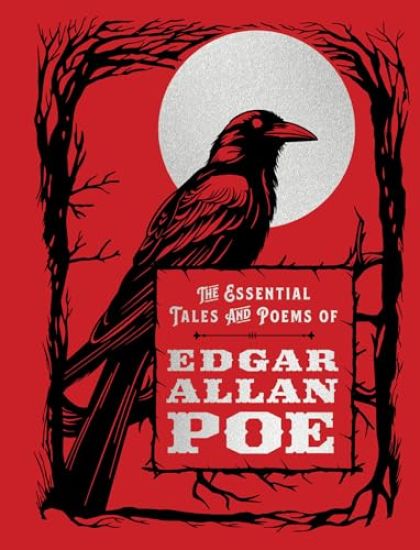
The Essential Tales and Poems of Edgar Allan Poe

The Essential Tales and Poems of Edgar Allan Poe

Edgar Allan Poe

Quarto Publishing Group USA Inc
2024
sidottu
Revel in the sumptuous language of Edgar Allan Poe’s best works in this elegantly designed hardcover edition. The Essential Tales and Poems of Edgar Allan Poe features the spine-chilling short stories and melodious poems of the famous Gothic American writer, spanning from 1827 to his death in 1849.This collectible edition features:A handsome faux-leather cover with foil-embossed designs21 short stories, including “The Tell-Tale Heart,” “The Pit and the Pendulum,” and “The Murders in the Rue Morgue”10 classic poems, including “The Raven,” “Annabel Lee,” and “The Bells”An introduction by Daniel Stashower An index of first linesA timeline of the life and times of Edgar Allan PoeEvery literature buff and fan of Gothic horror should have this indispensable volume in their home library.Essential volumes for the shelves of every classic literature lover, these deluxe classics editions include beautifully presented works from some of the most important authors in literary history. Other deluxe classics from Chartwell include Little Women, Alice’s Adventures in Wonderland, Anne of Green Gables, The Inferno, Dracula, The Republic, The Iliad, Meditations, and Irish Fairy and Folk Tales.
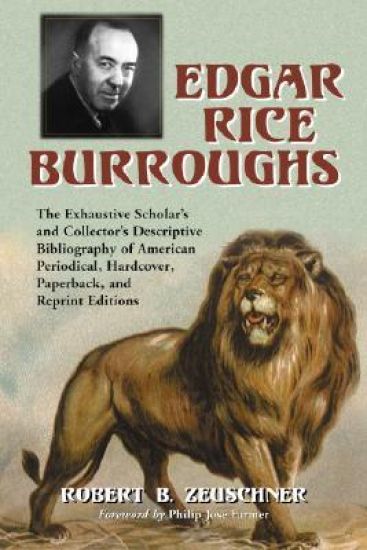
Edgar Rice Burroughs

Edgar Rice Burroughs

Robert B. Zeuschner

McFarland Co Inc
2007
pokkari
In creating some of the most enduring characters in 20th century literature, Burroughs (1875-1950) left a complex bibliographic record of editions, and a long chain of fascinated collectors. The present reference work details all United States versions of all his works published through 1995. Each listing begins with a description of the first magazine appearance of the story (with full publication data); the first hardcover is then examined in detail, with publisher, date, a complete description of the book's cover and jacket, print run, price, number of pages, and characteristics that separate it from following editions. Similar information is then provided from all subsequent editions.
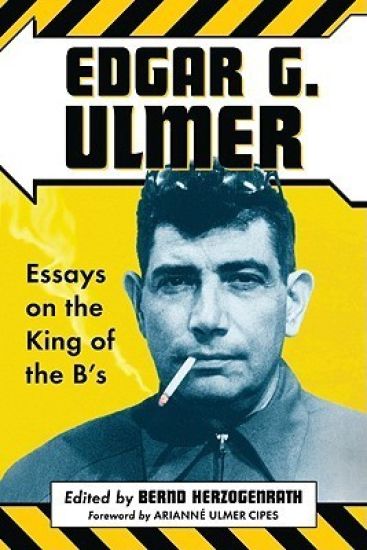
Edgar G. Ulmer

Edgar G. Ulmer

McFarland Co Inc
2009
pokkari
This collection of 20 essays pays homage to a filmmaker who had a reputation for delivering the most movie for the least money. Edgar G. Ulmer, nicknamed "The King of the Bs" and "The King of Poverty Row," gave us classics like The Black Cat, starring Bela Lugosi. His stealing away the wife of a producer led to exile from Hollywood and, working outside the studio system and with low budgets, he turned out film noir, science fiction, and ethnic films that achieved cult status and critical acceptance.
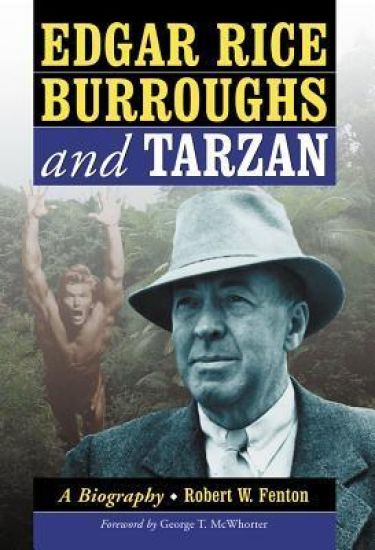
Edgar Rice Burroughs and Tarzan

Edgar Rice Burroughs and Tarzan

Robert W. Fenton

McFarland Co Inc
2010
pokkari
Like millions of other readers and moviegoers, as a youngster the late Robert W. Fenton loved swinging through the jungle with Tarzan. As an adult his interest was revived when he bought Tarzan creator Edgar Rice Burroughs' original office-estate in Tarzana, California, and began writing a biography of Burroughs. Originally titled The Big Swingers, it was the first full-scale, commercially published account of ERB's life and work. Here is Fenton's 1967 biography, back in print, as a wonderful source for a new generation of readers. Burroughs' early years were far from promising--he was dropped from school, was undistinguished as a cavalryman at Fort Grant, lost out in gold mining, and had little success as a salesman. He knew nothing about writing, but decided to try it anyway--and created Tarzan, one of the most famous characters of all time. A new foreword by George T. McWhorter and new photographs--there are 66 in all--are included.
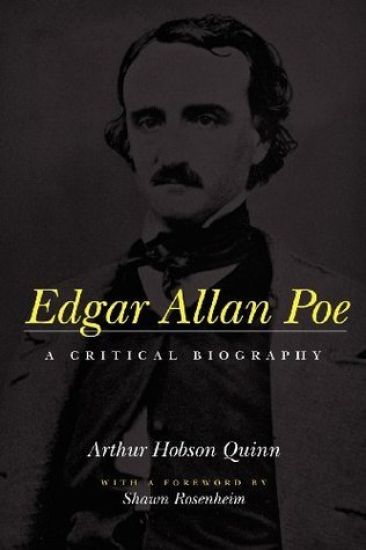
Edgar Allan Poe

Edgar Allan Poe

Arthur Hobson Quinn

Johns Hopkins University Press
1998
pokkari
Renowned as the creator of the detective story and a master of horror, the author of "The Red Mask of Death," "The Black Cat," and "The Murders of the Rue Morgue," Edgar Allan Poe seems to have derived his success from suffering and to have suffered from his success. "The Raven" and "The Tell-Tale Heart" have been read as signs of his personal obsessions, and "The Fall of the House of Usher" and "The Descent into the Maelstrom" as symptoms of his own mental collapse. Biographers have seldom resisted the opportunities to confuse the pathologies in the stories with the events in Poe's life. Against this tide of fancy, guesses, and amateur psychologizing, Arthur Hobson Quinn's biography devotes itself meticulously to facts. Based on exhaustive research in the Poe family archive, Quinn extracts the life from the legend, and describes how they both were distorted by prior biographies.
Edgar Allan Poe, Wallace Stevens, and the Poetics of American Privacy

Edgar Allan Poe, Wallace Stevens, and the Poetics of American Privacy

Louis A. Renza

Louisiana State University Press
2002
sidottu
Throughout the history of the United States, a commitment to both democratic political ideals and to capitalist realities has made privacy a persistently controversial issue. Only rarely, however, has privacy attracted the attention of American literary criticism. In his ingeniously argued new study, Louis A. Renza extends the idea of privacy beyond the received wisdom of its popular legal and psychological conceptions and, iconoclastically, beyond its conception in postmodern literary theory to show that the public-private paradigm has import for American literary texts past and present.It is a truism of cultural studies that the interior space of imagination is socially constructed and thus that the private is ineluctably political. But Renza shows, through a brilliantly original analysis of works by Edgar Allan Poe and Wallace Stevens, that as an effect of reading and writing, a real or ""radical"" privacy continually resists appropriation. In admirably close readings of Poe's tales, his long essay Eureka, and Stevens's Harmonium poems, Renza demonstrates that both writers ground the concept of privacy in the possibility of multiple interpretations of their texts. Neither Poe nor Stevens resists meaning or sense, but by thematically engaging in their work the inescapable public/private dichotomy of artistic creation, they create a highly personal idiom that, like Poe's ""purloined letter,"" allows them to ""hide in plain sight"" and in that way to finesse public constructions of meaning. Thus, surprisingly, privacy can always be conceived as something more than what current social-cultural codes urge us to believe.The poetics Renza compellingly elucidates does not deny the insights of current theory but offers a refreshing alternative that allows for the ""radical"" autonomy of authorship without resorting to vague elitist claims of individual genius. His thoughtful readings are a major contribution to traditional Poe and Stevens scholarship, and his challenging thesis will provoke new investigations into the privacy issue in American literature as a whole.
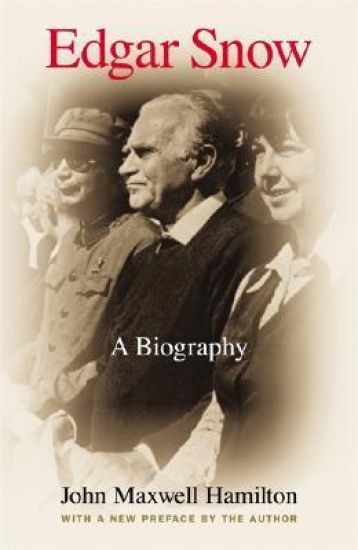
Edgar Snow

Edgar Snow

John Maxwell Hamilton

Louisiana State University Press
2003
nidottu
Edgar Snow (1905--1972) was one of the most notable Western journalists to report on China in both the revolutionary and postrevolutionary periods. He first became famous in the mid-1930s when he broke through a Nationalist blockade and reached the Communists in northwest China. For nearly a decade, no foreign reporter had seen the Communists, who were widely regarded as a ragtag bandit army. Snow took them seriously as a national movement. His reporting in the now-famous book Red Star over China was major news, even to the Chinese, thousands of whom joined the Communists after reading it. It has remained a seminal reference on the early Chinese Communist movement. In this award-winning biography, journalist John Maxwell Hamilton follows Snow from his birth in Kansas City to his rise as a celebrated foreign correspondent for the Saturday Evening Post, his ostracism during the cold war, and his role as a singular journalistic bridge between Communist China and the United States. With a new preface by the author, this revealing portrait of the widely misunderstood Snow firmly establishes him as a model for the kind of committed reporting that is crucial to understanding our interdependent world.
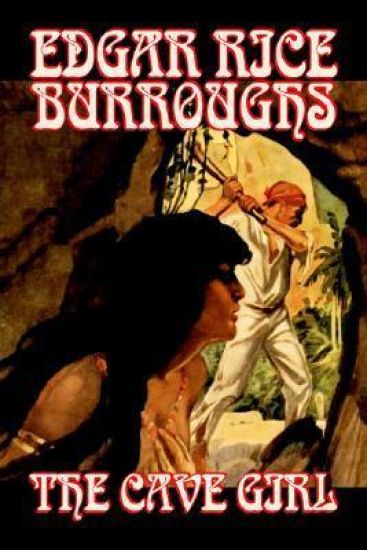
The Cave Girl by Edgar Rice Burroughs, Fiction, Literary
For the twenty-second time since the great wave had washed him from the steamer's deck and hurled him, choking and sputtering, upon this inhospitable shore, Waldo Emerson saw the sun sinking rapidly toward the western horizon. Suddenly Waldo became conscious from the corner of his eye that something was creeping upon him from behind out of the dark cave before which he had fought. Simultaneously with the realization of it he swung his cudgel in a wicked blow at this new enemy as he turned to meet it. The creature dodged back and the blow that would have crushed its skull grazed a hairbreadth from its face. Waldo struck no second blow and the cold sweat sprang to his forehead when he realized how nearly he had come to murdering a young girl. She crouched now in the mouth of the cave, eying him fearfully. Waldo removed his tattered cap, bowing low. "I crave your pardon," he said. "I had no idea that there was a lady here. I am very glad that I did not injure you." But now his attention was required by more pressing affairs -- the cave men were returning to the attack. They carried stones this time, and, while some of them threw the missiles at Waldo, the others attempted to rush his position. It was then that the girl hurried back into the cave, only to reappear a moment later carrying some stone utensils in her arms.
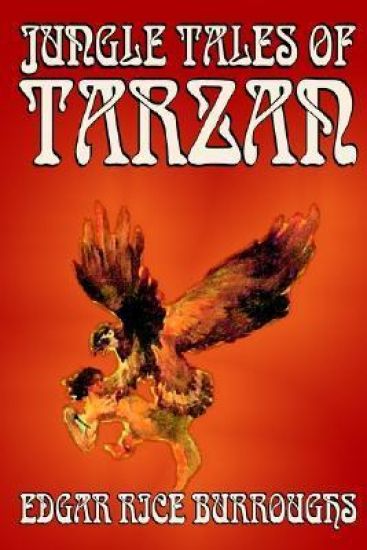
Jungle Tales of Tarzan by Edgar Rice Burroughs, Fiction, Literary, Action & Adventure
. . . . between Tarzan's avenging of his ape foster mother's death and his becoming leader of his ape tribe. In JUNGLE TALES OF TARZAN, Burroughs gives us an Ape-Man who might have fit in a television sitcom or a domestic drama. We see a Tarzan whose character is barely hinted at in the events of Tarzan on the Apes -- this is a collection of stories that take place in the same years as that first novel, but show us a very different aspect of Tarzan. We see "Tarzan's First Love," a tale of a teenage Tarzan with a distracting crush on a big-but-beautiful female gorilla called Teeka. The Ape-Man (well, boy, actually) declares his love for her and battles a childhood friend for her favor. But in the end he comes to understand that some things are Just Not Meant To Be, and forsakes his childhood heart-throb . . . In "The God of Tarzan," the Ape-Man asks himself the meaning of life -- and attempts to track down God in the same way that he would follow the spoor of a wounded deer. In "Tarzan Rescues the Moon," Tarzan sees a lunar eclipse and in his efforts to rescue the moon, shoots arrows into the moon until the moon re-emerges from the eclipse. In the end, it's Tarzan's struggle to find real meanings in the world around him that distinguish him from the apes who are his adoptive kin -- and make him as fascinating today as he was a hundred years ago.
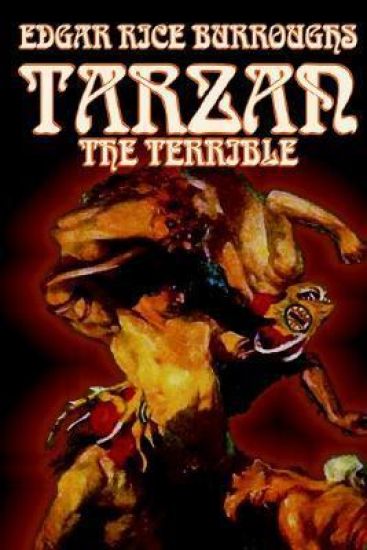
Tarzan the Terrible by Edgar Rice Burroughs, Fiction, Literary, Action & Adventure
In the previous volume, the Lord of the Jungle discovered the burnt corpse of his wife, Jane, after a visit to his African home by German soldiers. (One suspects that Burroughs never did like Jane; this sort of thing happened to her a lot.) In this volume, Tarzan learns that Jane was not murdered by the Germans but kidnaped -- and sets off in pursuit. As the novel begins, Tarzan has spent two months tracking his mate to Pal-ul-don ("Land of Men"), a hidden valley in Zaire, where he finds a land dinosaurs and men even stranger -- humanoids with tails. Ta-den is a hairless, white-skinned, Ho-don warrior; O-mat is a hairy, black skinned, Waz-don, chief of the tribe of Kor-ul-ja. In this new world Tarzan becomes a captive -- but he impresses his captors so well that they name him Tarzan-Jad-Guru ("Tarzan the Terrible"). Meanwhile, a second visitor has come to Pal-ul-don -- wearing only a loin cloth and carrying an Enfield rifle along and a long knife. Pal-ul-don is where Jane is being held captive, of course. . . .
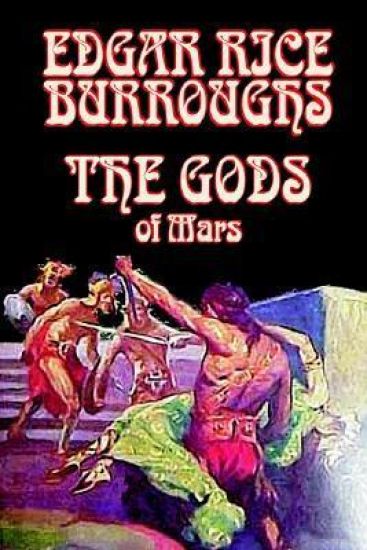
The Gods of Mars by Edgar Rice Burroughs, Science Fiction, Adventure
At the end of A PRINCESS OF MARS, the first volume in Burroughs's Mars series, John Carter managed to get the factory that produces oxygen for Barsoom working again -- and collapsed. When he came to, he found himself back on earth, and separated from his beloved Dejah Thoris, the Princess of Helium. It's a decade later when Carter returns to Barsoom, and he finds himself in that part of the planet that the natives consider to be "heaven" -- which is no heaven at all. Carter has to reunite with his friend the fierce green warrior Tars Tarkas, fight with plant men and the great white apes of Barsoom, violate some significant religious taboos, survive the affections of an evil goddess, foment a slave revolt, fight in an arena, and still save Dejah Thoris in the middle of a giant air battle between the red, green, black and white people of Barsoom. . . . High adventure, Martian style.
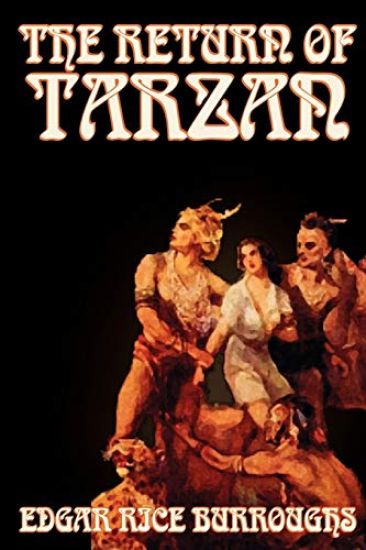
The Return of Tarzan by Edgar Rice Burroughs, Fiction, Literary, Action & Adventure
At the start of this volume, Tarzan knows his inheritance as an English lord, but is determined to hide that since he truly believes that his cousin, William Cecil Clayton, would make a better lord and husband for his beloved Jane. He gets involved with a married Russian countess (there's a plan -- oh, sure) who has issues with her criminal brother (Nicholas Rokoff -- a real villain, naturally, who becomes a regular in the series) and her older husband. As a consequence of his interaction with brother, Tarzan is lured into a room where he is attacked by a dozen Paris muggers. The scene that details this mugging is one of the great chapters in the literature of muggings. Tarzan fondly recalls his childhood and his foster ape mother with a friend, D'Arnot: "To you my friend, she would have appeared a hideous and ugly creature, but to me she was beautiful -- so gloriously does love transfigure its object."
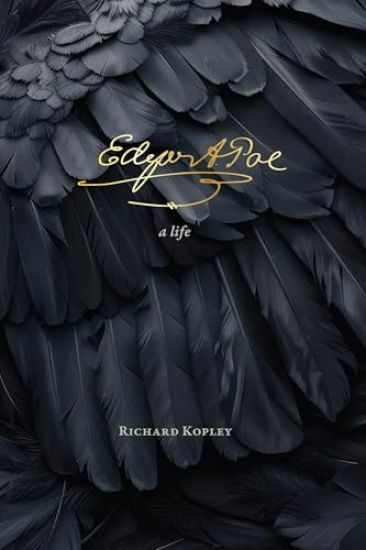
Edgar Allan Poe

Edgar Allan Poe

Richard Kopley

UNIVERSITY OF VIRGINIA PRESS
2025
sidottu
A ground-breaking exploration of one of America's most iconic and misunderstood authorsEdgar Allan Poe: A Life is the most comprehensive critical biography of Poe yet produced, exploring his fascinating life, his extraordinary work, and the vital relationship between the two. Best known for his tales of mystery and the macabre found in such works as The Raven, Annabel Lee, and The Tell-Tale Heart, this legendary American author continues to intrigue and enthral his devoted readers. Written by one of the world's leading Poe experts, this biography is a rich and rewarding study for the general reader as well as for the seasoned scholar. Richard Kopley combines a biographical narrative of Poe's enduring challenges—including his difficult foster father, his personal losses, his great struggles with depression and alcoholism, and the poverty that dogged his existence—with close readings of his work that focus not only on plot, character, and theme but also on language, allusion, and structure in a way that enhances our understanding of both. While incorporating past Poe scholarship, this volume also relates unknown stories of Poe culled from privately held letters unavailable to previous biographers, presenting a range of ground-breaking archival discoveries that illuminates the man and his oeuvre in ways never before possible.