
Kirjahaku
Etsi kirjoja tekijän nimen, kirjan nimen tai ISBN:n perusteella.
1000 tulosta hakusanalla Editor Phyllis Galde

Apostila De Editor De Textos
Daiani T de M Ribeiro; Daniel T de Melo; Rogério A de Sousa
Clube de Autores
2022
pokkari
Um processador de texto um programa usado para escrever no computador. Com ele, poss vel criar desde documentos simples at arquivos profissionais que s o mais complexos, tais como: cartas, curr culos, trabalhos escolares, apostilas, livros, etc. O processador de texto simula o funcionamento de uma m quina de escrever, mas com recursos que facilitam e agilizam a produ o, edi o e finaliza o de texto.

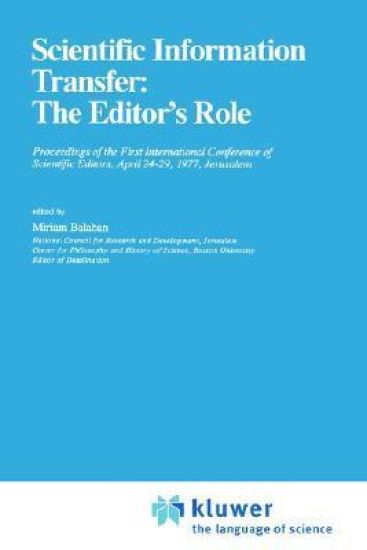
Scientific Information Transfer: The Editor’s Role
Kluwer Academic Publishers
1978
sidottu
It was Faraday who in 1821 said that there are three necessary stages of useful research. The first to begin it, the second to· end it, and the third 1 to publish it. There has since indeed been so much research and publication that we have become increasingly alarmed by the galloping proliferation of scientific information produced in relation to the user's ability to retrieve and consume it effectively, conveniently and creatively. In 1948, to deal with this concern, the Royal Society Scientific Infor 1 mation Conference held in London spanned the whole realm of scientific in formation. Sir Robert Robinson, President of the Royal Society, in his open ing address noted that "the study of scientific information services in all its ramifications has enormous scope", and the London conference dealt with scientific publication, format, editorial policy, subject grouping, organiza tion, abstracting, reviews, classification, indexing and training of infor mation officers. It was about this time that information science began to develop more on the retrieval end, so it seems logical that the first editors' group founded in 1949 was ICSU AB, the International Council of Scientific Unions Abstract ing Board. In 1958 the National Academy of Sciences International Conference of 2 Scientific Information in Washington limited its interests and expanded on the later phases of the life cycle of information - storage and retrieval.
“En bok ska ges ut, och behöver en bild som följer den i de mediala systemen. Snarare än ett författarporträtt i konventionell bemärkelse, som direkt identifierar boken utifrån författaren, vill jag göra en pressbild som är starkare kopplad till den specifika boken. En bild där författaren visuellt får ’ikläda sig’ en eller flera former som tillhör boken. På mer eller mindre konkreta sätt, givetvis. Men pressbilden bör alltid vara på bokens sida. I stället för att följa logiken för en marknadsföring av Signaturen, ville dessa pressbilder alltså visa hur boken också skapar sin författare; att författaren också är någonting som produceras av sammanhang som är större än honom eller henne själv – av texter, bilder, böcker, publiceringar, läsningar; av publiceringens ekologier i en vidare bemärkelse. […] Idag är den form av författarporträtt som kännetecknade 1990-talet och 2000-talets början inte längre lika dominerande. Men även om pressbilder nu kan se ut på en mängd olika sätt, har det ändå inte blivit mindre angeläget att fortsätta att försöka problematisera och vidga de visuella ramarna för pressbilder – att göra dem till integrerade delar av en undersökande publicering.” (CG)
Scientific Information Transfer: The Editor’s Role
Springer
2011
nidottu
It was Faraday who in 1821 said that there are three necessary stages of useful research. The first to begin it, the second to· end it, and the third 1 to publish it. There has since indeed been so much research and publication that we have become increasingly alarmed by the galloping proliferation of scientific information produced in relation to the user's ability to retrieve and consume it effectively, conveniently and creatively. In 1948, to deal with this concern, the Royal Society Scientific Infor 1 mation Conference held in London spanned the whole realm of scientific in formation. Sir Robert Robinson, President of the Royal Society, in his open ing address noted that "the study of scientific information services in all its ramifications has enormous scope", and the London conference dealt with scientific publication, format, editorial policy, subject grouping, organiza tion, abstracting, reviews, classification, indexing and training of infor mation officers. It was about this time that information science began to develop more on the retrieval end, so it seems logical that the first editors' group founded in 1949 was ICSU AB, the International Council of Scientific Unions Abstract ing Board. In 1958 the National Academy of Sciences International Conference of 2 Scientific Information in Washington limited its interests and expanded on the later phases of the life cycle of information - storage and retrieval.

Do you want to share the best writing with the world? Do you have an eye for detail? In I Can Be an Editor, readers are welcomed into the world of editing as they connect their growing writing skills with the work professionals out in the world do. In this series by award-winning author Meeg Pincus, young writers can learn what it takes to be a professional. From script writer to book author, students get a sneak peek at what their future may hold and the skills they can practice today to get them there.


Poems from an Editor's Table
Antigonos Verlag
2025
sidottu


Mary Gresley and an Editor's Tales
Antigonos Verlag
2025
sidottu

El binomio periodista-editor de imagen en la producción televisiva de noticias
Ediciones Nuestro Conocimiento
2025
pokkari
The Journalist-Image Editor Duo in Television News Production
Carlos Canelas
Our Knowledge Publishing
2025
pokkari
The Jessica Letters An Editor's Romance (Edition1)
John Ball; Joseph Dalton Hooker
Alpha Editions
2025
nidottu

A Freelance Editor's Guide to Ethics and Entrepreneurship
Ooligan Press
2027
nidottu
Every freelance editor's path is different--but the challenges are universal. Without institutional support, freelance editors bear the burden of finding work, maintaining client relationships, setting prices, and dealing with rights and permissions. These business fundamentals make the difference between a sustainable practice and a constant struggle, yet editing programs often only teach craft. That's why you need A Freelance Editor's Guide to Ethics and Entrepreneurship. This handbook covers the topics other resources overlook, providing the professional knowledge that newcomers struggle to learn and even seasoned editors may have missed. In this volume, the Editorial Freelancers Association--the nation's largest and oldest editorial organization--shares its most requested booklets about critical aspects of working as a freelance editor in the modern day. Each chapter, written by veteran freelancers and updated for this publication, answers your biggest questions, as well as those you might not yet know to ask. Inside, you'll find guidance on: Composing an effective freelance r sum Using freelance platforms safely Building consistent client pipelines Setting clear expectations with clients Customizing style guides Respectful querying with the NUANCE framework Conducting sensitivity reads Navigating copyright law Whether you're a newcomer learning the ropes, an experienced professional refining your editorial standards, or a mid-career editor transitioning from in-house to freelance work, this book is for you. It's a valuable resource for freelance editors at any stage who want to build a principled, sustainable editing practice grounded in clear ethics and sound business fundamentals. A Freelance Editor's Guide to Ethics and Entrepreneurship equips you with the tools you need to craft a freelance editorial practice that lasts.