Kirjojen hintavertailu. Mukana 11 699 587 kirjaa ja 12 kauppaa.

Kirjahaku

Etsi kirjoja tekijän nimen, kirjan nimen tai ISBN:n perusteella.

1000 tulosta hakusanalla Franchesca Collins

Europe's Advantage

Europe's Advantage

Francesca Carnevali

Oxford University Press
2005
sidottu
This is the first book to explore the causes of the decline of British manufacturing in the 20th century by focusing on the troubled relationship between banks and small firms in a comparative historical perspective. Since the mid-1970s, the 'rediscovery' of small firms and of the important role they have played in the economies of continental Europe have occupied a substantial part of the literature on the sources of economic competitiveness. In Britain, the relationship between banks and industry has been the object of intense speculation since before the First World War. Since then banks have been accused by the business community, academics and politicians of neglecting industrial finance and by doing so of reducing the competitiveness of British firms. By comparing the rise of small firms in France, Germany and Italy and their decline in Britain this book analyses how the structure of these countries' banking systems has affected small firms' growth. This analysis is placed in the historical context of the political economy of these four countries, to show how banking and industrial structures developed over the century as a consequence of the state's need to mediate between different social and economic groups. This approach allows the author to show why British banking came to be so concentrated and the negative impact that this had on the supply of finance to small firms. The experiences of France, Germany and Italy show alternative structures and policy responses towards small firms.
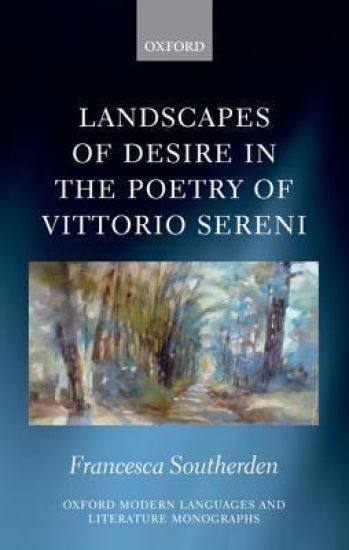
Landscapes of Desire in the Poetry of Vittorio Sereni

Landscapes of Desire in the Poetry of Vittorio Sereni

Francesca Southerden

Oxford University Press
2012
sidottu
Landscapes of Desire in the Poetry of Vittorio Sereni is the first book-length study in English on Vittorio Sereni (1913-83), one of the major figures of Italian twentieth-century poetry. It argues that a key innovation of Sereni's poetry is constituted in the way in which, from Frontiera [Frontier] (1941) to Stella variabile [Variable Star] (1981), he reworks the boundaries of poetic space to construct a lyric 'I' radically repositioned in the textual universe with respect to its predecessors: an 'I' that is decentred, in limine, and struggles to subordinate the world to its point of view. Through an interdisciplinary framework that bridges psychoanalytic, linguistic, and poetic theory, two main dimensions of Sereni's work are revisited and reassessed. The first is the role of liminality, which is presented as a condition of writing and as the mark of a desiring subject whose most desired object is the complete poem or total identity that elude him. The second is Sereni's relationship to the Italian poetic tradition, including Dante, Petrarch, Leopardi, and Montale, who mediate his contact with a textual beyond that slips further and further from view. The study maps, through close-reading, the poet's evolving use of deictic reference (spatio-temporal coordinates, demonstratives, personal pronouns) and the progressive transformation of the poem into a place of frustrated desire that occludes fulfilment. It argues that Sereni's particular brand of experimentalism develops from this point and that he represents a unique moment in the history of twentieth-century Italian poetry in the way in which he adapts pre-existing models of lyric discourse to new modes of expression.
Caring for a Living

Caring for a Living

Francesca Degiuli

Oxford University Press Inc
2016
sidottu
Today's world is aging at a great speed, and although increased longevity represents one of the greatest achievements of the last century, the extension of life expectancy does not necessarily correspond to an extension of healthy lives. Aging populations, particularly those with a high percentage of the oldest old, are often burdened with chronic conditions that require extended long-term care. Deciding who provides said care, and in what forms, are key problems that will soon affect a growing number of post-industrial high- and mid-income countries. ^iCaring for a Living^r contributes to this debate by exploring the organization of long-term care in Italy, a country already in the midst of an eldercare crisis. There, the answer to this problem has taken the shape of home eldercare assistance, an arrangement whereby long-term care services are bought in the market in the form of private and individualized assistance by families sometimes with economic support provided by the State. The providers of these services, commonly known as "badanti" (minders), are, for the most part, im/migrant women coming from different areas of the world. ^iCaring for a Living^r analyzes the emergence and development of this arrangement and the role that the state, Italian families, and workers themselves play in shaping and in defining it. The author provides timely insights on: the nature of long-term care and its requirements; the specific needs of families facing this issue; the changing role of the neoliberal State; and the ways in which global political and economic processes influence and shape an apparently individually based solution to long-term care. This book is ideal for graduate courses in sociology and anthropology, specifically in courses related to gender and migration, work and women, social inequality, and immigration studies.
Troy, Unincorporated

Troy, Unincorporated

Francesca Abbate

University of Chicago Press
2012
nidottu
Daily it storms: dams give out, a lake in the next county empties, every river swells. And the story says this is love, this is hope, Silly. It's sorry, but it means to keep the afternoon as I left it: folding chairs at a folding table and the light wasp-colored, an old postcard of this was a factory town. And him (who won't be you, not again, nor still) setting the kettle on the ancient stove. On the table, a receipt he'd written on - something about God handing the world back to Job. A meditation on the nature of betrayal, the constraints of identity, and the power of narrative, the lyric monologues in "Troy", "Unincorporated" offer a retelling of Chaucer's tragedy "Troilus and Criseyde". The tale's unrooted characters now find themselves adrift in the industrialized farmlands, strip malls, and half-tenanted "historic" downtowns of south-central Wisconsin, including the real, and literally unincorporated, town of Troy. Allusive and often humorous, they retain an affinity with Chaucer, especially in terms of their roles: Troilus, the courtly lover, suffers from depression. Pandarus, the hardworking catalyst who brings the lovers together in Chaucer's poem, is here a car mechanic. Aware of themselves as literary constructs, the narrator and characters in "Troy", "Unincorporated" are paradoxically driven by the desire to be autonomous creatures - tale tellers rather than tales told. Thus, through "Troy", "Unincorporated" follows Chaucer's plot, it moves beyond Chaucer to posit a possible fate for Criseyde on this "litel spot of erthe."
William James at the Boundaries

William James at the Boundaries

Francesca Bordogna

University of Chicago Press
2008
sidottu
At Columbia University in 1906, William James gave a highly confrontational speech to the American Philosophical Association (APA). He ignored the technical philosophical questions the audience had gathered to discuss and instead addressed the topic of human energy. Trampling on the rules of academic decorum, James invoked the work of amateurs, read testimonials on the benefits of yoga and alcohol, and concluded by urging his listeners to take up this psychological and physiological problem.What was the goal of this unusual speech? Rather than an oddity, Francesca Bordogna asserts that the APA address was emblematic - it was just one of many gestures that James employed as he plowed through the barriers between academic, popular, and pseudoscience, as well as the newly emergent borders between the study of philosophy, psychology, and the "science of man." Bordogna reveals that James' trespassing of boundaries was an essential element of a broader intellectual and social project. By crisscrossing divides, she argues, James imagined a new social configuration of knowledge, a better society, and a new vision of the human self. As the academy moves toward an increasingly interdisciplinary future, "William James at the Boundaries" reintroduces readers to a seminal influence on the way knowledge is pursued.
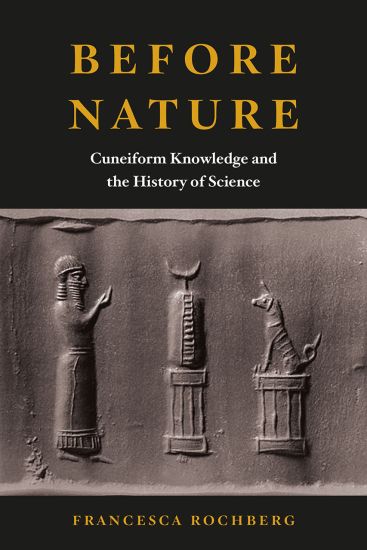
Before Nature

Before Nature

Francesca Rochberg

University of Chicago Press
2017
sidottu
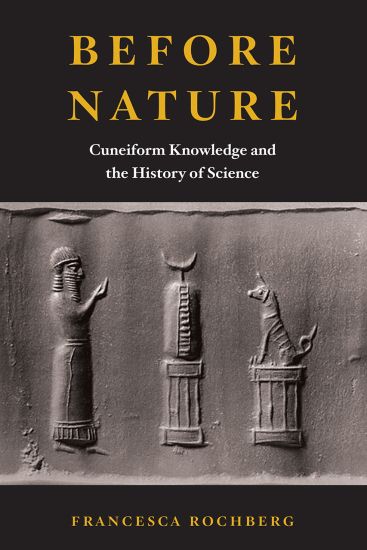
In the modern West, we take for granted that what we call the "natural world" confronts us all and always has but we are wrong. In reality, nature is a human construct. Before Nature is an exploration of that almost unimaginable time when there was no such thing as "nature" no word, reference, or sense for it. Long before the concept of nature formed over the long history of European philosophy and science, our ancestors in ancient Assyria and Babylonia developed the cuneiform script, the earliest system of writing used for documenting and observing the world in a way not wholly dissimilar to our modern science With Before Nature, Francesca Rochberg explores that Assyro-Babylonian knowledge tradition and shows how it relates to the history of science, despite not being focused around a conscious category of nature. From a modern, Western perspective, a world not conceived somehow within the framework of physical nature is difficult if not impossible to imagine. Yet, as Rochberg lays out, ancient Assyro-Babylonian investigations of regularity and irregularity, norms and anomalies clearly established an axis of knowledge between the knower and an intelligible, ordered world. Rochberg is the first scholar to make a case for how exactly we can understand cuneiform knowledge, prediction, and explanation in relation to science without recourse to later ideas of nature. Systematically examining the whole of Mesopotamian science from a remarkable analytic and historical perspective, Before Nature will open up surprising new pathways for studying the history of science.
It Was Like a Fever

It Was Like a Fever

Francesca Polletta

University of Chicago Press
2006
sidottu
Activists and politicians have long recognized the power of a good story to move people to action. In early 1960, four black college students sat down at a whites-only lunch counter in Greensboro, North Carolina, and refused to leave. Within a month, sit-ins spread to thirty cities in seven states. Student participants told stories of impulsive, spontaneous action - this despite all the planning that had gone into the sit-ins. "It was like a fever," they said. Francesca Polletta's "It Was Like a Fever" sets out to account for the power of storytelling in mobilizing political and social movements. Drawing on cases ranging from sixteenth-century tax revolts to contemporary debates about the future of the World Trade Center site, Polletta argues that stories are politically effective not when they have clear moral messages, but when they have complex, often ambiguous ones. The openness of stories to interpretation has allowed disadvantaged groups, in particular, to gain a hearing for new needs and to forge surprising political alliances. But, popular beliefs in America about storytelling as a genre have also hurt those challenging the status quo. A rich analysis of storytelling in courtrooms, newsrooms, public forums, and the United States Congress, "It Was Like a Fever" offers provocative new insights into the dynamics of culture and contention.
It Was Like a Fever – Storytelling in Protest and Politics

It Was Like a Fever – Storytelling in Protest and Politics

Francesca Polletta

University of Chicago Press
2006
nidottu
Activists and politicians have long recognized the power of a good story to move people to action. In early 1960, four black college students sat down at a whites-only lunch counter in Greensboro, North Carolina, and refused to leave. Within a month, sit-ins spread to thirty cities in seven states. Student participants told stories of impulsive, spontaneous action - this despite all the planning that had gone into the sit-ins. "It was like a fever," they said. Francesca Polletta's "It Was Like a Fever" sets out to account for the power of storytelling in mobilizing political and social movements. Drawing on cases ranging from sixteenth-century tax revolts to contemporary debates about the future of the World Trade Center site, Polletta argues that stories are politically effective not when they have clear moral messages, but when they have complex, often ambiguous ones. The openness of stories to interpretation has allowed disadvantaged groups, in particular, to gain a hearing for new needs and to forge surprising political alliances. But, popular beliefs in America about storytelling as a genre have also hurt those challenging the status quo. A rich analysis of storytelling in courtrooms, newsrooms, public forums, and the United States Congress, "It Was Like a Fever" offers provocative new insights into the dynamics of culture and contention.
Freedom Is an Endless Meeting – Democracy in American Social Movements
Freedom Is an Endless Meeting offers vivid portraits of American experiments in participatory democracy throughout the twentieth century. Drawing on meticulous research and more than one hundred interviews with activists, Francesca Polletta challenges the conventional wisdom that participatory democracy is worthy in purpose but unworkable in practice. Instead, she shows that social movements have often used bottom-up decision making as a powerful tool for political change.Polletta traces the history of democracy in early labor struggles and pre-World War II pacifism, in the civil rights, new left, and women's liberation movements of the sixties and seventies, and in today's faith-based organizing and anti-corporate globalization campaigns. In the process, she uncovers neglected sources of democratic inspiration—Depression-era labor educators and Mississippi voting registration workers, among them—as well as practical strategies of social protest. But Freedom Is an Endless Meeting also highlights the obstacles that arise when activists model their democracies after familiar nonpolitical relationships such as friendship, tutelage, and religious fellowship. Doing so has brought into their deliberations the trust, respect, and caring typical of those relationships. But it has also fostered values that run counter to democracy, such as exclusivity and an aversion to rules, and these have been the fault lines around which participatory democracies have often splintered. Indeed, Polletta attributes the fragility of the form less to its basic inefficiency or inequity than to the gaps between activists' democratic commitments and the cultural models on which they have depended to enact those commitments. The challenge, she concludes, is to forge new kinds of democratic relationships, ones that balance trust with accountability, respect with openness to disagreement, and caring with inclusiveness.For anyone concerned about the prospects for democracy in America, Freedom Is an Endless Meeting will offer abundant historical, theoretical, and practical insights. "This is an excellent study of activist politics in the United States over the past century. . . . Assiduously researched, impressively informed by a great number of thoughtful interviews with key members of American social movements, and deeply engaged with its subject matter, the book is likely to become a key text in the study of grass-roots democracy in America."—Kate Fullbrook, Times Literary Supplement"Polletta's portrayal challenges the common assumption that morality and strategy are incompatible, that those who aim at winning must compromise principle while those who insist on morality are destined to be ineffective. . . . Rather than dwell on trying to explain the decline of 60s movements, Polletta shows how participatory democracy has become the guiding framework for many of today's activists."—Richard Flacks, Los Angeles Times Book Review "In Freedom Is an Endless Meeting, Francesca Polletta has produced a remarkable work of historical sociology. . . . She provides the fullest theoretical work of historical sociology. . . . She provides the fullest theoretical picture of participatory democracy, rich with nuance, ambiguity, and irony, that this reviewer has yet seen. . . . This wise book should be studied closely by both academics and by social change activists."—Stewart Burns, Journal of American History
Inventing the Ties That Bind

Inventing the Ties That Bind

Francesca Polletta

University of Chicago Press
2020
sidottu
At a time of deep political divisions, leaders have called on ordinary Americans to talk to one another: to share their stories, listen empathetically, and focus on what they have in common, not what makes them different. In Inventing the Ties that Bind, Francesca Polletta questions this popular solution for healing our rifts. Talking the way that friends do is not the same as equality, she points out. And initiatives that bring strangers together for friendly dialogue may provide fleeting experiences of intimacy, but do not supply the enduring ties that solidarity requires. But Polletta also studies how Americans cooperate outside such initiatives, in social movements, churches, unions, government, and in their everyday lives. She shows that they often act on behalf of people they see as neighbors, not friends, as allies, not intimates, and people with whom they have an imagined relationship, not a real one. To repair our fractured civic landscape, she argues, we should draw on the rich language of solidarity that Americans already have.
Inventing the Ties That Bind

Inventing the Ties That Bind

Francesca Polletta

University of Chicago Press
2020
nidottu
At a time of deep political divisions, leaders have called on ordinary Americans to talk to one another: to share their stories, listen empathetically, and focus on what they have in common, not what makes them different. In Inventing the Ties that Bind, Francesca Polletta questions this popular solution for healing our rifts. Talking the way that friends do is not the same as equality, she points out. And initiatives that bring strangers together for friendly dialogue may provide fleeting experiences of intimacy, but do not supply the enduring ties that solidarity requires. But Polletta also studies how Americans cooperate outside such initiatives, in social movements, churches, unions, government, and in their everyday lives. She shows that they often act on behalf of people they see as neighbors, not friends, as allies, not intimates, and people with whom they have an imagined relationship, not a real one. To repair our fractured civic landscape, she argues, we should draw on the rich language of solidarity that Americans already have.
Before Nature

Before Nature

Francesca Rochberg

University of Chicago Press
2020
nidottu
In the modern West, we take for granted that what we call the “natural world” confronts us all and always has—but Before Nature explores that almost unimaginable time when there was no such conception of “nature”—no word, reference, or sense for it. Before the concept of nature formed over the long history of European philosophy and science, our ancestors in ancient Assyria and Babylonia developed an inquiry into the world in a way that is kindred to our modern science. With Before Nature, Francesca Rochberg explores that Assyro-Babylonian knowledge tradition and shows how it relates to the entire history of science. From a modern, Western perspective, a world not conceived somehow within the framework of physical nature is difficult—if not impossible—to imagine. Yet, as Rochberg lays out, ancient investigations of regularity and irregularity, norms and anomalies clearly established an axis of knowledge between the knower and an intelligible, ordered world. Rochberg is the first scholar to make a case for how exactly we can understand cuneiform knowledge, observation, prediction, and explanation in relation to science—without recourse to later ideas of nature. Systematically examining the whole of Mesopotamian science with a distinctive historical and methodological approach, Before Nature will open up surprising new pathways for studying the history of science.
Networking Operatic Italy

Networking Operatic Italy

Francesca Vella

University of Chicago Press
2022
sidottu
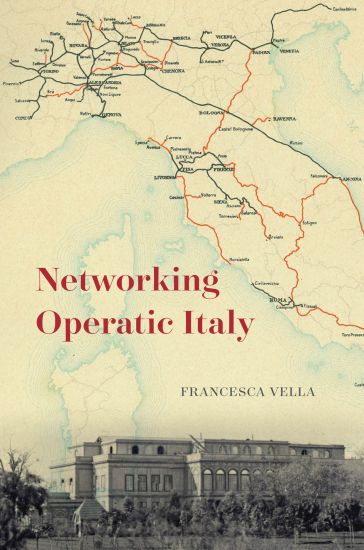
A study of the networks of opera production and critical discourse that shaped Italian cultural identity during and after Unification. Opera’s role in shaping Italian identity has long fascinated both critics and scholars. Whereas the romance of the Risorgimento once spurred analyses of how individual works and styles grew out of and fostered specifically “Italian” sensibilities and modes of address, more recently scholars have discovered the ways in which opera has animated Italians’ social and cultural life in myriad different local contexts. In Networking Operatic Italy, Francesca Vella reexamines this much-debated topic by exploring how, where, and why opera traveled on the mid-nineteenth-century peninsula, and what this mobility meant for opera, Italian cities, and Italy alike. Focusing on the 1850s to the 1870s, Vella attends to opera’s encounters with new technologies of transportation and communication, as well as its continued dissemination through newspapers, wind bands, and singing human bodies. Ultimately, this book sheds light on the vibrancy and complexity of nineteenth-century Italian operatic cultures, challenging many of our assumptions about an often exoticized country.
Globalization and the BRICs

Globalization and the BRICs

Francesca Beausang

Palgrave Macmillan
2012
sidottu
As the Eurozone faces an uncertain future and Obama struggles to demonstrate that America still has a superpower status, this book challenges the widespread perception that Brazil, Russia, India and China are becoming global economic and political powers, instead forecasting a decline rooted in excessive inequality and insufficient innovation.
Acrostici - In punta di nomi

Acrostici - In punta di nomi

Francesca Pompeo

Lulu.com
2017
pokkari
E'una raccolta di componimenti pi o meno poetici che nascono dalla passione dell'autrice per gli acrostici: un gioco enigmistico che consiste nel trovare un certo numero di parole le cui lettere iniziali formino a loro volta una parola o una frase di senso compiuto. Il libro suddiviso in due sezioni e racconta eventi spesso dolorosi accaduti negli ultimi anni: la prima parte ospita avvenimenti accaduti nel mondo, la seconda crimini e delitti soprattutto di casa nostra.
IL CIELO IN UNA STANZA Versi Gogyohka

IL CIELO IN UNA STANZA Versi Gogyohka

Francesca Agnese Giallongo

Lulu.com
2019
pokkari
IRDA EDIZIONI La poesia di Francesca Agnese Giallongo ? come un?enorme e nitida fotografia in cui natura e amore per la natura sono la matrice portante dei suoi versi. Versi che sono lievi, delicati, ricchi di quel sapore che ha l?anima del mondo. Un sapore dolce e intenso che sa di cielo e sa di mare ma anche di terra, dei frutti della terra che si stendono, come foglie, sulle pagine emozionanti del libro. Agnese ha la forza espressiva della semplicit?, quella tipica degli haiku giapponesi e risuona, pagina dopo pagina, in una vera e propria ode alla vit
Dioniso e gli Altri

Dioniso e gli Altri

Francesca Piombo

Lulu.com
2019
nidottu
Il libro propone uno studio degli dei piu rappresentativi della mitologia greca e dei modelli comportamentali a loro collegati. Scoprire quali siano questi modelli, scoprire quale sia il dio piu rappresentato o quello piu ignorato, puo aiutare l'uomo moderno ad esprimersi in pienezza, a conquistare cio che piu lo appaga, che da senso e significato alla sua esistenza.Mantenendo il contatto col proprio cuore, l'uomo in ricerca riuscira a mettere se stesso in quello che fara e si sentira pronto per nuove conquiste, nulla lo potra fermare.Il titolo del libro e dedicato alla mitologia del dio Dioniso, figura riassuntiva del percorso evolutivo dell'uomo, dal suo nascere da donna fino al difficile compito di realizzarsi come individuo autentico, integro e completo.
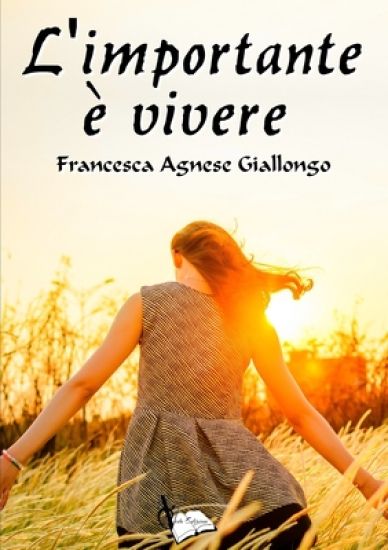
L’importante è vivere

L’importante è vivere

Francesca Agnese Giallongo

Lulu.com
2019
nidottu
VEDA EDIZIONIFrancesca Agnese Giallongo, nasce a Milano ma trascorre la fanciullezza ed adolescenza in collegio, dai diciotto mesi fino ai quindici anni. Si trasferisce in Germania per lavoro. Si sposa e diviene madre di tre figli e ora nonna di cinque nipotini. Oggi vive in un paese incontaminato della Sicilia affacciato sul mare e ricco di meraviglie naturali che sono per Agnese la spinta, la matrice di cui e intessuta tutta la sua poesia, ricca di immagini tipiche della natura. Il suo amore sviscerato per la natura, cui attinge costantemente, esplode in emozioni intense che il suo animo sensibile riesce, abilmente, a trasmettere in chi legge. Ha pubblicato da poco un libro.