Kirjojen hintavertailu. Mukana 11 717 486 kirjaa ja 12 kauppaa.

Kirjahaku

Etsi kirjoja tekijän nimen, kirjan nimen tai ISBN:n perusteella.

1000 tulosta hakusanalla Jacques Derrida

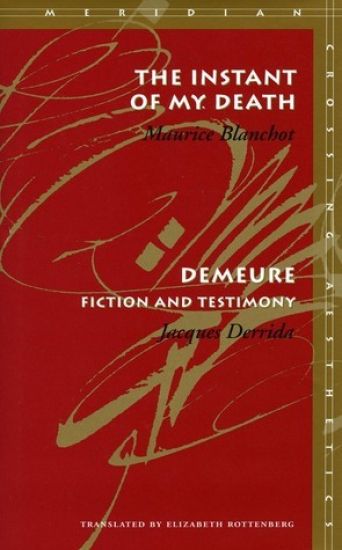
The Instant of My Death /<I>Demeure</I>

The Instant of My Death /<I>Demeure</I>

Blanchot Maurice; Derrida Jacques

Stanford University Press
2000
pokkari
This volume records a remarkable encounter in critical and philosophical thinking: a meeting of two of the great pioneers in contemporary thought, Maurice Blanchot and Jacques Derrida, who are also bound together by friendship and a complex relation to their own pasts. More than a literary text with critical commentary, it constitutes an event of central significance for contemporary philosophical, literary, and political concerns. The book consists of The Instant of My Death, a powerful short prose piece by Blanchot, and an extended essay by Derrida that reads it in the context of questions of literature and of bearing witness. Blanchot's narrative concerns a moment when a young man is brought before a firing squad during World War II and then suddenly finds himself released from his near death. The incident, written in the third person, is suggestively autobiographical—from the title, several remarks in the text, and a letter Blanchot wrote about a similar incident in his own life—but only insofar as it raises questions for Blanchot about what such an experience might mean. The accident of near death becomes, in the instant the man is released, the accident of a life he no longer possesses. The text raises the question of what it means to write about a (non)experience one cannot claim as one's own, and as such is a text of testimony or witness. Derrida's reading of Blanchot links the problem of testimony to the problem of the secret and to the notion of the instant. It thereby provides the elements of a more expansive reassessment of literature, testimony, and truth. In addressing the complex relation between writing and history, Derrida also implicitly reflects on questions concerning the relation between European intellectuals and World War II.
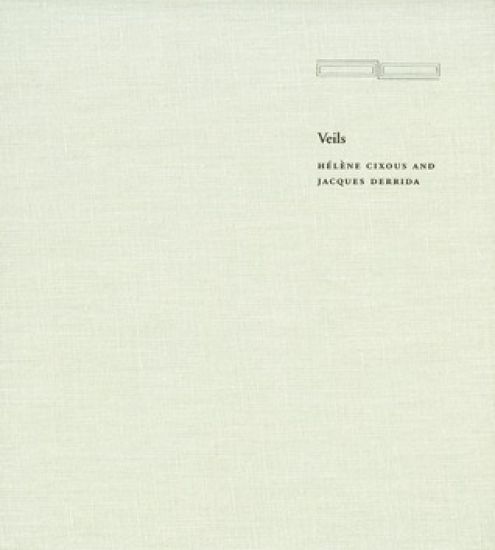
Veils

Veils

Cixous Helene; Derrida Jacques

Stanford University Press
2002
sidottu
Something of a historical event, this book combines loosely "autobiographical" texts by two of the most influential French intellectuals of our time. "Savoir," by Hélène Cixous, is a brief but densely layered account of her experience of recovered sight after a lifetime of severe myopia, an experience that ends with the unexpected turn of grieving for what is lost. Her literary inventiveness mines the coincidence in French between the two verbs savoir (to know) and voir (to see). Jacques Derrida's "A Silkworm of One's Own" complexly muses on a host of autobiographical, philosophical, and religious motifs—including his varied responses to "Savoir." The two texts are accompanied by six beautiful and evocative drawings that play on the theme of drapery over portions of the body. Veils suspends sexual difference between two homonyms: la voile (sail) and le voile (veil). A whole history of sexual difference is enveloped, sometimes dissimulated here—in the folds of sails and veils and in the turns, journeys, and returns of their metaphors and metonymies. However foreign to each other they may appear, however autonomous they may be, the two texts participate in a common genre: autobiography, confession, memoirs. The future also enters in: by opening to each other, the two discourses confide what is about to happen, the imminence of an event lacking any common measure with them or with anything else, an operation that restores sight and plunges into mourning the knowledge of the previous night, a "verdict" whose threatening secret remains out of reach by our knowledge.
Veils

Veils

Cixous Helene; Derrida Jacques

Stanford University Press
2002
pokkari
Something of a historical event, this book combines loosely "autobiographical" texts by two of the most influential French intellectuals of our time. "Savoir," by Hélène Cixous, is a brief but densely layered account of her experience of recovered sight after a lifetime of severe myopia, an experience that ends with the unexpected turn of grieving for what is lost. Her literary inventiveness mines the coincidence in French between the two verbs savoir (to know) and voir (to see). Jacques Derrida's "A Silkworm of One's Own" complexly muses on a host of autobiographical, philosophical, and religious motifs—including his varied responses to "Savoir." The two texts are accompanied by six beautiful and evocative drawings that play on the theme of drapery over portions of the body. Veils suspends sexual difference between two homonyms: la voile (sail) and le voile (veil). A whole history of sexual difference is enveloped, sometimes dissimulated here—in the folds of sails and veils and in the turns, journeys, and returns of their metaphors and metonymies. However foreign to each other they may appear, however autonomous they may be, the two texts participate in a common genre: autobiography, confession, memoirs. The future also enters in: by opening to each other, the two discourses confide what is about to happen, the imminence of an event lacking any common measure with them or with anything else, an operation that restores sight and plunges into mourning the knowledge of the previous night, a "verdict" whose threatening secret remains out of reach by our knowledge.
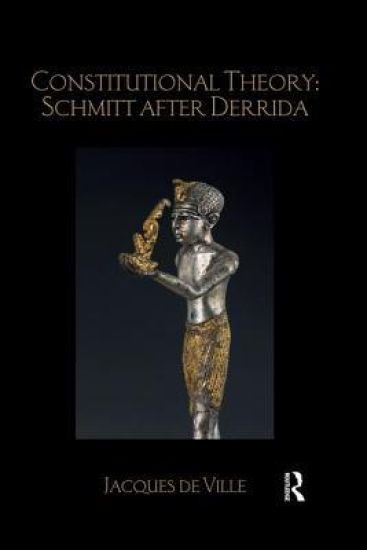
Constitutional Theory: Schmitt after Derrida

Constitutional Theory: Schmitt after Derrida

Jacques de Ville

Birkbeck Law Press
2019
nidottu
This book advances a new reading of the central works of Carl Schmitt and, in so doing, rethinks the primary concepts of constitutional theory. In this book, Jacques de Ville engages in a close analysis of a number of Schmitt’s texts, including Dictatorship (1921), The Concept of the Political (1927), Constitutional Theory (1928), Land and Sea (1942), Ex Captivitate Salus (1950), The Nomos of the Earth (1950) and The Theory of the Partisan (1963). This engagement takes place from the perspective of constitutional theory and focuses specifically on concepts or themes such as sovereignty, the state, the political, constituent power, democracy, representation, the constitution and human rights. The book seeks to rethink the structure of these concepts in line with Derrida’s analysis of Schmitt’s texts on the concept of the political in Politics of Friendship (1993). This happens by way of an analysis of Derrida’s engagement with Freud and other psychoanalysts. Although the main focus in the book is on Schmitt’s texts, it further examines two texts of Derrida (Khora (1993) and Fors: The Anglish Words of Nicholas Abraham and Maria Torok (1976)), by reading these alongside Schmitt’s own reflections on the positive concept of the constitution.
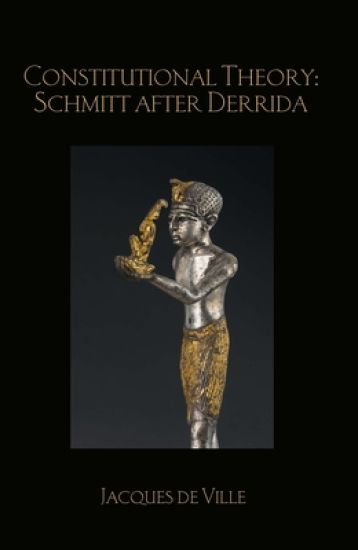
Constitutional Theory: Schmitt after Derrida
This book advances a new reading of the central works of Carl Schmitt and, in so doing, rethinks the primary concepts of constitutional theory. In this book, Jacques de Ville engages in a close analysis of a number of Schmitt’s texts, including Dictatorship (1921), The Concept of the Political (1927), Constitutional Theory (1928), Land and Sea (1942), Ex Captivitate Salus (1950), The Nomos of the Earth (1950) and The Theory of the Partisan (1963). This engagement takes place from the perspective of constitutional theory and focuses specifically on concepts or themes such as sovereignty, the state, the political, constituent power, democracy, representation, the constitution and human rights. The book seeks to rethink the structure of these concepts in line with Derrida’s analysis of Schmitt’s texts on the concept of the political in Politics of Friendship (1993). This happens by way of an analysis of Derrida’s engagement with Freud and other psychoanalysts. Although the main focus in the book is on Schmitt’s texts, it further examines two texts of Derrida (Khora (1993) and Fors: The Anglish Words of Nicholas Abraham and Maria Torok (1976)), by reading these alongside Schmitt’s own reflections on the positive concept of the constitution.
Jacques

Jacques

George Sand

Createspace Independent Publishing Platform
2018
nidottu
Fernande doit pouser Jacques, un homme plus g qu'elle, mais fortun . Fernande confie son amie Cl mence qu'elle pense tre amoureuse de Jacques. Cl mence la met en garde contre les mariages pr cipit s et arrang s par les parents. Fernande sent son affection un peu refroidie quand elle apprend l' ge de Jacques. Elle fait une enqu te sur lui et apprend qu'il a des singularit s de caract re, mais surtout qu'il a une grandeur d' me hors du commun. On vante aussi son sto cisme. A la guerre, lorsqu'il fut bless , il chantonnait. Jacques se confie Sylvia, sa meilleure amie. Il a avec elle des affinit s de caract re hors du commun. Ils ne peuvent malheureusement pas avoir de relations amoureuses car il leur est impossible de savoir s'ils sont ou non fr re et soeur, en raison d'une t n breuse histoire de famille. Jacques confie Sylvia qu'apr s toutes les d ceptions sentimentales qu'il a connues (il n'a rencontr que des femmes aux esprits mesquins et calculateurs), il met ses derniers espoirs dans sa relation avec Fernande dont il appr cie particuli rement la fra cheur de sentiments. Apr s le mariage, Jacques emm ne son pouse dans une de ses propri t s isol es du monde. La jeune femme souhaite vivre un amour intense et parfait. Elle est trop sensible aux changements d'humeurs qui affectent parfois son mari, car elle ne vit que pour lui. Elle soup onne que le pass de Jacques a souvent d tre douloureux...
Jacques

Jacques

George Sand

Hachette Livre - BNF
2018
pokkari
Jacques (Nouv. ed.) / par George SandDate de l'edition originale: 1857"Collection: Collection Michel Levy"Ce livre est la reproduction fidele d'une oeuvre publiee avant 1920 et fait partie d'une collection de livres reimprimes a la demande editee par Hachette Livre, dans le cadre d'un partenariat avec la Bibliotheque nationale de France, offrant l'opportunite d'acceder a des ouvrages anciens et souvent rares issus des fonds patrimoniaux de la BnF.Les oeuvres faisant partie de cette collection ont ete numerisees par la BnF et sont presentes sur Gallica, sa bibliotheque numerique.En entreprenant de redonner vie a ces ouvrages au travers d'une collection de livres reimprimes a la demande, nous leur donnons la possibilite de rencontrer un public elargi et participons a la transmission de connaissances et de savoirs parfois difficilement accessibles.Nous avons cherche a concilier la reproduction fidele d'un livre ancien a partir de sa version numerisee avec le souci d'un confort de lecture optimal. Nous esperons que les ouvrages de cette nouvelle collection vous apporteront entiere satisfaction.Pour plus d'informations, rendez-vous sur www.hachettebnf.frhttp: //gallica.bnf.fr/ark: /12148/bpt6k206800h
Réponse d'Oncle Jacques À La Lettre Aux Savoisiens, Avocat, Commissaire Du Gouvernement
Reponse d'oncle Jacques a la lettre aux Savoisiens, par Monsu Rubin, avocat, commissaire du gouvernement de la Republique pres le tribunal civil de Marseille. Signe: B. F. A.]Date de l'edition originale: 1848Appartient a l'ensemble documentaire: PACA1Ce livre est la reproduction fidele d'une oeuvre publiee avant 1920 et fait partie d'une collection de livres reimprimes a la demande editee par Hachette Livre, dans le cadre d'un partenariat avec la Bibliotheque nationale de France, offrant l'opportunite d'acceder a des ouvrages anciens et souvent rares issus des fonds patrimoniaux de la BnF.Les oeuvres faisant partie de cette collection ont ete numerisees par la BnF et sont presentes sur Gallica, sa bibliotheque numerique.En entreprenant de redonner vie a ces ouvrages au travers d'une collection de livres reimprimes a la demande, nous leur donnons la possibilite de rencontrer un public elargi et participons a la transmission de connaissances et de savoirs parfois difficilement accessibles.Nous avons cherche a concilier la reproduction fidele d'un livre ancien a partir de sa version numerisee avec le souci d'un confort de lecture optimal. Nous esperons que les ouvrages de cette nouvelle collection vous apporteront entiere satisfaction.Pour plus d'informations, rendez-vous sur www.hachettebnf.fr
A Jacques Barzun Reader

A Jacques Barzun Reader

Jacques Barzun

HarperCollins
2003
pokkari
Throughout his career Jacques Barzun, author of the New York Times bestseller and National Book Award Finalist From Dawn to Decadence, has always been known as a witty and graceful essayist, one who combines a depth of knowledge and a rare facility with words.Now Michael Murray has carefully selected eighty of Barzun's most inventive, accomplished, and insightful essays, and compiled them in one impressive volume. With subjects ranging from history to baseball to crime novels, A Jacques Barzun Reader is a feast for any reader.
Jacques and His Master

Jacques and His Master

Milan Kundera

HARPER PERENNIAL
2013
nidottu
A deliciously witty and entertaining "variation" on Diderot's novel Jacques le Fatalist, written for Milan Kundera's "private pleasure" in the aftermath of the Russian invasion of Czechoslovakia.When the "heavy Russian irrationality" fell on Czechoslovakia, Milan Kundera explains, he felt drawn to the spirit of the eighteenth century--"And it seemed to me that nowhere was it to be found more densely concentrated than in that banquet of intelligence, humor, and fantasy, Jacques le Fataliste."The upshot was this "Homage to Diderot," which has now been performed throughout the United States and Europe. Here, Jacques and His Master, newly translated by Simon Callow, is a text that will delight Kundera's admirers throughout the English-speaking world.
The Art of Jacques Pépin

The Art of Jacques Pépin

Jacques Pépin

HARPERCOLLINS PUBLISHERS INC
2025
sidottu
In celebration of legendary chef Jacques Pépin’s legacy and two premier passions in life, a stunning, curated collection of his favorite recipes and signature artworks.Just in time for his 90th birthday, The Art of Jacques Pépin celebrates master chef Jacques Pépin and his life of cooking and painting, with 99 of his all-time favorite and most-cooked recipes paired with pieces of his signature artworks spanning the last 60 years. Chapters cover all courses for a satisfying meal at home, including desserts, and his artworks are thoughtfully curated accordingly. The recipes are authentic Pépin essence—timelessly classic, delicious, and surprisingly achievable, including:Bread and Onion SoupRadicchio Salad with Garlic DressingStew of Spring VegetablesBaked Salmon with Pesto ButterChicken Legs with YamsPork Roast with RatatouilleChocolate Soufflé Oranges in CaramelA true creative expression of Jacques Pépin, this beautifully illustrated cookbook will inspire you to cook and create as Jacques does.As Jacques Pépin always signs off, happy cooking.