Kirjahaku
Etsi kirjoja tekijän nimen, kirjan nimen tai ISBN:n perusteella.
1000 tulosta hakusanalla Kenneth L Decroo


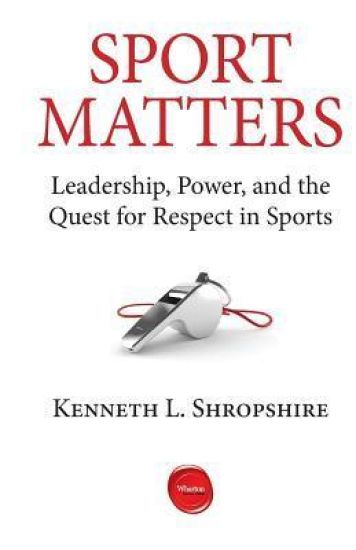
Donald Sterling. Ray Rice. The Washington Redskins. The Miami Dolphins. NCAA Athletes. These names, among countless others, have blanketed the headlines as the media has brought global attention to several recent sports controversies. Now, Kenneth L. Shropshire, The Wharton School of the University of Pennsylvania professor of Legal Studies and Business Ethics and Director of the Wharton Sports Business Initiative, uses these stories as a prism for exploring the leadership challenges facing team owners, management, players, and fans. In Sport Matters: Leadership, Power, and the Quest for Respect in Sports, Shropshire examines the need for diversity, inclusion, respect, and equality in sports, focusing on the need for leadership to embrace and deliver these principles in a real and tangible way within the sports industry. He also introduces the Sports Power Matrix, a framework for understanding power within the sports industry. Sport Matters addresses what the Donald Sterling drama can teach us about race and the need for inclusion at the ownership level; the lessons learned from the NFL and Ray Rice case; the Washington Redskins name and the economics of change; what the Miami Dolphins matter tells us about respect in the workplace and beyond; and compensation and equality in "amateur" sports. Sport Matters, filled with disturbing revelations and uncomfortable truths, also provides hope, revealing how obstacles to achieving an ideal culture of equality and respect within the sports industry can be removed. Shropshire argues that while change matters, continued emphasis on diversity, inclusion and respect is needed to create true progress.
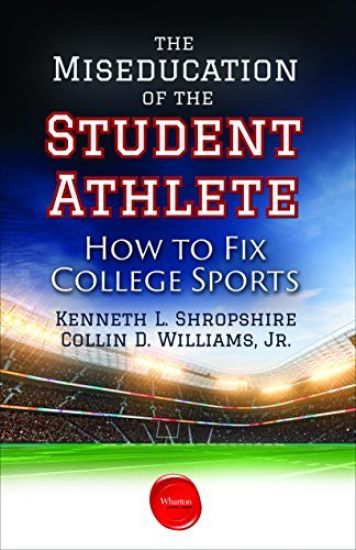
The Miseducation of the Student Athlete
Kenneth L. Shropshire; Collin D. Williams
Wharton Digital Press
2017
pokkari
2018 DIGITAL BOOK AWARD FINALIST FOR BEST SOCIAL IMPACT BOOK The student-athlete's life: practice, gym, weight room, film review, repeat. Simply put, sports come first. Academics is a distant second. As the revenues generated by big-time college sports continue to skyrocket, virtually all of the debate involves whether (and how much) student-athletes should be paid for play. Kenneth L. Shropshire and Collin D. Williams, Jr., argue that "student" has to come first in student-athlete: the focus should be on prioritizing a meaningful education. In The Miseducation of the Student Athlete: How to Fix College Sports, Shropshire and Williams draw on new research to reveal that it has become increasingly difficult for college athletes to balance school and sports, much less a social life, leading to serious economic, professional, and emotional consequences for young people. Given that fewer than 2% of all college men's basketball and football players will play at the professional level, the other 98% of student-athletes must be prepared to find and perform well in jobs outside of their respective field of play. In this bold call to action, Shropshire and Williams explain how we got here and what can be done about it. They lay out The Student-Athlete Manifesto, a roadmap to increase the likelihood that student-athletes can succeed both on and off the field. They also offer a Meaningful Degree Model, which ensures education pays for everyone, along with stories of success that show it is possible to be both a student and an athlete. A critical read for student-athletes, sports leadership, policy makers, and anyone who loves college sports, The Miseducation of the Student Athlete has the potential to disrupt college sport and create lasting change.
Donald Sterling. Ray Rice. The Washington Redskins. The Miami Dolphins. NCAA Athletes. These names, among countless others, have blanketed the headlines as the media has brought global attention to several recent sports controversies. Now, Kenneth L. Shropshire, The Wharton School of the University of Pennsylvania professor of Legal Studies and Business Ethics and Director of the Wharton Sports Business Initiative, uses these stories as a prism for exploring the leadership challenges facing team owners, management, players, and fans. In Sport Matters: Leadership, Power, and the Quest for Respect in Sports, Shropshire examines the need for diversity, inclusion, respect, and equality in sports, focusing on the need for leadership to embrace and deliver these principles in a real and tangible way within the sports industry. He also introduces the Sports Power Matrix, a framework for understanding power within the sports industry. Sport Matters addresses what the Donald Sterling drama can teach us about race and the need for inclusion at the ownership level; the lessons learned from the NFL and Ray Rice case; the Washington Redskins name and the economics of change; what the Miami Dolphins matter tells us about respect in the workplace and beyond; and compensation and equality in "amateur" sports. Sport Matters, filled with disturbing revelations and uncomfortable truths, also provides hope, revealing how obstacles to achieving an ideal culture of equality and respect within the sports industry can be removed. Shropshire argues that while change matters, continued emphasis on diversity, inclusion and respect is needed to create true progress.
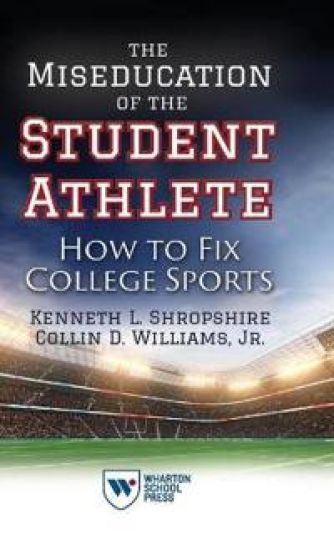
The Miseducation of the Student Athlete
Kenneth L. Shropshire; Collin D. Williams
Wharton Digital Press
2017
sidottu
2018 DIGITAL BOOK AWARD FINALIST FOR BEST SOCIAL IMPACT BOOK The student-athlete's life: practice, gym, weight room, film review, repeat. Simply put, sports come first. Academics is a distant second. As the revenues generated by big-time college sports continue to skyrocket, virtually all of the debate involves whether (and how much) student-athletes should be paid for play. Kenneth L. Shropshire and Collin D. Williams, Jr., argue that "student" has to come first in student-athlete: the focus should be on prioritizing a meaningful education. In The Miseducation of the Student Athlete: How to Fix College Sports, Shropshire and Williams draw on new research to reveal that it has become increasingly difficult for college athletes to balance school and sports, much less a social life, leading to serious economic, professional, and emotional consequences for young people. Given that fewer than 2% of all college men's basketball and football players will play at the professional level, the other 98% of student-athletes must be prepared to find and perform well in jobs outside of their respective field of play. In this bold call to action, Shropshire and Williams explain how we got here and what can be done about it. They lay out The Student-Athlete Manifesto, a roadmap to increase the likelihood that student-athletes can succeed both on and off the field. They also offer a Meaningful Degree Model, which ensures education pays for everyone, along with stories of success that show it is possible to be both a student and an athlete. A critical read for student-athletes, sports leadership, policy makers, and anyone who loves college sports, The Miseducation of the Student Athlete has the potential to disrupt college sport and create lasting change.

With essays by Ron Briley, Michael Ezra, Sarah K. Fields, Billy Hawkins, Jorge Iber, Kurt Kemper, Michael E. Lomax, Samuel O. Regalado, Richard Santillan, and Maureen Smith, this anthology explores the intersection of race, ethnicity, and sports and analyzes the forces that shaped the African American and Latino sports experience in post-World War II America. Contributors reveal that sports often reinforced dominant ideas about race and racial supremacy but that at other times sports became a platform for addressing racial and social injustices. The African American sports experience represented the continuation of the ideas of Black Nationalism--racial solidarity, black empowerment, and a determination to fight against white racism. Three of the essayists discuss the protest at the 1968 Olympic Games in Mexico City. In football, baseball, basketball, boxing, and track and field, African American athletes moved toward a position of group strength, establishing their own values and simultaneously rejecting the cultural norms of whites. Among Latinos, athletic achievement inspired community celebrations and became a way to express pride in ethnic and religious heritages as well as a diversion from the work week. Sports were a means by which leadership and survival tactics were developed and used in the political arena and in the fight for justice.


The Ministry of Vincent Van Gogh in Religion and Art
Kenneth L. Vaux
Wipf Stock Publishers
2012
pokkari

Winged History: The Life and Times of Kenneth L. Chastain, Aviator, Updated Edition is a must read for anyone interested in 20th century American aviation history. The visually documented chronicle, written by Chastain's only son, Ken Jr., traces the life of an American pilot over a period of 37 years and aircraft from early wood and fabric, small horsepower biplanes to the advanced Boeing 707 jetliner. In addition, Ken Jr. adds his intimate perspective on being the son of a professional pilot. Like most pilots of his era, Ken Sr flew military aircraft during World War II. Winged History details major milestones in American political and technological history, interwoven with Chastain's historical aviation adventures, and now updated to include even more interesting and insightful information.




Organizational Behavior and Theory in Healthcare
Kenneth L. Johnson; Stephen L. Walston
Health Administration Press
2021
sidottu

The Fish House Gang is a group of "Big Shots" who provide counterpoint to the story. Meet Charles "Chic" Sparks, clinical psychologist, noted tenor soloist, local police consultant and native of the Florida panhandle, the place where the story begins. The murder of another panhandle local; Thomas Reed, a man possessed with the facade of a wealthy philanthropist and the soul of a big-time drug cartel money launderer, ignites a chain reaction of death and destruction that draws Chic into his most harrowing investigation yet. Reed is killed by Randall Moss, a spaced-out crook with a serious inferiority complex. Unwittingly, Moss and his gang of callow misfits have stolen a safe that contains secrets that could expose the dark underbelly of the beast, the crime syndicate that controls a significant chunk of the American drug trade. A Mexican Cartel and an American bank formed this powerful syndicate. Chic is brought into the fray by his personal connection to Suzy, who survives the murderous onslaught triggered by the syndicates need to reclaim the secrets of the safe. She is alive, but in fear for her life, she needs Chic, he needs to save her. A hot romance develops. The reader follows Chic down a path of unpredictable twists and turns, encountering characters painted in 3 dimensions with bright, exotic colors. Fans of "The Firm" will enjoy the larger spiritual battle between good and evil, cloaked in this tale of money laundering and organized crime brought to bear by an unlikely hero.

The Toad and the Frog and Other Fables provides an entertaining and instructive set of new fables for young readers. The ten fables bring in a range of animals like pigs, frogs, snakes, hares, moles, mice, alligators and more. The fables are not overly didactic, but they do provide some valuable lessons for life in general. Many of the settings and characters were inspired by the childhood of the author growing up on a farm. Our increasingly urban lives provide some advantages to young readers, but the lack of interaction with nature and farm animals also makes the connection to our environment more difficult. The realistic settings and actions of the animal characters recreate some of these life experiences. The realistic settings are combined with the fantasy of talking animals to provide interesting stories with something learned by the characters. The lessons are applicable to our lives and are provided to support the important formation of our life experience. The result combines entertainment with instruction. Some of life's best lessons are those learned unintentionally.
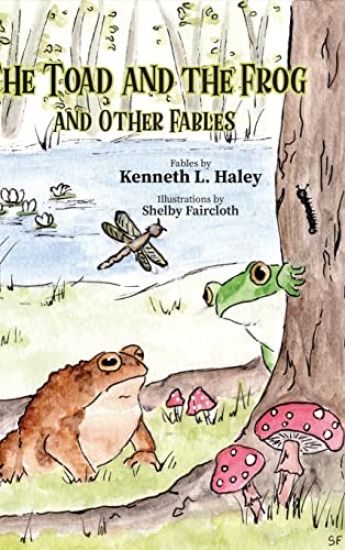
The Toad and the Frog and Other Fables provides an entertaining and instructive set of new fables for young readers. The ten fables bring in a range of animals like pigs, frogs, snakes, hares, moles, mice, alligators and more. The fables are not overly didactic, but they do provide some valuable lessons for life in general. Many of the settings and characters were inspired by the childhood of the author growing up on a farm. Our increasingly urban lives provide some advantages to young readers, but the lack of interaction with nature and farm animals also makes the connection to our environment more difficult. The realistic settings and actions of the animal characters recreate some of these life experiences. The realistic settings are combined with the fantasy of talking animals to provide interesting stories with something learned by the characters. The lessons are applicable to our lives and are provided to support the important formation of our life experience. The result combines entertainment with instruction. Some of life's best lessons are those learned unintentionally.