Kirjojen hintavertailu. Mukana 12 083 983 kirjaa ja 12 kauppaa.

Kirjahaku

Etsi kirjoja tekijän nimen, kirjan nimen tai ISBN:n perusteella.

1000 tulosta hakusanalla Knut Kristofersen

Shallow Soil

Shallow Soil

Knut Hamsun

Createspace Independent Publishing Platform
2015
nidottu
In the autumn of 1888 a Danish magazine published a few chapters of an autobiographical novel which instantly created the greatest stir in literary circles throughout Europe. At that time Ibsen, Bj rnson, Brandes, Strindberg, and other Scandinavian writers were at the height of their cosmopolitan fame, and it was only natural that the reading world should keep in close touch with the literary production of the North. But even the professional star-gazers, who maintained a vigilant watch on northern skies, had never come across the name of Knut Hamsun. He was unknown; whatever slight attention his earlier struggles for recognition may have attracted was long ago forgotten. And now he blazed forth overnight, with meteoric suddenness, with a strange, fantastic, intense brilliance which could only emanate from a star of the first magnitude.
Mördermoor Ostsee: Ein Küstenkrimi aus Mecklenburg

Mördermoor Ostsee: Ein Küstenkrimi aus Mecklenburg

Knut Henßler

Createspace Independent Publishing Platform
2015
nidottu
Nach ihrer Verabschiedung aus dem aktiven Polizeidienst erfinden sich die beiden ehemaligen ost-deutschen Kriminalkommissare Ole Timm und J rgen von Porzig neu und starten noch einmal durch. In ihrem zweiten Leben als Privatdetektive sind sie frei von l stigen Dienstvorschriften, herrschs chtigen Vorgesetzten, arroganten Staatsanw lten und moralisierenden, machtgeilen Beamten. Von nun an suchen sie sich ihre Kunden und F lle selbst aus und arbeiten entspannter, kreativer und erfolgreicher als fr her. Eine wachsende Klientel bittet sie um professionelle Hilfe. Und selbst die unter akutem Personalmangel leidende Kriminalpolizei ist immer fter auf die Unterst tzung der beiden alten Herren angewiesen. Aber nach getaner Arbeit lassen sie bei einem guten Rotwein, mit Knoblauch und einem aromatischen Pfeifentabak auch das Leben nicht zu kurz kommen. Wie schon in den zur ckliegenden Jahren dringen sie erneut in die scheinbar wohlerzogene b rgerliche Welt an der Ostsee ein und legen menschliche Bosheit, Gier, Korruption und Verlogenheit blo . Dabei bringen sie sich auch dieses Mal wieder in t dliche Gefahr.
Christology as Critique

Christology as Critique

Knut Alfsvag

Pickwick Publications
2018
pokkari
If the origin of the world is not a part of the world, what are the implications for our understanding of ourselves, the world, and its origin? In antiquity, both gentile and Christian authors agreed that the significance of this question could only be maintained by accepting the unbridgeable difference between the world and God. Not even Christology as the most ambitious attempt at developing a model for divine-human communication was allowed to undermine the principle of absolute divine difference. This changed with the modern emphasis on univocity and measurability as the defining aspects of knowledge. From the point of view of a philosophy of absolute difference, this appears as an arbitrary loss of perspective. By focusing on four authors--Cusanus, Luther, Hamann, and Kierkegaard--who have explored how the Christian and paradoxical understanding of Christ as eternal God and true human subverts the modern emphasis on unambiguity and definability, the present investigation makes an attempt to retrieve what has been lost. Classical Christology as interpreted by these authors thus appears as an indispensable tool for receiving and appreciating the gift of the world in a way that is not unduly limited by anthropocentric prejudice. ""Alfsvag's work is a further contribution to the deconstruction of modernity. It draws on the critical and constructive potential of premodern insights deployed by Cusanus and Luther and retrieved by Hamann and Kierkegaard. These insights, in line with Scripture and Chalcedonian Christology, are then applied to key theological problems today. The book, which I highly recommend, is accessible to the general reader but written for the scholar."" --Jeffrey Silcock, Australian Lutheran College / University of Divinity ""In this volume Knut Alfsvag tests the relationship between Christianity, and more specifically Christology, and other modes of recent thought by a deep yet focused examination of the relevant positions of Nicolas of Cusa, Martin Luther, Johann Hamann, and Soren Kierkegaard . . . Ultimately, Alfsvag argues that we would do well to consider the ties to created realities that ground the arguments of the early church as well as these select theologians, as we consider our own scientific, philosophical, and theological positions."" --Tim Dost, Concordia Seminary, St. Louis, Missouri ""What is the relationship between the world and the human? Against the irrationality of modernism this study proffers a surprising answer: the indispensability of Christology. Drawing on a line of counter-cultural thinkers, Alfsvag draws out the implications for our time in stimulating fashion. This is a study of gravitas, with far-reaching significance."" --Gordon L. Isaac, Gordon Conwell Theological Seminary Knut Alfsvag is Professor of Systematic Theology at VID Specialized University, Stavanger, Norway. His research focuses on questions concerning the understanding of God and theological method, and the relation between the two. He is the author of the book What No Mind Has Conceived: On the Significance of Christological Apophaticism (2010).
Christology as Critique

Christology as Critique

Knut Alfsvag

Pickwick Publications
2018
sidottu
If the origin of the world is not a part of the world, what are the implications for our understanding of ourselves, the world, and its origin? In antiquity, both gentile and Christian authors agreed that the significance of this question could only be maintained by accepting the unbridgeable difference between the world and God. Not even Christology as the most ambitious attempt at developing a model for divine-human communication was allowed to undermine the principle of absolute divine difference. This changed with the modern emphasis on univocity and measurability as the defining aspects of knowledge. From the point of view of a philosophy of absolute difference, this appears as an arbitrary loss of perspective. By focusing on four authors--Cusanus, Luther, Hamann, and Kierkegaard--who have explored how the Christian and paradoxical understanding of Christ as eternal God and true human subverts the modern emphasis on unambiguity and definability, the present investigation makes an attempt to retrieve what has been lost. Classical Christology as interpreted by these authors thus appears as an indispensable tool for receiving and appreciating the gift of the world in a way that is not unduly limited by anthropocentric prejudice. ""Alfsvag's work is a further contribution to the deconstruction of modernity. It draws on the critical and constructive potential of premodern insights deployed by Cusanus and Luther and retrieved by Hamann and Kierkegaard. These insights, in line with Scripture and Chalcedonian Christology, are then applied to key theological problems today. The book, which I highly recommend, is accessible to the general reader but written for the scholar."" --Jeffrey Silcock, Australian Lutheran College / University of Divinity ""In this volume Knut Alfsvag tests the relationship between Christianity, and more specifically Christology, and other modes of recent thought by a deep yet focused examination of the relevant positions of Nicolas of Cusa, Martin Luther, Johann Hamann, and Soren Kierkegaard . . . Ultimately, Alfsvag argues that we would do well to consider the ties to created realities that ground the arguments of the early church as well as these select theologians, as we consider our own scientific, philosophical, and theological positions."" --Tim Dost, Concordia Seminary, St. Louis, Missouri ""What is the relationship between the world and the human? Against the irrationality of modernism this study proffers a surprising answer: the indispensability of Christology. Drawing on a line of counter-cultural thinkers, Alfsvag draws out the implications for our time in stimulating fashion. This is a study of gravitas, with far-reaching significance."" --Gordon L. Isaac, Gordon Conwell Theological Seminary Knut Alfsvag is Professor of Systematic Theology at VID Specialized University, Stavanger, Norway. His research focuses on questions concerning the understanding of God and theological method, and the relation between the two. He is the author of the book What No Mind Has Conceived: On the Significance of Christological Apophaticism (2010).
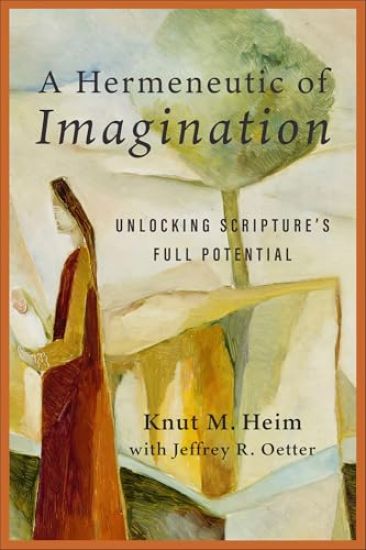
A Hermeneutic of Imagination

A Hermeneutic of Imagination

Knut M. Heim

BAKER PUBLISHING GROUP
2025
nidottu
To read the Bible well, we need to employ our imagination. This volume is the first book-length study that takes the Bible's imaginative nature seriously. It integrates insights from disciplines like neuroscience, metaphor theory and cognition, translation theory, the affective sciences, humor studies, and the interdisciplinary study of imagination itself into the academic and theological study of the Bible.Knut Heim and Jeffrey Oetter show that reading with imagination is a critical hermeneutic of engagement that fosters close, deep, lusciously savored, and pleasurable readings of the biblical texts. Bringing current scholarship from a variety of disciplines to bear on biblical interpretation, this book explains that Scripture employs often subtle literary techniques--including figurative language, emotions, and humor--that require imagination to recognize and interpret. Imagination helps us develop genuinely biblical ideas that get us closer to the meaning intended by the Holy Spirit and the original authors, resulting in more accurate interpretations when paired with traditional approaches. Even textual aspects that have until now remained odd, foreign, and confusing can become occasions for imaginative engagement that reveal new meaning and significance.A Hermeneutic of Imagination makes the case that reading with imagination is crucial for unlocking the Bible's full potential because it transforms academic study of the Bible into aesthetically inspiring, intellectually stimulating, emotionally rewarding, theologically rich, and spiritually transformative adventures of the mind that contribute to problem-solving and human flourishing today.
Growth of the Soil

Growth of the Soil

Knut Hamsun

Createspace Independent Publishing Platform
2017
nidottu
A few hours' rest, and he is on the move again: "Eyah, well...."-moving northward again, noting time by the sun; a meal of barley cakes and goats' milk cheese, a drink of water from the stream, and on again. This day too he journeys, for there are many kindly spots in the woods to be explored. What is he seeking? A place, a patch of ground? An emigrant, maybe, from the homestead tracts; he keeps his eyes alert, looking out; now and again he climbs to the top of a hill, looking out. The sun goes down once more. He moves along the western side of a valley; wooded ground, with leafy trees among the spruce and pine, and grass beneath. Hours of this, and twilight is falling, but his ear catches the faint purl of running water, and it heartens him like the voice of a living thing. He climbs the slope, and sees the valley half in darkness below; beyond, the sky to the south. He lies down to rest.
Hunger

Hunger

Knut Hamsun

Createspace Independent Publishing Platform
2017
nidottu
Hamsun was born on Aug. 4, 1860, in one of the sunny valleys of central Norway. From there his parents moved when he was only four to settle in the far northern district of Lofoden--that land of extremes, where the year, and not the day, is evenly divided between darkness and light; where winter is a long dreamless sleep, and summer a passionate dream without sleep; where land and sea meet and intermingle so gigantically that man is all but crushed between the two--or else raised to titanic measures by the spectacle of their struggle. The Northland, with its glaring lights and black shadows, its unearthly joys and abysmal despairs, is present and dominant in every line that Hamsun ever wrote. In that country his best tales and dramas are laid. By that country his heroes are stamped wherever they roam. Out of that country they draw their principal claims to probability. Only in that country do they seem quite at home. Today we know, however, that the pathological case represents nothing but an extension of perfectly normal tendencies.
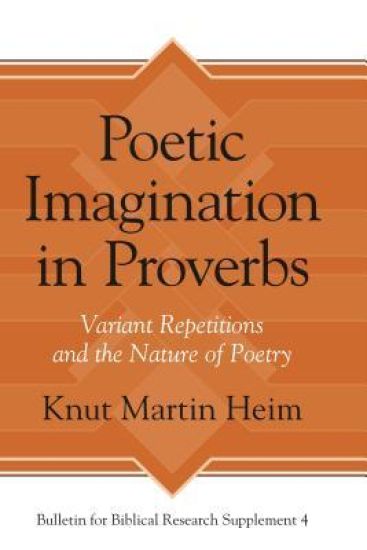
Poetic Imagination in Proverbs

Poetic Imagination in Proverbs

Knut Martin Heim

Eisenbrauns
2013
sidottu
No fewer than 223 verses in Proverbs appear two times (79 sets), three times (15 sets), or even four times (5 sets) in identical or slightly altered form—more than 24% of the book. Heim analyzes all of these, presenting them in delineated Hebrew lines and in English translation. Where appropriate, the translations are followed by textual notes that discuss uncertainties regarding the textual witnesses (textual criticism) and explore lexical, grammatical, and syntactical problems. Heim also analyzes the way the parallelism in each verse of a variant set has been constructed, presenting diagrams and tables with columns that highlight the corresponding similarities and differences among repeated verses. Key to this investigation is the search for links between the variants and their surrounding verses, such as repetitions of sound and sense.Heim shows that most variant repetitions result from skillful poetic creativity. Reconstruction of the editorial and creative poetic process highlights what poets did, how they did it, and why they did it. He develops criteria for determining the direction of borrowing between the verses and demonstrates that the phenomenon of variant repetition is an editorial concern that operates on the level of the book as a whole. He develops and refines a range of interpretive techniques and skills, arrives at fresh interpretations, and shows that ancient proverbial wisdom is relevant to modern societies.This study sheds new light on the nature of biblical poetry and on the methods and virtues best suited for its study. While specific to the book of Proverbs in the first instance, the findings in this study apply to poetry elsewhere. Three fundamental insights should inform future work on poetry: the creative combination of repetition with variation is the very essence of poetry; what has been written with imagination should be read with imagination; imaginative interpretation values the normal features of poetic expression and celebrates the truly unusual.