Kirjojen hintavertailu. Mukana 12 404 707 kirjaa ja 12 kauppaa.

Kirjahaku

Etsi kirjoja tekijän nimen, kirjan nimen tai ISBN:n perusteella.

1000 tulosta hakusanalla Kyle Stevens

The Intelligent Body

The Intelligent Body

Kyle L. Davies

WW Norton Co
2017
sidottu
Optimum health, peace of mind and personal fulfilment emerge from a sense of wholeness and alignment with our true selves. But challenges like trauma, chronic illness and stress can all-too-easily get in the way of that sense of wholeness, leaving many of us feeling we exist in a disease state, unable to experience the full richness of living. This book offers readers life-changing tools to regain harmony in their lives and bodies, whether they suffer from chronic fatigue syndrome, fibromyalgia, adrenal fatigue, trauma, depression or anxiety. It explains how we can learn to heal ourselves from the inside out by reconceptualising the relationships between our bodies, minds and emotions, embracing the full importance of the mind-body connection and tapping our natural restorative capacities. Easy-to-implement exercises supplement each of the lessons and provide practical steps to achieve a powerful sense of renewal.
Taming the Octopus

Taming the Octopus

Kyle Edward Williams

WW NORTON CO
2024
sidottu
Recent controversies around ESG investing and “woke” capital evoke an old idea: the Progressive-era vision of a socially responsible corporation. By the twentieth century, in fact, the notion that business leaders could benefit society had become a consensus view. But as Kyle Edward Williams’s brilliant history shows, New Deal liberalism realised a kind of big business supervision narrowly focused on the financial interests of shareholders. This inadvertently laid the groundwork for a set of fringe views to become orthodoxy: that market forces should rule every facet of society. Along the way American capitalism itself was reshaped, stripping businesses to their profit-making core. As a rising tide of activists pushed corporations to account for societal harms from napalm to seatbelts to inequitable hiring, a new idea emerged: that managers could maximise value for society while still turning a maximal profit. This elusive ideal, “stakeholder capitalism”, still dominates our headlines today. Williams’s necessary history equips us to reconsider democracy’s tangled relationship with capitalism.
Dungeons and Dragons Art and Arcana

Dungeons and Dragons Art and Arcana

Kyle Newman; Jon Peterson

Ten Speed Press
2018
sidottu
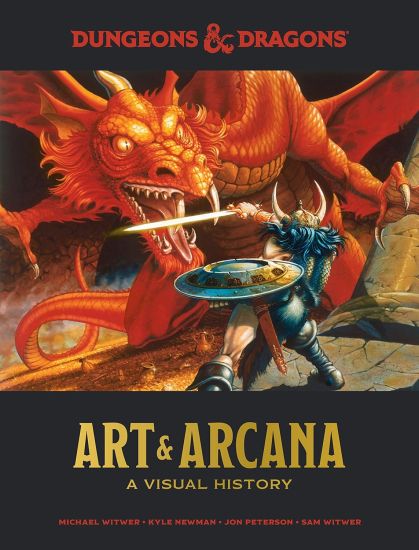
From one of the most iconic game brands in the world, this official DUNGEONS & DRAGONS illustrated history provides an unprecedented look at the visual evolution of the brand, showing its continued influence on the worlds of pop culture and fantasy. Inside the book, you'll find more than seven hundred pieces of artwork-from each edition of the core role-playing books, supplements, and adventures; as well as Forgotten Realms and Dragonlance novels; decades of Dragon and Dungeonmagazines; and classic advertisements and merchandise; plus never-before-seen sketches, large-format canvases, rare photographs, one-of-a-kind drafts, and more from the now-famous designers and artists associated with DUNGEONS & DRAGONS. The superstar author team gained unparalleled access to the archives of Wizards of the Coast and the personal collections of top collectors, as well as the designers and illustrators who created the distinctive characters, concepts, and visuals that have defined fantasy art and gameplay for generations. This is the most comprehensive collection of D&Dimagery ever assembled, making this the ultimate collectible for the game's millions of fans around the world.
Bruno Latour

Bruno Latour

Kyle McGee

Routledge
2013
sidottu
The first extended study of Bruno Latour’s legal theory, this book presents a critical reconstruction of the whole of Latour’s oeuvre to date, from Laboratory Life to An Inquiry into the Modes of Existence. Based on the powerful insights into normative effects that actor-network theory makes possible, the book advances a new theory of legal normativity and the force of law, rethinking Latour’s work on technology, the image, and referential scientific inscriptions, among others, and placing them within the ambit of legality. The book also captures and deepens the contrast between the modern legal institution and the value of law as a mode of existence, and provides a fulsome theoretical account of legal veridiction. Throughout, Latour’s thought is put into dialogue with important progenitors and adversaries as well as historical and contemporary strands of legal and political philosophy. But the thread of legality is not confined to Latour's reflections on the making of law; rather, it cuts through the whole of his highly diverse body of work. The empire of mononaturalism augured by modern philosophies of science is thoroughly juridical; as such, the actor-network theory that promises to undo that empire by freeing the value of the sciences from its epistemological clutches is unthinkable without the device of the trial and the descriptive semiotics of normativity that sustain ANT. The democratization of the sciences and the vibrancy of ecologized politics that become possible once the bifurcation of nature into essential primary and disposable secondary qualities is disabled, and once the ‘modern Constitution’ is called into doubt, also have important legal dimensions that have gone largely unexamined. Bruno Latour: The Normativity of Networks remedies this and other omissions, evaluating Latour’s thought about law while carrying it in striking new directions. This book introduces legal scholars and students to the thought of the philosopher and sociologist Bruno Latour, whilst also presenting a critical analysis of his work in and around law. This interdisciplinary study will be of interest to those researching in Law, Philosophy, and Sociology.
The Early Seleukids, their Gods and their Coins
Before Alexander, the Near East was ruled by dynasts who could draw on the significant resources and power base of their homeland, but this was not the case for the Seleukids who never controlled their original homeland of Macedon. The Early Seleukids, their Gods and their Coins argues that rather than projecting an imperialistic Greek image of rule, the Seleukid kings deliberately produced images that represented their personal power, and that were comprehensible to the majority of their subjects within their own cultural traditions. These images relied heavily on the syncretism between Greek and local gods, in particular their ancestor Apollo. The Early Seleukids, their Gods and their Coins examines how the Seleukids, from Seleukos I to Antiochos IV, used coinage to propagandise their governing ideology. It offers a valuable resource to students of the Seleukids and of Hellenistic kingship more broadly, numismatics, and the interplay of ancient Greek religion and politics.
Okinawan War Memory

Okinawan War Memory

Kyle Ikeda

Routledge
2013
sidottu
As one of Okinawa's most insightful writers and social critics, Medoruma Shun has highlighted the problems and limits of conventional representation of the Battle of Okinawa, raised new questions and concerns about the nature of Okinawan war memory, and expanded the possibilities of representing war through his groundbreaking and prize-winning fiction, editorials, essays, and speaking engagements. Yet, his writing has not been analyzed in regard to how his experience and identity as the child of two survivors of the Battle of Okinawa have powerfully shaped his understanding of the war and his literary craft.This book examines Okinawan war memory through the lens of Medoruma’s war fiction, and pays particular attention to the issues of second-generation war survivorship and transgenerational trauma. It explores how his texts contribute to knowledge about the war and its ongoing effects — on survivors, their offspring, and the larger community — in different ways from that of other modes of representation, such as survivor testimony, historical narrative, and realistic fiction. These dominant means of memory making have played a major role in shaping the various discourses about the war and the Battle of Okinawa, yet these forms of public memory and knowledge often exclude or avoid more personal, emotional, and traumatic experiences. Indeed, Ikeda’s analysis sheds light on the nature of trauma on survivors and their children who continue to inhabit sites of the traumatic past, and in turn makes an important contribution to studies on trauma and second-generation survivor experiences.This book will be of huge interest to students and scholars of Asian literature, Japanese literature, Japanese history, war memory and Okinawa.
Robert Ludlum's(tm) the Ares Decision

Robert Ludlum's(tm) the Ares Decision

Kyle Mills

Grand Central Publishing
2011
sidottu
In northern Uganda, an American special forces team is decimated by a group of normally peaceful farmers. Video of the attack shows even women and children possessing almost supernatural speed and strength, consumed with a rage that makes them immune to pain, fear, and all but the most devastating injuries. Covert-One's top operative, army microbiologist Colonel Jon Smith, is sent to investigate the attack and finds evidence of a parasitic infection that for centuries has been causing violent insanity and then going dormant. This time, though, it's different. The parasite had been purposely kept alive and crudely transmitted in acts of terrorism. Now the director of Iranian Intelligence is in Uganda trying to obtain this biological weapon to unleash it on the West. Smith and his team are ambushed and cut off from all outside support just as they begin to suspect that forces much more powerful than the Iranians are in play-forces that can be traced to Washington itself.
Service Oriented Architecture Field Guide for Executives

Service Oriented Architecture Field Guide for Executives

Kyle Gabhart; Bibhas Bhattacharya

John Wiley Sons Inc
2008
sidottu
Service Oriented Architecture Field Guide for Executives is a fundamental breakthrough in the business and technology perspectives of service oriented architecture (SOA). A valuable resource to help you understand and realize the benefits of SOA in today's companies, this guide will show you how to plan, implement, and achieve SOA value. Use a prescriptive approach to help you clearly understand SOA and to determine its applications for your business. Applicable to all industries, technology platforms, and operating environments, this innovative book will provide you with essential strategies.
Cognac

Cognac

Kyle Jarrard

John Wiley Sons Inc
2005
sidottu
Rich in history and admirable scholarship. . . . It's a fine grande champagne of a book, to be savored over and over.-Patricia Wells, author of The Provence CookbookCalled the ""brandy of the gods"" by Victor Hugo, Cognac is a universal symbol of refinement and quality. In the first comprehensive history of this celebrated drink, Kyle Jarrard charts Cognac's birth in the 1500s and its transformation into the world's most coveted brandy. Along the way, he reveals how Cognac distillers weathered vineyard die-offs, the German occupation, and other challenges over the years-and offers a fascinating behind-the-scenes look at Hennessy, Remy-Martin, Courvoisier, Martell, and other legendary brands.For any Cognac lover, this fascinating book will make the perfect gift.Kyle Jarrard (Paris, France) is a senior editor at the International Herald Tribune and author of the highly acclaimed novels Over There and Rolling the Bones.
Record Cultures

Record Cultures

Kyle Barnett

The University of Michigan Press
2021
nidottu
Record Cultures tells the story of how early U.S. commercial recording companies captured American musical culture in a key period in both music and media history. Amid dramatic technological and cultural changes of the 1920s and 1930s, small recording companies in the United States began to explore the genres that would later be known as jazz, blues, and country. Smaller record labels, many based in rural or out of the way Midwestern and Southern towns, were willing to take risks on the country’s regional vernacular music as a way to compete with more established recording labels. Recording companies’ relationship with radio grew closer as both industries were on the rise, propelled by new technologies. Radio, which had become immensely popular, began broadcasting more recorded music in place of live performances, and this created profitable symbiosis. With the advent of the talkies, the film industry completed the media trifecta. The novelty of recorded sound was replacing film accompanists, and the popularity of movie musicals solidified film’s connections with the radio and recording industries. By the early 1930s, the recording industry had gone from being part of the largely autonomous phonograph industry to being major media industry of its own, albeit deeply tied to—and, in some cases, owned by—the radio and film industries. The triangular relationships between these media industries marked the first major entertainment and media conglomerates in U.S. history. Through an interdisciplinary and intermedial approach to recording industry history, Record Cultures creates new connections between different strands of media research. It will be of interest to scholars of popular music, media studies, sound studies, American culture, and the history of film, television, and radio.
Record Cultures

Record Cultures

Kyle Barnett

The University of Michigan Press
2020
sidottu
Record Cultures tells the story of how early U.S. commercial recording companies captured American musical culture in a key period in both music and media history. Amid dramatic technological and cultural changes of the 1920s and 1930s, small recording companies in the United States began to explore the genres that would later be known as jazz, blues, and country. Smaller record labels, many based in rural or out of the way Midwestern and Southern towns, were willing to take risks on the country’s regional vernacular music as a way to compete with more established recording labels. Recording companies’ relationship with radio grew closer as both industries were on the rise, propelled by new technologies. Radio, which had become immensely popular, began broadcasting more recorded music in place of live performances, and this created profitable symbiosis. With the advent of the talkies, the film industry completed the media trifecta. The novelty of recorded sound was replacing film accompanists, and the popularity of movie musicals solidified film’s connections with the radio and recording industries. By the early 1930s, the recording industry had gone from being part of the largely autonomous phonograph industry to being major media industry of its own, albeit deeply tied to—and, in some cases, owned by—the radio and film industries. The triangular relationships between these media industries marked the first major entertainment and media conglomerates in U.S. history. Through an interdisciplinary and intermedial approach to recording industry history, Record Cultures creates new connections between different strands of media research. It will be of interest to scholars of popular music, media studies, sound studies, American culture, and the history of film, television, and radio.
Music Downtown

Music Downtown

Kyle Gann

University of California Press
2006
pokkari
This collection represents the cream of the more than five hundred articles written for the "Village Voice" by Kyle Gann, a leading authority on experimental American music of the late twentieth century. Charged with exploring every facet of cutting-edge music coming out of New York City in the 1980s and '90s, Gann writes about a wide array of timely issues that few critics have addressed, including computer music, multiculturalism and its thorny relation to music, music for the AIDS crisis, the brand-new art of electronic sampling and its legal implications, symphonies for electric guitars, operas based on talk shows, the death of twelve-tone music, and the various streams of music that flowed forth from minimalism. In these articles - including interviews with Yoko Ono, Philip Glass, Glenn Branca, and other leading musical figures - Gann paints a portrait of a bristling era in music history and defines the scruffy, vernacular field of Downtown music from which so much of the most fertile recent American music has come.
Constantine and the Captive Christians of Persia

Constantine and the Captive Christians of Persia

Kyle Smith

University of California Press
2016
sidottu
It is widely believed that the Emperor Constantine's conversion to Christianity politicized religious allegiances, dividing the Christian Roman Empire from the Zoroastrian Sasanian Empire and leading to the persecution of Christians in Persia. This account, however, is based on Greek ecclesiastical histories and Syriac martyrdom narratives that date to centuries after the fact. In this groundbreaking study, Kyle Smith analyzes diverse Greek, Latin, and Syriac sources to show that there was not a single history of fourth-century Mesopotamia. By examining the conflicting hagiographical and historical evidence, Constantine and the Captive Christians of Persia presents an evocative and evolving portrait of the first Christian emperor, uncovering how Syriac Christians manipulated the image of their western Christian counterparts to fashion their own political and religious identities during this century of radical change.
Constantine and the Captive Christians of Persia

Constantine and the Captive Christians of Persia

Kyle Smith

University of California Press
2019
pokkari
It is widely believed that the Emperor Constantine’s conversion to Christianity politicized religious allegiances, dividing the Christian Roman Empire from the Zoroastrian Sasanian Empire and leading to the persecution of Christians in Persia. This account, however, is based on Greek ecclesiastical histories and Syriac martyrdom narratives that date to centuries after the fact. In this groundbreaking study, Kyle Smith analyzes diverse Greek, Latin, and Syriac sources to show that there was not a single history of fourth-century Mesopotamia. By examining the conflicting hagiographical and historical evidence, Constantine and the Captive Christians of Persia presents an evocative and evolving portrait of the first Christian emperor, uncovering how Syriac Christians manipulated the image of their western Christian counterparts to fashion their own political and religious identities during this century of radical change.
Cult of the Dead

Cult of the Dead

Kyle Smith

University of California Press
2022
sidottu
A cultural history of how Christianity was born from its martyrs. Though it promises eternal life, Christianity was forged in death. Christianity is built upon the legacies of the apostles and martyrs who chose to die rather than renounce the name of their lord. In this innovative cultural history, Kyle Smith shows how a devotion to death has shaped Christianity for two thousand years. For centuries, Christians have cared for their saints, curating their deaths as examples of holiness. Martyrs’ stories, lurid legends of torture, have been told and retold, translated and rewritten. Martyrs’ bones are alive in the world, relics pulsing with wonder. Martyrs’ shrines are still visited by pilgrims, many in search of a miracle. Martyrs have even shaped the Christian conception of time, with each day of the year celebrating the death of a saint. From Roman antiquity to the present, by way of medieval England and the Protestant Reformation, Cult of the Dead tells the fascinating story of how the world’s most widespread religion is steeped in the memory of its martyrs.
Cult of the Dead

Cult of the Dead

Kyle Smith

University of California Press
2024
pokkari
A cultural history of how Christianity was born from its martyrs. Though it promises eternal life, Christianity was forged in death. Christianity is built upon the legacies of the apostles and martyrs who chose to die rather than renounce the name of their lord. In this innovative cultural history, Kyle Smith shows how a devotion to death has shaped Christianity for two thousand years. For centuries, Christians have cared for their saints, curating their deaths as examples of holiness. Martyrs’ stories, lurid legends of torture, have been told and retold, translated and rewritten. Martyrs’ bones are alive in the world, relics pulsing with wonder. Martyrs’ shrines are still visited by pilgrims, many in search of a miracle. Martyrs have even shaped the Christian conception of time, with each day of the year celebrating the death of a saint. From Roman antiquity to the present, by way of medieval England and the Protestant Reformation, Cult of the Dead tells the fascinating story of how the world’s most widespread religion is steeped in the memory of its martyrs.
Electronic Document Preparation and Management for CSEC® Examinations Coursebook with CD-ROM
This book covers the new EDPM CSEC syllabus to be taught from September 2011. It introduces computing fundamentals, electronic communication and keyboarding techniques before teaching the Microsoft Office (2003 - 2010) skills required by the course. Next, students are shown several aspects of document preparation, complete with sample documents. After covering document management and ethics, it gives SBA tips and exam papers (with answers included on the CD). Exercises and summaries are found at the end of each chapter. The accompanying CD-ROM is packed with material including interactive revision questions, PowerPoint presentations, tutorial videos, exercise files and a comprehensive glossary.
Slavery in the Late Roman World, AD 275–425

Slavery in the Late Roman World, AD 275–425

Kyle Harper

Cambridge University Press
2011
sidottu
Capitalizing on the rich historical record of late antiquity, and employing sophisticated methodologies from social and economic history, this book reinterprets the end of Roman slavery. Kyle Harper challenges traditional interpretations of a transition from antiquity to the Middle Ages, arguing instead that a deep divide runs through 'late antiquity', separating the Roman slave system from its early medieval successors. In the process, he covers the economic, social and institutional dimensions of ancient slavery and presents the most comprehensive analytical treatment of a pre-modern slave system now available. By scouring the late antique record, he has uncovered a wealth of new material, providing fresh insights into the ancient slave system, including slavery's role in agriculture and textile production, its relation to sexual exploitation, and the dynamics of social honor. By demonstrating the vitality of slavery into the later Roman empire, the author shows that Christianity triumphed amidst a genuine slave society.
American Oasis: Finding the Future in the Cities of the Southwest
An expansive and revelatory historical exploration of the multicultural, water-seeking, land-destroying settlers of the most arid corner of North America, arguing that in order to know where the United States is going in the era of mass migration and climate crisis we must understand where the Southwest has already been Albuquerque. Phoenix. Tucson. El Paso. Las Vegas. Iconic American cities surrounded by desert and rust. Teeming metropolises that seem to exist independently of the seemingly inhospitable and arid landscape that surrounds them, belying the rich insight they offer into American stories of migration, industry, bloodshed, and rebirth. Charting a geographic path through America's largest and hottest deserts, acclaimed journalist Kyle Paoletta maps the past and future of these cities, and the many other settlements from rural town to urban sprawl that make up the region that has come to be called "the American Southwest." Weaving together the stories of immigrants and indigenous populations, American Oasis pulls back the layers of settlement, sediment, habit, and effect that successive empires have left on the region, from the Athapascan, Din , Tewa, Apache, and Comanche, to the Spanish, Mexican, and, finally, American. As Paoletta's journey into the Southwest's history becomes inextricably linked to an exploration of its dependency on water, he begins to ask: where, ultimately, will cities like Las Vegas and Phoenix find themselves once the Colorado River and its branches dry up? Richly reported and sweeping in its history, American Oasis is the story of what one iconic region's past can tell us about our shared environmental and cultural future.