Kirjojen hintavertailu. Mukana 12 396 163 kirjaa ja 12 kauppaa.

Kirjahaku

Etsi kirjoja tekijän nimen, kirjan nimen tai ISBN:n perusteella.

1000 tulosta hakusanalla Philo

Philosophy and Ideology in Hume's Political Thought

Philosophy and Ideology in Hume's Political Thought

David Miller

Oxford University Press
1981
sidottu
This book was written with three aims in mind. The first was to provide a reasonably concise account of Hume's social and political thought that might help students coming to it for the first time. The second aim was to say something about the relationship between philosophy and politics, with explicit attention to Hume, but implicit reference to a general issue. The third is to offer an integrated account of Hume's thought. The book accounts for the varying interpretation of the conservative and liberalist traditions by arguing that the distinction between liberalism and conservatism had little application in mid-18th-century Britain. Hume's ideology contained elements that we should now identify as conservative and liberal respectively, and so by selective emphasis it is possible to make him seem a thoroughbred conservative or liberal according to choice. These two problems the relationship between Hume's philosophy and his politics, and the ideological character of his thought are pursued through the first and second parts of the book respectively.
Philosophy, Psychiatry and Neuroscience - Three Approaches to the Mind
This book proposes a new, unified view of the mind which integrates the insights of philosophers, psychologists, and neuroscientists. Through a detailed discussion of major theories from all these, and related disciplines, the author gradually reveals fundamental links between these previously unconnected approaches to human thought and experience. The author has studied medicine, philosophy, mathematics and history, and is currently a practising psychiatrist and a teacher at the Harvard Medical School. He discusses diverse fields of thought with depth and clarity, and his unique perspective should stimulate a re-evaluation of our traditional approaches to the mind.
Philosophy of Mental Representation
In Philosophy of Mental Representation five of the most original and important thinkers in philosophy of mind engage in an overlapping dialogue about mental representation. In new papers, contributors Andy Clark, Robert Cummins, Daniel Dennett, John Haugeland and Brian Cantwell Smith each investigate the views and claims of one of the other contributors regarding mental representation. The subject then offers a reply. An exciting feature of this collection is the dynamic discussion among all contributors following each exchange. The editor frames the discussions and provides a way into the debates for readers new to them.
Philosophy and Power in the Graeco-Roman World
Miriam Griffin is unrivalled as a bridge-builder between historians of the Graeco-Roman world and students of its philosophies. This volume in her honour brings togetherseventeen international specialists. Their essays range from Socrates to late antiquity, extending to Diogenes, Cicero, Pliny the Elder, Marcus Aurelius, the Second Sophistic, Ulpian, Augustine, the Neoplatonist tradition, women philosophers, provision for basic human needs, the development of law, the formulation of imperial power, and the interpretation of Judaism and early Christianity. Emperors and drop-outs, media stars and administrators, top politicians and abstruse professionals, even ordinary citizens in their epitaphs, were variously called philosophers. Philosophy could offer those in power moral support or confrontation, a language for making choices or an intellectual diversion, but they might disregard philosophy and get on with the exercise of power. 'Philosophy' means 'love of wisdom', but what was the power of philosophy?
Philosophy of Private Law

Philosophy of Private Law

William Lucy

Oxford University Press
2006
nidottu
On what basis does tort law hold us responsible to those who suffer as a result of our carelessness? Why, when we breach our contracts, should we make good the losses of those with whom we contracted? In what sense are our torts and our breaches of contract 'wrongs'? These two branches of private law have for centuries provided philosophers and jurists with grounds for puzzlement. This book provides an outline of, and intervention in, contemporary jurisprudential debates about the nature and foundation of liability in private law. After outlining the realm of the philosophy of private law, the book divides into two. Part I examines the various components of liability responsibility in private law, including the notions of basic responsibility, conduct, causation and wrongfulness. Part II considers arguments purporting to show that private law does and should embody a conception of either distributive or corrective justice or some combination of the two. Throughout the book a number of distinctions - between conceptual and normative argument, between jurisprudential 'theory' and private law 'practice', between legal obligation and moral obligation - are analyzed, the aim being to give students an informed grasp of both the limits and possibilities of the philosophy of private law.
Philosophical Foundations of the Law of Torts
Contemporary philosophy and tort law have long enjoyed a happy union. Tort theory today is an exceptionally active and wide ranging field within legal philosophy. This volume brings together established and emerging scholars from around the world and from varying disciplines that bring their distinct perspective to the philosophical problems of tort law. These ground breaking essays advance longstanding debates and open up new avenues of enquiry thus deepening and broadening the field. Contributions cover the major problematic areas of tort law, such as the relations between responsibility, fault, and strict liability; the morality of harm, compensation, and repair; and the relationship of tort with criminal and property law among many others.
Philosophical Foundations of Fiduciary Law
Fiduciary law is a critically important body of law. Fiduciary duties ensure the integrity of a remarkable variety of relationships, institutions, and organizations. They apply to relationships of great personal significance, including in some jurisdictions the relationship between parents and children. They structure a wide variety of commercial relationships, and they are essential to the regulation of relationships between professional service providers and their clients, including relationships between lawyer and client, doctor and patient, and investment manager and client. Fiduciary duties, perhaps uniquely in private law, challenge traditional ways of marking the boundaries between private and public law, inasmuch as they figure prominently in public governance. Indeed, there is even a storied tradition of thinking of the authority of the state in fiduciary terms. Notwithstanding its importance, fiduciary law has been woefully under-analysed by legal theorists. Filling this gap with a series of chapters by leading theorists, this book includes chapters on: the nature of fiduciary relationships, the connection between fiduciary duties and morality, the content and significance of fiduciary loyalty, the economic significance of fiduciary law, the application of fiduciary principles to public law and international law, the import of fiduciary relationships to theories of authority, and various other fundamental topics in the field. In many cases, new and important questions are raised by the book's chapters. Indeed, this book not only offers a much-needed theoretical assessment of fiduciary topics, it defines the field going forward, setting an agenda for future philosophical study of fiduciary law.
Philosophy Bites Again

Philosophy Bites Again

David Edmonds; Nigel Warburton

Oxford University Press
2014
sidottu
Philosophy Bites Again is a brand new selection of interviews from the popular podcast of the same name. It offers engaging and thought-provoking conversations with leading philosophers on a selection of major philosophical issues that affect our lives. Their subjects include pleasure, pain, and humour; consciousness and the self; free will, responsibility, and punishment; the meaning of life and the afterlife. Everyone will find ideas in this book to fascinate, provoke, and inspire them. Philosophy Bites was set up in 2007 by David Edmonds and Nigel Warburton. It has, to date, over 20 million downloads, and is listened to all over the world.
Philosophy without Intuitions

Philosophy without Intuitions

Herman Cappelen

Oxford University Press
2014
nidottu
The claim that contemporary analytic philosophers rely extensively on intuitions as evidence is almost universally accepted in current meta-philosophical debates and it figures prominently in our self-understanding as analytic philosophers. No matter what area you happen to work in and what views you happen to hold in those areas, you are likely to think that philosophizing requires constructing cases and making intuitive judgments about those cases. This assumption also underlines the entire experimental philosophy movement: only if philosophers rely on intuitions as evidence are data about non-philosophers' intuitions of any interest to us. Our alleged reliance on the intuitive makes many philosophers who don't work on meta-philosophy concerned about their own discipline: they are unsure what intuitions are and whether they can carry the evidential weight we allegedly assign to them. The goal of this book is to argue that this concern is unwarranted since the claim is false: it is not true that philosophers rely extensively (or even a little bit) on intuitions as evidence. At worst, analytic philosophers are guilty of engaging in somewhat irresponsible use of 'intuition'-vocabulary. While this irresponsibility has had little effect on first order philosophy, it has fundamentally misled meta-philosophers: it has encouraged meta-philosophical pseudo-problems and misleading pictures of what philosophy is.
Philosophy Bites Back

Philosophy Bites Back

David Edmonds; Nigel Warburton

Oxford University Press
2014
nidottu
Philosophy Bites Back is the second book to come out of the hugely successful podcast Philosophy Bites. It presents a selection of lively interviews with leading philosophers of our time, who discuss the ideas and works of some of the most important thinkers in history. From the ancient classics of Socrates, Plato, and Aristotle, to the groundbreaking modern thought of Wittgenstein, Rawls, and Derrida, this volume spans over two and a half millennia of western philosophy and illuminates its most fascinating ideas. Philosophy Bites was set up in 2007 by David Edmonds and Nigel Warburton. It has had over 12 million downloads, and is listened to all over the world.
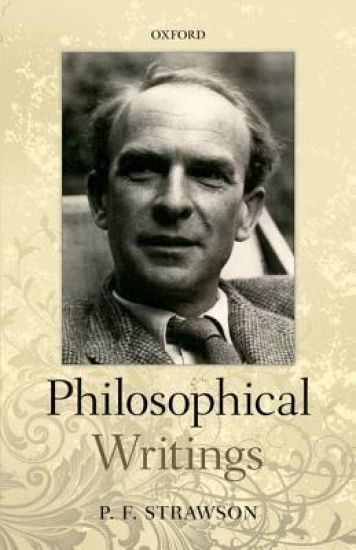
Philosophical Writings

Philosophical Writings

P. F. Strawson

Oxford University Press
2014
nidottu
This volume presents twenty-two uncollected philosophical essays by Sir Peter Strawson, one of the leading philosophers of the second half of the twentieth century. The essays (two of them previously unpublished) are drawn from seven decades of work, from 1949 to 2003. They span the broad range of Strawson's work: metaphysics, epistemology, philosophical logic, philosophy of language, ethical theory, and history of philosophy, along with metaphilosophical reflections and intellectual autobiography.
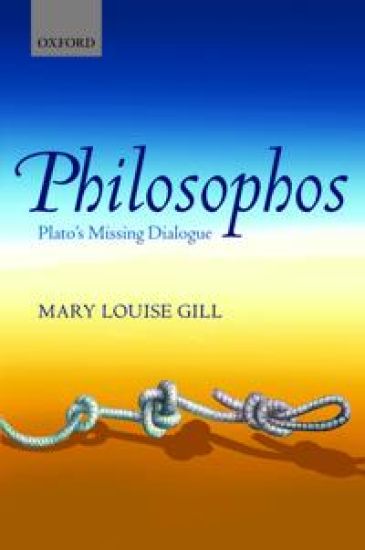
Philosophos

Philosophos

Mary Louise Gill

Oxford University Press
2014
nidottu
Plato famously promised to complement the Sophist and the Statesman with another work on a third sort of expert, the philosopher--but we do not have this final dialogue. Mary Louise Gill argues that Plato promised the Philosopher, but did not write it, in order to stimulate his audience and encourage his readers to work out, for themselves, the portrait it would have contained. The Sophist and Statesman are themselves members of a larger series starting with the Theaetetus, Plato's investigation of knowledge, and the whole series relies on the Parmenides, the second part of which presents a philosophical exercise, introduced as the first step in a larger philosophical program. Gill contends that the dialogues leading up to the missing Philosopher, though they reach some substantive conclusions, are philosophical exercises of various sorts designed to train students in dialectic, the philosopher's method; and that a second version of the Parmenides exercise, closely patterned on it, spans parts of the Theaetetus and Sophist and brings the philosopher into view. This is the exercise about being, the subject-matter studied by Plato's philosopher. Plato hides the pieces of the puzzle and its solution in plain sight, forcing his students (and modern readers) to dig out the pieces and reconstruct the project. Gill reveals how, in finding the philosopher through the exercise, the student becomes a philosopher by mastering his methods. She shows that the target of Plato's exercise is internally related to its pedagogical purpose.
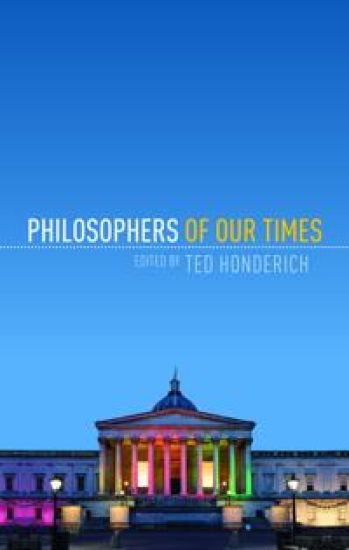
Philosophers of Our Times

Philosophers of Our Times

Oxford University Press
2015
sidottu
Eighteen of the world's most eminent philosophers of recent years tackle central questions of philosophy in this collection of the prestigious annual lectures given at the Royal Institute of Philosophy in London. The line-up of authors is stellar: Simon Blackburn, Ned Block, Tyler Burge, David Chalmers, Noam Chomsky, Jerry Fodor, Jürgen Habermas, Anthony Kenny, Christine Korsgaard, John McDowell, Alasdair MacIntyre, Thomas Nagel, Derek Parfit, T. M. Scanlon, John Searle, Sir Peter Strawson, Bernard Williams, and Mary Warnock. There are six pieces on questions to do with mind, perception, and action; four on reason and morality; six range over freedom, identity, religion, and politics; and the last two take a step back to look at philosophy itself and how it works. The best way to learn about philosophy is to read philosophy at its best: that is what this fascinating anthology offers.
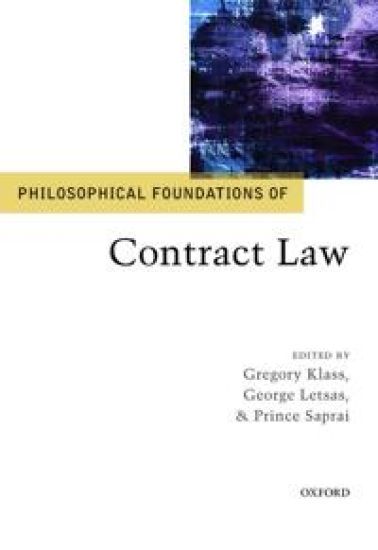
Philosophical Foundations of Contract Law
In recent years there has been a revival of interest in the philosophical study of contract law. In 1981 Charles Fried claimed that contract law is based on the philosophy of promise and this has generated what is today known as 'the contract and promise debate'. Cutting to the heart of contemporary discussions, this volume brings together leading philosophers, legal theorists, and contract lawyers to debate the philosophical foundations of this area of law. Divided into two parts, the first explores general themes in the contract theory literature, including the philosophy of promising, the nature of contractual obligation, economic accounts of contract law, and the relationship between contract law and moral values such as personal autonomy and distributive justice. The second part uses these philosophical ideas to make progress in doctrinal debates, relating for example to contract interpretation, unfair terms, good faith, vitiating factors, and remedies. Together, the essays provide a picture of the current state of research in this revitalized area of law, and pave the way for future study and debate.
Philosophical Foundations of Contract Law
In recent years there has been a revival of interest in the philosophical study of contract law. In 1981 Charles Fried claimed that contract law is based on the philosophy of promise and this has generated what is today known as 'the contract and promise debate'. Cutting to the heart of contemporary discussions, this volume brings together leading philosophers, legal theorists, and contract lawyers to debate the philosophical foundations of this area of law. Divided into two parts, the first explores general themes in the contract theory literature, including the philosophy of promising, the nature of contractual obligation, economic accounts of contract law, and the relationship between contract law and moral values such as personal autonomy and distributive justice. The second part uses these philosophical ideas to make progress in doctrinal debates, relating for example to contract interpretation, unfair terms, good faith, vitiating factors, and remedies. Together, the essays provide a picture of the current state of research in this revitalized area of law, and pave the way for future study and debate.
Philostratus: Lives of the Sophists (Flavii Philostrati Vitas Sophistarum)
Oxford Classical Texts, also known as Scriptorum Classicorum Bibliotheca Oxoniensis, provide authoritative, clear, and reliable editions of ancient texts, with apparatus criticus on each page. Philostratus 'The Athenian' was well-respected in philosophical and imperial circles of the third century AD and he was the first to coin the phrase 'The Second Sophistic'. His semi-biographical Lives of the Sophists was highly influential on later Neoplatonist philosophy. Based on a comprehensive study of manuscript tradition, this critical edition of Philostratus' history of the Greek sophists takes into account all major scholarly work on the text which has emerged since the last critical edition appeared in 1871. A detailed English preface provides the reader with the key information surrounding the independent witnesses used as a basis for the constitution of the text. Throughout the text, the volume's critical apparatus incorporates all relevant readings, as well as later emendations by modern scholars, and provides a clear and succinct presentation of all the textual variants. Also included is an apparatus fontium which identifies Philostratus' citations of older works, and an appendix containing the text of two declamations by the second-century sophist, Polemon, grounded in an exploration of all extant manuscripts and integrating all essential scholarly revisions made since the previous edition of Polemon published in 1873.
Philosophical issues in psychiatry III
Psychiatry has long struggled with the nature of its diagnoses. The problems raised by questions about the nature of psychiatric illness are particularly fascinating because they sit at the intersection of philosophy, empirical psychiatric/psychological research, measurement theory, historical tradition and policy. In being the only medical specialty that diagnoses and treats mental illness, psychiatry has been subject to major changes in the last 150 years. This book explores the forces that have shaped these changes and especially how substantial "internal" advances in our knowledge of the nature and causes of psychiatric illness have interacted with a plethora of external forces that have impacted on the psychiatric profession. It includes contributions from philosophers of science with an interest in psychiatry, psychiatrists and psychologists with expertise in the history of their field and historians of psychiatry. Each chapter is accompanied by an introduction and a commentary. The result is a dynamic discussion about the nature of psychiatric disorders, and a book that is compelling reading for those in the field of mental health, history of science and medicine, and philosophy.
Philosophy in the Hellenistic and Roman Worlds

Philosophy in the Hellenistic and Roman Worlds

Peter Adamson

Oxford University Press
2015
sidottu
Peter Adamson offers an accessible, humorous tour through a period of eight hundred years when some of the most influential of all schools of thought were formed: from the third century BC to the sixth century AD. He introduces us to Cynics and Skeptics, Epicureans and Stoics, emperors and slaves, and traces the development of Christian and Jewish philosophy and of ancient science. Chapters are devoted to such major figures as Epicurus, Lucretius, Cicero, Seneca, Plotinus, and Augustine. But in keeping with the motto of the series, the story is told 'without any gaps,' providing an in-depth look at less familiar topics that remains suitable for the general reader. For instance, there are chapters on the fascinating but relatively obscure Cyrenaic philosophical school, on pagan philosophical figures like Porphyry and Iamblichus, and extensive coverage of the Greek and Latin Christian Fathers who are at best peripheral in most surveys of ancient philosophy. A major theme of the book is in fact the competition between pagan and Christian philosophy in this period, and the Jewish tradition also appears in the shape of Philo of Alexandria. Ancient science is also considered, with chapters on ancient medicine and the interaction between philosophy and astronomy. Considerable attention is paid also to the wider historical context, for instance by looking at the ascetic movement in Christianity and how it drew on ideas from Hellenic philosophy. From the counter-cultural witticisms of Diogenes the Cynic to the subtle skepticism of Sextus Empiricus, from the irreverent atheism of the Epicureans to the ambitious metaphysical speculation of Neoplatonism, from the ethical teachings of Marcus Aurelius to the political philosophy of Augustine, the book gathers together all aspects of later ancient thought in an accessible and entertaining way.
Philosophical Foundations of Law and Neuroscience
The intersection between law and neuroscience has been a focus of intense research for the past decade, as an unprecedented amount of attention has been triggered by the increased use of neuroscientific evidence in courts. While the majority of this attention is currently devoted to criminal law, including capital cases, the wide-ranging proposals for how neuroscience may inform issues of law and public policy extend to virtually every substantive area in law. Bringing together the latest work from leading scholars in the field, this volume examines the philosophical issues that inform this emerging and vibrant subfield of law. From discussions featuring the philosophy of the mind to neuroscience-based lie detection, each chapter addresses foundational questions that arise in the application of neuroscientific technology in the legal sphere.
Philosophy of Science

Philosophy of Science

Samir Okasha

Oxford University Press
2016
nidottu
How much faith should we place in what scientists tell us? Is it possible for scientific knowledge to be fully 'objective'? What, really, can be defined as science? In the second edition of this Very Short Introduction, Samir Okasha explores the main themes and theories of contemporary philosophy of science, and investigates fascinating, challenging questions such as these. Starting at the very beginning, with a concise overview of the history of science, Okasha examines the nature of fundamental practices such as reasoning, causation, and explanation. Looking at scientific revolutions and the issue of scientific change, he asks whether there is a discernible pattern to the way scientific ideas change over time, and discusses realist versus anti-realist attitudes towards science. He finishes by considering science today, and the social and ethical philosophical questions surrounding modern science. ABOUT THE SERIES: The Very Short Introductions series from Oxford University Press contains hundreds of titles in almost every subject area. These pocket-sized books are the perfect way to get ahead in a new subject quickly. Our expert authors combine facts, analysis, perspective, new ideas, and enthusiasm to make interesting and challenging topics highly readable.