Kirjojen hintavertailu. Mukana 11 717 486 kirjaa ja 12 kauppaa.

Kirjahaku

Etsi kirjoja tekijän nimen, kirjan nimen tai ISBN:n perusteella.

1000 tulosta hakusanalla R.S. Hamilton

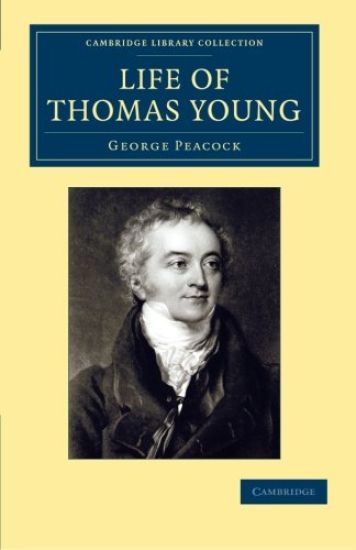
Life of Thomas Young M.D., F.R.S., etc.

Life of Thomas Young M.D., F.R.S., etc.

George Peacock

Cambridge University Press
2013
pokkari
Admired long after his death by the likes of Lord Rayleigh and Einstein, Thomas Young (1773–1829) was the definition of a polymath. By the age of fourteen he was proficient in thirteen languages, including Greek, Hebrew and Persian. After studies in Edinburgh, London, Göttingen and Cambridge he established himself as a physician in London, and over the course of his life made contributions to science, linguistics and music. He was the first to prove that light is a wave rather than molecular, his three-colour theory of vision was confirmed in the twentieth century, and his work in deciphering the Rosetta Stone laid the foundations for its eventual translation. Published in 1855, this engaging biography drew on letters, journals and private papers, taking the mathematician George Peacock (1791–1858) twenty years to complete. It stands as a valuable and affectionate portrait of 'the last man who knew everything'.
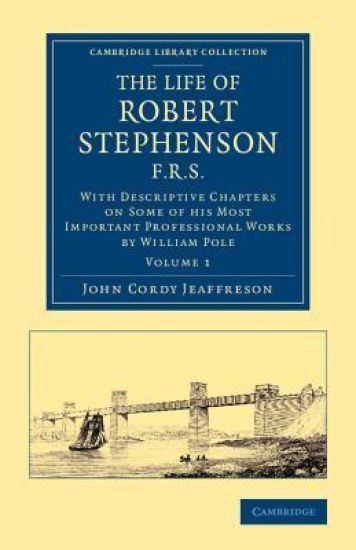
The Life of Robert Stephenson, F.R.S.

The Life of Robert Stephenson, F.R.S.

Jeaffreson John Cordy; Pole William

Cambridge University Press
2014
pokkari
Relying on incremental experiment rather than leaps into the unknown, Robert Stephenson (1803–59) forged an influential career as a highly respected railway and civil engineer. From the steam locomotive Rocket to the London and Birmingham Railway and the Britannia Bridge, his work helped to consolidate the foundations of the modern engineering profession. Based on the first-hand testimony of relatives and contemporaries as well as correspondence and official records, this 1864 biography by John Cordy Jeaffreson (1831–1901), published only five years after Stephenson's death, tells the story of this quiet industrial innovator. Five chapters by engineer William Pole (1814–1900) provide a more technical insight, examining some of Stephenson's most significant railway bridges and his involvement with the atmospheric system. Volume 1 traces Robert's early life, carefully moulded by his father George, and also covers the building of the London and Birmingham Railway.
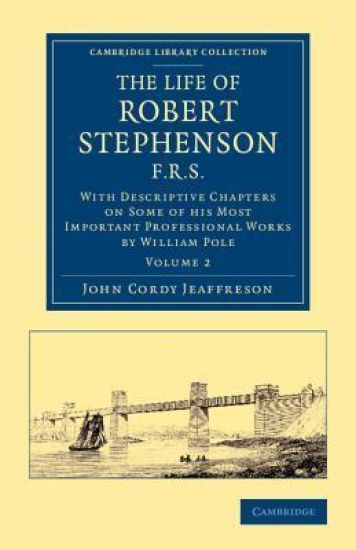
The Life of Robert Stephenson, F.R.S.

The Life of Robert Stephenson, F.R.S.

Jeaffreson John Cordy; Pole William

Cambridge University Press
2014
pokkari
Relying on incremental experiment and practice rather than individual leaps into the unknown, Robert Stephenson (1803–59) forged an influential career as a highly respected railway and civil engineer. From the steam locomotive Rocket to the London and Birmingham Railway and the Britannia Bridge, his work helped to consolidate the foundations of the modern engineering profession. Based on the first-hand testimony of relatives and contemporaries as well as correspondence and official records, this 1864 biography by John Cordy Jeaffreson (1831–1901), published only five years after Stephenson's death, tells the story of this quiet industrial innovator. Five chapters by engineer William Pole (1814–1900) provide a more technical insight, examining some of Stephenson's most significant railway bridges. Volume 2 covers his advocacy of standardisation of the permanent way during the Gauge War, and his life as a bridge builder and politician.
Memoir of Leonard Horner, F.R.S., F.G.S.

Memoir of Leonard Horner, F.R.S., F.G.S.

Leonard Horner

Cambridge University Press
2011
pokkari
Leonard Horner (1785–1864) was a prominent geologist, educator and, later, a factory inspector. In 1833 he was appointed to the Royal Commission on the employment of children in factories, and he inspected sites around the north of England. His earlier scientific work saw him elected a fellow of the Royal Society in 1813, and he was twice president of the Geological Society. The two-volume Memoir of Leonard Horner, edited by his daughter, Katharine Lyell, and published in 1890, is a selection of letters to and from his family and friends. The correspondence gives vivid insights into the world of this influential reformer. Volume 1 focuses on Horner's life from his childhood until 1838, taking in many of the key events of his professional career, including his election to the Royal Society, his attempts at improving higher education in Edinburgh and his involvement with the inspection of factories.
Memoir of Leonard Horner, F.R.S., F.G.S.

Memoir of Leonard Horner, F.R.S., F.G.S.

Leonard Horner

Cambridge University Press
2011
pokkari
Leonard Horner (1785–1864) was a prominent geologist, educator and, later, a factory inspector. In 1833 he was appointed to the Royal Commission on the employment of children in factories, and he inspected sites around the north of England. His earlier scientific work saw him elected a fellow of the Royal Society in 1813, and he was twice president of the Geological Society. The two-volume Memoir of Leonard Horner, edited by his daughter, Katharine Lyell, and published in 1890, is a selection of letters to and from his family and friends. The correspondence gives vivid insights into the world of this influential reformer. Volume 2 covers the period 1839–1864, and includes letters about Horner's activities at the Geological Society, his travels in Italy in 1861, his political concerns, and key moments in his personal life, such as the birth of his grandson in 1850.
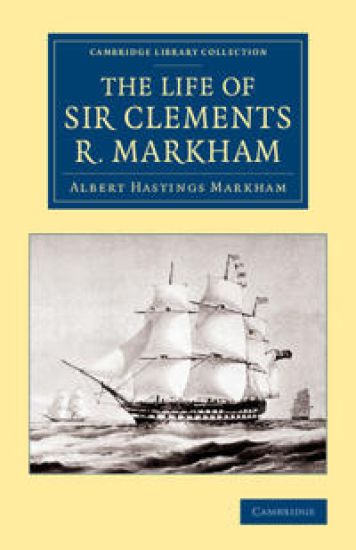
The Life of Sir Clements R. Markham, K.C.B., F.R.S.

The Life of Sir Clements R. Markham, K.C.B., F.R.S.

Albert Hastings Markham

Cambridge University Press
2014
pokkari
Albert Hastings Markham (1841–1918) was the cousin of the subject of this biography, published in 1917, and greatly admired his older relative, who had acted as his mentor. Clements R. Markham (1830–1916) is remembered as a prolific writer on historical geography, many of whose works are reissued in the Cambridge Library Collection. As a boy, he showed great enthusiasm for both history and exploration, and after a chance encounter with an admiral, joined the navy as a cadet. After eight years, he determined to leave the service and pursue a career as an explorer and writer. His first expedition was to Peru, but his main interest was in the Arctic. As an active member of both the Royal Geographical Society and the Hakluyt Society, he both published accounts of early voyages and urged further exploration in the polar regions, including the 1901–4 Discovery expedition under Robert Scott.
The Works of John Hunter, F.R.S.

The Works of John Hunter, F.R.S.

John Hunter; Ottley Drewry

Cambridge University Press
2015
pokkari
The surgeon and anatomist John Hunter (1728–93) left a famous legacy in the Hunterian Museum of medical specimens now in the Royal College of Surgeons, and in this collection of his writings, edited by James Palmer, with a biography by Drewry Ottley, published between 1835 and 1837. The first four volumes are of text, and the larger Volume 5 contains plates. Hunter had begun his career as a demonstrator in the anatomy classes of his brother William, before qualifying as a surgeon. He regarded surgery as evidence of failure - the mutilation of a patient who could not be cured by other means - and his studies of anatomy and natural history were driven by his belief that it was necessary to understand the normal physiological processes before attempting to cure the abnormal ones. Volume 1 contains Ottley's biography, a list of Hunter's published works, and his lectures on surgery.
The Works of John Hunter, F.R.S.

The Works of John Hunter, F.R.S.

John Hunter

Cambridge University Press
2015
pokkari
The surgeon and anatomist John Hunter (1728–93) left a famous legacy in the Hunterian Museum of medical specimens now in the Royal College of Surgeons, and in this collection of his writings, edited by James Palmer, with a biography by Drewry Ottley, published between 1835 and 1837. The first four volumes are of text, and the larger Volume 5 contains plates. Hunter had begun his career as a demonstrator in the anatomy classes of his brother William, before qualifying as a surgeon. He regarded surgery as evidence of failure - the mutilation of a patient who could not be cured by other means - and his studies of anatomy and natural history were driven by his belief that it was necessary to understand the normal physiological processes before attempting to cure the abnormal ones. Volume 2 discusses diseases of the jaw, teeth and gums, at a time when dental surgery was rudimentary.
The Works of John Hunter, F.R.S.

The Works of John Hunter, F.R.S.

John Hunter

Cambridge University Press
2015
pokkari
The surgeon and anatomist John Hunter (1728–93) left a famous legacy in the Hunterian Museum of medical specimens now in the Royal College of Surgeons, and in this collection of his writings, edited by James Palmer, with a biography by Drewry Ottley, published between 1835 and 1837. The first four volumes are of text, and the larger Volume 5 contains plates. Hunter had begun his career as a demonstrator in the anatomy classes of his brother William, before qualifying as a surgeon. He regarded surgery as evidence of failure - the mutilation of a patient who could not be cured by other means - and his studies of anatomy and natural history were driven by his belief that it was necessary to understand the normal physiological processes before attempting to cure the abnormal ones. Volume 3 discusses blood and the vascular system, wounds (especially those suffered in war), and infection.
The Works of John Hunter, F.R.S.

The Works of John Hunter, F.R.S.

John Hunter

Cambridge University Press
2015
pokkari
The surgeon and anatomist John Hunter (1728–93) left a famous legacy in the Hunterian Museum of medical specimens now in the Royal College of Surgeons, and in this collection of his writings, edited by James Palmer, with a biography by Drewry Ottley, published between 1835 and 1837. The first four volumes are of text, and the larger Volume 5 contains plates. Hunter had begun his career as a demonstrator in the anatomy classes of his brother William, before qualifying as a surgeon. He regarded surgery as evidence of failure - the mutilation of a patient who could not be cured by other means - and his studies of anatomy and natural history were driven by his belief that it was necessary to understand the normal physiological processes before attempting to cure the abnormal ones. Volume 4 contains Hunter's works on animal physiology, with notes by the distinguished palaeontologist Richard Owen.
The Works of John Hunter, F.R.S.: Volume 5, Plates

The Works of John Hunter, F.R.S.: Volume 5, Plates

John Hunter

Cambridge University Press
2015
pokkari
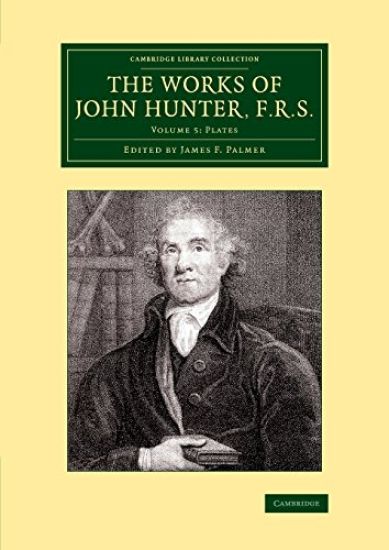
The surgeon and anatomist John Hunter (1728–93) left a famous legacy in the Hunterian Museum of medical specimens now in the Royal College of Surgeons, and in this collection of his writings, edited by James Palmer, with a biography by Drewry Ottley, published between 1835 and 1837. The first four volumes are of text, and the larger Volume 5 contains plates. Hunter had begun his career as a demonstrator in the anatomy classes of his brother William, before qualifying as a surgeon. He regarded surgery as evidence of failure - the mutilation of a patient who could not be cured by other means - and his studies of anatomy and natural history were driven by his belief that it was necessary to understand the normal physiological processes before attempting to cure the abnormal ones. Volume 5 contains the plates which accompany the works in the other volumes, along with notes.