
Kirjahaku
Etsi kirjoja tekijän nimen, kirjan nimen tai ISBN:n perusteella.
1000 tulosta hakusanalla Reid B. Locklin





This work has been selected by scholars as being culturally important, and is part of the knowledge base of civilization as we know it.This work is in the "public domain in the United States of America, and possibly other nations. Within the United States, you may freely copy and distribute this work, as no entity (individual or corporate) has a copyright on the body of the work.Scholars believe, and we concur, that this work is important enough to be preserved, reproduced, and made generally available to the public. We appreciate your support of the preservation process, and thank you for being an important part of keeping this knowledge alive and relevant.

This work has been selected by scholars as being culturally important, and is part of the knowledge base of civilization as we know it.This work is in the "public domain in the United States of America, and possibly other nations. Within the United States, you may freely copy and distribute this work, as no entity (individual or corporate) has a copyright on the body of the work.Scholars believe, and we concur, that this work is important enough to be preserved, reproduced, and made generally available to the public. We appreciate your support of the preservation process, and thank you for being an important part of keeping this knowledge alive and relevant.


Reproduction of the original. The publishing house Megali specialises in reproducing historical works in large print to make reading easier for people with impaired vision.

Reproduction of the original. The publishing house Megali specialises in reproducing historical works in large print to make reading easier for people with impaired vision.


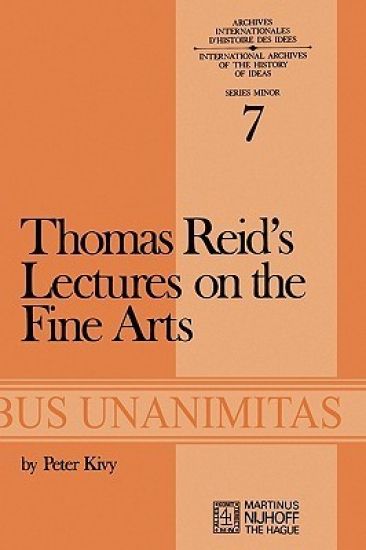
Thomas Reid’s Lectures on the Fine Arts
Kluwer Academic Publishers
1973
nidottu
The past few years have seen a revival of interest in Thomas Reid's philosophy. His moral theory has been studied by D. D. Raphael (The Moral Sense) and his entire philosophical position by S. A. Grave (The Scottish Philosophy of Common Sense). Prior to both, A. D. Woozley gave us the first modern reprint of Reid's Essays on the Intellectual Powers of Man - in fact the first edition of any work by Reid to appear in print since the Philosophical Works was edited in the nineteenth century by Sir William Hamilton. But Reid's aesthetic philosophy has not received its due. Woozley, in abridging the Essays, omitted the whole final essay, "On Taste," which is the only extended work on aesthetic theory that Reid ever published. Raphael, being interested primarily in Reid's moral theory, understand ably, treated aesthetics only as it was related to morality. And Grave, although he did present a short and very cogent resume of Reid's aes thetic position, obviously found himself drawn to other elements of Reid's philosophy. There are, of course, some accounts of Reid's aes thetic theory to be found in the various studies of eighteenth-century British aesthetics and criticism. None, however, appears to me to do any kind of justice to the philosophical questions which Reid treats in his aesthetics and philosophy of art.
I: BIOGRAPHICAL SKETCH OF REID Thomas Reid (1710-96) was born at Strachan in Kincardineshire, Scotland, not far from Aberdeen. Reid was fortunate in his family connections. For instance his mother's brother was David Gregory, Savilian professor of Astronomy at Oxford and close friend of Sir Isaac Newton. Reid entered Marischal College, Aberdeen, at the age of twelve after the usual spell in Aberdeen Grammar School. After a short period as college librarian he married his cousin Margaret Gregory, having gained the position of (Presbyterian) minister at New Machar, in the gift of King's College, Aberdeen, which he held from 1737 till 1752. Although Reid published only one paper, An Essay on Quantity, in this period he was far from intellectually idle; for one thing he familiarised himself with the works of Bishop Butler, especially The Analogy of Religion, which, together with those of Samuel Clarke and Isaac Newton, were to have a profound influence on his mature philosophy. In 1752 Reid was appointed a regent at King's College, Aberdeen. During his regency he not only founded a crucially important discussion group, 'The Wise Club', and familiarised himself with David Hume's A Treatise of Human Nature both through his own reading and by exhaustive discussion of it within the group; he also wrote extensively. He composed and delivered his seminal Latin Philosophical Orations.

Mayne Reid: A Memoir of his Life, has been acknowledged as a major work throughout human history, and we have taken precautions to assure its preservation by republishing this book in a modern manner for both present and future generations. This book has been completely retyped, revised, and reformatted. The text is readable and clear because these books are not created from scanned copies.

Spool Knitting, a classical book, was published more than a century ago and has been considered important throughout the human history, and so that this work is never forgotten we at Alpha Editions have made efforts in its preservation by republishing this book in a modern format for present and future generations. This whole book has been reformatted, retyped and designed. These books are not made of scanned copies of their original work and hence the text is clear and readable.

"Mayne Reid: A Memoir of His Life" by Elizabeth Hyde Reid offers an intimate look at the life of the renowned Irish adventure novelist and soldier. The memoir explores his early years in Ireland, where he was raised in a well-educated family with aspirations to enter the clergy. However, his adventurous spirit led him to a different path, one that took him to America in search of new experiences. The narrative captures his dynamic personality, from his childhood yearning for travel to his varied roles in America, including teaching and writing. It also highlights notable encounters, such as his friendship with Edgar Allan Poe, adding depth to Reid's literary journey. The memoir places a strong emphasis on Reid's role as both a writer and a soldier, particularly during his involvement in the Mexican-American War. Elizabeth Hyde Reid provides a detailed account of his life, shedding light on the influences that shaped his work and character. The memoir serves as a valuable resource for understanding not only Reid's literary contributions but also the personal experiences that influenced his writings and adventurous pursuits.
This book is meant to serve as an introduction to the philosophy of Thomas Reid by way of a study of certain themes central to that philosophy as we find it expounded in his extensive and influential published writings. The choice of these themes inevitably reflects philosophical interests of the author of this book to some extent but a main consideration behind their selection is that they are extensively treated by Reid in response to treatments by certain of his predecessors in an identifiable tradition called by Yolton 'The Way ofIdeas'. My interest in Reid's philosophy was first awakened by the brilliant writings of A.N. Prior, and in particular by Part II of his posthumous 'Objects of Thought' called 'What we think about' together with his suggestion that Reid was a precursor of Mill on the signification of proper names. It is my hope that the standard of exegesis and of discussion throughout the book, and especially in the case of these topics, is a not unworthy tribute to that thinker.
Rescuing A Dying Organization: Learn how to save your organization from an untimely demise with this new book by business educator Geary Reid
Geary Reid
Amazon Digital Services LLC - Kdp Print Us
2021
nidottu
Save your organization from going under with advice from business management expert Geary Reid. Seeing your organization falter can be terrifying. You may feel helpless and powerless as you watch all you have worked for start to come undone. With experience stemming from years of corporate leadership, Geary Reid offers this book of expert advice to assure you that it is possible to stop the death of your organization. With the help of straightforward comparisons, Reid illustrates the exact steps leaders must take to bring a business or organization back from the brink and ensure its ongoing survival.
Anthony Reid and the Study of the Southeast Asian Past
ISEAS
2012
nidottu
To celebrate Anthony Reid’s numerous and seminal contributions to the field of Southeast Asian history, a group of his colleagues and students has contributed essays for this Festschrift. In addition to introductory essays which provide personal and intellectual histories of Anthony Reid the man, there is a range of original scholarly contributions addressing historical issues which Reid has researched during his career. Divided into sections which examine Southeast Asia in the world, early modern Southeast Asia, and modern Southeast Asia, these works engage with issues ranging from the Age of Commerce and comparative Eurasian history, to nationalism, ethnic hybridity, Islam, technological change, and the Chinese and Arabs in Southeast Asia. The authors include some of the foremost historians of Southeast Asia in our generation.