Kirjojen hintavertailu. Mukana 12 595 353 kirjaa ja 12 kauppaa.

Kirjahaku

Etsi kirjoja tekijän nimen, kirjan nimen tai ISBN:n perusteella.

1000 tulosta hakusanalla Ridgley Torrence

Wheels

Wheels

Frances Ridley

Collins
2005
nidottu
Some wheels are big and some wheels are small. This exciting book is full of photos of all kinds of wheels: big and small, fat and thin, fast and slow, from skateboards to tractors, that children are sure to be curious about. Pink B/ Band 1B books offer simple, predictable texts with familiar objects and actions.Text type – A simple non-fiction text.A simple pictoral summary with captions on pages 14 and 15 provides an oppportunity to recap and discuss the information in the book.This book has been levelled for Reading Recovery
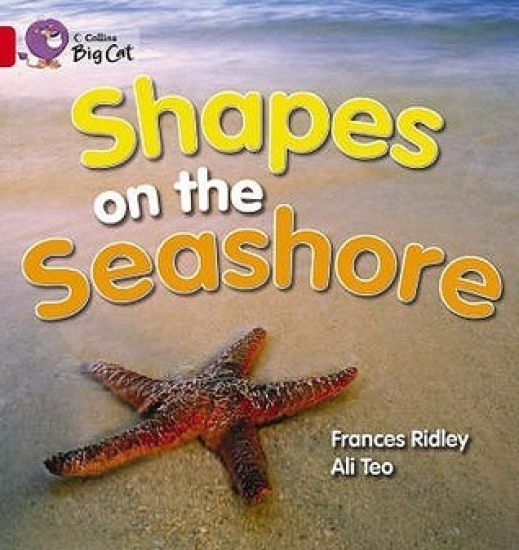
Shapes on the Seashore

Shapes on the Seashore

Frances Ridley

Collins
2005
nidottu
A boy and his mother go for a walk along the seashore and find all sorts of shapes. There’s a starfish shaped like a star, a pebble that’s an oval and a jellyfish that’s a circle. A combination of fascinating photos and delightful artwork show the variety of shapes that can be found. Red A/Band 2A books offer predictable text with familiar objects and actions, combined with simple story development.Text type – A simple recount.The shapes are repeated on pages 14 and 15 for children to recall and discuss.This book has been levelled for Reading Recovery.
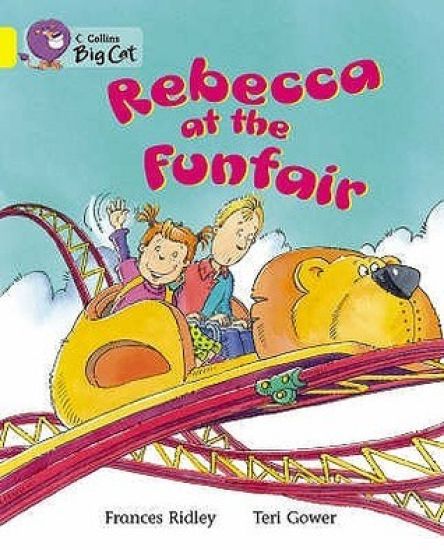
Rebecca at the Funfair

Rebecca at the Funfair

Frances Ridley

Collins
2005
nidottu
Rebecca went to the funfair with mum and dad. She didn’t like the hall of mirrors, and the rollercoaster made her turn green – but when she won lots of prizes on a stall, she decided that she liked it after all! The funny illustrations show Rebecca’s gradual change of opinion, and include lots of details for early readers to talk about. Yellow (Band 3) books offer varied sentence structure and natural langauge. This book is told in rhyme.Text type – A story with a familiar setting.A map of the fair is included on pages 14 and 15 which can be used to check comprehension.Curriculum links – Maths: Shape, space and measures.This book has been levelled for Reading Recovery
Francis Crick

Francis Crick

Matt Ridley

HARPERCOLLINS PUBLISHERS
2008
nidottu
Acclaimed author Matt Ridley traces the colourful life of the man who discovered the structure of DNA, the building blocks of life. Building on a biographical tradition that can be traced back to Aubrey's ‘Brief Lives’, Dr Johnson's ‘Lives of the Poets’ and Lytton Strachey's ‘Eminent Victorians’, this exciting and ground-breaking new series pairs great biographers, historians and novelists with iconic subjects, the writing bristling with original and distinctive points of view. On 28 February 1953, Francis Crick walked into the Eagle pub in Cambridge and announced that he and his American colleague James Watson ‘had found the secret of life’. In fact, they had indeed done so. That morning, Crick and Watson had worked out the structure of DNA (deoxyribonucleic acid). They had discovered its 'double helix' form, one which could replicate itself, confirming theories that it carried life's hereditary information. Matt Ridley's life of Crick begins with his birth in 1916 at the home of a shoe factory owner, his early explosive experiments at primary school and time developing torpedoes in the Navy. After his seismic DNA discovery, which won him the Nobel Prize before he'd even gained a PhD, the scientist's later work was rarely uncontroversial. From California, he proposed that life began when micro-organisms from another planet were dropped here by a spaceship sent to Earth, and maintained that the 'human soul' was entirely explicable in terms of brain activity. Matt Ridley's entertaining account traces the colourful and entirely original work behind one of mankind's greatest discoveries and displays the life of a scientist considered of the very first rank.
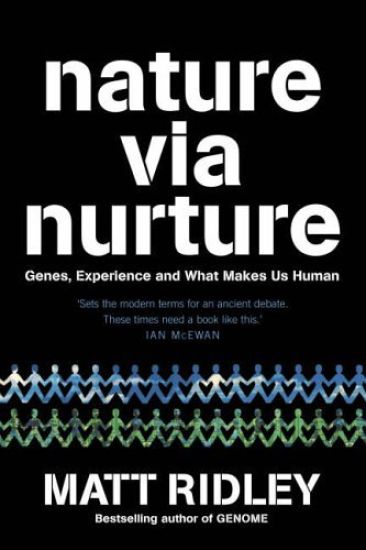
Nature via Nurture

Nature via Nurture

Matt Ridley

HARPERCOLLINS PUBLISHERS
2006
pokkari
Acclaimed author Matt Ridley's thrilling follow-up to his bestseller 'Genome'. Armed with the extraordinary new discoveries about our genes, Ridley turns his attention to the nature versus nurture debate to bring the first popular account of the roots of human behaviour.
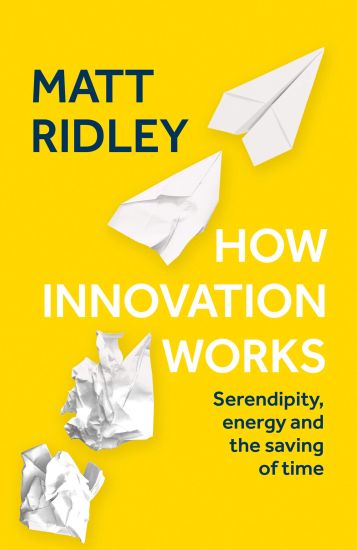
How Innovation Works

How Innovation Works

Matt Ridley

HARPERCOLLINS PUBLISHERS
2020
sidottu
'Ridley is spot-on when it comes to the vital ingredients for success' Sir James Dyson Building on his bestseller The Rational Optimist, Matt Ridley chronicles the history of innovation, and how we need to change our thinking on the subject.
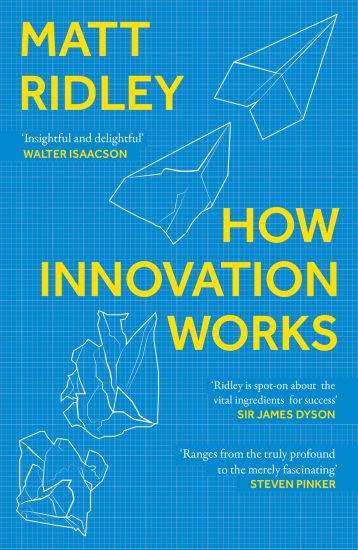
How Innovation Works

How Innovation Works

Matt Ridley

Fourth Estate Ltd
2021
nidottu
‘Ridley is spot-on when it comes to the vital ingredients for success’ Sir James Dyson Building on his bestseller The Rational Optimist, Matt Ridley chronicles the history of innovation, and how we need to change our thinking on the subject. Innovation is the main event of the modern age, the reason we experience both dramatic improvements in our living standards and unsettling changes in our society. It is innovation that will shape the twenty-first century. Yet innovation remains a mysterious process, poorly understood by policy makers and businessmen alike. Matt Ridley argues that we need to see innovation as an incremental, bottom-up, fortuitous process that happens as a direct result of the human habit of exchange, rather than an orderly, top-down process developing according to a plan. Innovation is crucially different from invention, because it is the turning of inventions into things of practical and affordable use to people. It speeds up in some sectors and slows down in others. It is always a collective, collaborative phenomenon, involving trial and error, not a matter of lonely genius. It still cannot be modelled properly by economists, but it can easily be discouraged by politicians. Far from there being too much innovation, we may be on the brink of an innovation famine. Ridley derives these and other lessons from the lively stories of scores of innovations – from steam engines to search engines – how they started and why they succeeded or failed.
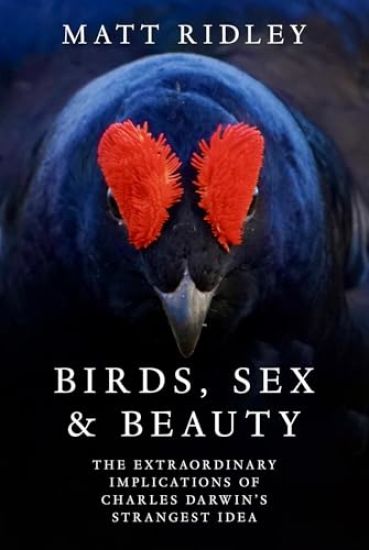
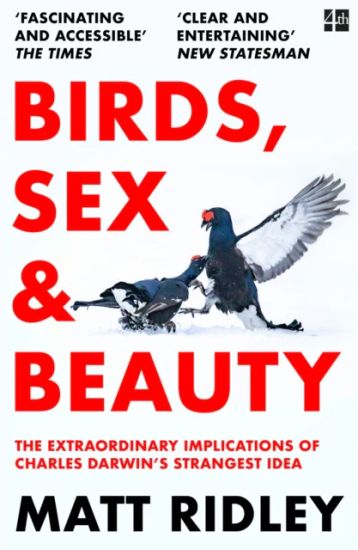
Birds, Sex and Beauty

Birds, Sex and Beauty

Matt Ridley

HARPERCOLLINS PUBLISHERS
2025
sidottu
In his new book, acclaimed science writer Matt Ridley looks to the peculiar mating rituals of birds to better understand the rich origins and ongoing significance of Darwin's sexual selection theory. 'FASCINATING' The Times ‘Matt Ridley is one of our finest science writers … A treat for bird lovers and evolutionary biologists alike’ Richard Dawkins Animals rarely treat sex as a simple or mutually beneficial transaction. Choosing a mate is often a transcendent event to be approached with reverence, suspicion, angst and quite a bit of violence. For Matt Ridley, nowhere is this more acute than in birds. From a freezing hide on the Pennine moors at dawn, Ridley closely studies the rare Black Grouse. He is there for the lek – an elaborate courtship ritual of squabbling and strutting males. They dance and sing for hours each day to attract a mate over several months. With most males leaving exhausted and unsuccessful, Ridley looks at how females make their choice to cast fresh light on how such rituals have evolved and why. His pursuit follows five generations of biologists from Darwin and Wallace to the present day, uncovering how they have grappled with the implications of sexual selection as an eccentric, gonzo form of evolution. While most Victorian scientists found it impossible to believe female birds could select mates, Darwin was obsessed with the idea of sexual as well as natural selection. Drawing on his own lifelong passion, Ridley eavesdrops on the elaborate displays of bird species around the world, from the complex art installations made by Bowerbirds in Australia to the bubbling calls of Curlews in the UK’s declining moorlands. In a wonderful blend of nature writing and elegant exploration of recent evolutionary theory, Birds, Sex and Beauty shows not only how mate choice has shaped the natural world, including humans, but how the song and plumage of birds can be thrillingly, breathtakingly beautiful. ‘Clear and entertaining … Ridley explains all this history with lucidity and wit’New Statesman ‘Most of this fascinating and accessible book is about birds … Ridley, very clearly, loves birds — and the enthusiasm is infectious’The Times ‘This is a fascinating story told with wit, scholarship and the passion of a true conversationist. Lord Ridley writes in the best tradition of great British naturalists’ Country Life ‘Birds, Sex & Beauty is a good read. It is a compelling history of sexual selection, rather than a synthesis that moves the field forwards’Nature
Birds, Sex and Beauty

Birds, Sex and Beauty

Matt Ridley

HARPERCOLLINS PUBLISHERS
2025
nidottu
In his new book, acclaimed science writer Matt Ridley looks to the peculiar mating rituals of birds to better understand the rich origins and ongoing significance of Darwin's sexual selection theory.'Matt Ridley is one of our finest science writers ... A treat for bird lovers and evolutionary biologists alike' Richard Dawkins
The Agile Gene: How Nature Turns on Nurture
A historical analysis of the nature-versus-nurture debate documents the 2001 discovery that there are fewer genes in a human genome than previously thought and considers the argument that nurture elements are also largely responsible for human behavior. Originally published as Nature Via Nurture. Reprint.
The Red Queen: Sex and the Evolution of Human Nature
"A terrific book, witty and lucid, and brimming with provocative conjectures." (Wall Street Journal) from the author of the acclaimed New York Times bestseller GenomeBrilliantly written, The Red Queen compels us to rethink everything from the persistence of sexism to the endurance of romantic love.Referring to Lewis Carroll's Red Queen from Through the Looking-Glass, a character who has to keep running to stay in the same place, Matt Ridley demonstrates why sex is humanity's best strategy for outwitting its constantly mutating internal predators. The Red Queen answers dozens of other riddles of human nature and culture--including why men propose marriage, the method behind our maddening notions of beauty, and the disquieting fact that a woman is more likely to conceive a child by an adulterous lover than by her husband. The Red Queen offers an extraordinary new way of interpreting the human condition and how it has evolved.
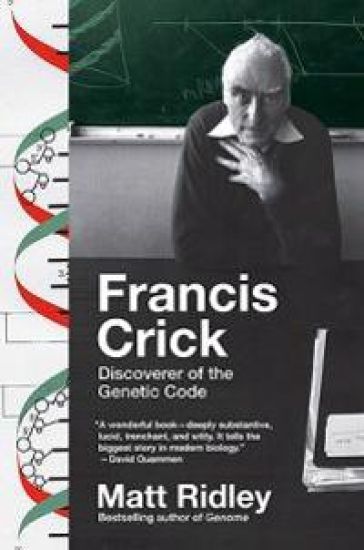
Francis Crick: Discoverer of the Genetic Code
Part of the acclaimed Eminent Lives series, Francis Crick is the first biography of the eminent scientist, co-discoverer of the double helix structure of DNA. Written by Matt Ridley, the award-winning author of the national bestseller Genome, Francis Crick traces his life from middle class mediocrity in the English Midlands through a lackluster education and six years designing magnetic mines for the Royal Navy to his leap into biology at the age of 31 and his enormous success, providing "a considerably more complete and colorful portrait of Crick than has existed before." (New York Times)
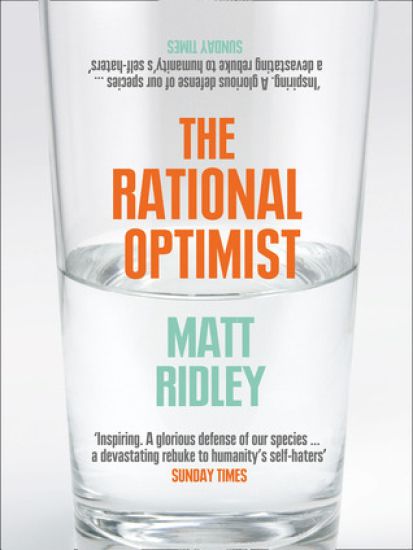
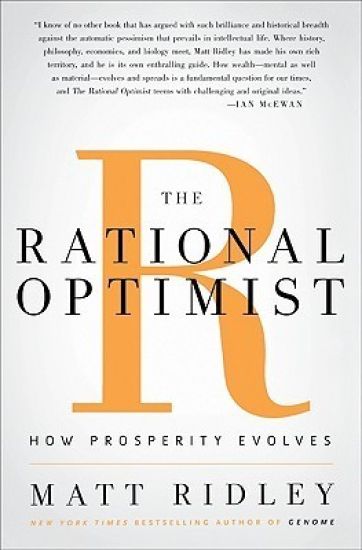
The Rational Optimist: How Prosperity Evolves
"Ridley writes with panache, wit, and humor and displays remarkable ingenuity in finding ways to present complicated materials for the lay reader." -- Los Angeles Times In a bold and provocative interpretation of economic history, Matt Ridley, the New York Times-bestselling author of Genome and The Red Queen, makes the case for an economics of hope, arguing that the benefits of commerce, technology, innovation, and change--what Ridley calls cultural evolution--will inevitably increase human prosperity. Fans of the works of Jared Diamond (Guns, Germs, and Steel), Niall Ferguson (The Ascent of Money), and Thomas Friedman (The World Is Flat) will find much to ponder and enjoy in The Rational Optimist.
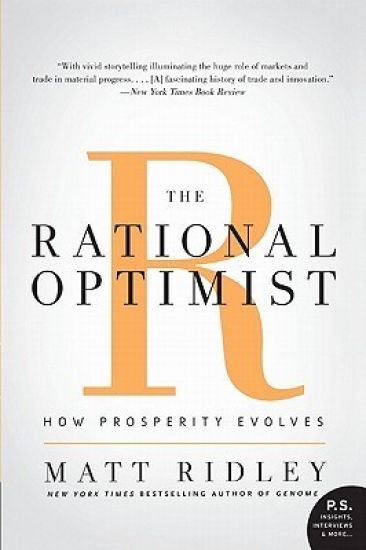
The Rational Optimist: How Prosperity Evolves
"A delightful and fascinating book filled with insight and wit, which will make you think twice and cheer up." -- Steven PinkerIn a bold and provocative interpretation of economic history, Matt Ridley, the New York Times-bestselling author of Genome and The Red Queen, makes the case for an economics of hope, arguing that the benefits of commerce, technology, innovation, and change--what Ridley calls cultural evolution--will inevitably increase human prosperity. Fans of the works of Jared Diamond (Guns, Germs, and Steel), Niall Ferguson (The Ascent of Money), and Thomas Friedman (The World Is Flat) will find much to ponder and enjoy in The Rational Optimist.For two hundred years the pessimists have dominated public discourse, insisting that things will soon be getting much worse. But in fact, life is getting better--and at an accelerating rate. Food availability, income, and life span are up; disease, child mortality, and violence are down all across the globe. Africa is following Asia out of poverty; the Internet, the mobile phone, and container shipping are enriching people's lives as never before.An astute, refreshing, and revelatory work that covers the entire sweep of human history--from the Stone Age to the Internet--The Rational Optimist will change your way of thinking about the world for the better.
Morning of Fire

Morning of Fire

Scott Ridley

William Morrow Company
2011
nidottu
Morning of Fire by Scott Ridley is the thrilling story of 18th century American explorer and expeditioner John Kedrick as he journeyed for land and trade in the Pacific. Set against the backdrop of one of the most exciting and uncertain times in world history, John Kendrick's odyssey aboard his sailing ship Lady Washington carries him from the shores of New England across the unexplored waters of the Pacific Northwest to the contentious ports of China and the war-ravaged islands of Hawaii, all while avoiding intrigues and traps from the British and the Spanish. Morning of Fire is riveting American and naval history that brings the era of George Washington, John Adams, and Thomas Jefferson gloriously alive--a tale of danger, adventure, and discovery that fans of Nathaniel Philbrick will not want to miss.
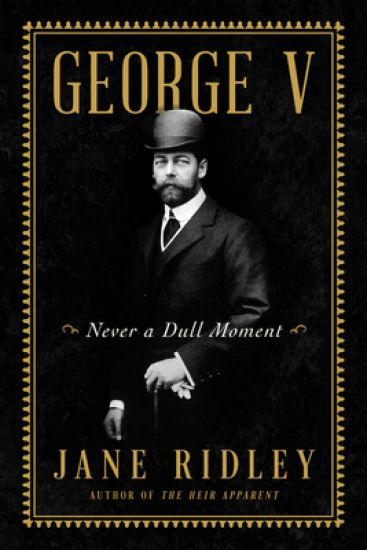
George V: Never a Dull Moment
From one of the most beloved and distinguished historians of the British monarchy, here is a lively, intimately detailed biography of a long-overlooked king who reimagined the Crown in the aftermath of World War I and whose marriage to the regal Queen Mary was an epic partnershipThe grandfather of Queen Elizabeth II, King George V reigned over the British Empire from 1910 to 1936, a period of unprecedented international turbulence. Yet no one could deny that as a young man, George seemed uninspired. As his biographer Harold Nicolson famously put it, "he did nothing at all but kill animals and stick in stamps." The contrast between him and his flamboyant, hedonistic, playboy father Edward VII could hardly have been greater.However, though it lasted only a quarter-century, George's reign was immensely consequential. He faced a constitutional crisis, the First World War, the fall of thirteen European monarchies and the rise of Bolshevism. The suffragette Emily Davison threw herself under his horse at the Derby, he refused asylum to his cousin the Tsar Nicholas II during the Russian Revolution, and he facilitated the first Labour government. And, as Jane Ridley shows, the modern British monarchy would not exist without George; he reinvented the institution, allowing it to survive and thrive when its very existence seemed doomed. The status of the British monarchy today, she argues, is due in large part to him.How this supposedly limited man managed to steer the crown through so many perils and adapt an essentially Victorian institution to the twentieth century is a great story in itself. But this book is also a riveting portrait of a royal marriage and family life. Queen Mary played a pivotal role in the reign as well as being an important figure in her own right. Under the couple's stewardship, the crown emerged stronger than ever. George V founded the modern monarchy, and yet his disastrous quarrel with his eldest son, the Duke of Windsor, culminated in the existential crisis of the Abdication only months after his death.Jane Ridley has had unprecedented access to the archives, and for the first time is able to reassess in full the many myths associated with this crucial and dramatic time. She brings us a royal family and world not long vanished, and not so far from our own.
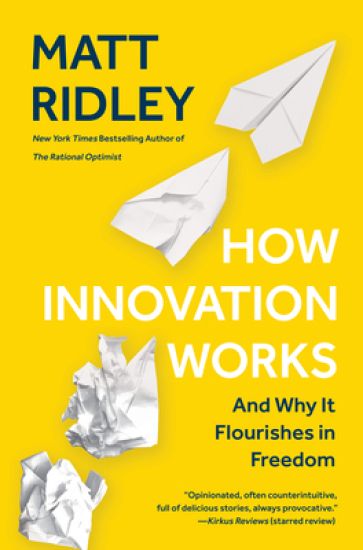
How Innovation Works: And Why It Flourishes in Freedom
Building on his national bestseller The Rational Optimist, Matt Ridley chronicles the history of innovation, and how we need to change our thinking on the subject.Innovation is the main event of the modern age, the reason we experience both dramatic improvements in our living standards and unsettling changes in our society. Forget short-term symptoms like Donald Trump and Brexit, it is innovation that will shape the twenty-first century. Yet innovation remains a mysterious process, poorly understood by policy makers and businessmen alike.Matt Ridley argues that we need to see innovation as an incremental, bottom-up, fortuitous process that happens as a direct result of the human habit of exchange, rather than an orderly, top-down process developing according to a plan. Innovation is crucially different from invention, because it is the turning of inventions into things of practical and affordable use to people. It speeds up in some sectors and slows down in others. It is always a collective, collaborative phenomenon, involving trial and error, not a matter of lonely genius. It happens mainly in just a few parts of the world at any one time. It still cannot be modeled properly by economists, but it can easily be discouraged by politicians. Far from there being too much innovation, we may be on the brink of an innovation famine.Ridley derives these and other lessons from the lively stories of scores of innovations, how they started and why they succeeded or failed. Some of the innovation stories he tells are about steam engines, jet engines, search engines, airships, coffee, potatoes, vaping, vaccines, cuisine, antibiotics, mosquito nets, turbines, propellers, fertilizer, zero, computers, dogs, farming, fire, genetic engineering, gene editing, container shipping, railways, cars, safety rules, wheeled suitcases, mobile phones, corrugated iron, powered flight, chlorinated water, toilets, vacuum cleaners, shale gas, the telegraph, radio, social media, block chain, the sharing economy, artificial intelligence, fake bomb detectors, phantom games consoles, fraudulent blood tests, hyperloop tubes, herbicides, copyright, and even life itself.