Kirjojen hintavertailu. Mukana 11 244 527 kirjaa ja 12 kauppaa.

Kirjahaku

Etsi kirjoja tekijän nimen, kirjan nimen tai ISBN:n perusteella.

1000 tulosta hakusanalla Rodney Simpson

The Quantum Theory of Light

The Quantum Theory of Light

Rodney Loudon

Oxford University Press
2000
sidottu
This third edition, like its two predecessors, provides a detailed account of the basic theory needed to understand the properties of light and its interactions with atoms, in particular the many nonclassical effects that have now been observed in quantum-optical experiments. The earlier chapters describe the quantum mechanics of various optical processes, leading from the classical representation of the electromagnetic field to the quantum theory of light. The later chapters develop the theoretical descriptions of some of the key experiments in quantum optics. Over half of the material in this third edition is new. It includes topics that have come into prominence over the last two decades, such as the beamsplitter theory, squeezed light, two-photon interference, balanced homodyne detection, travelling-wave attenuation and amplification, quantum jumps, and the ranges of nonliner optical processes important in the generation of nonclassical light. The book is written as a textbook, with the treatment as a whole appropriate for graduate or postgraduate students, while earlier chapters are also suitable for final- year undergraduates. Over 100 problems help to intensify the understanding of the material presented.
Choosing a Prime Minister

Choosing a Prime Minister

Rodney Brazier

Oxford University Press
2020
sidottu
When the door closes on one prime minister's rule, what happens next? General elections are only one possible way to enter 10 Downing Street. Using all relevant constitutional conventions, precedents, non-legal codes, historical events, and laws, this title offers a comprehensive account of all the circumstances in which the premiership is attained and lost. Over seven chapters, this book follows the sequence of events starting with how a prime minister can lose office, continues on to examine the procedures that then have to be followed, and considers at length the ways in which a politician can become leader of the country. Also explored are the possible emergencies, such as the sudden serious illness or even death of a prime minister, and their constitutional responses. This book concludes by looking at whether the procedures discussed could be set out in an authoritative and user-friendly code, and a sample one is suggested. Covering historical examples and modern turmoil, this book in an essential guide for understanding the rules and processes involved in choosing a prime minister.
Constitutional Reform

Constitutional Reform

Rodney Brazier

Oxford University Press
2008
nidottu
The third edition of Constitutional Reform examines central government, Parliament, and the judiciary in Britain and proposes an agenda for reform. In addition to issues such as voting reform, reform of House of Lords and how citizens' rights might be better protected, the book considers the best methods through which such changes should be achieved and provides material for the international comparison of constitutions. Whilst the book has been fully revised and updated to provide a retrospective analysis of the major constitutional reforms of Tony Blair's premiership, it is not limited to that government's agenda and includes material on previous government's reforms and Gordon Brown's reform agenda. The third edition includes two new chapters, one on the structure and possible future of the United Kingdom and the other on whether the United Kingdom should adopt a codified constitution. It retains the clarity and lucid writing style of previous editions and features an expanded bibliography enabling readers to follow up points of particular interest. The book provides detailed coverage of British constitutional reform in the early twenty-first century and whilst aimed primarily at students of constitutional law, politics and government, it will also be of interest to the general reader.
After Modernity

After Modernity

Rodney Harrison; John Schofield

Oxford University Press
2010
sidottu
This book summarizes archaeological approaches to the contemporary past, and suggests a new agenda for the archaeology of late modern societies. The principal focus is the archaeology of developed, de-industrialized societies during the second half of the twentieth century and the beginning of the twenty-first. This period encompasses the end of the Cold War and the beginning of the 'internet age', a period which sits firmly within what we would recognize to be a period of 'lived and living memory'. Rodney Harrison and John Schofield explore how archaeology can inform the study of this time period and the study of our own society through detailed case studies and an in-depth summary of the existing literature. Their book draws together cross-disciplinary perspectives on contemporary material culture studies, and develops a new agenda for the study of the materiality of late modern societies.
After Modernity

After Modernity

Rodney Harrison; John Schofield

Oxford University Press
2010
nidottu
This book summarizes archaeological approaches to the contemporary past, and suggests a new agenda for the archaeology of late modern societies. The principal focus is the archaeology of developed, de-industrialized societies during the second half of the twentieth century and the beginning of the twenty-first. This period encompasses the end of the Cold War and the beginning of the 'internet age', a period which sits firmly within what we would recognize to be a period of 'lived and living memory'. Rodney Harrison and John Schofield explore how archaeology can inform the study of this time period and the study of our own society through detailed case studies and an in-depth summary of the existing literature. Their book draws together cross-disciplinary perspectives on contemporary material culture studies, and develops a new agenda for the study of the materiality of late modern societies.
How Media Ownership Matters

How Media Ownership Matters

Rodney Benson; Mattias Hessérus; Timothy Neff; Julie Sedel

OXFORD UNIVERSITY PRESS INC
2025
sidottu
Does it matter who owns and funds the media? As journalists and management consultants set off in search of new business models, there's a pressing need to understand anew the economic underpinnings of journalism and its role in democratic societies. How Media Ownership Matters provides a fresh approach to understanding news media power, moving beyond the typical emphasis on market concentration or media moguls. Through a comparative analysis of the US, Sweden, and France, as well as interviews of news executives and editors and an original collection of industry data, this book maps and analyzes four ownership models: market, private, civil society, and public. Highlighting the effects of organizational logics, funding, and target audiences on the content of news, the authors identify both the strengths and weaknesses various forms of ownership have in facilitating journalism that meets the democratic ideals of reasoned, critical, and inclusive public debate. Ultimately, How Media Ownership Matters provides a roadmap to understanding how variable forms of ownership are shaping the future of journalism and democracy.
How Media Ownership Matters

How Media Ownership Matters

Rodney Benson; Mattias Hessérus; Timothy Neff; Julie Sedel

OXFORD UNIVERSITY PRESS INC
2025
nidottu
Does it matter who owns and funds the media? As journalists and management consultants set off in search of new business models, there's a pressing need to understand anew the economic underpinnings of journalism and its role in democratic societies. How Media Ownership Matters provides a fresh approach to understanding news media power, moving beyond the typical emphasis on market concentration or media moguls. Through a comparative analysis of the US, Sweden, and France, as well as interviews of news executives and editors and an original collection of industry data, this book maps and analyzes four ownership models: market, private, civil society, and public. Highlighting the effects of organizational logics, funding, and target audiences on the content of news, the authors identify both the strengths and weaknesses various forms of ownership have in facilitating journalism that meets the democratic ideals of reasoned, critical, and inclusive public debate. Ultimately, How Media Ownership Matters provides a roadmap to understanding how variable forms of ownership are shaping the future of journalism and democracy.
On Rules, Politics and Knowledge

On Rules, Politics and Knowledge

Rodney Bruce Hall; Nicholas Onuf; Cecelia Lynch; Oliver Kessler

Palgrave Macmillan
2010
sidottu
Interrogates and extends Friedrich Kratochwil's pathbreaking work on knowledge, normative phenomena, and political practice in international relations. Contributors reflect on the ways in which normative phenomena, politics, and knowledge claims are linked in practice.
National Collective Identity

National Collective Identity

Rodney Bruce Hall

Columbia University Press
1999
pokkari
With the dissolution of Cold War tensions, as new states take shape around the world and as nationalist and ethnic conflicts come to characterize the international order, questions of national identity have become pivotal for peacekeepers, policymakers, and scholars. In National Collective Identity, Rodney Hall illustrates how centuries-old dynastic traditions have been replaced in the modern era by nationalist and ethnic identity movements.This book delineates three epochal changes in the international system: from the medieval, feudal-theocratic order to the dynastic-sovereign system in the sixteenth century, the territorial sovereign system in the seventeenth century, and finally, after the American and French Revolutions, the national sovereign system. In rich historical detail, this book reexamines a broad spectrum of international conflicts--including the Seven Years War, the Napoleonic wars, the Franco-Prussian War, the First World War, and the Cold War and its aftermath--in terms of the shifting sands of state identities through time.Arguing for the need to make a clear distinction between nation and state--one that has largely been overlooked in recent international relations studies on nationalism--Hall shows how an understanding of this dichotomy can help forecast the development of new states over time. National Collective Identity ascribes transformative power to social actors rather than viewing them as merely conditioned by the self-perpetuating logic of the state. In so doing, Hall presents a new theoretical model that accounts for human agency as an integral component of national systems.
The Rise of Mormonism

The Rise of Mormonism

Rodney Stark

Columbia University Press
2005
sidottu
Will Mormonism be the next world faith, one that will rival Catholicism, Islam, and other major religions in terms of numbers and global appeal? This was the question Rodney Stark addressed in his much-discussed and much-debated article, "The Rise of a New World Faith" (1984), one of several essays on Mormonism included in this new collection. Examining the religion's growing appeal, Rodney Stark concluded that Mormons could number 267 million members by 2080. In what would become known as "the Stark argument," Stark suggested that the Mormon Church offered contemporary sociologists and historians of religion an opportunity to observe a rare event: the birth of a new world religion. In the years following that article, Stark has become one of the foremost scholars of Mormonism and the sociology of religion. This new work, the first to collect his influential writings on the Mormon Church, includes previously published essays, revised and rewritten for this volume. His work sheds light on both the growth of Mormonism and on how and why certain religions continue to grow while others fade away. Stark examines the reasons behind the spread of Mormonism, exploring such factors as cultural continuity with the faiths from which it seeks converts, a volunteer missionary force, and birth rates. He explains why a demanding faith like Mormonism has such broad appeal in today's world and considers the importance of social networks in finding new converts. Stark's work also presents groundbreaking perspectives on larger issues in the study of religion, including the nature of revelation and the reasons for religious growth in an age of modernization and secularization.
The Seaford Axe Hoard

The Seaford Axe Hoard

Rodney Castleden

Lulu.com
2018
pokkari
The fascinating story of the discovery and rediscovery of a unique prehistoric stone axe hoard. The 15 flint axes were found in 1986, but then forgotten and only displayed as a hoard in 2014, when their national importance was recognized. Hoards like this are very rare. Where were the axes made? By a remarkable coincidence, the factory where they were manufactured was also discovered in 2014, very close at hand. Neolithic Seaford is re-created in new maps. From all the evidence it is possible to reconstruct what it was like to live in Sussex five thousand years ago. Royal paperback, 134 pages, 49 b&w illustrations.
Cambrian Intelligence

Cambrian Intelligence

Rodney A. Brooks

Bradford Books
1999
pokkari
Until the mid-1980s, AI researchers assumed that an intelligent system doing high-level reasoning was necessary for the coupling of perception and action. In this traditional model, cognition mediates between perception and plans of action. Realizing that this core AI, as it was known, was illusory, Rodney A. Brooks turned the field of AI on its head by introducing the behavior-based approach to robotics. The cornerstone of behavior-based robotics is the realization that the coupling of perception and action gives rise to all the power of intelligence and that cognition is only in the eye of an observer. Behavior-based robotics has been the basis of successful applications in entertainment, service industries, agriculture, mining, and the home. It has given rise to both autonomous mobile robots and more recent humanoid robots such as Brooks' Cog.This book represents Brooks' initial formulation of and contributions to the development of the behavior-based approach to robotics. It presents all of the key philosophical and technical ideas that put this "bottom-up" approach at the forefront of current research in not only AI but all of cognitive science.
The Social and Political Implications of the 1984 Jesse Jackson Presidential Campaign
Part of the Praeger Series in Political Economy, this volume assembles prominent political scientists, sociologists, economists, historians, anthropologists, theologians, and journalists to examine the intricacies of the ground-breaking 1984 campaign for president by Jesse Jackson. As no other studies have done, this book explores the social and cultural context of the evolving political process in which the campaign took shape. The contributors study the campaign in a broad social and cultural context that helps to explain the campaign's strengths and weaknesses. The book's interdisciplinary approach reveals the economic, sociological, and political ramifications of the first serious run for the presidency by an African-American. Students and scholars of political science, sociology, anthropology, and communications, as well as professionals in the fields of journalism, public relations, and campaign consulting, will find this book enlightening reading.The volume explores a broad range of issues in terms of how they relate to Jackson's historical run for president, including: racial equity questions; educational and economic opportunity for minorities; family stability in minority communities; community development; and Third World politics. The contributors come to a number of conclusions about the future of politics for minority candidates. Some suggest that future campaigns by Jackson, or any minority candidate, will run into more difficulty inside the political parties than did Jackson's. Others suggest that the 1984 campaign represents a radicalization of the black and progressive American voter. The future, according to this provocative book, holds difficulty for both the Democratic and Republican parties as their candidates, whatever race or religion, bridge the ideological gaps dividing the voters.
Jimmy Carter as Peacemaker

Jimmy Carter as Peacemaker

Rodney L Troester

Praeger Publishers Inc
1996
sidottu
Jimmy Carter left the White House in January of 1981 in the wake of the Iranian hostage crisis, a faltering economy, and a stunning defeat at the polls. At the relatively young age of 56, Carter joined the elite fraternity of former presidents. When contemporary U.S. presidents have left office, they have generally written their memoirs, established their presidential libraries, served on corporate boards, or assumed elder statesman roles. Jimmy Carter has taken a different path, and this study demonstrates how the Carter post-presidency has redefined the role of former president and refurbished Carter's image. The author argues that Carter has shown that through active involvement in world affairs and humanitarian causes, and through the careful investment of post-presidential credibility and political capital, a former president can make significant contributions to a more peaceful world.
Lockerbie

Lockerbie

Rodney Wallis

Praeger Publishers Inc
2000
sidottu
The explosion of Pan Am Flight 103 over Lockerbie, Scotland, in December 1988, should never have happened. Wallis, who has extensive, direct, personal knowledge of aviation security matters gained from his position at the crossroads of security information and the industry's endeavors to combat aviation terrorism, had warned the industry one year before the bombing that the interline element of baggage represented the prime opportunity for terrorist activity and had urged the adoption of passenger and baggage matching, a system that he had helped to develop. Mandated by the FAA for use at high risk airports, it was the feature missing from Pan Am's activity at Frankfort, an omission so cruelly exploited by the bombers. Wallis argues that the priority given by governments to technological solutions to the continuing terrorist threat puts the flying public at unnecessary risk every day.This volume brings together all of the facts surrounding the sabotage of Flight 103, including the investigation and the civil litigation in which so much of the story unfolded for the first time. It uncovers the fundamental weaknesses in Pan Am's communication and management policies. Wallis supports the policy that politics are politics and explores the possibility that U.S. and U.K. policy towards a neutral trial for the two Libyans indicted for the bombing, which may have been affected by the wider scenario of Middle East politics rather than simple justice for the victims of Lockerbie. Although the tragedy has led to improvements in defense technology for use against acts of aviation sabotage, these methods have yet to be applied universally.
The Infernal Return

The Infernal Return

Rodney Farnsworth

Praeger Publishers Inc
2001
sidottu
George Lukas and other leading filmmakers acknowledge their indebtedness to mythographic scholarship on archetypes. In his new study, author Rodney Farnsworth identifies a pattern of filmmakers' obsessions with archetypical rituals centered on sacrifice and the family in films made between 1977 and 1983, a period of political upheaval on both sides of the Atlantic. Combining a strong historical reading of the films in a sociopolitical context and utilizing Queer Theory as a framework for his arguments, Farnsworth offers a close examination of key films of the period, including works by Stanley Kubrick, Robert Altman, and Francis Ford Coppola, and provides a fascinating and timely glimpse of an important political and cinematic time. Marking the end of a more liberal era, the late seventies and early eighties witnessed the growth of reactionary conservative movements such as the New Religious Political Right. These were the years that gave birth to movies--from esoteric art-house pictures to blockbusters such as Star Wars--that seemed in many cases to be adaptations of primordial mythology, subverting liberal-to-moderate views into reactionary depictions of family life. Although filmmakers had turned to these myths to shape their works, Farnsworth observes, the unstable, volatile nature of the archetypes deconstructed their best social intentions into something rich, strange, and deadly. This thought-provoking work will be of interest to students of social history as well as film studies.
How Safe Are Our Skies?

How Safe Are Our Skies?

Rodney Wallis

Praeger Publishers Inc
2003
sidottu
The September 11, 2001, attacks on the World Trade Center and the Pentagon raised numerous questions about American and international aviation security. Former Director of Security of the International Air Transport Association Rodney Wallis suggests that the failure to maximize U.S. domestic air security, which left air travelers vulnerable to attack, lay largely with the carriers themselves. He contends that future policies should parallel the standards of the International Civil Aviation Organization. Wallis considers the Aviation and Transportation Security Act adopted by the U.S. Congress in the wake of September 11 and offers a modus operandi to the FAA that would enable them to maximize the benefits this legislation provides to air travelers.This important work reviews past government reactions to the threat posed by air terrorism and questions whether these were effective responses or merely window dressing. It also includes practical advice for air travelers on how to maximize their own security when flying on international routes by monitoring airport and airline security for themselves.
Leading Your Business to the Next Level

Leading Your Business to the Next Level

Rodney Page; Peter Tosh

Praeger Publishers Inc
2005
sidottu
Companies that have survived the perils of startup face an entirely new and different set of challenges as the firm prospers and grows. For owners, executives, managers, and employees alike, the evolution of an enterprise from entrepreneurship to maturity is aruduous and requires a talent for managing constant change, both in the marketplace and in the company itself. Setting your company on a trajectory of profitable growth—and getting past that crucial break—even point—requires fundamentally different strategies, skills, and techniques from what worked in startup mode. Any forewarning puts entrepreneurial leaders ahead in coping with the obstacles over the next hill. Leading Your Business to the Next Level provides that forewarning and offers practical management approaches that will make the growth journey less hazardous and more rewarding. Drawing from the authors' combined 70+ years of experience working in and consulting to high-growth organizations, the book provides a toolkit for navigating the transition from the chaos, intensity, and informality of the startup to the relative order of the more established firm. Through illustrative case examples and interactive elements, including checklists and diagnostics, they demonstrate how mastery of six core disciplines is the key to achieving and sustaining profitable growth: * enhancing customer loyalty; * dynamic planning and budgeting; * executing the business plan; * maximizing leadership effectiveness; * changing the emphasis from sales/revenue to margin/profit; * positioning human resource management as a strategic asset. In an environment where over 50% of small businesses fail in the first year and 95% within five years, Leading Your Businesss to the Next Level will help you and your organization make the critical transition from startup to mature and growing business.Illustrative case examples and many interactive elements, including diagnostic assessments, the book provides a toolkit for navigating such challenges as: setting the right pace for growth extending product and service linesshifting from sales and revenue generation to margins and profitsreinforcing customer loyalty making the transition from informal to more process-oriented management practices
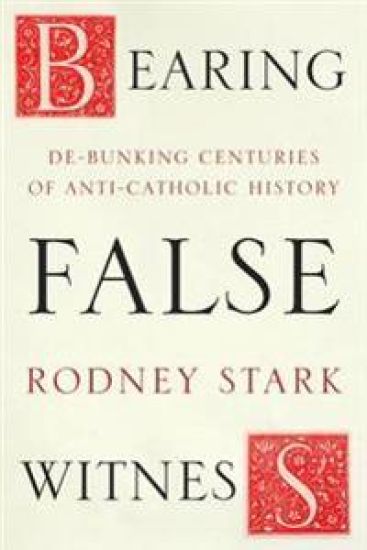
Bearing False Witness

Bearing False Witness

Rodney Stark

SPCK Publishing
2017
pokkari
The following historical statements all appear in well-established textbooks, and have become part of our common culture. Which of them would you say are true? * The Catholic Church incited and actively colluded in nearly two millennia of anti-Semitic violence, and Pope Pius XII is still rightfully known as ‘Hitler’s Pope’. * Only recently have we become aware of ancient and remarkably enlightened Christian gospels, which narrow-minded Catholic authorities tried to suppress. * Once in power as the official Church of Rome, Christians quickly and brutally persecuted paganism out of existence. * The fall of Rome and the ascendancy of the Church precipitated Europe’s decline into a millennium of ignorance and backwardness, which lasted until the Renaissance. * Initiated by the pope, the Crusades were but the first bloody chapter in the history of unprovoked and brutal Christian colonialism. * The Spanish Inquisition tortured and murdered huge numbers of innocent people for ‘imaginary’ crimes, such as witchcraft and blasphemy. * The Catholic Church persecuted and tried to suppress scientists such as Galileo, and the Scientific ‘Revolution’ therefore occurred mainly in more tolerant Protestant societies. * Being entirely comfortable with slavery, the Catholic Church did nothing to oppose its introduction in the New World, or to make it more humane. * Until very recently, Catholicism’s hierarchical view of the ideal state has resulted in its bitter resistance to all efforts to establish more liberal governments and its eager support for right-wing dictators. * It was the Protestant Reformation that broke the repressive Catholic grip on progress and ushered in capitalism, religious freedom and the modern world. In this powerful and persuasive book Rodney Stark subjects these and other widely-held beliefs to a rigorous historical assessment. He gives a compelling account of how each of them became accepted as the conventional wisdom, how egotism and ideology often worked together to create false or highly distorted pictures of people and events, and how we need to work hard to recover the truth if we’re to undo the cultural damage that centuries of anti-Catholic history has done.