Kirjojen hintavertailu. Mukana 12 390 323 kirjaa ja 12 kauppaa.

Kirjahaku

Etsi kirjoja tekijän nimen, kirjan nimen tai ISBN:n perusteella.

1000 tulosta hakusanalla Walter Lippmann

Walter Benjamin and the Aesthetics of Power

Walter Benjamin and the Aesthetics of Power

Lutz Koepnick

University of Nebraska Press
1999
sidottu
Walter Benjamin and the Aesthetics of Power explores Walter Benjamin's seminal writings on the relationship between mass culture and fascism. The book offers a nuanced reading of Benjamin's widely influential critique of aesthetic politics, while it contributes to current debates about the cultural projects of Nazi Germany, the changing role of popular culture in the twentieth century, and the way in which Nazi aesthetics have persisted into the present. Lutz Koepnick first explores the development of the aestheticization thesis in Benjamin's work from the early 1920s to his death in 1940. Pushing Benjamin's fragmentary remarks to a logical conclusion, Koepnick sheds light on the ways in which the Nazis employed industrial mass culture to redress the political as a self-referential space of authenticity and self-assertion. Koepnick then examines to what extent Benjamin's analysis of fascism holds up to recent historical analyses of the National Socialist period and whether Benjamin's aestheticization thesis can help conceptualize cultural politics today. Although Koepnick insists on crucial differences between the stage-managing of political action in modern and postmodern societies, he argues throughout that it is in Benjamin's emphatic insistence on experience that we may find the relevance of his reflections today. Walter Benjamin and the Aesthetics of Power is both an important contribution to Benjamin studies and a revealing addition to our understanding of the Third Reich and of contemporary culture's uneasy relationship to Nazi culture.
Walter Johnson

Walter Johnson

Henry W. Thomas; Shirley Povich

Bison Books
1998
pokkari
"This lavishly illustrated narrative of Walter Johnson's life is the definitive work on the subject and is likely to remain so." - Lawrence S. Ritter, 'Oldtyme Baseball News'. "Henry Thomas's biography of Walter Johnson is carefully researched, thoroughly documented, and, best of all, a pleasure to read." - 'Spitball'. "Does justice to Johnson's extraordinary on-field accomplishments, and it also emphasizes his decency, humility, and self-effacing humor." - 'Booklist'. "Belongs in the very top ranks of sports biographies." - 'Washington Times'. "One of the most comprehensive biographies ever written about an athlete. Incredibly detailed, filled with fascinating stories about arguably the greatest pitcher of all time." - Tim Kurkjian, senior writer for 'Sports Illustrated'. "Delights the soul." - 'Sports Collectors Digest'. Henry W. Thomas, the grandson of Walter Johnson, lives in Arlington, Virginia. He is currently editing, for audio release, the interviews taped by Lawrence Ritter for his classic "The Glory of Their Times". Shirley Povich died in 1998 at the age of 92 after seventy-five years as an award-winning sportswriter for the 'Washington Post'.
Walter Harper, Alaska Native Son

Walter Harper, Alaska Native Son

Mary F. Ehrlander

Bison Books
2017
sidottu
2018 Alaskana Award from the Alaska Library Association 2018 Alaska Historical Society James H. Drucker Alaska Historian of the Year AwardWalter Harper, Alaska Native Son illuminates the life of the remarkable Irish-Athabascan man who was the first person to summit Mount Denali, North America’s tallest mountain. Born in 1893, Walter Harper was the youngest child of Jenny Albert and the legendary gold prospector Arthur Harper. His parents separated shortly after his birth, and his mother raised Walter in the Athabascan tradition, speaking her Koyukon-Athabascan language. When Walter was seventeen years old, Episcopal archdeacon Hudson Stuck hired the skilled and charismatic youth as his riverboat pilot and winter trail guide. During the following years, as the two traveled among Interior Alaska’s Episcopal missions, they developed a father-son-like bond and summited Denali together in 1913. Walter’s strong Athabascan identity allowed him to remain grounded in his birth culture as his Western education expanded, and he became a leader and a bridge between Alaska Native peoples and Westerners in the Alaska territory. He planned to become a medical missionary in Interior Alaska, but his life was cut short at the age of twenty-five, in the Princess Sophia disaster of 1918 near Skagway, Alaska. Harper exemplified resilience during an era when rapid socioeconomic and cultural change was wreaking havoc in Alaska Native villages. Today he stands equally as an exemplar of Athabascan manhood and healthy acculturation to Western lifeways whose life will resonate with today’s readers.
Walter Benjamin

Walter Benjamin

Stanford University Press
1996
sidottu
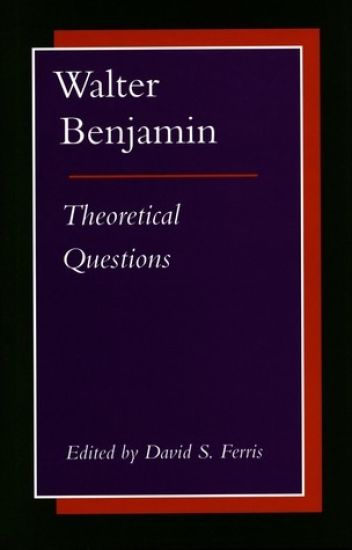
This collection of nine essays focuses on those writings of Walter Benjamin (1892-1940) on literature and language that have a direct relevance to contemporary literary theory, notably his analyses of myth, violence, history, criticism, literature, and mass media. In an introductory essay, David S. Ferris discusses the problem of history, aura, and resistance in Benjamin's later work and in its reception. Samuel Weber, in a reading of Benjamin's most influential essay, "The Work of Art in the Age of Mechanical Reproduction," analyzes the status of the image and technology in Benjamin's own terms and in the shadow of Heidegger. Rodolphe Gasché devotes himself to an analysis of Benjamin's dissertation on the German Romantics, providing a valuable guide to a major text that has yet to appear in English translation.
Walter Benjamin

Walter Benjamin

Stanford University Press
1996
pokkari
This collection of nine essays focuses on those writings of Walter Benjamin (1892-1940) on literature and language that have a direct relevance to contemporary literary theory, notably his analyses of myth, violence, history, criticism, literature, and mass media. In an introductory essay, David S. Ferris discusses the problem of history, aura, and resistance in Benjamin’s later work and in its reception. Samuel Weber, in a reading of Benjamin’s most influential essay, “The Work of Art in the Age of Mechanical Reproduction,” analyzes the status of the image and technology in Benjamin’s own terms and in the shadow of Heidegger. Rodolphe Gasché devotes himself to an analysis of Benjamin’s dissertation on the German Romantics, providing a valuable guide to a major text that has yet to appear in English translation.
Walter Benjamin

Walter Benjamin

Sigrid Weigel

Stanford University Press
2013
sidottu
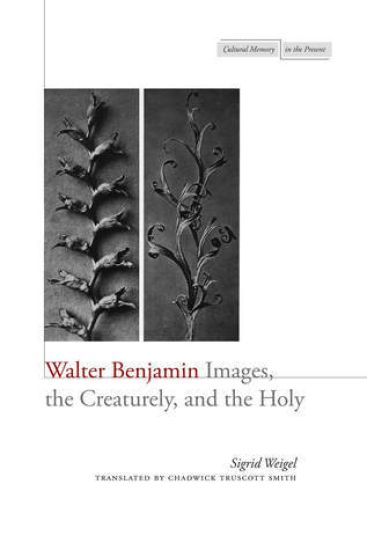
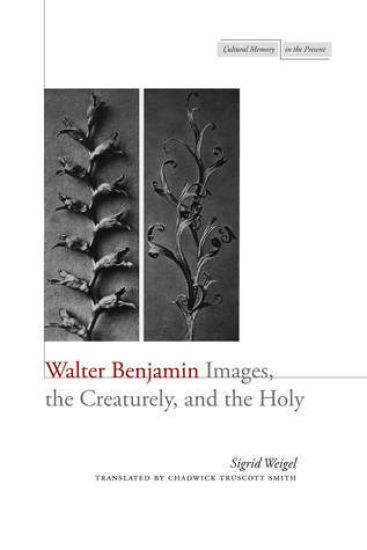
Arguing that the importance of painting and other visual art for Benjamin's epistemology has yet to be appreciated, Weigel undertakes the first systematic analysis of their significance to his thought. She does so by exploring Benjamin's dialectics of secularization, an approach that allows Benjamin to explore the simultaneous distance from and orientation towards revelation and to deal with the difference and tensions between religious and profane ideas. In the process, Weigel identifies the double reference of 'life' to both nature and to a 'supernatural' sphere as a guiding concept of Benjamin's writings. Sensitive to the notorious difficulty of translating his language, she underscores just how much is lost in translation, particularly with regard to religious connotations. The book thus positions Benjamin with respect to the other European thinkers at the heart of current discussions of sovereignty and martyrdom, of holy and creaturely life. It corrects misreadings, including Agamben's staging of an affinity between Benjamin and Schmitt, and argues for the closeness of Benjamin's work to that of Aby Warburg, with whom Benjamin unsuccessfully attempted an intellectual exchange.
Walter Benjamin

Walter Benjamin

Sigrid Weigel

Stanford University Press
2013
pokkari
Arguing that the importance of painting and other visual art for Benjamin's epistemology has yet to be appreciated, Weigel undertakes the first systematic analysis of their significance to his thought. She does so by exploring Benjamin's dialectics of secularization, an approach that allows Benjamin to explore the simultaneous distance from and orientation towards revelation and to deal with the difference and tensions between religious and profane ideas. In the process, Weigel identifies the double reference of 'life' to both nature and to a 'supernatural' sphere as a guiding concept of Benjamin's writings. Sensitive to the notorious difficulty of translating his language, she underscores just how much is lost in translation, particularly with regard to religious connotations. The book thus positions Benjamin with respect to the other European thinkers at the heart of current discussions of sovereignty and martyrdom, of holy and creaturely life. It corrects misreadings, including Agamben's staging of an affinity between Benjamin and Schmitt, and argues for the closeness of Benjamin's work to that of Aby Warburg, with whom Benjamin unsuccessfully attempted an intellectual exchange.
Walter White

Walter White

The University of North Carolina Press
2006
nidottu
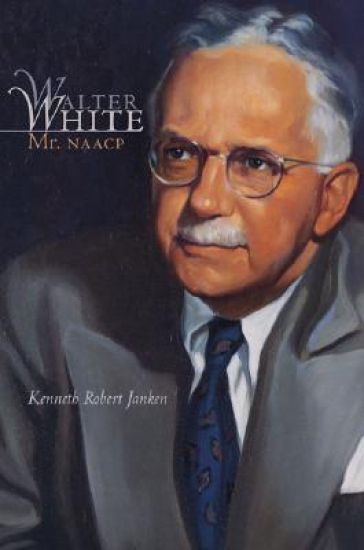
Walter White (1893-1955) was among the nation's preeminent champions of civil rights. With blond hair and blue eyes, he could ""pass"" as white even though he identified as African American, and his physical appearance allowed him to go undercover to investigate more than 40 lynchings and race riots in the years following World War I. As executive secretary of the NAACP from 1931 until his death in 1955, White promoted the Harlem Renaissance and led influential national campaigns against lynching, segregation in the military, and racism in Hollywood movies. In this first scholarly biography, Kenneth Robert Janken considers the man who embodied many contradictions. Walter White gained access to white elite culture, establishing friendships with Eleanor Roosevelt and numerous congressmen and Supreme Court justices, but he ultimately considered himself - and was considered by many - an organization man, ""Mr. NAACP.
Walter Hines Page

Walter Hines Page

The University of North Carolina Press
2011
nidottu
The varied career of Walter Hines Page affected many facets of the American political and social milieu from the end of Reconstruction through World War I. A North Carolinian, Page was one of the first southerners after Reconstruction to argue that sectional hostility was needless, and he constantly worked to restore national union and frequently acted as an interpreter for the North and the South. As a journalist, publisher, reformer, president-maker, and ambassador, he strove to assure both North and South that the southerner was basically an American, that southern problems were national ones, and that education and hard work could recreate the Union.As a young man, Page found the South too stifling to give scope to his ambitions. He left it for good at the age of twenty-nine to make a brilliant career as editor and book publisher in the North. He served as editor of Forum, Atlantic Monthly, and World's Work. Later he founded the publishing firm Doubleday, Page & Company. As a magazine editor he wrote about the problems of the South; as a book publisher he introduced many southern writers to the nation; as a member of several of the most powerful philanthropic boards he sought funds to improve education and public health in the South. As a result of his early support of Woodrow Wilson for the presidency, Page was appointed ambassador to the Court of St. James's from which he fervently advocated the Allied cause.Throughly researching both American and British government documents and private papers, and using interviews with Page's contemporaries, Cooper reinterprets and establishes the significance of Page's career.A UNC Press Enduring Edition -- UNC Press Enduring Editions use the latest in digital technology to make available again books from our distinguished backlist that were previously out of print. These editions are published unaltered from the original, and are presented in affordable paperback formats, bringing readers both historical and cultural value.
Walter Clark

Walter Clark

Brooks Aubrey Lee

The University of North Carolina Press
2011
nidottu
In this life of Walter Clark, the author tells of an antebellum boyhood on a Carolina plantation and a long career of involvement in the bitterest sociopolitical battles the state of North Carolina has known, which won Clark a national reputation as a liberal noted for his straight thinking and his clear speaking.A UNC Press Enduring Edition -- UNC Press Enduring Editions use the latest in digital technology to make available again books from our distinguished backlist that were previously out of print. These editions are published unaltered from the original, and are presented in affordable paperback formats, bringing readers both historical and cultural value.
Walter's Perspective

Walter's Perspective

Walter Jacobson; Bill Kurtis

Southern Illinois University Press
2012
sidottu
Walter Jacobson's highly readable book Walter's Perspective: A Memoir of Fifty Years in Chicago TV News provides a unique glimpse into the rough-and-tumble Chicago news business as seen through the eyes of one of its legendary players. From his first news job working as a legman for Daily News columnist Jack Mabley in the 1950s to his later role as a news anchor and political commentator at CBS-owned WBBM, Jacobson battled along the front lines of an industry undergoing dramatic changes. While it is ultimately Jacobson's story, a memoir of a long and distinguished (and sometimes highly controversial) career, it is also an insider's account of the inner workings of Chicago television news, including the ratings games, the process of defining news and choosing stories, the media's power and its failures, and the meddling by corporate and network executives. As a reporter, Jacobson was regularly contentious and confrontational. He was fired on a number of occasions and was convicted of libeling tobacco company Brown and Williamson, resulting in a multimillion-dollar federal court judgment against him and CBS. Yet it was this gutsy attitude that put him at the top of the news game, enabling him to get inside information on Chicago government and politics, and helped him become the first local television reporter to be granted a visa to visit Communist China. With an engaging writing style, Jacobson relates these experiences and much more. He recollects his interactions with Chicago mayors Richard J. and Richard M. Daley, Jane Byrne, Harold Washington, and Rahm Emanuel; recounts his coverage of such fascinating news stories as the violent 1968 Democratic National Convention and the execution of convicted mass murderer John Wayne Gacy; and recalls his reporting on and interviews with Louis Farrakhan, governors George Ryan and Rod Blagojevich, and Barack Obama. More than a memoir, Walter's Perspective is the extraordinary journey of one reporter whose distinctive career followed the changing face of Chicago's local news.
Walter's Perspective

Walter's Perspective

Walter Jacobson; Bill Kurtis

Southern Illinois University Press
2017
nidottu
Walter Jacobson’s highly readable book Walter’s Perspective: A Memoir of Fifty Years in Chicago TV News provides a unique glimpse into the rough-and-tumble Chicago news business as seen through the eyes of one of its legendary players. From his first news job working as a legman for Daily News columnist Jack Mabley in the 1950s to his later role as a news anchor and political commentator at CBS-owned WBBM, Jacobson battled along the front lines of an industry undergoing dramatic changes. While it is ultimately Jacobson’s story, a memoir of a long and distinguished (and sometimes highly controversial) career, it is also an insider’s account of the inner workings of Chicago television news, including the ratings games, the process of defining news and choosing stories, the media’s power and its failures, and the meddling by corporate and network executives.
The Poetical Works of Sir Walter Scott

The Poetical Works of Sir Walter Scott

Walter Scott

Wildside Press
2025
pokkari
The aim in this edition of SCOTT'S POEMS has been to give a correct text, with such portions of Scott's notes as are likely to be useful or interesting to the general reader, and with fuller and better pictorial illustrations than are to be found in any former edition. The volume contains all the poems (not the plays, which are seldom, if ever, read nowadays, unless as mere literary curiosities), with the exception of a few bits of personal or occasional verse which Scott himself would never have printed, and which are not worth preserving. The original contributions to the Border Minstrelsy are included, except Scott's portion of Thomas the Rhymer (the Third Part only), which could not well be separated from the rest Of the Songs scattered through the novels and plays, the best of such as are comparatively independent of the context are given, together with all the poetical mottoes written by Scott himself for the heading of chapters.
The Poetical Works of  Sir Walter Scott

The Poetical Works of Sir Walter Scott

Walter Scott

Wildside Press
2025
sidottu
The aim in this edition of SCOTT'S POEMS has been to give a correct text, with such portions of Scott's notes as are likely to be useful or interesting to the general reader, and with fuller and better pictorial illustrations than are to be found in any former edition. The volume contains all the poems (not the plays, which are seldom, if ever, read nowadays, unless as mere literary curiosities), with the exception of a few bits of personal or occasional verse which Scott himself would never have printed, and which are not worth preserving. The original contributions to the Border Minstrelsy are included, except Scott's portion of Thomas the Rhymer (the Third Part only), which could not well be separated from the rest Of the Songs scattered through the novels and plays, the best of such as are comparatively independent of the context are given, together with all the poetical mottoes written by Scott himself for the heading of chapters.
Walter Netsch

Walter Netsch

Northwestern University Library

Northwestern University Press
2008
sidottu
Northwestern University Library presents the first monograph devoted to the architect Walter Netsch, an early partner in Skidmore, Owings and Merrill and chief designer of the U.S.Air Force Academy and Cadet Chapel. This illustrated book includes a detailed chronology, biography, essays about his work and field theory design aesthetics, and statements by Netsch from 1954 to 2006.
Walter C. Mycroft

Walter C. Mycroft

Walter C. Mycroft

Scarecrow Press
2006
nidottu
Walter Charles Mycroft (1890-1959) was the film critic of the Evening Standard from 1922-1927, and also a founding member of London's Film Society. In 1928, he was appointed Head of the Scenario Department—and then Director of Production—at British International Pictures (later Associated British Pictures). In 1941 Mycroft was sacked following the death of the company's Managing Director and the requisition of Elstree studios by the British Government for war purposes. After that his career went into steady decline, although after the Second World War he worked for nearly a decade as Scenario Adviser to Robert Clark, who ran the rebuilt Elstree studios. This long-lost memoir, which Mycroft wrote mainly in the 1940s, offers a detailed account of the vagaries and complex economic vicissitudes of British film production in the 1930s. Mycroft also recalls how he selected film stories for directors Harry Lachman, E. A. Dupont and Alfred Hitchcock, and he reveals, for the first time, the true story behind Hitchcock's departure from British International Pictures. Mycroft also provides incisive portraits of British film industry captains: the charismatic Alexander Korda, C. M. Woolf, the rising J. Arthur Rank, and above all John Maxwell, the shrewd iconoclastic Scots lawyer who built Associated British into the largest and most financially successful film corporation in pre-war Britain. The memoirs conclude with the death of Maxwell and Mycroft's fall from grace at Elstree. The volume is supplemented by four appendixes consisting of Mycroft's earlier writings on the aesthetics and business of film production, along with a filmography of over 200 films on which he worked. This memoir provides both scholars and the general reader with new and fascinating insights into the worlds of British journalism during the first two decades of the twentieth century and of British film production during the 1930s. Walter Mycroft: The Time of My Life will be of interest not only to scholars of British journalism a